seamus dubhghaill

Promoting Irish Culture and History from Little Rock, Arkansas, USA


Leave a comment

Death of John Roberts, Anglo-Irish Architect

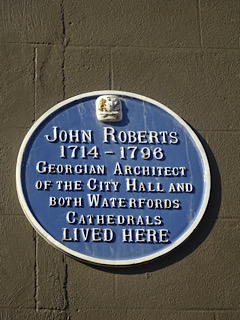
John RobertsAnglo-Irish architect working in the Georgian style, dies in Waterford, County Waterford, on May 23, 1796. He is best known for the buildings he designed in that city.

Roberts is born in Waterford in 1712 or 1714, the son of Thomas Roberts, an architect and builder. Little is known of his early life, although he possibly trains in London for a time. At 17, he elopes with Mary Susannah Sautelle, a Huguenot heiress who also lives in Waterford.

In 1746, Roberts is asked by the Church of Ireland (ProtestantBishop of Waterford and LismoreRichard Chenevix, to complete the new Bishop’s Palace.

Around 1760 Roberts designs Mount Congreve, near Kilmeadan.

In 1785, Roberts builds a house in Waterford for William Morris, now the Harbour Commissioners’ headquarters and the Chamber of Commerce. In 1786, he designs Newtown House, later Newtown School, a Quaker school. In 1787, he designs The Leper Hospital and Church of St. Stephen. He also builds the Assembly Rooms on Waterford’s Mall in 1788, which is now the Theatre Royal and City Hall.

Roberts had the unusual distinction of designing both the Protestant and Catholic cathedrals of Waterford: Christ Church Cathedral (1770s) and the Cathedral of the Most Holy Trinity (1790s) respectively.

Outside of Waterford, Roberts designs Curraghmore and Mount Congreve (both in County Waterford), St Iberius’ Church (Wexford) and is reputed to have designed Tyrone House (County Galway), Cappoquin House(County Waterford) and Moore Hall, County Mayo.

Roberts has between 21 and 24 children with his wife Susannah, of whom eight live to adulthood, including the painters Thomas Roberts and Thomas Sautelle Roberts. They live for many years in the old bishop’s palace, opposite the cathedral, with a country residence at Roberts Mount. He is nicknamed “Honest John” because he pays his workers so reliably, sometimes giving half their pay directly to their wives so that it would not be wasted on alcohol.

Roberts dies on May 23, 1796, after falling asleep on the floor of the Cathedral of the Most Holy Trinity, Waterford, and contracting pneumonia. The main square in Waterford is named John Roberts Square in his honour.

His son, the Reverend John Roberts became a magistrate and rector. The Rev. John’s son is Abraham Roberts, a general in the East India Company, and Abraham’s son is Frederick Roberts, 1st Earl Roberts, a World War I field marshal. Roberts’ sons Thomas and Sautelle become artists, as does his daughter, who paints scenery for the Waterford Theatre and landscapes.

Another great-grandson is the architect Samuel Ussher Roberts (1821–1900).


Leave a comment

Death of George Moore, Novelist, Poet & Critic

George Augustus Moore, novelist, short story writer, poet, art critic, memoirist, and dramatist, dies at his home in London on January 21, 1933. He is considered an innovator in fiction in his day.

Moore is born in Moore Hall, near Lough Carra, County Mayo on February 24, 1852. He comes from a distinguished Catholic family of Irish landholders. When he is 21, he leaves Ireland for Paris to become a painter. His Reminiscences of the Impressionist Painters (1906) vividly describes the Café Nouvelle-Athènes and the circle of Impressionist painters who frequent it. He is particularly friendly with Édouard Manet, who sketches three portraits of him. Another account of the years in Paris, in which he introduces the younger generation in England to his version of fin de siècle decadence, is his first autobiography, Confessions of a Young Man (1888).

Deciding that he has no talent for painting, Moore returns to London in 1882 to write. His first novels, A Modern Lover (1883) and A Mummer’s Wife (1885), introduce a new note of French Naturalism into the English scene, and he later adopts the realistic techniques of Gustave Flaubert and Honoré de Balzac. Esther Waters (1894), his best novel, deals with the plight of a servant girl who has a baby out of wedlock. It is a story of hardship and humiliation illumined by the novelist’s compassion. It is an immediate success, and he follows it with works in a similar vein: Evelyn Innes (1898) and Sister Teresa (1901).

In 1901 Moore moves to Dublin, partly because of his loathing for the South African War and partly because of the Irish Literary Revival spearheaded by his friend, the poet William Butler Yeats. In Dublin he contributes notably to the planning of the Abbey Theatre. He also produces The Untilled Field (1903), a volume of fine short stories reminiscent of Ivan Turgenev’s writing that focuses on the drudgery of Irish rural life, and a short poetic novel, The Lake (1905). The real fruits of his life in Ireland, however, come with the trilogy Hail and Farewell (Ave, 1911; Salve, 1912; Vale, 1914). Discursive, affectionate, and satirical by turns, it reads like a sustained monologue that is both a carefully studied piece of self-revelation and an acute, though not always reliable, portrait gallery of his Irish acquaintance, which included Yeats, George William Russell, and Lady Gregory. Above all it is a perfectly modulated display of the comic spirit.

The increasing narrowness of the Irish mind, politics, and clericalism sends Moore back to England in 1911. After Hail and Farewell, he makes another literary departure. Aiming at epic effect he produces The Brook Kerith (1916), an elaborate and stylish retelling of the Gospel story that is surprisingly effective despite some dull patches. He continues his attempts to find a prose style worthy of epic theme in Héloïse and Abélard (1921). His other works include A Story-Teller’s Holiday (1918), a blend of autobiography, anecdote, Irish legend, and satire, Conversations in Ebury Street (1924), autobiography, The Pastoral Loves of Daphnis and Chloe (1924) and Ulick and Soracha (1926), an Irish legendary romance.

George Moore dies at his home at Ebury Street in the London district of Belgravia on January 21, 1933, leaving a fortune of £70,000. He is cremated in London at a service attended by Ramsay MacDonald among others. An urn containing his ashes is interred on Castle Island in Lough Carra in view of the ruins of Moore Hall, which had been burned by anti-treaty forces in 1923, during the final months of the Irish Civil War.


Leave a comment

Birth of George Moore, Writer, Poet & Dramatist

george-augustus-moore

George Augustus Moore, novelist, short story writer, poet, art critic, memoirist, and dramatist, is born in Moore Hall, near Lough Carra, County Mayo on February 24, 1852. He is considered an innovator in fiction in his day.

Moore comes from a distinguished Catholic family of Irish landholders. When he is 21, he leaves Ireland for Paris to become a painter. His Reminiscences of the Impressionist Painters (1906) vividly describes the Café Nouvelle-Athènes and the circle of Impressionist painters who frequent it. He is particularly friendly with Édouard Manet, who sketches three portraits of him. Another account of the years in Paris, in which he introduces the younger generation in England to his version of fin de siècle decadence, is his first autobiography, Confessions of a Young Man (1888).

Deciding that he has no talent for painting, Moore returns to London in 1882 to write. His first novels, A Modern Lover (1883) and A Mummer’s Wife (1885), introduce a new note of French Naturalism into the English scene, and he later adopts the realistic techniques of Gustave Flaubert and Honoré de Balzac. Esther Waters (1894), his best novel, deals with the plight of a servant girl who has a baby out of wedlock. It is a story of hardship and humiliation illumined by the novelist’s compassion. It is an immediate success, and he follows it with works in a similar vein: Evelyn Innes (1898) and Sister Teresa (1901).

In 1901 Moore moves to Dublin, partly because of his loathing for the South African War and partly because of the Irish Literary Revival spearheaded by his friend, the poet William Butler Yeats. In Dublin he contributes notably to the planning of the Abbey Theatre. He also produces The Untilled Field (1903), a volume of fine short stories reminiscent of Ivan Turgenev’s writing that focuses on the drudgery of Irish rural life, and a short poetic novel, The Lake (1905). The real fruits of his life in Ireland, however, come with the trilogy Hail and Farewell (Ave, 1911; Salve, 1912; Vale, 1914). Discursive, affectionate, and satirical by turns, it reads like a sustained monologue that is both a carefully studied piece of self-revelation and an acute, though not always reliable, portrait gallery of his Irish acquaintance, which included Yeats, George William Russell, and Lady Gregory. Above all it is a perfectly modulated display of the comic spirit.

The increasing narrowness of the Irish mind, politics, and clericalism sends Moore back to England in 1911. After Hail and Farewell, he makes another literary departure. Aiming at epic effect he produces The Brook Kerith (1916), an elaborate and stylish retelling of the Gospel story that is surprisingly effective despite some dull patches. He continues his attempts to find a prose style worthy of epic theme in Héloïse and Abélard (1921). His other works include A Story-Teller’s Holiday (1918), a blend of autobiography, anecdote, Irish legend, and satire, Conversations in Ebury Street (1924), autobiography, The Pastoral Loves of Daphnis and Chloe (1924) and Ulick and Soracha (1926), an Irish legendary romance.

George Moore dies at his home at Ebury Street in the London district of Belgravia on January 21, 1933, leaving a fortune of £70,000. He is cremated in London at a service attended by Ramsay MacDonald among others. An urn containing his ashes is interred on Castle Island in Lough Carra in view of the ruins of Moore Hall, which had been burned by anti-treaty forces in 1923, during the final months of the Irish Civil War.