seamus dubhghaill

Promoting Irish Culture and History from Little Rock, Arkansas, USA


Leave a comment

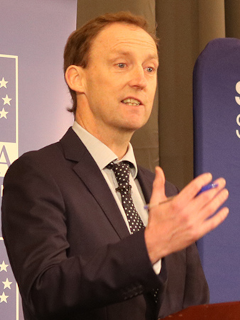
Birth of Barry Andrews, Fianna Fáil Politician

Barry Andrews, Fianna Fáil politician who serves as a Member of the European Parliament (MEP) for the Dublin constituency, is born in Dublin on May 16, 1967. He previously serves as Minister of State for Children from 2008 to 2011. He is a Teachta Dála (TD) for the Dún Laoghaire constituency from 2002 to 2011.

Andrews comes from a family with strong political connections. His grandfather, Todd Andrews, fought in the Irish War of Independence and became a founder-member of Fianna Fáil, and his grandmother, Mary Coyle, was a member of Cumann na mBan. His father, David Andrews, served as a TD from 1965 to 2002 and is a former Minister for Foreign Affairs, while his uncle, Niall Andrews, is a former Fianna Fáil TD and MEP and his cousin, Chris Andrews (son of Niall Andrews), has been a Sinn Féin TD since 2020 (having previously served as a Fianna Fáil TD from 2007 to 2011). In April 2018, Andrews is described as “part of Fianna Fáil royalty.”

Andrews is educated at Blackrock College and attends university at University College Dublin (UCD). Before entering political life, he works as a secondary school teacher in Dublin from 1991 until 1997, working in Senior College Ballyfermot, Sutton Park School and Bruce College. While a secondary school teacher, he studies law at King’s Inns and qualifies as a barrister in 1997. He is called to the Bar in 1997 and practices as a barrister until 2003.

Andrews is first elected to public office in the 1999 Irish local elections as a Dún Laoghaire–Rathdown County Councillor. He is elected to Dáil Éireann at the 2002 Irish general election.

In June 2006, Andrews leads a group of Fianna Fáil backbenchers in an unsuccessful attempt to establish a backbench committee to influence government policy. At the 2007 Irish general election, he retains his seat in Dún Laoghaire with 8,587 votes.

Andrews is appointed Minister of State for Children in May 2008. As Minister, he frames the Government response to the Ryan Report on Institutional Abuse. This includes an Implementation Plan that delivers an additional 200 social workers for the HSE Child and Family Services. In April 2009, he introduces the Early Childhood Care and Education (ECCE) Scheme, which provides, for the first time, free universal access to pre-school education. The scheme benefits 65,000 children in 2013.

After the release of the Murphy Report into child abuse in the Dublin diocese in November 2009, Andrews, speaking at a conference in Dublin Castle, is asked about the position of the Bishop of Limerick, Donal Murray. He says, “I think it’s everybody’s view that if adverse findings are made against an individual in a commission of inquiry, then it would be amazing that there be no consequences for them.” Bishop Murray subsequently apologises to survivors and resigns from office.

In December 2009, Andrews oversees the introduction of government policy to lower the legal age of consent to sixteen, citing a Joint Oireachtas Committee on the Constitution report which recommends the legal age be reduced to sixteen from the current seventeen. He expresses the view the existing laws are “inappropriate” and out of touch with the modern reality of sexual relations between young people and promises to publish legislation to change the age of consent to sixteen. He notes that Ireland and Malta are “the only countries in Europe with an age of consent of seventeen.” However, the law is not passed by the Oireachtas before the 2011 Irish general election in which Fianna Fáil cedes power to a Fine Gael-Labour coalition.

On January 31, 2011, in the run up to the general election, Andrews is named Health spokesman by the party leader, Micheál Martin. He loses his seat at the general election.

In September 2012, Andrew is appointed Fianna Fáil Director of Elections for the Children’s referendum.

In February 2019, Andrews is selected as the Fianna Fáil candidate for the Dublin constituency at the 2019 European Parliament election. He is elected in May 2019 receiving 14.1% of the 1st preference votes, but as the fourth candidate elected, he does not take his seat until after the UK leaves the European Union on January 31, 2020.

In June 2023, Andrews is the recipient of the Defence, Security and Space Award at The Parliament Magazine‘s annual MEP Awards.

Andrews is a member of the European Parliament Committee on Development, the European Parliament Committee on International Trade, the European Parliament Committee on Women’s Rights and Gender Equality, the Delegation to the EU-UK Parliamentary Partnership Assembly, the Delegation to the EU-Turkey Joint Parliamentary Committee and the European Parliament Delegation for Relations with South Africa. His contributions to the International Trade committee include his work on the Corporate Sustainability Due Diligence Directive (CSDDD) where he is a rapporteur.

Andrews is a founder member of the European Parliament’s Sustainable Development Goals (SDG) Alliance. He also founds the Brussels-Belfast Forum with members of the Northern Ireland Assembly.

Andrews is appointed EU Chief Observer for the 2023 Nigerian Federal and State elections by High Representative Vice President Josep Borrell. A report on the election is subsequently produced highlighting that the election was marred by a lack of transparency, public mistrust in the Independent National Electoral Commission (INEC), violence, and vote buying, stressing the need for comprehensive electoral reforms.

Outside of his political career, Andrews is appointed chief executive of the Irish aid charity GOAL in November 2012, replacing the retiring founder, John O’Shea. In October 2016, he resigns from GOAL after it is revealed that other senior executives of GOAL have been involved in “large-scale fraud,” though there is no suggestion that he himself is involved in the scandal. In October 2017, the new CEO of GOAL announces a deficit of €31.6 million due to the fraud but says that it will survive after “one of the most challenging years” in its 40-year history.

In March 2017, Andrews is appointed as Director-General of the Irish State-supported EU think tank and advocacy body, the Institute of International and European Affairs (IIEA), with the Chairperson of the IIEA, former Leader of the Labour Party, Ruairi Quinn, describing him as having the “political and administrative skills” of value to the IIEA.

Andrews is married and has two sons and a daughter. His brother, David McSavage, is a comedian, and he is a first cousin of former RTÉ television and radio presenter Ryan Tubridy.


Leave a comment

Birth of Michael O’Riordan, Founder of the Communist Party of Ireland

Michael O’Riordan, the founder of the Communist Party of Ireland who also fights with the Connolly Column in the International Brigades during the Spanish Civil War, is born at 37 Pope’s Quay, Cork, County Cork, on November 12, 1917.

O’Riordan is the youngest of five children. His parents come from the West Cork Gaeltacht of BallingearyGougane Barra. Despite his parents being native speakers of the Irish language, it is not until he is interned in the Curragh Camp during World War II that he learns Irish, being taught by fellow internee Máirtín Ó Cadhain, who goes on to lecture at Trinity College, Dublin.

As a teenager, O’Riordan joins the Irish nationalist youth movement, Fianna Éireann, and then the Irish Republican Army (IRA). The IRA at the time is inclined toward left-wing politics and socialism. Much of its activity concerns street fighting with the quasi-fascist Blueshirt movement and he fights Blueshirt fascism on the streets of Cork in 1933–34. He is friends with left-wing inclined republicans such as Peadar O’Donnell and Frank Ryan, and in 1934, he follows them into the Republican Congress, a short-lived socialist republican party.

O’Riordan joins the Communist Party of Ireland in 1935 while still in the IRA and works on the communist newspaper The Irish Workers’ Voice. In 1937, following the urgings of Peadar O’Donnell, several hundred Irishmen, mostly IRA or ex-IRA men, go to fight for the Spanish Republic in the Spanish Civil War with the XVth International Brigade. They are motivated in part by enmity towards the 800 or so Blueshirts, led by Eoin O’Duffy who go to Spain to fight on the “nationalist” side in the Irish Brigade. He accompanies a party led by Frank Ryan. In the Republic’s final offensive of July 25, 1938, he carries the flag of Catalonia across the River Ebro. On August 1, he is severely injured by shrapnel on the Ebro front. He is repatriated to Ireland the following month, after the International Brigades are disbanded.

In 1938 O’Riordan is offered an Irish Army commission by the Irish Free State but chooses instead to train IRA units in Cork. As a result of his IRA activities during World War II, or the Emergency as it is known in neutral Ireland, he is interned in the Curragh internment camp from 1939 until 1943 where he is Officer Commanding of the Cork Hut and partakes in Máirtín Ó Cadhain’s Gaelic League classes as well as publishing Splannc (Irish for “Spark,” named after Vladimir Lenin‘s newspaper).

In 1944 O’Riordan is founding secretary of the Liam Mellows Branch of the Labour Party and in 1945 is a founding secretary of the Cork Socialist Party, whose other notable members include Derry Kelleher, Kevin Neville and Máire Keohane-Sheehan.

O’Riordan subsequently works as a bus conductor in Cork and is active in the Irish Transport and General Workers Union (ITGWU). In 1946 he stands as a Cork Socialist Party candidate in the Cork Borough by-election and afterwards moves to Dublin where he lives in Victoria Street with his wife Kay Keohane of Clonakilty, continues to work as a bus conductor and remains active in the ITGWU.

In 1947, O’Riordan is a founding secretary of the Irish Workers’ League and general secretary thereafter, and of its successor organisation the Irish Workers’ Party from 1962–70.

In the 1960s, O’Riordan is a pivotal figure in the Dublin Housing Action Committee which agitates for clearances of Dublin’s slums and for the building of social housing. There, he befriends Fr. Austin Flannery, leading Minister for Finance and future Taoiseach Charles Haughey to dismiss Flannery as “a gullible cleric” while the Minister for Local Government, Kevin Boland, describes him as a “so-called cleric” for sharing a platform with O’Riordan.

In all O’Riordan runs for election five times, campaigning throughout for the establishment of a socialist republic in Ireland but given Ireland’s Catholic conservatism and fear of communism, he does so without success. He does, however, receive playwright Sean O’Casey‘s endorsement in 1951.

O’Riordan’s participation in the Spanish Civil War is always an important part of his political identity. In 1966 he attends the International Brigades’ Reunion in Berlin and is instrumental in having Frank Ryan’s remains repatriated from Germany to Ireland in 1979.

O’Riordan is a member of the Irish Chile Solidarity Committee and attends the 1st Party Congress of the Communist Party of Cuba in 1984. He also campaigns on behalf of the Birmingham Six and attends their Appeal trial in 1990. He serves as General Secretary of the Communist Party of Ireland (1970–83) and as National Chairman of the party (1983–88). He publishes many articles under the auspices of the CPI.

O’Riordan’s last major public outing comes in 2005 at the re-dedication of the memorial outside Dublin’s Liberty Hall to the Irish veterans of the Spanish Civil War. He and other veterans are received by President of Ireland Mary McAleese. He is also presented with Cuba’s Medal of Friendship by the Cuban Consul Teresita Trujillo to Ireland on behalf of Cuban President Fidel Castro.

In 1969, according to Soviet dissident Vasili Mitrokhin, O’Riordan is approached by IRA leaders Cathal Goulding and Seamus Costello with a view to obtaining guns from the Soviet KGB to defend Irish republican areas of Belfast during the communal violence that marks the outbreak of the Troubles. Mitrokhin alleges that O’Riordan then contacts the Kremlin, but the consignment of arms does not reach Ireland until 1972. The operation is known as Operation Splash. The IRA splits in the meantime between the Provisional IRA and the Official IRA and it is the latter faction who receives the Soviet arms. Mitrokhin’s allegations are repeated in Boris Yeltsin‘s autobiography.

O’Riordan’s book, Connolly Column – The Story of the Irishmen who fought for the Spanish Republic 1936–1939, is published in 1979 and deals with the Irish volunteers of the International Brigade who fought in support of the Spanish Republic against Francisco Franco in the Spanish Civil War (1936–1939). An updated version of the book is reprinted in 2005 and is launched by the Lord Mayor of Dublin, Cllr. Michael Conaghan at a book launch at SIPTU headquarters, Liberty Hall. The book is the inspiration for Irish singer-songwriter Christy Moore‘s famous song “Viva la Quinta Brigada.”

In 1991, O’Riordan’s wife dies at the age of 81 at their home. He continues to live in their family home before moving to Glasnevin in 2000 to be close to his son Manus who lives nearby. He lives there until falling ill in November 2005 and is taken to the Mater Hospital. His health rapidly deteriorates, and he quickly develops Alzheimer’s disease. Soon afterwards he is moved to St. Mary’s Hospital in the Phoenix Park where he spends the final few months of his life, before his death at the age of 88 on May 18, 2006.

O’Riordan’s funeral at Glasnevin Crematorium is attended by over a thousand mourners. Following a wake the previous night at Finglas Road, hundreds turn up outside the house of his son Manus and traffic grounds to a halt as family, friends and comrades – many of whom are waving the red flag of the Communist Party of Ireland – escort O’Riordan to Glasnevin Cemetery. A secular ceremony takes place led by Manus O’Riordan, Head of Research at SIPTU, with contributions from O’Riordan’s family, Communist Party general secretary Eugene McCartan and IBMT representative Pauline Frasier.

The funeral congregation includes politicians such as Labour Party leader Pat Rabbitte, his predecessor Ruairi Quinn, party front-bencher Joan Burton, Sinn Féin TD Seán Crowe and councillor Larry O’Toole, ex-Workers’ Party leader Tomás Mac Giolla and former Fianna Fáil MEP Niall Andrews. Also in attendance are union leaders Jack O’Connor (SIPTU), Mick O’Reilly (ITGWU) and David Begg (ICTU). Actors Patrick Bergin, Jer O’Leary, singer Ronnie Drew, artist Robert Ballagh, and newsreader Anne Doyle are also among the mourners. Tributes are paid by President of Ireland Mary McAleese, Taoiseach Bertie Ahern, Sinn Féin leader Gerry Adams and Labour Party TDs Ruairi Quinn and Michael D. Higgins.