
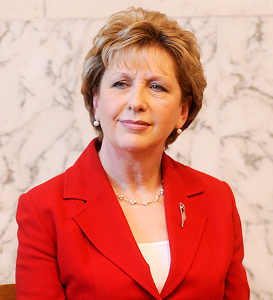
Mary Patricia McAleese, Irish Independent politician who serves as the 8th President of Ireland from November 1997 to November 2011, is born in Belfast, Northern Ireland on June 27, 1951. She is the second female president and is first elected in 1997 succeeding Mary Robinson, making McAleese the world’s first woman to succeed another as president. She is re-elected unopposed for a second term in office in 2004 and is the first President of Ireland to have come from either Northern Ireland or Ulster.
Born Mary Patricia Leneghan, McAleese is the eldest of nine children in a Roman Catholic family. Her family is forced to leave the area by loyalists when The Troubles break out. Educated at St. Dominic’s High School, she also spends some time when younger with the Poor Clares, Queen’s University Belfast, from which she graduates in 1973, and Trinity College, Dublin. She is called to the Bar of Northern Ireland in 1974 and remains a member of the Bar Council of Ireland. She opposes abortion and divorce.
In 1975, McAleese is appointed Professor of Criminal Law, Criminology and Penology at Trinity College, Dublin and in 1987, she returns to her Alma Mater, Queen’s, to become Director of the Institute of Professional Legal Studies. In 1994, she becomes the first female Pro-Vice-Chancellor of Queen’s University. She works as a barrister and also works as a journalist with RTÉ.
McAleese uses her time in office to address issues concerning justice, social equality, social inclusion, anti-sectarianism and reconciliation. She describes the theme of her Presidency as “Building Bridges.” This bridge-building materialises in her attempts to reach out to the unionist community in Northern Ireland. These steps include celebrating The Twelfth at Áras an Uachtaráin and she even incurs criticism from some of the Irish Catholic hierarchy by taking communion in a Church of Ireland cathedral in Dublin. Despite being a practising Roman Catholic, she holds liberal views regarding homosexuality and women priests. She is a member of the Council of Women World Leaders and is ranked the 64th most powerful woman in the world by Forbes. In spite of some minor controversies, McAleese remains popular, and her Presidency is regarded as successful.
McAleese receives awards and honorary doctorates throughout her career. On May 3, 2007, she is awarded The American Ireland Fund Humanitarian Award. On October 31, 2007, she is awarded an honorary Doctor of Laws from the University of Otago, New Zealand. On May 19, 2009, she becomes the third living person to be awarded the freedom of Kilkenny, succeeding Brian Cody and Séamus Pattison. The ceremony, at which she is presented with two hurleys, takes place at Kilkenny Castle. On May 24, 2009, she is awarded an honorary Doctor of Laws from Mount Holyoke College in South Hadley, Massachusetts. On May 22, 2010, she is awarded an honorary Doctor of Law from Fordham University, in the Bronx, New York City, where she delivers the commencement speech to the class of 2010. On November 8, she is awarded an honorary doctorate at University of Massachusetts Lowell in Lowell, Massachusetts.
On June 8, 2013, a ceremony is held to rename a bridge on the M1 motorway near Drogheda as the Mary McAleese Boyne Valley Bridge to honour McAleese’s contribution to the Northern Ireland peace process.

 seamus dubhghaill