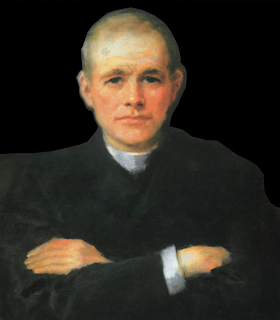
Dinneen is a leading figure in the Irish Texts Society, publishing editions of Geoffrey Keating‘s Foras Feasa ar Éirinn, poems by Aogán Ó Rathaille, Piaras Feiritéar, Tadhg Gaelach Ó Súilleabháin, and other poets. He also writes a novel and a play in Irish, and translates such works as Charles Dickens‘s A Christmas Carol into Irish. His best known work, however, is his Irish–English dictionary, Foclóir Gaedhilge agus Béarla, which is first published in 1904. The stock and plates of the dictionary are destroyed during the Easter Rising of 1916, so Dinneen takes the opportunity to expand the dictionary. A much larger second edition, compiled with the assistance of Liam S. Gógan, is published in 1927. His request to the Irish Texts Society to include Gogan’s name on the title page is refused. Gogan continues to work on the collection of words up to his death in 1979. This complementary dictionary is published online in 2011.
Máire Nic Shiubhlaigh, Irish actress and republican activist, is born Mary Elizabeth Walker in Charlemont Street, Dublin, on May 8, 1883. She starts acting in her teens and appears in the first Irish language play performed in Ireland. She is a founder-member of the Abbey Theatre and is leading lady on its opening night in 1904, when she plays the title role in W. B. Yeats‘s Cathleen ni Houlihan. She later joins the Theatre of Ireland, which she helps to found.
Nic Shiubhlaigh is born into a nationalist and Irish-speaking family. Her father, Matthew, comes from County Carlow and is a printer and publisher who becomes proprietor of the Gaelic Press. Her mother, Mary, is a dressmaker from Dublin. She grows up in 56 High Street in the Dublin Liberties.
Nic Shiubhlaigh joins the Gaelic League about 1898 and comes into contact with Arthur Griffith and William Rooney. She joins the cultural and revolutionary women’s group Inghinidhe na hÉireann in 1900. With the help of drama enthusiasts William and Frank Fay, she starts acting with the drama group of Inghinidhe na hÉireann. In 1901, the drama group takes part in a feis with two plays, Tobar Draoidheachta by Patrick S. Dinneen and Red Hugh by Alice Milligan. George Russell and W.B. Yeats, who are in attendance at the performance, are moved by the dedication of the amateur players. Russell, who had already offered the Fays his mythic play Deirdre, persuades Yeats to offer them his patriotic play, Cathleen ni Houlihan.
In 1902, Nic Shiubhlaigh joins W. G. Fay’s Irish National Dramatic Company, along with others such as Maire Quinn, Brian Callender, Charles Caulfield, James H. Cousins, P. J. Kelly, Dudley Digges and Frederick Ryan. Their first production of the two one-act plays, Cathleen ni Houlihan, with Maud Gonne in the lead role, and Deirdre, is on April 2, 1902. The company, which has no funds to speak of, acquires a couple of bare rooms at 34 Lower Camden Street, which with the help of friends from Irish-revival societies, they turn into a tiny theatre. They rehearse at the Coffee Palace and also use the Molesworth Hall for productions. In March 1903, with other members of her family, she appears in the first production of Yeats’ morality play, The Hour-Glass, in which she plays the part of the Angel.
In 1903, the playwrights and most of the actors and staff from these productions go on to form the Irish National Theatre Society, which has its registered offices in the Camden Street theatre. Nic Shiubhlaigh is a founder member and on the management committee of the society. Yeats is president, while Russell, Maud Gonne and Douglas Hyde are vice-presidents. William Fay is stage manager. The society founds the Abbey Theatre.
Nic Shiubhlaigh acts in the Abbey Theatre from the time of its founding. On its opening night on December 27, 1904, she plays the name part in Cathleen ni Houlihan. Her portrait is painted by John Butler Yeats for the occasion and hangs in the vestibule. She is the principal actress of the company after Máire Quinn’s departure to the United States, and when she leaves, the burden of the chief women’s rôles falls upon Sara Allgood.
In September 1905, the Abbey administrator and financial backer, an English theatre impresario called Annie Horniman, in hopes of improving the artistic quality of the productions at the Abbey, offers to guarantee salaries (a sum of £500 per year) for the actors and for Willie Fay as producer. To her mind, this will allow the actors and Fay to dispense with their day jobs and concentrate wholly upon their acting. The more nationally-minded members of the staff disagree. Nic Shiubhlaigh writes, “It was pointed out that the old Irish National Theatre Society had been founded in 1902 on the understanding that its independence as a national movement was to be secured only through the efforts of its members. It would be contrary to these ideals to accept a subsidy from an independent source.” For them it would mean a choice between a national theatre and an artistic theatre. At a meeting of the society, supported by Yeats, Gregory and Synge, the motion to accept Miss Horniman’s proposition is passed by a majority of shareholdings rather than a majority of votes. Nic Shiubhlaigh along with others resign, but they agree to remain until the end of the year, as part of an upcoming tour of England.
Nic Shiubhlaigh remains with the Abbey until December 1905, when along with Honor Lavelle (also known as Helen Laird), Emma Vernon, Máire Garvey, Frank Walker, Seumas O’Sullivan, Padraic Colum and George Roberts, she leaves. She joins the Theatre of Ireland, which she helps to found. This is formed in June 1906 with aims similar to the Irish National Theatre Society. She returns to the Abbey in 1910.
At the time of the 1916 Easter Rising, Nic Shiubhlaigh is living in Glasthule, a suburb of Dublin. She cycles into the city and, along with other members of Cumann na mBan, makes her way to Jacob’s Biscuit Factory, whose garrison under the command of Thomas MacDonagh guards the city against the troops of Portobello Barracks, and acts as an information and supplies hub for other garrisons around the city. She commands the women of the garrison. They remain there until the surrender, cooking and rendering first aid to the garrison, and bringing despatches through the city.
Nic Shiubhlaigh had retired from professional acting in 1912, and seldom works in professional theatre again. In 1929, she marries former IRA Director of Organisation, Major General Eamon “Bob” Price, and they move to Laytown, County Meath.
Nic Shiubhlaigh’s last stage appearance, alongside her sister Gypsy, is in a production of Gaol Gate at the Olympia Theatre, Dublin, on November 21, 1948, staged to mark the 150th anniversary of the death of Theobald Wolfe Tone.
Nic Shiubhlaigh dies on September 9, 1958, in the Drogheda cottage hospital.
Her book, The Splendid Years, written with the help of her nephew Edward Kenny, recalls the years of the national revival and the Easter Rising.


 seamus dubhghaill