seamus dubhghaill

Promoting Irish Culture and History from Little Rock, Arkansas, USA


Leave a comment

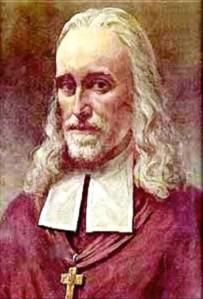
Oliver Plunkett Beatified by Pope Benedict XV

oliver-plunkett

Oliver Plunkett, Roman Catholic Archbishop of Armagh and Primate of All Ireland, is beatified by Pope Benedict XV on May 23, 1920.

Plunkett is born on November 1, 1625, in Loughcrew, County Meath, to well-to-do parents with Hiberno-Norman ancestors. He is ordained a priest in 1654 and deputed by the Irish bishops to act as their representative in Rome. Meanwhile, the Cromwellian conquest of Ireland (1649–1653) has defeated the Roman Catholic cause in Ireland. In the aftermath, the public practice of Roman Catholicism is banned, and Roman Catholic clergy are executed. As a result, it is impossible for Plunkett to return to Ireland for many years.

He eventually sets foot on Irish soil again on March 7, 1670, as the English Restoration of 1660 has begun on a basis of toleration. After arriving back in Ireland, he sets about reorganising the ravaged Roman Church and builds schools both for the young and for clergy, whom he finds “ignorant in moral theology and controversies.” The Penal Laws have been relaxed in line with the Declaration of Breda in 1660 and Plunkett is able to establish a Jesuit College in Drogheda in 1670.

On the enactment of the Test Act in 1673, to which Plunkett does not agree for doctrinal reasons, the college is closed and demolished. Plunkett goes into hiding, traveling only in disguise, and refusing a government edict to register at a seaport to await passage into exile. In 1678, the so-called Popish Plot, concocted in England by clergyman Titus Oates, leads to further anti-Roman Catholic action. Archbishop Peter Talbot of Dublin is arrested, and Plunkett again goes into hiding.

Despite being on the run and with a price on his head, Plunkett refuses to leave his flock. At some point before his final incarceration, he takes refuge in a church that once stood in the townland of Killartry, in the parish of Clogherhead in County Louth, seven miles outside Drogheda. He is arrested in Dublin in December 1679 and imprisoned in Dublin Castle. Plunkett is tried at Dundalk for conspiring against the state by allegedly plotting to bring 20,000 French soldiers into the country, and for levying a tax on his clergy to support 70,000 men for rebellion.

Plunkett is found guilty of high treason in June 1681 “for promoting the Roman faith” and is condemned to death. He is hanged, drawn, and quartered at Tyburn on July 1, 1681, the last Roman Catholic martyr to die in England.

Oliver Plunkett is beatified on May 23, 1920, and canonised in 1975, the first new Irish saint for almost seven hundred years, and the first of the Irish martyrs to be beatified. For the canonisation, the customary second miracle is waived. Plunkett has since been followed by 17 other Irish martyrs who were beatified by Pope John Paul II in 1992. Among them are Archbishop Dermot O’Hurley, Margaret Ball, and the Wexford Martyrs.


Leave a comment

First Burial at Glasnevin Cemetery, Dublin

glasnevin-tower

The first burial takes place at Glasnevin Cemetery in Glasnevin, Dublin, on February 22, 1832.

Prior to the establishment of Glasnevin Cemetery, Irish Catholics have no cemeteries of their own in which to bury their dead. The repressive Penal Laws of the eighteenth-century place heavy restrictions on the public performance of Catholic services, forcing Catholics to conduct a limited version of their own funeral services in Protestant churchyards or graveyards. This situation continues until an incident at a funeral held at St. Kevin’s Churchyard in 1823 provokes public outcry when a Protestant sexton reprimands a Catholic priest for proceeding to perform a limited version of a funeral mass. The outcry prompts Daniel O’Connell, champion of Catholic rights, to launch a campaign and prepare a legal opinion proving that there is actually no law forbidding praying for a dead Catholic in a graveyard. O’Connell pushes for the opening of a burial ground in which both Irish Catholics and Protestants can give their dead a dignified burial.

Glasnevin Cemetery is consecrated and opened to the public for the first time on February 21, 1832. The first burial, that of eleven-year-old Michael Carey from Francis Street in Dublin, takes place on the following day in a section of the cemetery known as Curran’s Square. The cemetery is initially known as Prospect Cemetery, a name chosen from the townland of Prospect, which surrounds the cemetery lands.

SONY DSC

Originally covering nine acres of ground, the area of the cemetery has now grown to approximately 124 acres and is the final resting place of some 1.5 million people. The cemetery consists of two parts. The main part, with its trademark high walls and watchtowers, is located on one side of the road from Finglas to the city centre, while the other part, called St. Paul’s, is located across the road and beyond a green space, between two railway lines.

Glasnevin is one of the few cemeteries that allows stillborn babies to be buried in consecrated ground and contains an area called the Angels Plot for that purpose. In 1982, a crematorium is constructed within the cemetery grounds by Glasnevin Trust and has since been used for people of various religious denominations who wish to be cremated.

Glasnevin contains historically notable monuments and the graves of many of Ireland’s most prominent national figures. These include the graves of Daniel O’Connell, Charles Stewart Parnell, Michael Collins (pictured at right), Éamon de Valera, Arthur Griffith, Maud Gonne, Kevin Barry, Roger Casement, Constance Markievicz, Pádraig Ó Domhnaill, Seán MacBride, Jeremiah O’Donovan Rossa, Frank Duff, Brendan Behan, Christy Brown, and Luke Kelly of the Dubliners.

Glasnevin Cemetery remains under the care of the Dublin Cemeteries Committee and the development, expansion, and refurbishment of the cemetery is an ongoing task.

The Catholic Mass is celebrated by members of the parish clergy every Sunday at 9:45 AM. An annual blessing of the graves takes place each summer as it has since the founding of the cemetery in 1832.