seamus dubhghaill

Promoting Irish Culture and History from Little Rock, Arkansas, USA


Leave a comment

Pickett’s Charge

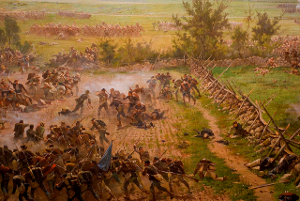
On July 3, 1863, at Gettysburg, Pennsylvania, as the sun rises behind the men of Colonel Dennis O’Kane’s Irish 69th Pennsylvania Volunteer Infantry on Cemetery Ridge, the most famous assault of the American Civil War is being prepared across the mile of open field in front of them. The 69th Pennsylvania will be at the very vortex of that assault, now known to posterity as Pickett’s Charge.

Pickett’s Charge is an infantry assault ordered by Confederate General Robert E. Lee against Major General George G. Meade‘s Union positions on the last day of the Battle of Gettysburg during the American Civil War. Its futility is predicted by the charge’s commander, Lt. General James Longstreet, and it is arguably an avoidable mistake from which the Southern war effort never fully recovers militarily or psychologically. The farthest point reached by the attack has been referred to as the high-water mark of the Confederacy.  The charge is named after Maj. General George Pickett, one of three Confederate generals who lead the assault under Longstreet.

Pickett’s charge is part of Lee’s “general plan” to take Cemetery Hill and the network of roads it commands. On the night of July 2, Meade correctly predicts at a council of war that Lee will attack the center of his lines the following morning.

At 1:00 PM on July 3, a massive artillery bombardment by the Confederate guns sails mostly over the heads of the 69th. The bombardment is meant to soften up the Union defense and silence its artillery but is largely ineffective. About 3:00 PM the barrage slackens, and the rebel infantrymen begin their assault. “And let your work this day be for victory or to the death,” Colonel Dennis O’Kane tells his men as the furious rebel onslaught approaches. Approximately 12,500 men in nine infantry brigades advance over open fields for three-quarters of a mile under heavy Union artillery and rifle fire.

Soon the 69th is forced to refuse both flanks as the Confederate tide rolls up to them and laps around both sides. While many around them run, the 69th stands fast. Although some Confederates are able to breach the low stone wall that shields many of the Union defenders, they cannot maintain their hold and are repulsed with over 50% casualties. The regiment’s tenacious stand in front of the famous copse of trees is a pivotal part of the crucial Union victory and a decisive defeat for the Confederacy that ends the three-day battle and Lee’s campaign into Pennsylvania.

Good to his word, Colonel O’Kane is killed and, lying dead near the 69th’s position, wearing gray lay Pvt. Willie Mitchel of the 1st Virginia Infantry, son of Irish patriot John Mitchel. At the most crucial battle of America’s Civil War, Irish are killing Irish on a foreign field once again.

Years later, when asked why his charge at Gettysburg failed, Pickett replies, “I’ve always thought the Yankees had something to do with it.”

Leave a comment

Founding of the Ancient Order of Hibernians in America

The Ancient Order of Hibernians (AOH) is founded in the United States on May 4, 1836, at St. James’ Roman Catholic Church in New York City, near the old Five Points neighbourhood. A branch is formed the same year at Pottsville, Pennsylvania. The existence and activities of the Order are concealed for some years.

During the late 1860s and early 1870s many of the lodges of the order in Pennsylvania are infiltrated by the Molly Maguires. However, the Molly Maguires and their criminal activities are condemned at the 1876 national convention of the AOH, and the Order is reorganised in the Pennsylvania coal areas.

In 1884 there is a split in the organisation. The Order has previously been governed by the Board of Erin, which has governed the order in Ireland, Great Britain and the United States, but is composed of officers selected exclusively by the organisations in Ireland and Great Britain. The majority leave in 1884 and become the Ancient Order of Hibernians of America, while the small group calls itself Ancient Order of Hibernians, Board of Erin. In 1897 the Ancient Order of Hibernians, Board of Erin, has approximately 40,000 members concentrated in New YorkNew JerseyOhioIllinois, and Michigan, while the Ancient Order of Hibernians of America has nearly 125,000 members scattered throughout nearly every state in the union. The two groups reunite in 1898.

female auxiliary, the Daughters of Erin, is formed in 1894, and has 20,000 members in 1897. It is attached to the larger, “American” version of the order. The AOH has 181,000 members in 1965 and 171,000 in 736 local units of “Divisions” in 1979. John F. Kennedy joins the AOH in 1947.

The Ladies Ancient Order of Hibernians (LAOH) raises $50,000 to build the Nuns of the Battlefield sculpture in Washington, D.C., which the United States Congress authorises in 1918. The Irish American sculptor, Jerome Connor, ends up suing the Order for non-payment.

In 1982, in a revival of Hibernianism, the Thomas Francis Meagher Division No. 1 forms in Helena, Montana, dedicated to the principles of the Order and to restoring a historically accurate record of Brigadier General Meagher’s contributions to Montana. Soon after, six additional divisions form in Montana.

The Order organises the New York City St. Patrick’s Day Parade for 150 years, emphasising a conservative Catholic interpretation of the Irish holiday. In 1993 control is transferred to an independent committee amid controversy over the exclusion of Irish American gay and lesbian groups.

The Brothers of St. Patrick Division of the Ancient Order of Hibernians in America is established at Brother’s of St. Patrick in Midway City, California, in 1995.

In 2013, The Ancient Order of Hibernians raises and distributes over $200,000 to aid victims of Hurricane Sandy.

In 2014, the AOH calls for a boycott of Spencer’s Gifts, for selling products the AOH says promote anti-Irish stereotypes and irresponsible drinking.

On May 10, 2014, a memorial to Commodore John Barry, an immigrant from Wexford who is a naval hero of the American Revolution and who holds commission number one in the subsequent United States Navy, is dedicated on the grounds of the United States Naval Academy. The memorial and associated “Barry Gate” are presented to the Academy by the members of the Ancient Order of Hibernians.

Several buildings of the Ancient Order of Hibernians are listed on the U.S. National Register of Historic Places or are otherwise notable.


Leave a comment

Birth of Charles Thomson, American Revolution Patriot

charles-thomson

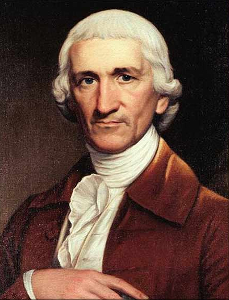
Charles Thomson, Patriot leader in Philadelphia during the American Revolution and the secretary of the Continental Congress (1774–1789) throughout its existence, is born in Gorteade townland, Maghera parish, County Derry, on November 29, 1729.

After the death of his mother in 1739, Thomson’s father emigrates to the British colonies in America with Charles and two or three brothers. The father dies at sea, and the penniless boys are separated in America. Charles is cared for by a blacksmith in New Castle, Delaware, and is educated in New London, Pennsylvania. In 1750 he becomes a tutor in Latin at the Philadelphia Academy.

During the French and Indian War, Thomson is an opponent of the Pennsylvania proprietorsAmerican Indian policies. He serves as secretary at the Treaty of Easton (1758) and writes An Enquiry into the Causes of the Alienation of the Delaware and Shawanese Indians from the British Interest (1759), which blames the war on the proprietors. He is allied with Benjamin Franklin, the leader of the anti-proprietary party, but the two men part politically during the Stamp Act crisis in 1765. Thomson becomes a leader of Philadelphia’s Sons of Liberty. He is married to the sister of Benjamin Harrison V, another signer, as delegate, of the Declaration of Independence.

Thomson is a leader in the revolutionary crisis of the early 1770s. John Adams calls him the “Samuel Adams of Philadelphia.” Thomson serves as the secretary of the Continental Congress through its entirety. Through those 15 years, the Congress sees many delegates come and go, but Thomson’s dedication to recording the debates and decisions provides continuity. Along with John Hancock, president of the Congress, Thomson’s name appears on the first published version of the Declaration of Independence in July 1776.

Thomson’s role as secretary to Congress is not limited to clerical duties. According to biographer Boyd Schlenther, Thomson “took a direct role in the conduct of foreign affairs.” Fred S. Rolater has suggested that Charles Thomson was essentially the “Prime Minister of the United States.” Thomson is also noted for designing, with William Barton, the Great Seal of the United States. The Great Seal plays a prominent role in the January 14, 1784, ratification of the Treaty of Paris (1783). Britain’s representatives in Paris initially dispute the placement of the Great Seal and Congressional President Thomas Mifflin‘s signature, until mollified by Benjamin Franklin.

But Thomson’s service is not without its critics. James Searle, a close friend of John Adams, and a delegate, begins a cane fight on the floor of Congress against Thomson over a claim that he was misquoted in the “Minutes” that results in both men being slashed in the face. Such brawls on the floor are not uncommon, and many of them are promoted by argument over Thomson’s recordings. Political disagreements prevent Thomson from getting a position in the new government created by the United States Constitution. Thomson resigns as secretary of Congress in July 1789 and hands over the Great Seal, bringing an end to the Continental Congress.

Thomson spends his final years at Harriton House in Bryn Mawr, Pennsylvania, working on a translation of the Bible. He also publishes a synopsis of the four evangelists in 1815. In retirement, Thomson also pursues his interests in agricultural science and beekeeping. Charles Thomson dies on August 16, 1824, in Lower Merion Township, Pennsylvania. He is buried at Laurel Hill Cemetery in Philadelphia.


Leave a comment

Ireland Reacts to Terrorist Attacks in U.S.

tricolour-at-ground-zero

President Mary McAleese goes on RTÉ Radio on September 11, 2001, to express her shock and horror at the terrorist attacks in the United States.

The President says that these atrocities are “crimes against the very foundations of our humanity.” She comments that “it is unbearable and almost unbelievable for the rest of the world to be witnessing such wanton destruction of human life in front of our eyes.”

President McAleese speaks by telephone with the United States Ambassador to Ireland, Richard Egan, and asks him to convey to President George W. Bush the heartfelt sympathies of the Irish people in this hour of great tragedy for the people of America, a nation which Ireland holds so dear.

The Irish government names more than a dozen of its natives among the dead in New York City, Washington, D.C., and Pennsylvania. Based on family names and individual stories, there are many hundreds of American dead with Irish heritage, including Americans who through parents or grandparents have become Irish citizens.

The website www.IrishTribute.com, set up in reaction to the September 11 attacks, estimates that perhaps one-sixth of the dead are in some way “Irish.” The website claims that “September 11, 2001 may well go down as the bloodiest day in the history of the Irish people. An estimated 1,000 people who were of Irish descent or of Irish birth were lost in the violent events on that day.”

A National Day of Mourning is held in Ireland on September 14 and a remembrance mass is held on September 12, 2001. Ireland is one of the few countries to hold a service day. Taoiseach Bertie Ahern and President McAleese are both in attendance.

Families in Limerick take in American tourists grounded at Shannon Airport after all flights into and out of the United States are cancelled.

The only flag, other than the U.S. flag, to fly at the Ground Zero site is the Irish tricolour, which is put in place by the Carpenters Union #608 and FDNY Command Post.

In the wake of the attacks, the Irish government immediately begins reviewing security arrangements.


2 Comments

Black Thursday – The Molly Maguire Executions

molly-maquires-gallows

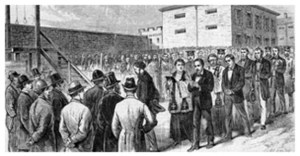
On June 21, 1877, a day that will long be remembered as Black Thursday, ten members of the Molly Maguires, an Irish labor organization, are executed in Pennsylvania, the first of twenty executions that make up the largest mass execution of any group by the U.S. federal government in history.

The Molly Maguires is an Irish 19th-century secret society active in Ireland, Liverpool, and parts of the eastern United States, best known for their activism among Irish American and Irish immigrant coal miners in Pennsylvania. The Mollies are believed to have been present in the anthracite coal fields of Pennsylvania in the United States since at least the Panic of 1873.

Members of the Mollies are accused of murder, arson, kidnapping and other crimes, in part based on allegations by Franklin B. Gowen and the testimony of a Pinkerton detective, James McParland, a native of County Armagh. Fellow prisoners testified against the defendants, who were arrested by the Coal and Iron Police. Gowen acts as a prosecutor in some of the trials. The Molly Maguires become largely inactive following the executions of 1877 and 1878.

On June 21, 1877, the first ten executions take place. Six Mollies – James Carroll, James Roarity, Hugh McGehan, James Boyle, Thomas Munley, and Thomas Duffy – are hanged in the prison at Pottsville, Pennsylvania. The sheriff hangs them successively two-by-two rather than build special gallows to accommodate six. An immense crowd gathers covering the surrounding hills. Boyle carries a blood-red rose and McGehan has two roses in his lapel. Carrol and Roarity declare their innocence from the scaffold. In County Donegal, McGehan’s relatives meet in the kitchen and, it is said, the sky blackens at the moment of hanging.

On the same date, Alexander Campbell, John “Yellow Jack” Donohue, Michael J. Doyle, and Edward J. Kelly are hanged at a Carbon County prison in Mauch Chunk for the murders of John P. Jones and Morgan Powell, both mine bosses. Here gallows have been erected to accommodate four hangings and the four are hung at the same instant. Campbell, just before his execution, allegedly slaps a muddy handprint on his cell wall stating, “There is proof of my words. That mark of mine will never be wiped out. It will remain forever to shame the county for hanging an innocent man.” The handprint remains to this day.

Ten more condemned, Thomas Fisher, John “Black Jack” Kehoe, Patrick Hester, Peter McHugh, Patrick Tully, Peter McManus, Dennis Donnelly, Martin Bergan, James McDonnell, and Charles Sharpe, are hanged at Mauch Chunk, Pottsville, Bloomsburg, and Sunbury over the next year. Peter McManus is the last Molly Maguire to be tried and convicted for murder at the Northumberland County Courthouse in 1878.


Leave a comment

Death of Shipbuilding Mogul John Roach

john-roach

John Roach, an American industrialist who rises from humble origins as an Irish immigrant laborer to found the largest and most productive shipbuilding empire in the postbellum United States, John Roach & Sons, dies in New York City on January 10, 1887.

Roach is born on December 25, 1815, at Mitchelstown, County Cork, Ireland, the first of seven children to Patrick Roche, a retail salesman, and his wife Abigail Meany. In 1832, at the age of sixteen, he emigrates together with his cousin to the United States. Arriving in New York City, he is at first unable to find regular work, but eventually gains secure employment at the Howell Works of James P. Allaire on the recommendation of a former employee of his father.

In 1852, after 20 years in the employment of Allaire, Roach and three partners purchase the Etna Iron Works, a small New York City ironworks which has fallen into receivership. Roach soon becomes sole proprietor, and during the American Civil War transforms the Etna Iron Works into a major manufacturer of marine engines. He continues to prosper after the war and in 1867 he purchases the Morgan Iron Works on New York’s East River and relocates his business there.

In 1871, Roach purchases the Reaney, Son & Archbold shipyard in Chester, Pennsylvania, which has fallen into receivership and renames it the Delaware River Iron Ship Building and Engine Works. This becomes his main facility. Over the next few years, he founds a network of new companies in Chester to support the shipyard’s operations. To give his sons a stake in the business, Roach founds the firm of John Roach & Sons, which becomes the overall parent and marketing company. He also attempts to create his own shipping line with the establishment of the United States and Brazil Mail Steamship Company, but this venture is a costly failure.

From 1871 until 1885, John Roach & Sons is easily the largest and most productive shipbuilding firm in the United States, building more tonnage of ships than its next two chief competitors combined. In the mid-1880s the firm runs into trouble when a series of U.S. Navy contracts become the subject of political controversy. Roach signed the contracts under a Republican administration, but when the Democratic administration of Grover Cleveland comes to power, it voids one of the contracts. Doubts over the validity of the remaining three contracts make it impossible for John Roach & Sons to obtain loans and, in 1885, the Roach shipbuilding empire is forced into receivership.

During the contract disputes, Roach falls ill with a chronic mouth infection which is diagnosed as cancer in 1886. Roach undergoes surgery in the spring of 1886, but it provides only temporary relief. He dies at the age of 71 on January 10, 1887, while his business is still in the hands of receivers. Roach’s eldest son, John Baker Roach, assumes control of the business which continues for another 20 years, although it never regains the pre-eminent position in American shipbuilding that it had enjoyed under Roach Sr.

During its existence between 1871 and 1907, the shipyard established by Roach builds 179 iron ships, 98 under Roach’s own management and an additional 81 under that of John Baker Roach.