seamus dubhghaill

Promoting Irish Culture and History from Little Rock, Arkansas, USA


Leave a comment

Death of Robert Bates, Member of the Shankill Butchers

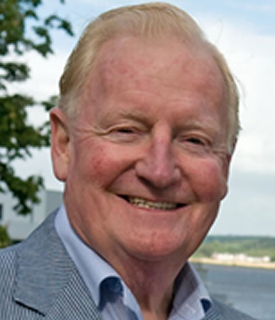
Robert William Bates, Northern Irish loyalist, dies in Belfast, Northern Ireland, on June 11, 1997. He is a member of the Ulster Volunteer Force and the infamous Shankill Butchers gang, led by Lenny Murphy.

Bates is born into an Ulster Protestant family and grows up in the Shankill Road area of Belfast. He has a criminal record dating back to 1966, and later becomes a member of the Ulster loyalist paramilitary organisation, the Ulster Volunteer Force (UVF). Bates, employed as a barman at the Long Bar, is recruited into the Shankill Butchers gang in 1975 by its notorious ringleader, Lenny Murphy. 

The gang uses The Brown Bear pub, a Shankill Road drinking haunt frequented by the UVF, as its headquarters. Bates, a “sergeant” in the gang’s hierarchy, is an avid participant in the brutal torture and savage killings perpetrated against innocent Catholics after they are abducted from nationalist streets and driven away in a black taxi owned by fellow Shankill Butcher, William Moore.

The killings typically involve grisly-throat slashings preceded by lengthy beatings and torture. Bates is said to have been personally responsible for beating James Moorhead, a member of the Ulster Defence Association (UDA), to death on January 30, 1977, and to have played a central role in the kidnapping and murder of Catholic Joseph Morrisey three days later.  He also kills Thomas Quinn, a derelict, on February 8, 1976, and the following day is involved in shooting dead Archibald Hanna and Raymond Carlisle, two Protestant workmen that Bates and Murphy mistake for Catholics.

Martin Dillon reveals that Bates is also one of the four UVF gunmen who carries out a mass shooting in the Chlorane Bar attack in Belfast city centre on June 5, 1976. Five people (three Catholics and two Protestants) are shot dead. The UVF unit bursts into the pub in Gresham Street and orders the Catholics and Protestants to line up on opposite ends of the bar before they open fire. He later recounts his role in the attack to police; however, he claims that he never fired any shots due to his revolver having malfunctioned. Forensics evidence contradicts him as it proves that his revolver had been fired inside the Chlorane Bar that night. Lenny Murphy is in police custody at the time the shooting attack against the Chlorane Bar takes place.

Bates is arrested in 1977, along with Moore and other “Shankill Butcher” accomplices. His arrest follows a sustained attack by Moore and Sam McAllister on Catholic Gerard McLaverty, after which they dump his body, presuming him dead. However, McLaverty survives and identifies Moore and McAllister to the Royal Ulster Constabulary who drive him up and down the Shankill Road during a loyalist parade until he sees his attackers. During questioning both men implicate Bates, and other gang members, leading to their arrests. Following a long period spent on remand, he is convicted in February 1979 of murder related to the Shankill Butcher killings and given ten life sentences, with a recommendation by the trial judge, Justice Turlough O’Donnell, that he should never be released.

At the start of his sentence, Bates is involved in a series of violent incidents involving other inmates. He later claims that he had perpetrated these acts in order to live up to his “Basher” nickname. He serves as company commander of the UVF inmates and becomes noted as a stern disciplinarian.

However, while in the Maze Prison, Bates is said to have “found God,” and as a result becomes a born again Christian. He produces a prison testimony, which is later reprinted in The Burning Bush, and, after publicly advocating an end to violence, is transferred to HM Prison Maghaberry.

In prison, Bates forms a friendship with Provisional IRA member and fellow detainee Brendan Hughes. Bates foil a UVF assassination plot on Hughes.

It has been alleged that his image appears on the cover of Searching for the Young Soul Rebels by Dexy’s Midnight Runners.

In October 1996, eighteen months prior to the signing of the Good Friday Agreement, Bates is cleared for early release by the Life Sentence Review Board. He is given the opportunity of participating in a rehabilitation scheme, spending the day on a work placement and returning to prison at night. As he arrives for work in his native Shankill area of Belfast early on the morning of June 11, 1997, he is shot dead by the son of a UDA man named James Curtis Moorehead, who Bates had killed in 1977. The killer identifies himself to Bates as the son of his victim before opening fire. The Sutton Index of Deaths attributes his assassination to a feud between the UVF and the UDA. Bates had been working at the Ex-Prisoners Interpretative Centre (EPIC), a drop-in centre for former loyalist prisoners.

Bates’s killing had not been sanctioned by the UDA leadership but nevertheless they refuse to agree to UVF demands that the killer should be handed over to them, instead exiling him from the Shankill. He is rehoused in the Taughmonagh area where he quickly becomes an important figure in the local UDA as a part of Jackie McDonald‘s South Belfast Brigade.

Bates’s name is subsequently included on the banner of a prominent Orange Lodge on the Shankill Road, called  Old Boyne Island Heroes. Relatives of Shankill Butchers victim Cornelius Neeson condemn the banner, stating that “it hurts the memory of those the butchers killed.” A fellow Lodge member and former friend of Bates defends the inclusion of his name to journalist Peter Taylor: “I knew him very well and he’d been a personal friend for twenty or thirty years and to me he was a gentleman.” He goes on to describe him as having been “an easy-going, decent fellow, and as far as the Lodge is concerned, a man of good-standing.”

Bates is buried in a Free Presbyterian Church of Ulster ceremony by Reverend Alan Smylie. His funeral is attended by a large representation from local Orange Lodges. Peace activist Mairead Maguire is also among the mourners, arguing that Bates had “repented, asked for forgiveness and showed great remorse for what he had done,” while a memorial service held at the spot of his killing two days after the funeral is attended by Father Gerry Reynolds of Clonard Monastery.[8]

Leave a comment

Birth of Fr. Alec Reid, Facilitator in the Northern Ireland Peace Process

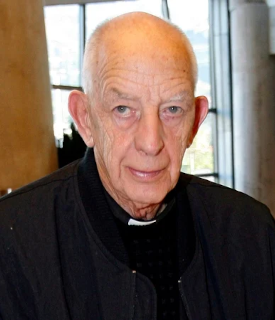
Alexander Reid CSsR, Irish Catholic priest noted for his facilitator role in the Northern Ireland peace process, is born in Dublin on August 5, 1931. BBC journalist Peter Taylor subsequently describes Reid’s role as “absolutely critical” to the success of the peace process.

Reid is raised in Nenagh, County Tipperary, from the age of six following the death of his father. He studies English, history and philosophy at University College Galway.

Reid is professed as a Redemptorist in 1950 and ordained a priest seven years later. For the next four years, he gives Parish Missions in Limerick, Dundalk and Galway (Esker), before moving to Clonard Monastery in Belfast, where he spends almost the next forty years. The Redemptorist Monastery at Clonard stands on the interface between the Catholic nationalist Falls Road and the Protestant loyalist Shankill Road areas of west Belfast.

In the late 1980s, Reid facilitates a series of meetings between Gerry Adams and John Hume, in an effort to establish a “Pan-Nationalist front” to enable a move toward renouncing violence in favour of negotiation. Reid, himself a staunch nationalist who favours a united Ireland and the withdrawal of British forces from Northern Ireland, then acts as their contact person with the Irish Government in Dublin from a 1987 meeting with Charles Haughey up to the signing of the Good Friday Agreement in 1998. In this role, which is not public knowledge at the time, he holds meetings with various Taoisigh, and particularly with Martin Mansergh, advisor to various Fianna Fáil leaders. After the eventual success of the peace negotiations, Gerry Adams says, “there would not be a peace process at this time without [Father Reid’s] diligent doggedness and his refusal to give up.”

In 1988 in Belfast, Reid delivers the last rites to two British Army corporals, David Howes and Derek Wood of the Royal Corps of Signals, who are killed by the Provisional Irish Republican Army (IRA) – an event known as the corporals killings – after they drive into the funeral cortège of IRA member Kevin Brady, who had been killed in the Milltown Cemetery attack. A photograph of his involvement in that incident becomes one of the starkest and most enduring images of the Troubles. Unknown until years later, he is carrying a letter from Sinn Féin President Gerry Adams to Social Democratic and Labour Party (SDLP) leader John Hume outlining Adams’ suggestions for a political solution to the Troubles. Adams later tells the BBC in 2019 that Reid also advised U.S Ambassador to Ireland Jean Kennedy Smith during the peace process, stating “He was talking to her on the side and she was talking to her brother Teddy.”

After he moves to Dublin, Reid is involved in peace efforts in the Basque Country. In January 2003, he is awarded the Sabino Arana 2002 “World Mirror” prize, by the Sabino Arana Foundation in Bilbao, in recognition of his efforts at promoting peace and reconciliation. He and a Methodist minister, the Rev. Harold Good, announce that the IRA has decommissioned their arms at a news conference in September 2005.

Reid is involved in controversy in November 2005 when he makes comments during a meeting in Fitzroy Presbyterian Church concerning the Unionist community in Northern Ireland. When the loyalist activist Willie Frazer makes remarks that Catholics had butchered Protestants during the Troubles, Reid angrily responds, “You don’t want to hear the truth. The reality is that the nationalist community in Northern Ireland were treated almost like animals by the unionist community. They were not treated like human beings. They were treated like the Nazis treated the Jews.” Reid later apologises, saying his remarks had been made in the heat of the moment. In an interview with CNN, he says that “The IRA were, if you like, a violent response to the suppression of human rights.”

Reid dies in a Dublin hospital on November 22, 2013. He is survived by two sisters and an aunt, and is buried in Milltown Cemetery, Belfast.


Leave a comment

Birth of Declan Arthurs, Provisional Irish Republican Army Volunteer

Declan Arthurs, a Volunteer in the Provisional Irish Republican Army‘s (IRA) East Tyrone Brigade in the mid-1980s, is born in Galbally, County Tyrone, Northern Ireland, on October 28, 1965.

Arthurs is one of six children, and the fourth of Paddy and Amelia Arthurs. He works on the family farm learning how to drive diggers. He works as an agricultural contractor for the farm. He has one young daughter.

Arthurs joins the East Tyrone Brigade of the Provisional IRA in 1982 in the wake of Martin Hurson‘s death on the 1981 Irish Hunger Strike. Hurson is also from Galbally like Arthurs, and Arthurs and his friends look up to Hurson. At the time he joins so do other young men from the same area, like Tony Gormley, Eugene Kelly, Seamus Donnelly and Martin McCaughey.

Over a year and a half year period in the mid-1980s the East Tyrone Brigade attacks and bombs Royal Ulster Constabulary (RUC) barracks and stations in Ballygawley, Tynan, The Birches, Coalisland, Dungannon, Carrickmore and Castlederg. They bomb hotels and other businesses in Kildress, Ballyronan, Dungannon and Cookstown.

Arthurs takes part in two of the IRA’s biggest attacks of the 1980s. At the attack on the Ballygawley barracks in December 1985 and the attack on the RUC Birches barracks in August 1986, Arthurs is a key member of the team who drives a digger past a security fence, stops it outside the barracks, lights a fuse, runs to safety and wrecks the barracks with a 200-pound bomb in the JCB Digger.

Arthurs is killed along with seven other IRA Volunteers who are ambushed by the Special Air Service (SAS) during the Loughgall Ambush on May 8, 1987. Before the SAS fires he lights the 40-second fuse on the bomb and it destroys most of the station, injuring a number of British decoys inside. The Loughgall ambush is supposed to be a carbon copy attack of the bombing of The Birches barracks, with the IRA expecting no resistance. One of the photos of the aftermath of the ambush shows that Arthurs died with the Zippo lighter he used to light the fuse still in his hand.

Amelia Arthurs, Declan’s mother, says of the ambush in an interview to journalist Peter Taylor, “He was mowed down. He could have been taken prisoner. They knew that the ‘boys’ were coming and they lay in wait. The SAS never gave them a chance. Declan died for his country and I’m very proud of him. He was caught up in a war and he died.”

Arthurs is buried in St. John’s Cemetery, Galbally, beside IRA Volunteer Seamus Donnelly who also died in the Loughgall ambush.


Leave a comment

The Shankill Road Bombing

The Shankill Road bombing is carried out by the Provisional Irish Republican Army (IRA) on October 23, 1993 and is one of the most notorious incidents of the Troubles in Northern Ireland.

During the early 1990s, loyalist paramilitaries drastically increase their attacks on the Irish Catholic and Irish nationalist community and, for the first time since the beginning of the Troubles, are responsible for more deaths than the republicans. The Ulster Defence Association‘s (UDA) West Belfast brigade, and its commander, Johnny Adair, play a key role in this. Adair had become the group’s commander in 1990.

The UDA’s Shankill headquarters is above Frizzell’s fish shop on the Shankill Road. The UDA’s Inner Council and West Belfast brigade regularly meets there on Saturdays. Peter Taylor says it is also the office of the Loyalist Prisoners’ Association (LPA), and on Saturday mornings is normally crowded, as that is when money is given to prisoners’ families. According to Henry McDonald and Jim Cusack, the IRA have had the building under surveillance for some time. They say that the IRA decides to strike when one of their scouts spots Adair entering the building on the morning of Saturday, October 23, 1993. Later, in a secretly-recorded conversation with police, Adair confirms that he had been in the building that morning.

The IRA’s Belfast Brigade launches an operation to assassinate the UDA’s top commanders, whom it believes are at the meeting. The plan allegedly is for two IRA members to enter the shop with a time bomb, force out the customers at gunpoint and flee before it explodes, killing those at the meeting. As they believe the meeting is being held in the room above the shop, the bomb is designed to send the blast upwards. IRA members maintain that they would have warned the customers as the bomb was primed. It has an eleven-second fuse, and the IRA state that this would allowed just enough time to clear the downstairs shop but not enough for those upstairs to escape.

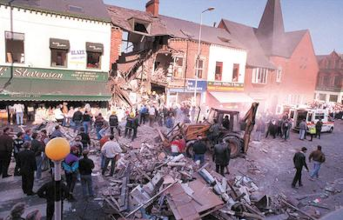
The operation is carried out by Thomas Begley and Seán Kelly, two IRA members in their early twenties from Ardoyne. They drive from Ardoyne to the Shankill in a hijacked blue Ford Escort, which they park on Berlin Street, around the corner from Frizzell’s. Dressed as deliverymen, they enter the shop with the five-pound bomb in a holdall. It is shortly after 1:00 PM on a Saturday afternoon and the area is crowded with mostly women and children. While Kelly waits at the door, Begley makes his way through the customers towards the counter, where the bomb detonates prematurely. Forensic evidence shows that Begley had been holding the bomb over the refrigerated serving counter when it exploded. Begley is killed along with nine other people, two of them children. They are the owner John Frizzell (63), his daughter Sharon McBride (29), Leanne Murray (13), UDA member Michael Morrison (27), his partner Evelyn Baird (27) and their daughter Michelle (7), George Williamson (63) and his wife Gillian (49), and Wilma McKee (38). The force of the blast causes the old building to collapse into a pile of rubble. The upper floor comes down upon those inside the shop, crushing many of the survivors under the rubble, where they remain until rescued some hours later by volunteers and emergency services. About 57 people are injured. At the scene during the rescue operation are several senior loyalists, including Adair and Billy McQuiston. The latter had been in a pub on the nearest corner when the bomb went off. Among those rescued from the rubble is the badly-wounded Seán Kelly.

Unknown to the IRA, if a UDA meeting had taken place, it had ended early and those attending it had left the building before the bomb exploded. McDonald and Cusack state that Adair and his men had stopped using the room for important meetings, allegedly because a sympathiser within the Royal Ulster Constabulary (RUC) told Adair that the police had it bugged.

There was great anger and outrage in the Shankill in the wake of the bombing. Billy McQuiston tells journalist Peter Taylor that “anybody on the Shankill Road that day, from a Boy Scout to a granny, if you’d given them a gun they would have gone out and retaliated.” Many Protestants see the bombing as an indiscriminate attack on them. Adair believes that the bomb was meant for him. Two days after the bombing, as Adair is driving away from his house, he stops and tells a police officer, “I’m away to plan a mass murder.”

In the week following the bombing, the UDA and UVF launch a wave of “revenge attacks,” killing 14 civilians. The UDA shoots a Catholic delivery driver in Belfast after luring him to a bogus call just a few hours after the bombing. He dies on October 25. On 26 October, the UDA shoots dead another two Catholic civilians and wounds five in an indiscriminate attack at a Council Depot on Kennedy Way, Belfast. On October 30, UDA members enter a pub in Greysteel frequented by Catholics and again open fire indiscriminately. Eight civilians, six Catholics and two Protestants, are killed and 13 are wounded. This becomes known as the Greysteel massacre. The UDA states it is a direct retaliation for the Shankill Road bombing.

Seán Kelly, the surviving IRA member, is badly wounded in the blast, having lost his left eye and is unable to move his left arm. Upon his release from hospital, however, he is arrested and convicted of nine counts of murder, each with a corresponding life sentence. In July 2000, he is released under the terms of the Good Friday Agreement. In an interview shortly after his release, he says he had never intended to kill innocent people and regrets what happened.


Leave a comment

The Loughinisland Massacre

CREATOR: gd-jpeg v1.0 (using IJG JPEG v80), quality = 90

The Loughinisland massacre takes place on June 18, 1994, in the small village of Loughinisland, County Down, Northern Ireland. Members of the Ulster Volunteer Force (UVF), a loyalist paramilitary group, burst into a pub with assault rifles and fire on the customers, killing six civilians and wounding five. The pub is targeted because it is frequented mainly by Catholics. The UVF claims the attack is retaliation for the killing of three UVF members by the Irish National Liberation Army (INLA) two days earlier.

About 24 people are gathered in The Heights Bar, also known as O’Toole’s Pub, watching the Republic of Ireland vs. Italy in the 1994 FIFA World Cup. It is thus sometimes referred to as the “World Cup massacre.”

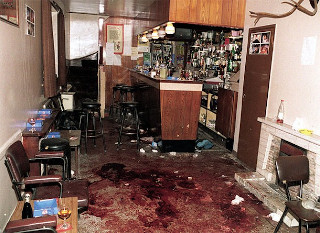
At 10:10 PM, two UVF members wearing boilersuits and balaclavas walk into the bar. One shouts “Fenian bastards!” and opens fire on the crowd with a vz. 58 assault rifle, spraying the small room with more than sixty bullets. Six men are killed outright, and five other people are wounded. Witnesses say the gunmen then run to a getaway car, “laughing.” One witness describes “bodies … lying piled on top of each other on the floor.” The dead were Adrian Rogan (34), Malcolm Jenkinson (52), Barney Green (87), Daniel McCreanor (59), Patrick O’Hare (35) and Eamon Byrne (39), all Catholic civilians. O’Hare is the brother-in-law of Eamon Byrne and Green is one of the oldest people to be killed during the Troubles.

The UVF claims responsibility within hours of the attack. It claims that an Irish republican meeting was being held in the pub and that the shooting was retaliation for the INLA attack. Police say there is no evidence the pub had links to republican paramilitary activity and say the attack is purely sectarian. Journalist Peter Taylor writes in his book Loyalists that the attack may not have been sanctioned by the UVF leadership. Police intelligence indicates that the order to retaliate came from the UVF leadership and that its ‘Military Commander’ had supplied the rifle used. Police believe the attack was carried out by a local UVF unit under the command of a senior member who reported to the leadership in Belfast.

The attack receives international media coverage and is widely condemned. Among those who send messages of sympathy are Pope John Paul II, Queen Elizabeth II and United States President Bill Clinton. Local Protestant families visit their wounded neighbours in the hospital, expressing their shock and disgust.

There have been allegations that police (Royal Ulster Constabulary) double agents or informants in the UVF were linked to the massacre and that police protected those informers by destroying evidence and failing to carry out a proper investigation. At the request of the victims’ families, the Police Ombudsman for Northern Ireland investigate the police. In 2011 the Ombudsman concludes that there were major failings in the police investigation, but no evidence that police colluded with the UVF. The Ombudsman does not investigate the role of informers and the report is branded a whitewash. The Ombudsman’s own investigators demand to be disassociated from it. The report is quashed, the Ombudsman replaced, and a new inquiry ordered.

In 2016, a new Ombudsman report concludes that there had been collusion between the police and the UVF, and that the investigation was undermined by the wish to protect informers but found no evidence police had foreknowledge of the attack. A documentary film about the massacre, No Stone Unturned, is released in 2017. It names the main suspects, one of whom is a member of the British Army and claims that one of the killers was an informer.


Leave a comment

Death of Brendan Duddy

brendan-duddy

Brendan Duddy, a businessman from Derry, Northern Ireland who plays a key role in the Northern Ireland peace process, dies on May 12, 2017. A notable Catholic republican, who is a pacifist and firm believer in dialogue, he becomes known by Secret Intelligence Service (MI6) as “The Contact.” In his book Great Hatred; Little Room – Making Peace in Northern Ireland, Tony Blair‘s political advisor Jonathan Powell describes Duddy as the “key” which leads to discussions between republicans and MI6, and ultimately the Northern Ireland peace process.

Duddy runs a fish and chip shop in the late 1960s which is supplied with beef burgers from a supplier whose van driver is Martin McGuinness. He is first approached by MI6 officer Frank Steele in the early 1970s but turns the approach down.

In light of the dissolution of Stormont in 1972, Duddy’s role as an intermediary starts in January 1972, when asked by friend and Derry’s Chief Police Office Frank Lagan to persuade the Official Irish Republican Army and the Provisional Irish Republican Army to remove their weapons from the Bogside. Both sides comply, but the Official IRA retains a few weapons for defensive purposes. After thirteen unarmed civil rights marchers are shot dead by British Parachute Regiment troops in what becomes known as Bloody Sunday, Duddy warns Lagan, “This is absolutely catastrophic. We’re going to have a war on our hands.”

In the aftermath of the events and repercussions of Bloody Sunday, MI6 agent Michael Oatley arrives in Belfast in 1973 seeking to understand the situation in Northern Ireland and hopefully create a communications channel between the IRA and the British Government. Duddy becomes the go-between for the communications, and this leads to the IRA ceasefire of 1975/76.

Duddy and Oatley are the main channel of communications between the British Government and the IRA leadership during the 1981 Irish hunger strike. Duddy is codenamed “Soon” by the British. Over the period of July 4-6, 1981, they exchange many telephone calls, with Duddy urging the “utmost haste” on the part of the British because “the situation would be irreparably damaged if a hunger striker died.” He suggests steps which could be taken to give the Provisional IRA a way of ending the strike. British Prime Minister Margaret Thatcher personally amends the text of an offer which is conveyed to the IRA through Duddy, but the British consider the reply unsatisfactory and do not continue to negotiate through Duddy. Hunger striker Joe McDonnell dies the following day.

In November 1991, as his now friend Oatley is about to retire from MI6 service, Duddy calls Oatley to a diner in Derry. When dinner has finished, McGuinness enters the property. During the meeting, McGuinness and Oatley discuss options for moving the situation forward. A few weeks later, Duddy is pursued by a British businessman who wants to create jobs in Derry. In the first meeting, the businessman produces a letter from then Secretary of State for Northern Ireland Peter Brooke, introducing the “businessman” as Oatley’s MI6 successor. Duddy calls the MI6 agent “Fred,” and acting as the go-between they successfully negotiate a ceasefire. Talks between McGuinness and representatives of the British government are held secretly in his house.

After the end of The Troubles, Duddy serves as a member of the Northern Ireland Policing Board and helps broker negotiations related to the marching season. He also testifies to the Bloody Sunday Inquiry, with regards his role and actions of both sides.

On March 26, 2008, the BBC broadcasts a documentary entitled The Secret Peacemaker about Duddy, directed by Peter Norrey, and presented by Peter Taylor, a journalist who has known Duddy is “the link” for ten years.

In the spring of 2009, Duddy donates his private archives to the James Hardiman Library, NUI Galway, where they are now available to researchers. They chart his involvement in the peace process from 1972 to 1993, and his ongoing interest, and correspondence relating to Northern Ireland, until 2007. The Brendan Duddy Archive is opened in 2011.

At the age of 80, Brendan Duddy dies at Altnagelvin Area Hospital in Derry, Northern Ireland on May 12, 2017.