seamus dubhghaill

Promoting Irish Culture and History from Little Rock, Arkansas, USA


Leave a comment

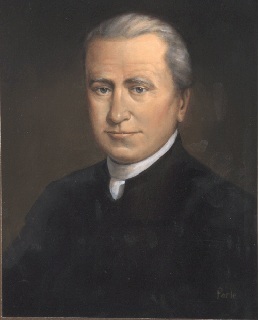
Death of Edmund Ignatius Rice, Missionary & Educationalist

Edmund Ignatius Rice, Catholic missionary and educationalist, dies on August 29, 1844, at Mount Sion, Waterford, County Waterford, after living in a near-comatose state for more than two years.

Rice is born on June 1, 1766, at Westcourt, Callan, County Kilkenny, the fourth of seven sons of Robert Rice, a farmer, and his wife, Margaret Tierney. His education begins at a local hedge school. He subsequently transfers to a school in Kilkenny before being apprenticed in 1779 to his uncle, a prosperous merchant at Waterford. He amasses a fortune in the lucrative provisioning trade of the city, and in 1785 he marries Mary Elliott, the daughter of a local tanner. Their only child, Mary, has intellectual disabilities and Rice suffers additional heartbreak with the death of his wife in 1789 following an accident, possibly by a fever that set in afterwards.

The death of his wife clearly affects Rice’s life. While he continues in trade and is an active member of the Catholic committee in the city, his priorities are radically changed. From this point he becomes increasingly involved in pious and charitable pursuits. He assists in the foundation of the Trinitarian Orphan Society in 1793 and the Society for the Relief of Distressed Roomkeepers in 1794. He joins religious confraternities and devotes considerable attention to the plight of prisoners. His endeavours become more focused in 1797 when, in response to a controversial pastoral of Bishop Thomas Hussey of Waterford and Lismore, he embraces the cause of Catholic education. In 1802, he establishes a religious community of laymen who set out to do for the neglected poor boys of Waterford what Nano Nagle had done for poor girls in Cork. His community is the genesis of both the Presentation Brothers and the Irish Congregation of Christian Brothers. Rice’s “monks” follow a variation of the Presentation rule, and his school curriculum is a pragmatic combination of best practice of the time overlaid by an uncompromisingly Catholic emphasis. By the time of his death in 1844, the Christian Brothers run forty-three schools, including six in England.

Rice is pivotal in the revival of Irish Catholicism following the severe dislocation of the penal era. Among the urban poor the Brothers make a landmark contribution in widening the social base of the institutional church. Through their teaching and catechetical instruction, they introduce the poor to the new forms of devotion which become the hallmark of nineteenth-century Catholicism. This effort brings a previously marginalised class within the ranks of the institutional church, which in time becomes the backbone of the emerging Catholic Ireland. The Brothers also play a determined role in the Catholic response to the proselytising efforts of the protestant Second Reformation in the country. Rice’s Brothers assist in the moulding of a distinctively Catholic urban working class, by promoting literacy alongside piety and instilling in their pupils the middle-class virtues of personal discipline, hard work, and sobriety.

Rice collaborates closely with other Catholic leaders of his age. His congregation is central to the success of Theobald Mathew‘s temperance movement. In 1828, at the height of the emancipation campaign, he invites Daniel O’Connell to lay the foundation stone of the Brothers’ model school at North Richmond Street, Dublin. This “monster meeting” attracts an attendance of 100,000, before which O’Connell hails Rice as the “patriarch of the monks of the west.” During the Repeal campaign, too, the Brothers frequently host the Liberator. Reflecting on their efforts, O’Connell declares that “education to be suited to this country must be Catholic and Irish in its tone, having as its motto Faith and Fatherland.”

Rice’s uncompromising adherence to these principles is not without difficulty. It leads to a predictably acrimonious relationship with the secular national board and his eventual withdrawal of the Brothers’ schools from the system in 1836. Rejection of the national board imposes serious financial burdens on the Christian Brothers which are relieved only by the bounties provided by the Intermediate Education Act (1878). Withdrawal also serves to alienate many friends and benefactors, including Daniel Murray, Archbishop of Dublin, who is a commissioner of national education. But the bishops gradually adopt Rice’s stance. After 1838 they become increasingly hostile to the national board, and the Brothers’ schools, with their acclaimed textbooks, are recognised as a bulwark against non-denominational education. For similar reasons, the Brothers become closely associated with Irish nationalism. In 1892, the MP William O’Brien observes that “the Christian Brothers system was regarded in Ireland as the really national system.”

The 1830s bring a rapid deterioration in Rice’s health. Financial difficulties frustrate his plans, and the plight of the three Dublin foundations is particularly acute. Rice resigns as superior general of his congregation in 1838, but fraught relations with his successor, Br. Michael Paul Riordan, blights his later years.

From this time on, Rice spends an increasing proportion of his time at Mount Sion and the adjoining school, showing a continued interest in the pupils and their teachers. He also takes a short walk each day on the slope of Mount Sion, but his increasingly painful arthritis leads the community superior, Joseph Murphy, to purchase a wheelchair for his benefit. At Christmas time in 1841, his health takes a turn for the worse and even though expectations of his imminent death do not turn out to be justified, he is increasingly confined to his room.

After living in a near-comatose state for more than two years and in the constant care of a nurse since May 1842, Rice dies on August 29, 1844, at Mount Sion, Waterford, where his remains lie in a casket to this day. Large crowds fill the streets around his house in Dublin to honour him. He is beatified by Pope John Paul II in 1996.

(From: “Rice, Edmund Ignatius” by Dáire Keogh, Dictionary of Irish Biography, http://www.dib.ie, October 2009)


Leave a comment

Birth of Blessed Edmund Ignatius Rice

Blessed Edmund Ignatius Rice, educator, philanthropist, and the founder of the Congregation of Christian Brothers, is born in Westcourt, Callan, County Kilkenny on June 1, 1762.

Rice is born into a Catholic family and is one of nine children. It comes as a surprise that a Catholic family can be prosperous in these days but they have a lease of a good-sized farm and are industrious people. In view of his future work in education it is fortunate that he receives a very good education himself, first at a local hedge school and then at a private secondary school in Kilkenny.

Rice is apprenticed to his uncle, Michael Rice, in Waterford at the age of 17. Waterford is then the second largest port in Ireland with an expanding trade with England, France and Spain and has very special trading links across the Atlantic with Newfoundland. His uncle is involved in providing food and services for the crews and passengers of the ships trading in and out of the port of Waterford. His uncle becomes a very prosperous businessman, and his business expands even more after it is handed over to his nephew. His great wealth is later to be used in transforming the lives of countless young boys.

At the age of 25 Rice marries Mary Elliot and is left a widower two years later when she dies after falling from a horse. He is left with a handicapped daughter, Mary. He calls in his stepsister Joan Murphy to help him care for his daughter so he can develop the business he inherited from his uncle.

In 1802, having properly cared for his daughter, Rice begins a night school for the uneducated boys from the quays of Waterford. His deep desire is to found a religious order of men who will educate these poor boys so that they can live with dignity and high self-esteem. But his volunteer assistants cannot stick with it. Neither can the paid teachers he later employs. Just when his spirits are lowest, and he looks to be a failure to all his business colleagues, two men from his native Callan join him not only to educate these unruly boys but also to join him in his plan to found a religious order. To do such a thing is contrary to the law. Nevertheless, Rice and his growing number of companions proceed. In 1808 seven of them take religious vows under Bishop Power of Waterford. They are called Presentation Brothers. This is the first congregation of men to be founded in Ireland and one of the few ever founded in a Church by a layman. Rice has in the meantime built a substantial school out of his own money, but it is already proving too small for the many boys who flock to him for an education.

Gradually an extraordinary transformation takes place in the “quay kids” of Waterford. Rice and his Brothers educate them, clothe and feed them. Other Bishops in Ireland supply him with men whom he prepares for religious life and teaching. In this way the Presentation Brothers spread throughout Ireland. However, the groups in separate dioceses are not under his control but that of the bishop. This creates problems when Brothers need to be transferred. Rice seeks and ultimately obtains approval from Pope Pius VII for his Brothers to be made into a pontifical congregation with Rice as Superior General. He is then able to move Brothers to wherever they are most needed. From this time on they are called Christian Brothers. By 1825 there are 30 Christian Brothers working in 12 towns and cities and educating 5,500 boys, free of charge. Many of these boys are also being clothed and fed.

Rice’s life is steeped in a spirituality that is strong and practical. He is forever caring for the poor in the wretched circumstances of their lives, for he believes there is a great need “to give to the poor in handfuls.” Many people, both men and women, from many cultures, young and old are helped and given hope and purpose and a new footing in life. He and his Brothers even card for the inmates of the jails of Waterford. He is privileged to comfort and accompany many a condemned man to the gallows. The poor never forget his love for them and see him as “a man raised up by God.”

Rice endures many and severe trials and in 1829 it seems the Christian Brothers are going to be suppressed by the law of the land. They face extinction but this does not happen. An even worse trial comes to him personally when some of his own Brothers try to undermine his work. Fortunately, they are unsuccessful. He gave his Brothers as their motto a text from the Book of Job that means so much to him in his life: “The Lord has given, and the Lord has taken away; blessed be the name of the Lord forever.”

In 1838, at the age of 76, Rice retires from leadership of the congregation and returns to Waterford. After living in a near-comatose state for more than two years, he dies at Mount Sion, Waterford on August 29, 1844, where his remains lie in a casket to this day.

Rice is declared to be Blessed Edmund Rice by Pope John Paul II in Rome on October 6, 1996. His Feast Day in the Catholic Church is 5 May.

(From: “Blessed Edmund Ignatius Rice,” Diocese of Waterford & Lismore, http://www.waterfordlismore.ie)


Leave a comment

Death of Writer John McGahern

john-mcgahern

John McGahern, regarded as one of the most important Irish writers of the latter half of the twentieth century, dies in Dublin on March 30, 2006. Known for the detailed dissection of Irish life found in works such as The Barracks, The Dark and Amongst Women, The Observer hails him as “the greatest living Irish novelist” before his death and in its obituary The Guardian describes him as “arguably the most important Irish novelist since Samuel Beckett.”

Born in Knockanroe about half a mile from Ballinamore, County Leitrim, McGahern is the eldest child of seven. Raised alongside his six young siblings on a small farm in Knockanroe, his mother runs the farm (with some local help) while maintaining a job as a primary school teacher in the local school. His father, a Garda sergeant, lives in the Garda barracks at Cootehall in County Roscommon, a somewhat sizeable distant away from his family at the time. His mother subsequently dies of cancer in 1944, when the young McGahern is ten years old resulting in the unrooting of the McGahern children to their new home with their father in the aforementioned Garda barracks, Cootehall.

In the years following his mother’s death, McGahern completes his primary schooling in the local primary school, and ultimately wins a scholarship to the Presentation Brothers secondary school in Carrick-on-Shannon. Having traveled daily to complete his second level education, he continues to accumulate academic accolades by winning the county scholarship in his Leaving Certificate enabling him to continue his education to third level.

Following on from his second level success, McGahern is offered a place at St. Patrick’s College of Education in Drumcondra where he trains to be a teacher. Upon graduation from third level education, he begins his career as a primary schoolteacher at Scoil Eoin Báiste (Belgrove) primary school in Clontarf where, for a period, he teaches the eminent academic Declan Kiberd. He is dismissed from Scoil Eoin Báiste on the order of the Archbishop of Dublin, John Charles McQuaid. He is first published by the London literary and arts review, X magazine, which publishes in 1961 an extract from his abandoned first novel, The End or Beginning of Love.

McGahern marries his first wife, Finnish-born Annikki Laaksi, in 1965 and in the same year publishes his second novel, The Dark, which is banned by the Censorship of Publications Board for its alleged pornographic content along with its implied sexual abuse by the protagonist’s father. Due to the controversy which is stirred by the book’s publication McGahern is dismissed from his teaching post and forced to move to England where he works in a variety of jobs before returning to Ireland to live and work on a small farm near Fenagh in County Leitrim.

John McGahern dies from cancer in the Mater Misericordiae University Hospital in Dublin on March 30, 2006, at the age of 71. He is buried in St. Patrick’s Church, Aughawillan alongside his mother.


Leave a comment

Birth of Writer John McGahern

John McGahern, regarded as one of the most important Irish writers of the latter half of the twentieth century, is born in Knockanroe about half a mile from Ballinamore, County Leitrim, on November 12, 1934. Known for the detailed dissection of Irish life found in works such as The Barracks, The Dark, and Amongst Women, The Observer hails him as “the greatest living Irish novelist” before his death in 2006.

McGahern is the eldest child of seven. Raised alongside his six young siblings on a small farm in Knockanroe, McGahern’s mother runs the farm with some local help whilst maintaining a job as a primary school teacher in the local school. His father, a Garda sergeant, lives in the Garda barracks at Cootehall in County Roscommon, a somewhat sizeable distant away from his family at the time. In 1944, when McGahern is ten years old, his mother dies of cancer, resulting in the unrooting of the McGahern children to their new home with their father in the Garda barracks at Cootehall.

In the years following his mother’s death, McGahern completes his primary schooling in the local primary school, and ultimately wins a scholarship to the Presentation Brothers secondary school in Carrick-on-Shannon. Having travelled daily to complete his second level education, McGahern continues to accumulate academic accolades by winning the county scholarship in his Leaving Certificate enabling him to continue his education to third level.

Following his second level success, McGahern is offered a place at St. Patrick’s College of Education in Drumcondra where he trains to be a teacher. Upon graduation from third level education, McGahern begins his career as a primary schoolteacher at Scoil Eoin Báiste primary school in Clontarf where, for a period, he teaches the eminent academic Declan Kiberd, before returning to third level education in University College Dublin where he graduates in 1957. He is first published by the London literary and arts review magazine, X, which publishes in 1961 an extract from his unpublished first novel, The End or Beginning of Love.

McGahern’s first published novel, The Barracks (1963), chronicles the life of the barrack’s Garda sergeant’s second wife, Elizabeth Reegan, who is in the decline of health due to cancer. The Barracks is adapted for the stage in 1969 by Hugh Leonard.

McGahern marries his first wife, Finnish-born Annikki Laaski, in 1965 and in the same year publishes his second novel, The Dark, which is banned by the Irish Censorship Board for its alleged pornographic content along with its implied sexual abuse by the protagonist’s father. Due to the controversy, which is stirred by the book’s publication, McGahern is dismissed from his teaching post and forced to move to England where he works in a variety of jobs, including on building sites, before returning to Ireland to live and work on a small farm near Fenagh in County Leitrim.

After the publications of The Leavetaking (1974) and The Pornographer (1975), his fifth and perhaps best-known novel, Amongst Women, is published in 1990. The novel details the story of Michael Moran, an Irish Republican Army (IRA) veteran of the Irish War of Independence and the Irish Civil War, who now dominates his family in the unforgiving farmlands of County Leitrim, near Mohill.

John McGahern dies from cancer at the age of 71 in the Mater Hospital in Dublin on March 30, 2006. He is buried in St. Patrick’s Church Aughawillan alongside his mother.