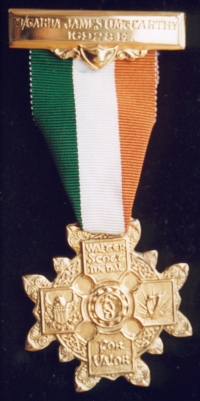
The Garda medal is instituted at the behest of Colonel Walter Scott, a New York Cityphilanthropist who took an interest in policing. In 1923 he gives a one thousand dollar gold Bond which pays for in perpetuity a gold medal. The award is to be presented under the following condition: No action, however heroic, will merit the award of the Scott medal unless it takes the shape of an act of most exceptional bravery and heroism involving the risk of life in the execution of duty, and armed with full previous knowledge of the risk involved.
Guard Mulroy is accosted by two armed men who tell him he has five minutes to live. He waits for his opportunity, springs upon the man with the revolver, tackles him and holds him, but is shot and seriously wounded by the other man who fires his single barreled shotgun and then proceeds to beat Guard Mulroy on the head with the shotgun. The struggle ends when the stock of the shotgun separates from the barrel and Guard Mulroy grabs the barrel with one hand while still holding the other man with the loaded revolver with the other. Guard Mulroy disarms the man with the revolver while the other runs off. He then tells the remaining man to go home. Guard Mulroy falls unconscious and later awakes to find himself in the ditch with the revolver in one hand and the barrel in the other. He returns to his station at 5:00 AM, gets his wounds dressed, and then goes out with another Guard and arrests one of the men.
Born Charles William St. John Burgess, Brugha is the tenth of fourteen children and is educated at the JesuitBelvedere College but is forced to leave at the age of sixteen because of the failure of his father’s business.
In 1899 Brugha join the Gaelic League, and he subsequently changes his name from Charles Burgess to Cathal Brugha. He meets his future wife, Kathleen Kingston, at an Irish class in Birr, County Offaly and they marry in 1912. They have six children, five girls and one boy. Brugha becomes actively involved in the Irish Republican Brotherhood (IRB) and in 1913 he becomes a lieutenant in the Irish Volunteers. He leads a group of twenty Volunteers to receive the arms smuggled into Ireland in the Howth gun-running of 1914.
He is second-in-command at the South Dublin Union under Commandant Éamonn Ceannt in the Easter Rising of 1916. On the Thursday of Easter Week, being badly wounded, he is unable to leave when the retreat is ordered. Brugha, weak from loss of blood, continues to fire upon the enemy and is found by Eamonn Ceannt singing “God Save Ireland” with his pistol still in his hands. He is initially not considered likely to survive. He recovers over the next year but is left with a permanent limp.
Brugha is elected speaker of Dáil Éireann at its first meeting on January 21, 1919, and he reads out the Declaration of Independence in Irish, which ratifies “the establishment of the Irish Republic.” On the following day, he is appointed president of the ministry pro tempore. He retains this position until April 1, 1919, when Éamon de Valera takes his place.
Brugha has differences with Michael Collins, who, although nominally only the IRA’s Director of Intelligence, has far more influence in the organisation as a result of his position as a high-ranking member of the Irish Republican Brotherhood, an organisation that Brugha sees as undermining the power of the Dáil and especially the Ministry for Defence. Brugha opposes the oath of allegiance required for membership of the IRB and, in 1919, his proposition that all Volunteers should swear allegiance to the Irish Republic and the Dáil is adopted.
At a top-level IRA meeting in August 1920, Brugha argues against ambushes of Crown forces unless there is first a call to surrender, but it is dismissed as unrealistic by the brigade commanders present. Brugha also has the idea of moving the front line of the war to England but is opposed by Collins.
In the months between the Treaty debates and the outbreak of Civil War, Brugha attempts to dissuade his fellow anti-treaty army leaders including Rory O’Connor, Liam Mellows and Joe McKelvey from taking up arms against the Free State. When the IRA occupies the Four Courts, he and Oscar Traynor call on them to abandon their position. When they refuse, Traynor orders the occupation of the area around O’Connell Street in the hope of easing the pressure on the Four Courts and of forcing the Free State to negotiate.
On June 28, 1922, Brugha is appointed commandant of the forces in O’Connell Street. The outbreak of the Irish Civil War ensues in the first week of July when Free State forces commence shelling of the anti-treaty positions.
Most of the anti-Treaty fighters under Oscar Traynor escape from O’Connell Street when the buildings they are holding catch fire, leaving Brugha in command of a small rearguard. On July 5, he orders his men to surrender but refuses to do so himself. He then approaches the Free State troops, brandishing a revolver. He sustains a bullet wound to the leg which severs a major artery.
Cathal Brugha dies on July 7, 1922, eleven days before his 48th birthday. He has been re-elected as an anti-Treaty Teachta Dála (TD) at the 1922 Irish general election but dies before the Dáil assembles. He is buried in Glasnevin Cemetery.
Lily Kempson, aged 99, the last surviving participant in the 1916 Easter Rising, dies in Seattle, Washington, on January 22, 1996. Born into the ranks of Dublin’s poor, Elizabeth Ann `Lily’ Kempson shares two rooms with her 92-year-old grandmother, her parents, and eight siblings.
Early on the morning of April 24, 1916, Lily dresses quietly so as to not disturb the other family members. Leaving undetected, Lily never returns home.
When Lily arrives at Liberty Hall, preparations for the Rising are already well underway. Weeks earlier Constance Markievicz and other women members of the Citizens Army, perhaps Lily amongst them, had stacked grenades and ammunition in the basement. Now this weaponry, already dispersed throughout the city, is to be used to defend the proclamation of an Irish Republic.
The initial plan for women to primarily take care of the wounded is scrapped. Attached to the Red Cross unit, Lily Kempson and her female comrades are swiftly incorporated within the main body of the fight. Lily is armed with a revolver. A handful of women, who have already played a key role in securing access to St. Stephens Green, set about evacuating civilians and guarding the gates. The insurgents dig in but they were unable to secure surrounding buildings because of a chronic shortage of personnel.
As dawn breaks on Tuesday morning, Lily is awakened by the rattle of machine gun fire. The British have occupied the Shelbourne, a hotel overlooking the park. The insurgents hold the Green for less than twenty hours. Throughout the week-long siege of Dublin, Kempson acts as a courier for Patrick Pearse and the other men inside the General Post Office (GPO).
The superior firepower of the British and the strategic advantage of the Shelbourne make evacuation of the park as inevitable as it is urgent. A line of retreat has been secured. In an advance party of three men and three women, Lily Kempson accompanies Constance Markievicz and Mary Hyland to seize the College of Surgeons, a sturdy building overlooking the north of the Green. It is here the Green’s contingent makes their heroic last stand, holding the ground for five days. They surrendered only after receiving a dispatch directly from the General Post Office. As their contingent prepares to surrender, Lily is chosen to carry the garrison’s last dispatches to addresses throughout the city.
In the immediate aftermath of The Rising, the Kempsons’ Dublin home is raided by the British army, but Lily is not to be found. Lily makes the decision to leave Ireland when her name appears on a British list of wanted suspects. Using her sister’s passport, she travels to England and boards a ship to New York. From New York, she then sails on to Seattle where she meets and marries a fellow Irishman, Matt McAlerney. They have seven children, 34 grandchildren, and 116 great-grandchildren by the time Lily passes away.
In her final years she attracts the attention of the local American press. Each Easter she briefly becomes a celebrity as her story of being the last survivor is retold.