seamus dubhghaill

Promoting Irish Culture and History from Little Rock, Arkansas, USA


Leave a comment

Death of Irish Writer Denis Johnston

Irish writer (William) Denis Johnston dies on August 8, 1984, at Ballybrack, County Dublin. He writes mostly plays, but also works of literary criticism, a book-length biographical essay of Jonathan Swift, a memoir and an eccentric work on cosmology and philosophy. He also works as a war correspondent and as both a radio and television producer for the BBC.

Johnston is born in Dublin on June 18, 1901, the only child of William John Johnston from Magherafelt, a barrister and later an Irish Supreme Court judge, and his wife Kathleen (née King), a teacher and singer from Belfast. They are Presbyterians and liberal home rulers. He sees the family home in Dublin occupied by rebels during the 1916 Easter Rising.

Johnston is educated at St. Andrew’s College, Dublin (1908–15, 1917–19), and Merchiston Castle School, Edinburgh (1915–16). In 1918, he attempts to join Sinn Féin, offering to supply the party with weapons taken from his Officers’ Training Corps. In 1922, while reading history and law at Christ’s College, Cambridge (1919–23) he tries to enlist in the civil war Free State army. He goes on to study at the Harvard Law School (1923–24) and enters King’s Inns in Dublin and the Inner Temple in London.

In London, developing his interest in the theatre, Johnston abandons plans for a legal and political career.

Johnston is a protégé of W. B. Yeats and George Bernard Shaw, and has a stormy friendship with Seán O’Casey. He is a pioneer of television and war reporting. He works as a lawyer in the 1920s and 1930s before joining the BBC as a writer and producer, first in radio and then in the fledgling television service. His broadcast dramatic work includes both original plays and adaptation of the work of many different writers.

Johnston’s first play, The Old Lady Says “No!”, helps establish the worldwide reputation of Dublin’s Gate Theatre. His second play, The Moon in the Yellow River, has been performed around the globe in numerous productions featuring such storied names as James Mason, Jack Hawkins, Claude Rains, Barry Fitzgerald, James Coco and Errol Flynn. Later plays deal with the life of Jonathan Swift, the 1916 Rebellion, the pursuit of justice, and the fear of death. He writes two opera libretti and a pageant.

“Passionate in his radical skepticism and loathing of what he saw as the pernicious influence of the Roman Catholic Church,” at the end of 1933, Johnston joins the trade unionist John Swift, the Dublin novelist Mary Manning, and fellow northerner, the libertarian socialist Jack White, in forming The Secular Society of Ireland. “Convinced that clerical domination in the community is harmful to advance,” the society seeks “to establish in this country complete freedom of thought, speech and publication, liberty for mind, in the widest toleration compatible with orderly progress and rational conduct.” Among other things it aims to terminate the clerically-dictated ban on divorce, the Censorship of Publications Act and the system of clerical management, and consequent sectarian teaching, in schools.

This is at a time of heightened clerical militancy and as soon the meeting place of the Society (from which it distributed the British journal The Freethinker) is exposed, it has to shift to private houses outside of Dublin. In 1936, Johnston and the other members disband the society and donate the proceeds to the government of the beleaguered Spanish Republic. He has become a recognised man of the left. In 1930 he joins the Irish Friends of Soviet Russia, and though never a party member, until as late as the 1950s he professes faith in a communist future.

During World War II he serves as a BBC war correspondent, reporting from El Alamein, through the Italian campaign, to Buchenwald and Adolf Hitler‘s Berghof. For this he is awarded an OBE, a mention in dispatches, and the Yugoslav Partisans Medal. He then becomes Director of Programmes for the television service.

Johnston later moves to the United States and teaches at Mount Holyoke College, Smith College and other universities. He keeps extensive diaries throughout his life, now deposited in the Library of Trinity College, Dublin, and these together with his many articles and essays give a distinctive picture of his times and the people he knew. Another archive of his work is held at the library of Ulster University at Coleraine. He receives honorary degrees from Ulster University and Mount Holyoke College and is a member of Aosdána.

Johnston and actress Shelah Richards are the parents of Jennifer Johnston, a respected novelist and playwright, and a son, Micheal. His second wife is the actress Betty Chancellor, with whom he has two sons, Jeremy and Rory.

Johnston dies on August 8, 1984, at Ballybrack, County Dublin, and is buried in St. Patrick’s Cathedral close. His epitaph is a quotation from The Old Lady Says “No!” – Emmet’s lines praising Dublin “the strumpet city.”

Johnston’s war memoir, Nine Rivers from Jordan, reaches The New York Times‘ Best Seller list and is cited in the World Book Encyclopedia‘s 1950s article on World War II under “Books to Read,” along with Winston Churchill, Dwight D. Eisenhower, et al. Joseph Ronsley cites an unnamed former CBS Vietnam War correspondent who called the book the “Bible,” carrying it with him constantly, “reading it over and over in the field during his tour of duty.” In a profile in The New Yorker in 1938, Clifford Odets is quoted as saying that the only playwrights he admires are John Howard Lawson, Sean O’Casey, and Denis Johnston.

The Denis Johnston Playwriting Prize is awarded annually by Smith College Department of Theatre for the best play, screenplay or musical written by an undergraduate at Smith College, Mount Holyoke College, Amherst College, Hampshire College and the University of Massachusetts Amherst. The prize is endowed by his former student at Smith, Carol Sobieski.

Leave a comment

Birth of Harry Boland, Politician & President of the Irish Republican Brotherhood

Harry Boland, Irish republican politician who serves as President of the Irish Republican Brotherhood (IRB) from 1919 to 1920, is born at 6 Dalymount Terrace, Phibsborough, Dublin, on April 27, 1887. He serves as a Teachta Dála (TD) from 1918 to 1922.

Boland is the son of Irish Republican Brotherhood member James Boland and Kate Woods. He was active in GAA circles in early life and referees the 1914 All-Ireland Senior Football Championship Final. He joins the IRB at the same time as his older brother Gerald in 1904, following in the footsteps of his father, uncle and probably grandfather. He is educated at the Synge Street CBS, but hads a personality clash with one of the brothers so he refuses to carry on his attendance at the school. He then goes to De la Salle College, County Laois, as a novice.

Boland later joins the Irish Volunteers along with Gerry and his younger brother Ned. They take an active part in the Easter Rising of 1916.

At the 1918 Irish general election, Boland is elected as an MP for South Roscommon. In line with all the Sinn Féin MPs elected at that election, he does not take his seat in the British House of Commons but withdraws to sit in the declared independent Dáil Éireann (the First Dáil) and is named by Éamon de Valera as special envoy to the United States, a role his uncle Jack had played 25 years earlier. He leaves Ireland for the United States along with de Valera as part of a campaign to raise awareness and support for their cause in America. He negotiates a loan of $20,000 from the Irish Republic to the Russian Soviet Federative Socialist Republic through the head of the Soviet Bureau, Ludwig Martens, using some Russian jewelry as collateral. These jewels are transferred to Ireland when he returns. His sister Kathleen and her mother are entrusted with the safekeeping of jewels.

During the Irish War of Independence (1919-21), Boland operates alongside Michael Collins, who is a close friend.

At the 1921 Irish elections, Boland is elected to the Second Dáil as one of the TDs for the Mayo South–Roscommon South. He opposes the Anglo-Irish Treaty. In the ensuing Irish Civil War (1922-23), he sides with the Anti-Treaty Irish Republican Army.

In the 1922 Irish general election, Boland is re-elected to the Dáil representing Mayo South–Roscommon South. Six weeks later, on July 31, he is shot by soldiers of the National Army when they attempt to arrest him at the Skerries Grand Hotel. Two officers enter his room and, although unarmed, he is shot and mortally wounded during a struggle.

The following day, August 1, 1922, Boland dies in St. Vincent’s Hospital in Dublin. As he lay dying, he refuses to give the name of his attacker to his sister, Kathleen. He is buried at Glasnevin Cemetery. The service takes place from the Whitefriar Street Carmelite Church. The hearse is followed by Cumann na mBan, Clan na Gael and the Irish Citizen Army women’s section.

Boland’s death affects Collins and possibly spurs him toward peace negotiations with Éamon de Valera.

Boland’s brother, Gerald Boland, is a prominent member of Fianna Fáil and later serves as Minister for Justice. His nephew, Kevin Boland, serves as a Minister until he resigns in solidarity with the two ministers, Charles Haughey and Neil Blaney, who are sacked from the government in May 1970 during the Arms Crisis. Kevin Boland’s resignation from Fianna Fáil and the subsequent loss of his seat marks the end of an era for the Boland political dynasty.

Boland’s nephew, Harry Boland, is a basketball player who competes in the 1948 Summer Olympics in London. He dies on December 18, 2013, at the age of 88.

In the 1991 TV movie The Treaty, Boland is portrayed by Malcolm Douglas. In the 1996 film Michael Collins, he is portrayed by American actor Aidan Quinn. The film is criticised for fictionalising both Boland’s death and Collins’ life.


Leave a comment

The Limerick Soviet

The Limerick Soviet exists for a two-week period from April 15 to April 27, 1919, and is one of a number of self-declared Irish soviets that are formed around Ireland between 1919 and 1923. At the beginning of the Irish War of Independence, a general strike is organised by the Limerick Trades and Labour Council, as a protest against the British Army‘s declaration of a “Special Military Area” under the Defence of the Realm Act 1914, which covers most of Limerick city and a part of the county. The soviet runs the city for the period, prints its own money and organises the supply of food.

From January 1919 the Irish War of Independence develops as a guerrilla conflict between the Irish Republican Army (IRA) (backed by Sinn Féin‘s Dáil Éireann), and the British government. On April 6, 1919, the IRA tries to liberate Robert Byrne, who is under arrest by the Royal Irish Constabulary (RIC) in a hospital, being treated for the effects of a hunger strike. In the rescue attempt Constable Martin O’Brien is fatally wounded, and another policeman is seriously injured. Byrne is also wounded and dies later the same day.

In response, on April 9 British Army Brigadier Griffin declares the city to be a Special Military Area, with RIC permits required for all wanting to enter and leave the city as of Monday, April 14. British Army troops and armoured vehicles are deployed in the city.

On Friday, April 11 a meeting of the United Trades and Labour Council, to which Byrne had been a delegate, takes place. At that meeting Irish Transport and General Workers’ Union (ITGWU) representative Sean Dowling proposes that the trade unions take over Town Hall and have meetings there, but the proposal is not voted on. On Saturday, April 12 the ITGWU workers in the Cleeve’s factory in Lansdowne vote to go on strike. On Sunday, April 13, after a twelve-hour discussion and lobbying of the delegates by workers, a general strike is called by the city’s United Trades and Labour Council. Responsibility for the direction of the strike is devolved to a committee that describes itself as a soviet as of April 14. The committee has the example of the Dublin general strike of 1913 and “soviet” (meaning a self-governing committee) has become a popular term after 1917 from the soviets that had led to the Russian Soviet Federative Socialist Republic.

A transatlantic air race is being organised from Bawnmore in County Limerick at the same time but is cancelled. The assembled journalists from England and the United States take up the story of an Irish soviet and interview the organisers. The Trades Council chairman John Cronin is described as the “father of the baby Soviet.” Ruth Russell of the Chicago Tribune remarks on the religiosity of the strike committee, observes “the bells of the nearby St. Munchin’s Church tolled the Angelus and all the red-badged guards rose and blessed themselves.” The Sinn Féin Mayor of Limerick, Phons O’Mara, tells Russell there is no prospect of socialism, as “There can’t be, the people here are Catholics.”

The general strike is extended to a boycott of the troops. A special strike committee organises food and fuel supplies, prints its own money based on the British shilling, and publishes its own newspaper called The Worker’s Bulletin. The businesses of the city accept the strike currency. Cinemas open with the sign “Working under authority of the strike committee” posted. Local newspapers are allowed to publish once a week as long as they have the caption “Published by Permission of the Strike Committee.” Outside Limerick there is some sympathy in Dublin, but not in the main Irish industrial area around Belfast. The National Union of Railwaymen does not help.

On April 21 The Worker’s Bulletin remarks that “A new and perfect system of organisation has been worked out by a clever and gifted mind, and ere long we shall show the world what Irish workers are capable of doing when left to their own resources.” On Easter Monday 1919, the newspaper states “The strike is a worker’s strike and is no more Sinn Féin than any other strike.”

Liam Cahill argues, “The soviet attitude to private property was essentially pragmatic. So long as shopkeepers were willing to act under the soviet’s dictates, there was no practical reason to commandeer their premises.” While the strike is described by some as a revolution, Cahill adds, “In the end the soviet was basically an emotional and spontaneous protest on essentially nationalist and humanitarian grounds, rather than anything based on socialist or even trade union aims.”

After two weeks the Sinn Féin Lord Mayor of Limerick, Phons O’Mara, and the Catholic bishop Denis Hallinan call for the strike to end, and the Strike Committee issues a proclamation on April 27, 1919, stating that the strike is over.

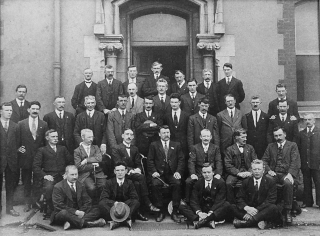
(Pictured: Photograph of Members of the 1919 Limerick Soviet, April 1919, Limerick City)