seamus dubhghaill

Promoting Irish Culture and History from Little Rock, Arkansas, USA


Leave a comment

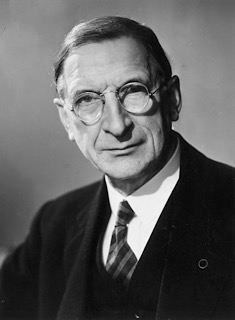
Birth of Éamon de Valera, Third President of Ireland

Éamon de Valera, Irish politician and patriot, is born George de Valero on October 14, 1882, in Lennox Hill, a neighborhood on the Upper East Side of Manhattan in New York City. He serves as Taoiseach (1932–48, 1951–54, 1957–59) and President of Ireland (1959–73). An active revolutionary from 1913, he becomes president of Sinn Féin in 1917 and founds the Fianna Fáil party in 1926. In 1937, he makes his country a sovereign state, renamed Ireland, or Éire. His academic attainments also inspire wide respect. He becomes chancellor of the National University of Ireland in 1921.

De Valera is the son of Catherine Coll, who is originally from Bruree, County Limerick, and Juan Vivion de Valera, described on the birth certificate as a Spanish artist born in 1853. His father dies when he is two years old. He Is then sent to his mother’s family in County Limerick, and studies at the local national school and at Blackrock College, Dublin. He graduates from the Royal University of Ireland and becomes a teacher of mathematics and an ardent supporter of the Irish language revival. In 1913, he joins the Irish Volunteers, which had been organized to resist opposition to Home Rule for Ireland.

In the 1916 Easter Rising in Dublin, de Valera commands an occupied building and is the last commander to surrender. Because of his American birth, he escapes execution by the British but is sentenced to penal servitude. Released in 1917 but arrested again and deported in May 1918 to England, where he is imprisoned, he is acclaimed by the Irish as the chief survivor of the uprising and in October 1917 is elected president of the Irish republican and democratic socialist Sinn Féin political party, which wins three-fourths of all the Irish constituencies in December 1918.

After a dramatic escape from HM Prison Lincoln in February 1919, de Valera goes in disguise to the United States, where he collects funds. He returns to Ireland before the Irish War of Independence ends with the truce that takes effect on July 11, 1921, and appoints plenipotentiaries to negotiate in London. He repudiates the Anglo-Irish Treaty of December 6, 1921, that they signed to form the Irish Free State, however, primarily because it imposes an oath of allegiance to the British crown.

After Dáil Éireann ratifies the treaty by a small majority in 1922, de Valera supports the republican resistance in the ensuing Irish Civil WarW. T. Cosgrave’s Irish Free State ministry imprisons him, but he is released in 1924 and then organizes a republican opposition party that does not sit in Dáil Éireann. In 1927, however, he persuades his followers to sign the oath of allegiance as “an empty political formula,” and his new Fianna Fáil (“Soldiers of Destiny”) party then enters the Dáil, demanding abolition of the oath of allegiance, of the governor-general, of the Seanad Éireann (senate) as then constituted, and of land-purchase annuities payable to Great Britain. The Cosgrave ministry is defeated by Fianna Fáil in 1932, and de Valera, as head of the new ministry, embarks quickly on severing connections with Great Britain. He withholds payment of the land annuities, and an “economic war” results. Increasing retaliation by both sides enables de Valera to develop his program of austere national self-sufficiency in an Irish-speaking Ireland while building up industries behind protective tariffs. In the new Constitution of Ireland, ratified by referendum in 1937, the Irish Free State becomes Ireland, a sovereign, independent democracy tenuously linked with the British Commonwealth (under the Executive Authority (External Relations) Act 1936) only for purposes of diplomatic representation.

De Valera’s prestige is enhanced by his success as president of the council of the League of Nations in 1932 and of its assembly in 1938. He also enters negotiations with British Prime Minister Neville Chamberlain in which he guarantees that he will never allow Ireland to be used as a base for attacking Britain in the event of war. This culminates in the Anglo-Irish defense agreement of April 1938, whereby Britain relinquishes the naval bases of Cobh, Berehaven, and Lough Swilly (retained in a defense annex to the 1921 treaty), and in complementary finance and trade treaties that end the economic war. This makes possible de Valera’s proclamation in September 1939, upon the outbreak of World War II, that Ireland will remain neutral and will resist attack from any quarter. In secret, however, de Valera also authorizes significant military and intelligence assistance to both the British and the Americans throughout the war. He realizes that a German victory will imperil Ireland’s independence, of which neutrality is the ultimate expression. By avoiding the burdens and destruction of the war, de Valera achieves a relative prosperity for Ireland in comparison with the war-torn countries of Europe, and he retains office in subsequent elections.

In 1948, a reaction against the long monopoly of power and patronage held by de Valera’s party enables the opposition, with the help of smaller parties, to form an interparty government under John A. Costello. Ironically, this precarious coalition collapses within three years after Ireland becomes a republic by means of the repeal of the Executive Authority (External Relations) Act 1936 and the severance of all ties with the British Commonwealth, an act de Valera had avoided. De Valera resumes office until 1954, when he appeals unsuccessfully for a fresh mandate, and Costello forms his second interparty ministry. No clearly defined difference now exists between the opposing parties in face of rising prices, continued emigration, and a backward agriculture. De Valera claims, however, that a strong single-party government is indispensable and that all coalitions must be weak and insecure. On this plea he obtains, in March 1957, the overall majority that he demands.

In 1959, de Valera agrees to stand as a candidate for the presidency. He resigns his position as Taoiseach and leader of the Fianna Fáil party. In June he is elected president, and is reelected in 1966. He retires to a nursing home near Dublin in 1973 and dies there on August 29, 1975.

De Valera’s career spans the dramatic period of Ireland’s modern cultural and national revolution. As an anticolonial leader, a skillful constitutionalist, and a symbol of national liberation, he dominates Ireland in the half century following the country’s independence.

(From: “Éamon de Valera, president of Ireland,” Encyclopedia Britannica, http://www.britannica.com, last updated August 14, 2025)
Leave a comment

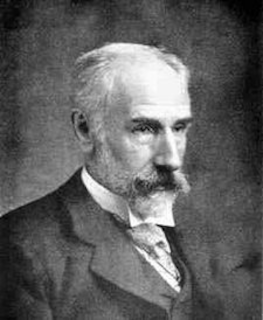
Death of Francis Ysidro Edgeworth, Philosopher & Political Economist

Francis Ysidro Edgeworth, Anglo-Irish philosopher and political economist who makes significant contributions to the methods of statistics during the 1880s, dies in Oxford, Oxfordshire, England on February 13, 1926.

Edgeworth is born on February 8, 1845, at Edgeworthstown, County Longford, the fifth of six sons of Francis Beaufort Edgeworth and his Spanish wife Rosa Florentina Eroles, daughter of exiled Catalan general Antonio Eroles. He is a grandson of Richard Lovell Edgeworth. His father dies when he is two years old, followed by his aunt Maria Edgeworth two years later. He is educated at home by tutors until he enters Trinity College Dublin (TCD) at the age of seventeen. Leaving to become a scholar at Magdalen Hall, he then proceeds to Balliol College, Oxford, where he takes a first-class degree in literae humaniores. After studying law at the Inner Temple, he is called to the bar in 1877, but never practises, choosing instead to lecture in logic at King’s College, London, where in 1888 he is appointed Professor of Political Economy, and in 1890 Tooke Professor of Economic Science and Statistics.

In 1891, Edgeworth becomes Drummond Professor of Political Economy at Oxford and is elected a fellow of All Souls College, Oxford, where he resides principally for the remainder of his career. In the same year he is appointed the founding editor of The Economic Journal and is credited with its success by the economist (and later joint editor) John Maynard Keynes. He writes seven small books and numerous articles and reviews but does not develop a systematic approach to economics. Thus, he never produces a treatise, once informing Keynes that it is for the same reason he never married – large-scale enterprises do not appeal to him. Instead, he applies a highly abstract, mathematical approach to economics, a methodology that is not helped by a difficult writing style. Although his work is sometimes controversial, he makes many original contributions to economics and statistics, which are still recognised. For example, in his own lifetime he is the finest exponent of what he himself calls “mathematical psychics,” the application of quasi-mathematical methods to the social sciences. His career, however, never quite fulfills its promise.

In 1911, Edgeworth inherits the Edgeworthstown estate, and shortly afterward becomes president of the Royal Economic Society (1912–14) and Fellow of the British Academy. Ahead of his time in many areas, he argues against the inequality of men’s and women’s wages. He has an eccentric character and is, according to Keynes, a difficult mixture of reserve, pride, kindness, modesty, courtesy, and stubbornness. His friend and fellow economist Alfred Marshall once says, “Francis is a charming fellow, but you must be careful with Ysidro.” He is never particularly happy, and dies a bachelor, although Keynes admits that it is not from want of susceptibility to women.

Edgeworth resigns his chair in 1922 and is appointed emeritus professor. In 1925, his essays are published in three volumes as his Collected Economic Papers, and for the first time his reputation is properly established throughout the world. He dies at Oxford on February 13, 1926.

(From: “Edgeworth, Francis Ysidro” by Patrick M. Geoghegan, Dictionary of Irish Biography, http://www.dib.ie, October 2009)


Leave a comment

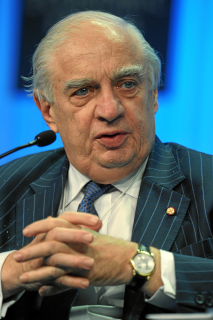
Birth of Peter Sutherland, Barrister & Politician

File source: http://commons.wikimedia.org/wiki/File:Peter-Sutherland-2011.jpg

Peter Denis Sutherland, businessman, barrister and politician, is born in Foxrock, Dublin on April 25, 1946. He is a barrister by profession and a Senior Counsel of the Bar Council of Ireland. He is known for serving in a variety of international organisations, political and business roles.

Sutherland is educated at Gonzaga College, Ranelagh, Dublin. He is of partial Scottish ancestry. He graduates in Civil Law at University College Dublin and practices at the Irish Bar between 1969 and 1980. He marries Maruja Sutherland, a Spaniard, in 1974.

Sutherland makes his entry into politics when he is appointed Attorney General of Ireland in June 1981. He resigns in March 1982 only to take the post again between December 1982 and December 1984.

Sutherland is appointed to the European Commission in 1985. He is Chairman of the Committee that produces The Sutherland Report on the completion of the Internal Market of the European Economic Community (EEC), commissioned by the European Commission and presented to the European Council at its Edinburgh meeting in 1992.

Sutherland serves as United Nations Special Representative of the Secretary-General for International Migration from January 2006 until March 2017. He is responsible for the creation of the Global Forum on Migration and Development (GFMD). He also serves as President of the International Catholic Migration Commission, as well as member of the Migration Advisory Board of the International Organisation for Migration.

In 1993, Sutherland becomes Director-General of the General Agreement on Tariffs and Trade, now the World Trade Organization. He serves as Chairman of Allied Irish Banks (AIB) from 1989 to 1993 and as Chairman of Goldman Sachs from 1995 to 2015.

In September 2016, Sutherland suffers a heart attack while on his way to Mass at a Catholic Church in London. Six months later, he resigns from his post as United Nations Special Representative of the Secretary-General for International Migration because of poor health. After a long illness, he dies at St. James’s Hospital in Dublin on January 7, 2018, of complications from an infection, at the age of 71. He is buried in Kilternan Cemetery Park in Dublin.

Peter Sutherland received numerous awards including European Person of the Year Award (1988).

(Pictured: Peter D. Sutherland, Chairman, Goldman Sachs International, United Kingdom; Member of the Foundation Board of the World Economic Forum, speaks during the session ‘China’s Impact on Global Trade and Growth’ at the Annual Meeting 2011 of the World Economic Forum in Davos, Switzerland, January 27, 2011. Copyright by World Economic Forum swiss-image.ch/Photo by Michael Wuertenberg)


Leave a comment

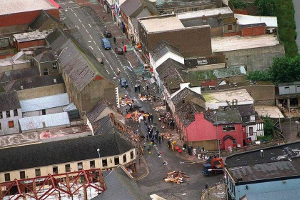
The Omagh Car Bombing

The Omagh bombing, a car bombing in Omagh, County Tyrone, Northern Ireland, takes place on August 15, 1998. It is carried out by a group calling themselves the Real Irish Republican Army, a Provisional Irish Republican Army (IRA) splinter group who opposes the IRA’s ceasefire and the Good Friday Agreement.

On the day of the bombing, the bombers drive a car, loaded with 230 kilograms (510 lb) of fertiliser-based explosives, across the Irish border. At approximately 2:19 PM they park the vehicle outside S.D. Kells’ clothes shop in Omagh’s Lower Market Street, on the southern side of the town centre, near the crossroads with Dublin Road. They are unable to find a parking space near the intended target, the Omagh courthouse. The two male occupants arm the bomb and, upon exiting the car, walk east down Market Street towards Campsie Road.

Three telephone calls are made warning of a bomb in Omagh, using the same codeword that had been used in the Real IRA’s bomb attack in Banbridge two weeks earlier. At 2:32 PM, a warning is telephoned to Ulster Television saying, “There’s a bomb, courthouse, Omagh, Main Street, 500 lb., explosion 30 minutes.” One minute later, the office receives a second warning saying, “Martha Pope (which is the RIRA’s code word), bomb, Omagh town, 15 minutes.” The caller claims the warning on behalf of “Óglaigh na hÉireann.” One minute later, the Coleraine office of the Samaritans receives a call stating that a bomb will go off on “Main Street” about 200 yards (180 m) from the courthouse. The recipients pass the information on to the Royal Ulster Constabulary (RUC) but are claimed to be inaccurate and police inadvertently move people towards the bomb.

The car bomb detonates at 3:10 PM in the crowded shopping area. The bombing kills 29 people, including a woman pregnant with twins, and injures some 220 others. Twenty-one people who are in the vicinity of the vehicle die at the scene. Eight more people die on the way to or in the hospital. The death toll is higher than that of any single incident during what are considered “the Troubles.”

The bombing causes outrage both locally and internationally, spurs on the Northern Ireland peace process, and deals a severe blow to the Dissident republican campaign. The Real IRA apologises and declares a ceasefire shortly afterwards. The victims include people from many backgrounds: Protestants, Catholics, a Mormon teenager, five other teenagers, six children, a mother pregnant with twins, two Spanish tourists, and others on a day trip from the Republic of Ireland. Both unionists and Irish nationalists are killed and injured.

It is alleged that the British, Irish and U.S. intelligence agencies have information which could have prevented the bombing, most of which comes from double agents inside the Real IRA. This information is not given to the local police, the Royal Ulster Constabulary (RUC). In 2008 it is revealed that British intelligence agency, Government Communications Headquarters, was monitoring conversations between the bombers as the bomb was being driven into Omagh.

A 2001 report by the Police Ombudsman says that the RUC Special Branch failed to act on prior warnings and slammed the RUC’s investigation of the bombing. The RUC has obtained circumstantial and coincidental evidence against some suspects, but it has not come up with anything to convict anyone of the bombing. Colm Murphy is tried, convicted, and then released after it is revealed that Garda Síochána forged interview notes used in the case. Murphy’s nephew, Sean Hoey, is also tried and found not guilty.

In June 2009, the victims’ families win a GB£1.6 million civil action against four defendants. In April 2014, Seamus Daly is charged with the murders of those killed, however, the case against him is withdrawn in February 2016.