seamus dubhghaill

Promoting Irish Culture and History from Little Rock, Arkansas, USA


Leave a comment

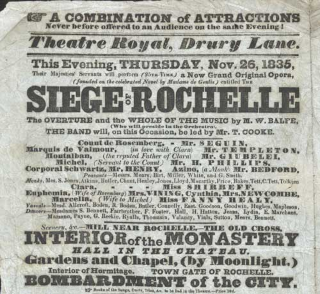
“The Siege of Rochelle” First Performed at Drury Lane Theatre

Irish composer Michael William Balfe‘s opera The Siege of Rochelle is first performed at the Drury Lane Theatre in London on October 29, 1835.

The opera is originally prepared for the English Opera House but for some reason the theatrical manager, Samuel James Arnold, does not want it. Instead, Alfred Bunn, the manager of Drury Lane Theatre, seizes the opportunity and begins what is a very fruitful collaboration with Balfe that lasts a decade. Balfe is to become the mainstay of English Opera for almost the next 30 years with a succession of popular operas.

The opera runs for 70 nights on its initial run and is revived in the following three seasons with Balfe singing the role of Michel. Queen Victoria sees the opera on November 15, 1837, her first state visit to a theatre during her reign. In 1836, the opera is reported as staged in Leeds, York, Sheffield, Manchester, Liverpool, Bath and Dublin with Abigail Betts as Clara. John Wilson, who sings in the initial run of the opera, also sings in, at least, some of these. Madame Balfe chooses the opera for her benefit in 1841, and Bunn opens his 1843 season with it on September 30. Emma Romer uses it to open her 1853 season at the Surrey Theatre, although it is being described by then as “somewhat hacknied.”

October 1875 sees a revival of the opera by the Carl Rosa Opera Company at the Princess’s Theatre, and it is then included in the company’s repertoire that tours to Manchester in 1875, Liverpool in 1876, Birmingham in 1877 and Dublin in 1879. The Turner Company tours it in 1893. This is possibly the opera’s last performance until the Wexford Festival Opera performances in 1963. The overture and songs from the opera, such as “When I beheld the anchor weigh’d” continue to retain a place in the concert hall and the home into the 20th century.

In 1838, the opera is performed by the Caradori-Allan troupe at the Park Theatre in New York but fails although it appears to be retained in the repertory. In 1839, it is performed again in Dublin with Balfe as Michel and in Sydney in 1848.

The opera’s production sparks an acrimonious argument between a correspondent in The Examiner accusing Balfe of plagiarism from Luigi Ricci‘s 1832 opera, Chiara di Rosemberg, and, in defence, Frederick Beale, from Balfe’s publishers, and Balfe. The matter seems to be settled in Balfe’s favour when the score of Chiara di Rosemberg is displayed at music publisher Cramer, Beale and Co. so that people can compare the two for themselves. While Edward Fitzball probably uses Ricci’s libretto as the basis for his, it does not seem to have been a straight translation, as some allege, but similarities would help to feed the accusations of plagiarism, bolstered by the Italian training and approach of both composers and the fact that Balfe had sung in Chiara di Rosemberg in Italy in 1834.

Balfe is said to have been paid £5 a night by Bunn and 400 guineas for the score by the publishers Cramer, Beale and Co. In 1871, the Bury and Norwich Post (April 11, 1871) report that the copyright has sold for £156 and just over ten years later the Aberdeen Evening Express (May 8, 1883) notes that the copyright has been sold again for approximately £20, adding “So much for Balfe’s ‘popularity.”


Leave a comment

Birth of Jonathan Swift, Essayist, Pamphleteer, Poet & Cleric

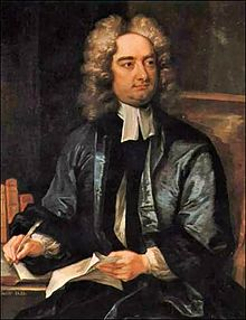
Jonathan Swift, satirist, essayist, political pamphleteer, poet and cleric who becomes Dean of St. Patrick’s Cathedral, Dublin, is born in Dublin on November 30, 1667.

Swift’s father, an attorney, also named Jonathan Swift, dies just two months before he is born. Without steady income, his mother struggles to provide for her newborn. Moreover, he is a sickly child. It is later discovered that he suffers from Ménière’s disease, a condition of the inner ear that leaves the afflicted nauseous and hard of hearing. In an effort to give her son the best upbringing possible, Swift’s mother gives him over to Godwin Swift, her late husband’s brother and a member of the respected professional attorney and judges group Gray’s Inn. Godwin Swift enrolls his nephew with one of his cousins in Kilkenny College, which is perhaps the best school in Ireland at the time. He arrives there at the age of six, where he is expected to have already learned the basic declensions in Latin. He has not and thus begins his schooling in a lower form. He graduates in 1682, when he is 15. His transition from a life of poverty to a rigorous private school setting proves challenging. He does, however, make a fast friend in William Congreve, the future poet and playwright.

In 1682, Swift commences his undergraduate studies at Trinity College, Dublin. In 1686, he receives a Bachelor of Arts degree and goes on to pursue a master’s degree. Not long into his research, huge unrest breaks out in Ireland. The king of Ireland, England and Scotland is soon to be overthrown. What becomes known as the Glorious Revolution of 1688 spurs him to move to England and start anew. For 10 years, Swift works in Surrey‘s Moor Park and acts as an assistant to Sir William Temple, 1st Baronet.

During his Moor Park years, Swift meets the daughter of Temple’s housekeeper, an 8-year-old named Esther Johnson, known as “Stella.” They become lovers for the rest of their lives until Johnson’s death in 1728. It is rumored that they marry in 1716, and that Swift keeps of lock of Johnson’s hair in his possession at all times.

During his decade of work for Temple, Swift returns to Ireland twice. On a trip in 1695, he takes all necessary requirements to become an ordained priest in the Anglican tradition. Under Temple’s influence, he also begins to write, first short essays and then a manuscript for a later book. Temple dies in 1699. Swift completes the task of editing and publishing Temple’s memoirs. He then leans on his priestly qualifications and finds work ministering to a pea-sized congregation just 20 miles outside of Dublin. For the next ten years, he gardens, preaches and works on the house provided to him by the church. He also returns to writing. His first political pamphlet is titled A Discourse on the Contests and Dissentions in Athens and Rome.

In 1704, Swift anonymously releases A Tale of a Tub and The Battle of the Books. Tub, although widely popular with the masses, is harshly disapproved of by the Church of England. Ostensibly, it criticizes religion, but Swift means it as a parody of pride. Nonetheless, his writings earn him a reputation in London and when the Tories come into power in 1710, they ask him to become editor of The Examiner, their official paper. After a time, he becomes fully immersed in the political landscape and begins writing some of the most cutting and well-known political pamphlets of the day, including The Conduct of the Allies, an attack on the Whigs. Privy to the inner circle of Tory government, he lays out his private thoughts and feelings in a stream of letters to his beloved Stella. They are later published as The Journal to Stella.

When he sees that the Tories will soon fall from power, Swift returns to Ireland. In 1713, he takes the post of Dean at St. Patrick’s Cathedral, Dublin. While leading his congregation at St. Patrick’s, he begins to write what would become his best-known work. In 1726, at last finished with the manuscript, he travels to London and benefits from the help of several friends, who anonymously publish it as Travels into Several Remote Nations of the World, in Four Parts. By Lemuel Gulliver, First a Surgeon, and then a Captain of Several Ships, more simply known as Gulliver’s Travels. The book is an immediate success and has not been out of print since its first run.

Not long after the celebration of this work, Esther Johnson, falls ill. She dies in January 1728. Her death moves Swift to write The Death of Mrs. Johnson.

In 1742, Swift suffers a stroke and loses the ability to speak. He dies on October 19, 1745. He is laid to rest next to Esther Johnson inside Dublin’s St. Patrick’s Cathedral.


Leave a comment

Death of Jonathan Swift, Satirist & Essayist

jonathan-swift

Jonathan Swift, satirist, essayist, political pamphleteer, poet and cleric who becomes Dean of St. Patrick’s Cathedral, Dublin, dies in Dublin on October 19, 1745.

Swift is born in Dublin on November 30, 1667. His father, an attorney, also named Jonathan Swift, dies just two months before he is born. Without steady income, his mother struggles to provide for her newborn. Moreover, he is a sickly child. It is later discovered that he suffers from Ménière’s disease, a condition of the inner ear that leaves the afflicted nauseous and hard of hearing. In an effort to give her son the best upbringing possible, Swift’s mother gives him over to Godwin Swift, her late husband’s brother and a member of the respected professional attorney and judges group Gray’s Inn. Godwin Swift enrolls his nephew in the Kilkenny Grammar School (1674–1682), which is perhaps the best school in Ireland at the time. His transition from a life of poverty to a rigorous private school setting proves challenging. He does, however, make a fast friend in William Congreve, the future poet and playwright.

At age 14, Swift commences his undergraduate studies at Trinity College, Dublin. In 1686, he receives a Bachelor of Arts degree and goes on to pursue a master’s degree. Not long into his research, huge unrest breaks out in Ireland. The king of Ireland, England and Scotland is soon to be overthrown. What becomes known as the Glorious Revolution of 1688 spurs him to move to England and start anew. For 10 years, Swift works in Surrey‘s Moor Park and acts as an assistant to Sir William Temple.

During his Moor Park years, Swift met the daughter of Temple’s housekeeper, an 8-year-old named Esther Johnson. They become lovers for the rest of their lives until Johnson’s death. It is rumored that they marry in 1716, and that Swift keeps of lock of Johnson’s hair in his possession at all times.

During his decade of work for Temple, Swift returns to Ireland twice. On a trip in 1695, he takes all necessary requirements to become an ordained priest in the Anglican tradition. Under Temple’s influence, he also begins to write, first short essays and then a manuscript for a later book. Temple dies in 1699. Swift completes the task of editing and publishing Temple’s memoirs. He then leans on his priestly qualifications and finds work ministering to a pea-sized congregation just 20 miles outside of Dublin. For the next ten years, he gardens, preaches and works on the house provided to him by the church. He also returns to writing. His first political pamphlet is titled A Discourse on the Contests and Dissentions in Athens and Rome.

In 1704, Swift anonymously releases A Tale of a Tub and The Battle of the Books. Tub, although widely popular with the masses, is harshly disapproved of by the Church of England. Ostensibly, it criticizes religion, but Swift means it as a parody of pride. Nonetheless, his writings earn him a reputation in London and when the Tories come into power in 1710, they ask him to become editor of The Examiner, their official paper. After a time, he becomes fully immersed in the political landscape and begins writing some of the most cutting and well-known political pamphlets of the day, including The Conduct of the Allies, an attack on the Whigs. Privy to the inner circle of Tory government, he lays out his private thoughts and feelings in a stream of letters to his beloved Stella. They are later published as The Journal to Stella.

When he sees that the Tories will soon fall from power, Swift returns to Ireland. In 1713, he takes the post of dean at St. Patrick’s Cathedral in Dublin. While leading his congregation at St. Patrick’s, he begins to write what would become his best-known work. In 1726, at last finished with the manuscript, he travels to London and benefits from the help of several friends, who anonymously publish it as Travels into Several Remote Nations of the World, in Four Parts. By Lemuel Gulliver, First a Surgeon, and then a Captain of Several Ships, more simply known as Gulliver’s Travels. The book is an immediate success and has not been out of print since its first run.

Not long after the celebration of this work, Swift’s longtime love, Esther Johnson, falls ill. She dies in January 1728. Her death moves Swift to write The Death of Mrs. Johnson.

In 1742, Swift suffers a stroke and loses the ability to speak. On October 19, 1745, Jonathan Swift dies. He is laid to rest next to Esther Johnson inside Dublin’s St. Patrick’s Cathedral.