After moving to Houston in 1994, Devlin tends bar in Irish pubs and music venues for a number of years before starting his first band. From his perspective behind the bar, he realizes there is a local demand for Irish rock music that nobody is fulfilling. In 1996, to this end he forms a band called On the Dole. Although the band does well for several years, opening for legendary Irish touring acts like The Wolfe Tones and The Saw Doctors, eventually he decides it is time to clear the decks and start again.
In 2003, while hosting a weekly open mic at an Irish pub, Devlin meets bassist and singer Chad Smalley, son of Nobel laureateRichard Smalley and a veteran of the Houston music scene who had recently returned from New York and is looking for a new project. The two of them soon begin singing and performing together every week, developing a tight vocal harmony style.
In July 2004, Devlin and Smalley form Blaggards, along with violinist Turi Hoiseth and drummer Brian Vogel. Hoiseth and Vogel have since left the band, leaving Devlin and Smalley as the only original members.
The song “Big Strong Man” from Blaggards’ first album Standards (2005) appears in the 2010 British film The Kid, directed by Nick Moran.
“Big Strong Man” and “Drunken Sailor” (also from Standards) are both featured in episode 86 of the CBS series The Good Wife, aired on March 24, 2013.
Blaggards’ second album, Live in Texas, is released in 2010. It is a recording of a live performance at Houston’s Continental Club on June 13, 2009. The band’s latest album, Blagmatic, is released on July 14, 2021.
Blaggards, with Arizona-based fiddle player Heide Riggs and drummer Kevin “Turbo” Newton in the current lineup, continue to maintain a rigorous schedule, playing constantly throughout Texas and touring nationally several times a year. Beginning in 2010 (excluding the COVID years), the band does a 10-day Ireland tour every year in the early fall.
Warfield is raised in the Dublin suburb Inchicore, the second born in a family of four boys. Today, he and his wife June Warfield (née Radburn) reside in Blessington, County Wicklow.
Warfield is one of the founding members and lead singers of the Irish Folk band, The Wolfe Tones. He has written many songs for the band, notably “Up and Away (The Helicopter Song),” “Irish Eyes” and “My Heart is in Ireland.” “Let the People Sing” is written in dedication to those Irish ballad singers who were banned from singing Irish songs. It has been performed by many Celtic and Irish Rebel bands, including Celtic band Charlie and the Bhoys. The song is popular among fans of Celtic F.C. and a version is performed by The Malleys, omitting the second verse, at Celtic Park on match days.
Warfield’s affiliation with Celtic F.C. leads to him being asked to write a song for the club to celebrate its 100th anniversary. As a result, “Celtic Symphony” is composed. It is a song popular with many Celtic fans, but controversial due to its chorus, which features the words “ooh, ah, up the RA.” This is often seen as being a pro-Irish Republican Army (IRA) stance, but according to Warfield, the words were included in the balladic tradition of writing what is observed at the time.
As a songwriter, Warfield’s writing is typically a social commentary on Ireland and its issues. For the 2012 album, Child of Destiny, Warfield composes “Swing A Banker,” which is a comical ballad referring to Irish bankers as chickens. The music video is recorded outside the Treasury Building in Dublin.
The Wolfe Tones continue to tour but have announced that they are set to retire in 2024, after 60 years of performing together. In addition to gigs in the United States, there will be concerts at Galway Airport, Castlebar, County Mayo, and in the 3Arena in Dublin, with the band’s final gig taking place in Belfast in October 2024.
As of January 2024, Warfield has not communicated with his brother Derek Warfield since he left The Wolfe Tones in 2001.
Warfield is a singer, songwriter, mandolin player and a founding member of The Wolfe Tones, performing with the band for nearly thirty-seven years, writing and recording over 60 songs. As a founding member, he is featured on every album recorded by the band from 1965’s debut album The Foggy Dew through to 1989’s 25th Anniversary.
In 1989, a contract is signed by Warfield, signing rights to an American distributor, Shanachie Records. The contents of this contract are apparently misrepresented to the other members of The Wolfe Tones, resulting in a clause that prevents them from recording any new material. Unable to reverse this agreement, they continue to tour, albeit without any new material. As of July 2017, Warfield has not spoken to his brother and former bandmate Brian Warfield since he left The Wolfe Tones in 2001.
A solo album, Legacy, is released in 1995 as he is still eligible to record under his own name. With Warfield on vocals and mandolin, the music on this album is performed by a new band, although he is still touring with The Wolfe Tones. Legacy is followed by Liberte’ ’98, Sons of Erin, Take Me Home To Mayo and Clear The Way. He also has a video Legacy and two books, The Songs and Ballads of 1798 and The Irish Songster of the American Civil War.
In 2001, after a show played in Limerick, Warfield leaves The Wolfe Tones to concentrate on his own career. Calling themselves “Brian Warfield, Tommy Byrne and Noel Nagle, formerly of The Wolfe Tones,” the remaining three go on to release You’ll Never Beat the Irish (2001) and the subsequent album Child of Destiny (2011).
Warfield has performed his music and songs at American Civil War events and commemorations at such sites as Gettysburg, Sharpsburg and Harrisburg with his band, The Sons of Erin. His 2002 release, Clear the Way, is the second in his Irish Songs in the Civil War series.
The ballad “Take Me Home to Mayo,” written by Belfastman Seamus Robinson as a tribute to Michael Gaughan, is recorded as a duet with Irish American Andy Cooney and is the title track of another 2002 Warfield release.
In 2003, following a complaint by an Ulster Unionist Party (UUP) politician, Roy Beggs, Jr., a radio channel dedicated to the music of Derek Warfield is removed from the in-flight entertainment of Aer Lingus. Beggs complains of the “Blatant promotion of militant, armed republicanism” by the playing of this music, saying it is the same as “the speeches of Osama bin Laden being played on a trans-Atlantic Arabian airline.” Aer Lingus removes the material from their flights stating: “It is something that should not have been on board and we removed it immediately we became aware of it.”
In March 2006, Warfield releases his ninth solo album, a 36-song double CD of Irish songs. On March 1, 2006, his wife Nuala dies, followed by the death of his eldest daughter on September 28, 2007.
Warfield now tours with his new band, Derek Warfield and The Young Wolfe Tones.
A biography of Robert Emmet in two volumes, although not written by Warfield, has been published by him, and a collaboration with Raymond Daly of Tullamore has resulted in the publishing of a critically acclaimed book of lyrics and histories of Irish songs called Celtic and Ireland in Song and Story.
Following the outbreak of the Troubles in the late 1960s, the Provisional IRA conducts an armed campaign that seeks to create a united Ireland by ending Northern Ireland‘s status as part of the United Kingdom. As a result of increasing levels of violence in Northern Ireland, internment without trial is introduced there in August 1971, and in the Republic of Ireland the coalition government led by Fine Gael’s Liam Cosgrave is attempting to curb IRA activity. Fine Gael had come to power on a law-and-order ticket, with a policy of “getting tough on crime.” Suspected IRA members are arrested and accused of IRA membership by a superintendent in the Garda Síochána, a crime under the Offences against the State Acts. They are tried at the juryless Special Criminal Court in Dublin, where the traditional IRA policy of not recognising the court results in a fait accompli as no defence is offered and IRA membership carries a minimum mandatory one-year sentence, resulting in internment in all but name. In September 1973 IRA Chief of Staff Seamus Twomey appears at the Special Criminal Court charged with IRA membership, and states, “I refuse to recognise this British-orientated quisling court.” He is found guilty and receives a five-year sentence. By October 1973 the IRA’s command structure is seriously curbed, with Twomey and other senior republicans J. B. O’Hagan and Kevin Mallon all being held in Mountjoy Prison.
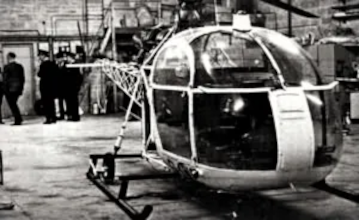
The IRA immediately begins making plans to break Twomey, O’Hagan and Mallon out of the prison. The first attempt involves explosives that had been smuggled into the prison, which are to be used to blow a hole in a door which will give the prisoners access to the exercise yard. From there, they are to scale a rope ladder thrown over the exterior wall by members of the IRA’s Dublin Brigade who are to have a getaway car waiting to complete the escape. The plans when the prisoners cannot gain access to the exercise yard and the rope ladder is spotted, so the IRA begins making new escape plans. The idea of using a helicopter in an escape had been discussed before in a plot to break Gerry Adams out of Long Kesh internment camp but had been ruled out because of faster and more sophisticated British Army helicopters being stationed at a nearby base. The IRA’s GHQ staff approves the plan to break out Twomey, O’Hagan and Mallon, and arrangements are made to obtain a helicopter. A man with an American accent calling himself Mr. Leonard approaches the manager of Irish Helicopters at Dublin Airport, with a view to hiring a helicopter for an aerial photographic shoot in County Laois. After being shown the company’s fleet of helicopters, Leonard arranges to hire a five-seater Alouette II for October 31.
Leonard arrives at Irish Helicopters on October 31 and is introduced to the pilot of the helicopter, Captain Thompson Boyes. Boyes is instructed to fly to a field in Stradbally, in order to pick up Leonard’s photographic equipment. After landing Boyes sees two armed, masked men approaching the helicopter from nearby trees. He is held at gunpoint and told he will not be harmed if he follows instructions. Leonard leaves with one gunman, while the other gunman climbs aboard the helicopter armed with a pistol and an ArmaLite rifle. Boyes is instructed to fly towards Dublin following the path of railway lines and the Royal Canal and is ordered not to register his flight path with Air Traffic Control. As the helicopter approaches Dublin, Boyes is informed of the escape plan and is instructed to land in the exercise yard at Mountjoy Prison.
In the prison’s exercise yard, the prisoners are watching a football match. Shortly after 3:35 p.m. the helicopter swings in to land in the prison yard, with Kevin Mallon directing the pilot using semaphore. A prison officer on duty initially takes no action as he believes the helicopter contains the Minister for Defence, Paddy Donegan. After prisoners surround the eight prison officers in the yard, fights break out as the officers realise an escape attempt is in progress. As other prisoners restrain the officers, Twomey, Mallon and O’Hagan board the helicopter. As the helicopter takes off, in the confusion one officer shouts, “Close the gates, close the fucking gates.” The helicopter flies north and lands at a disused racecourse in the Baldoyle area of Dublin, where the escapees are met by members of the IRA’s Dublin Brigade. Boyes is released unharmed, and the escapees are transferred to a taxi that had been hijacked earlier and are transported to safe houses.
The escape makes headlines around the world and is an embarrassment for Cosgrave’s government, which is criticised for “incompetence in security matters” by opposition party Fianna Fáil. An emergency debate on security is held in Dáil Éireann on November 1.
The IRA releases a statement on the escape, which reads, “Three republican prisoners were rescued by a special unit from Mountjoy Prison on Wednesday. The operation was a complete success, and the men are now safe, despite a massive hunt by Free State forces.” Shortly after the escape Twomey gives an exclusive interview to German magazine Der Spiegel, where the reporter says people throughout Europe are joking about the incident as “the escape of the century.” Irish rebel band the Wolfe Tones writes a song celebrating the escape called “The Helicopter Song,” which is immediately banned by the government yet still tops the Irish Singles Chart after selling twelve thousand copies in a single week.
The escape results in all IRA prisoners being held at Mountjoy Prison and Curragh Camp being transferred to the maximum security Portlaoise Prison. In order to prevent any further escapes, the perimeter of the prison is guarded by members of the Irish Army, and wires are erected over the prison yard to prevent any future helicopter escape. Cosgrave states there will be “no hiding place” for the escapees, and a manhunt involving twenty thousand members of the Irish Defence Forces and Garda Síochána ensues.
Mallon is recaptured at a Gaelic Athletic Association dance in a hotel near Portlaoise on December 10, 1973, and imprisoned in Portlaoise Prison. He escapes from there in a mass break-out on August 18, 1974, when nineteen prisoners escape after overpowering guards and using gelignite to blast through the gates. He is recaptured in Foxrock in January 1975 and returned to Portlaoise Prison. O’Hagan is recaptured in Dublin in early 1975, and also imprisoned in Portlaoise Prison. After the end of his original twelve-month sentence, he is immediately arrested and sentenced to a further two years imprisonment for escaping. Twomey evades recapture until December 2, 1977, when he is spotted sitting in a car in Sandycove by members of the Garda’s Special Branch who are investigating an arms shipment after a tip-off from police in Belgium. He drives away after spotting the officers, before being recaptured in the centre of Dublin after a high-speed car chase. He is also imprisoned in Portlaoise Prison until his release in 1982.
In 2021, Brendan Hughes publishes an autobiography Up Like a Bird, an account of the planning and organisation of the escape, co-authored with Doug Dalby.
McDonnell is one of ten children. He attends a nearby Roman Catholic school. He marries Goretti in 1970 and moves into her sister’s house in Lenadoon. There are only two Catholic houses in this predominantly Ulster Protestanthousing estate, and their house is attacked on numerous occasions.
McDonnell agrees with the goals of the 1981 Irish hunger strike, namely: the right not to wear a prison uniform; the right not to do prison work; the right of free association with other prisoners; the right to organise their own educational and recreational facilities and the right to one visit, one letter and one parcel per week.
Although McDonnell is not involved in the first hunger strike in 1980, he joins Bobby Sands and the others in the second hunger strike the following year. During the strike he fights the general election in the Republic of Ireland, and only narrowly misses election in the Sligo–Leitrim constituency. He goes 61 days without food before dying on July 8, 1981. He has two children. His wife takes an active part in the campaign in support of the hunger strikers.
McDonnell is buried in the grave next to Bobby Sands at Milltown Cemetery in west Belfast. John Joe McGirl, McDonnell’s election agent in Sligo–Leitrim, gives the oration at his funeral. Quoting Patrick Pearse, he states, “He may seem the fool who has given his all, by the wise men of the world; but it was the apparent fools who changed the course of Irish history.”
McDonnell is born on Slate Street in the lower Falls Road of Belfast, Northern Ireland on September 14, 1951, as one of ten children. He attends a nearby Roman Catholic school. He marries Goretti in 1970 and moves into her sister’s house in Lenadoon. There are only two Catholic houses in this predominantly Ulster Protestanthousing estate, and their house is attacked on numerous occasions.
McDonnell agrees with the goals of the Irish hunger strike, namely: the right not to wear a prison uniform; the right not to do prison work; the right of free association with other prisoners; the right to organise their own educational and recreational facilities and the right to one visit, one letter and one parcel per week.
Although McDonnell is not involved in the first hunger strike in 1980, he joins Bobby Sands and the others in the second hunger strike the following year. During the strike he fights the general election in the Republic of Ireland, and only narrowly misses election in the Sligo–Leitrim constituency. He goes 61 days without food before dying on July 8, 1981. He has two children. His wife takes an active part in the campaign in support of the hunger strikers.
McDonnell is buried in the grave next to Bobby Sands at Milltown Cemetery in west Belfast. John Joe McGirl, McDonnell’s election agent in Sligo–Leitrim, gives the oration at his funeral. Quoting Patrick Pearse, he states, “He may seem the fool who has given his all, by the wise men of the world; but it was the apparent fools who changed the course of Irish history.”
South is born in 1928 in Limerick where he is educated at Sexton Street Christian Brothers School, later working as a clerk in a local wood-importing company called McMahon’s. South is a member of a number of organisations including the Gaelic League, Legion of Mary, Clann na Poblachta, and Sinn Féin. In Limerick he founds the local branch of Maria Duce, a social Catholic organisation, where he also edits both An Gath and An Giolla. He receives military training as a lieutenant of the Irish army reserve, the LDF which later becomes the FCA (An Fórsa Cosanta Áitiúil or Local Defence Force), before he becomes a volunteer in the Irish Republican Army.
South is a devout Catholic, being a member of An Réalt, the Irish-speaking chapter of the Legion of Mary, and a conservative, even by the standards of the day. He is also a member of the Knights of Columbanus.
On New Year’s Day 1957, fourteen IRA volunteers cross the border into County Fermanagh to launch an attack on a joint RUC/B Specials barracks in Brookeborough. During the attack a number of volunteers are injured, two fatally. South and Fergal O’Hanlon die of their wounds as they are making their escape. They are carried into an old sandstone barn by their comrades which is later demolished by a British army jeep. Stone from the barn is used to build a memorial at the site.
The attack on the barracks inspires two popular rebel songs: “Seán South of Garryowen” and “The Patriot Game.” “Seán South of Garryowen,” is written by Sean Costelloe from County Limerick to the tune of another republican ballad “Roddy McCorley” and is made famous by The Wolfe Tones. The popularity of this song leads to the misconception that South is from Garryowen, a suburb in Limerick city. In fact, South is actually from 47 Henry Street in Limerick.
South is also mentioned in The Rubberbandits song “Up Da Ra”, which pokes fun at the concept of armchair republicanism using the literary device of the unreliable narrator.
There is a plaque dedicated to Seán South outside his birthplace on Henry Street, Limerick.





 seamus dubhghaill