seamus dubhghaill

Promoting Irish Culture and History from Little Rock, Arkansas, USA


Leave a comment

Birth of Mervyn Archdall, Antiquarian & Church of Ireland Clergyman

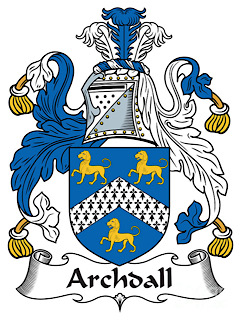
Mervyn Archdall, Irish antiquarian and clergyman of the Church of Ireland, is born on April 22, 1723, in Dublin, elder son among two sons and three daughters of William Archdall, goldsmith, and his wife Henrietta, a widow who is the daughter of Henry Gonne, curate of Finglas. His father is Dublin assay master from 1736 until his death in 1751, and is a member of the gentry family from Castle Archdale, County Fermanagh.

Archdall is educated by Dr. Keenane, and enters Trinity College Dublin (TCD) in 1739. He graduates with a Bachelor of Arts (BA) in 1744 and a Master of Arts (MA) in 1747, and is ordained in the Church of Ireland. He is curate of Howth from 1750 to 1753, and of Kilgobbin and Taney, also in Dublin, from 1753 to 1758, rector of Nathlash in the diocese of Cloyne from 1749 to 1758, and from 1756 domestic chaplain to Richard Pococke, Bishop of Ossory. In 1761 Pococke gives Archdall the livings of Agharney and Attanagh in Ossory which he holds until 1786, when he becomes rector of Slane in the Diocese of Meath. He is also prebendary of Cloneamary from 1762 to 1764 and of Mayne from 1764 to 1772, both in Ossory.

Archdall is interested, almost from his student days, in ancient history and antiquities, and for forty years he gathers material for a work similar to an earlier compilation, William Dugdale‘s Monasticon Anglicanum. He intends to publish two or more large folio volumes, but after Pococke’s death has no sponsor and has to pay for its publication himself causing him to cut back the scale of the project. Monasticon Hibernicum appears in 1786 as a quarto volume, though still of over 800 pages. Archdall attempts encyclopaedic coverage of the history of Ireland’s pre-reformation monasteries and abbeys. The work is ground-breaking and ambitious, though marred by mistakes and inadequacies. He receives help from friends, including scholars such as Pococke and Edward Ledwich, and with them and others is a founder member of the Royal Irish Academy (RIA) in 1786.

In 1789, Archdall publishes his second important work, a new edition of The Peerage of Ireland by John Lodge. Lodge’s original work in four volumes is expanded by Archdall into seven octavos, adding a good deal of material from his own research to update the genealogies, as well as incorporating manuscript additions unpublished by the original author. These had been left in a cipher or in a private form of shorthand which could not be decoded by any contemporary expert in Dublin, and Archdall is just about to abandon the attempt to read them when his second wife works on it and discovers the key.

Archdall’s first wife, Sarah Colles or Collis, whom he marries in Dublin on July 30, 1747, is said to have been a relative of Thomas Prior, though she may also – or instead – have been connected in some way to Pococke. The bishop is known to have educated Christopher Colles (1739–1816), who becomes an important engineer and entrepreneur in the United States. They have two sons and a daughter, the elder son dying young. Sarah dies on May 28, 1782. Archdall marries his second wife, Abigail Young, on November 25, 1782.

Archdall’s works are still of interest to historians and genealogists, and surviving copies are valuable collectors’ items. In an apologia in his preface to the Peerage he notes, “I have left that inaccurate which could not be exact, and that imperfect which cannot be completed.” He dies suddenly on August 6, 1791, and is buried in Slane churchyard.

(From: “Archdall, Mervyn” by Linde Lunney, Dictionary of Irish Biography, http://www.dib.ie, October 2009)


Leave a comment

The Dublin Society Renamed Royal Dublin Society

royal-dublin-society

The Dublin Society for Improving Husbandry, Manufactures and Other Useful Arts, which is originally founded on June 25, 1731, becomes the Royal Dublin Society on June 19, 1820.

The society is founded by members of the Dublin Philosophical Society, chiefly Thomas Prior. On July 1, 1731, at the second meeting of the Society, the designation “and Sciences” is added to the end of its name. The Society’s broad agenda is to stimulate economic activity and aid the creation of employment in Ireland. For the first few years of its existence, the Dublin Society concentrates on tillage technology, land reclamation, forestry, the production of dyestuffs, flax cultivation and other agricultural areas.

In 1738, following the publication of his pamphlet entitled Reflections and Resolutions Proper for the Gentlemen of Ireland, Samuel Madden initiates a grant or “premium” scheme to create incentives for improvements in Irish agricultural and arts. He proposes that a fund of £500 be raised for this purpose and he personally contributes £130. By 1740 the premium scheme has raised £900 and is adjudicated upon the following January and awarded to enterprises in earthenware, cotton, leatherwork, flax, surveying, as well as a number of painters and sculptors.

In 1761 the Irish Parliament votes for £12,000 to be given to the Dublin Society for the promotion of agriculture, forestry, arts and manufactures. This funding is used to increase the amount of premiums distributed by the Dublin Society. Further funds are given by Parliament to the Dublin Society on a sporadic basis until 1784 when an annual parliamentary vote of £5,000 is put in place and remains so until the dissolution of Grattan’s Parliament in 1800.

The “Royal” prefix is adopted in 1820 when George IV becomes Society patron.

The society purchases Leinster House, home of the Duke of Leinster, in 1815 and founds a natural history museum there. The society acquires its current premises at Ballsbridge in 1879 and has since increased from the original fifteen to forty acres. The premises consist of a number of exhibition halls, a stadium, meeting rooms, bars, restaurants, and RDS Simmonscourt Pavilion, a multi-purpose venue.

The Boyle Medal, named after Robert Boyle (1627–1691), is inaugurated in 1899 and is awarded jointly by the RDS and The Irish Times for scientific research of exceptional merit in Ireland. As of 2014 the medal has been awarded to 39 scientists.


Leave a comment

Founding of the Dublin Society for Improving Husbandry

royal-dublin-society-logoThe Dublin Society for Improving Husbandry (Cumann Ríoga Bhaile Átha Cliath) is founded on June 25, 1731 “to promote and develop agriculture, arts, industry, and science in Ireland.” On June 25, 1820, the name is changed to Royal Dublin Society (RDS) and is commonly known as the “Dublin Society.”

The society is originally founded by members of the Dublin Philosophical Society, chiefly Thomas Prior and Samuel Madden, as the “Dublin Society for improving Husbandry, Manufactures and other Useful Arts.” On July 8, 1731, a couple of weeks after initial foundation, the designation “and Sciences” is added to the end of its name.

The stated aim of the “Dublin Society” is therefore to promote the development of arts, agriculture, industry, and science in Ireland. In 1792 the Society purchases the Leskean Cabinet to further this ambition. The “Royal” prefix is adopted in 1820 when George IV becomes Society patron.

The society purchases Leinster House, home of the Duke of Leinster, in 1815 and founds a natural history museum there. The society acquires its current premises at Ballsbridge in 1879, and has since increased from the original fifteen acre site to forty acres. The premises consist of a number of exhibition halls, a stadium, meeting rooms, bars, restaurants, and a multi purpose venue named RDS Simmonscourt Pavilion.

The RDS Main Hall is a major centre for exhibitions, concerts, and other cultural events in Dublin. It hosts, for example, the Young Scientist and Technology Exhibition each January.

The Simmonscourt Pavilion has a capacity of approximately 7,000, and hosted the Meteor Music Awards in February 2008, as well as a number of concerts including The Smashing Pumpkins and My Chemical Romance, and two Eurovision Song Contests, in 1981 and 1988. Simmonscourt is where the show jumping horses are stabled during Dublin Horse Show week.