seamus dubhghaill

Promoting Irish Culture and History from Little Rock, Arkansas, USA


Leave a comment

Postponement of the Easter Rising

general-post-office

On Saturday, April 22, 1916, the Easter Rising, originally planned for the following day, Easter Sunday, is postponed for one day.

At dawn a messenger from the Kerry Volunteers arrives in Dublin and informs James Connolly, Commandant of the Dublin Brigade, that Roger Casement had been arrested in County Kerry the previous day during a failed attempt to smuggle arms into Ireland on board the German ship Aud. A meeting of the Military Council is hastily organised, and the decision is made not to inform Chief-of-Staff of the Irish Volunteers, Eoin MacNeill, about Casement’s arrest.

Later in the morning, after attempting to escape the area, Karl Spindler, captain of the Aud, makes the decision to scuttle his ship after it is intercepted by the Royal Navy. Although Spindler and the crew are rescued, the armaments on board the Aud are lost. By early afternoon the Military Council is made aware of the loss of their arms shipment.

At 6:00 PM, Sean Fitzgibbon, Colm O’Loughlin, and Michael Joseph O’Rahilly arrive at Woodtown Park and inform MacNeill of the arrests and the loss of the Aud. After confronting Patrick Pearse at St. Enda’s School, a bilingual school for boys founded by Pearse, MacNeill and others, including O’Rahilly and Bulmer Hobson, gather at the house of Seumas O’Kelly on Rathgar Road and a decision is made to issue countermanding orders cancelling the Rising planned for Easter Sunday. To make sure that the countermanding order is received and understood, James Ryan is sent overnight to Cork, Colm O’Loughlin to Dundalk and Coalisland, Sean Fitzgibbon to Waterford, and Min Ryan to Wexford. O’Rahilly travels to Limerick, Kerry, Cork, and Tipperary. This succeeds in delaying the rising for only one day, although it greatly reduces the number of Volunteers who turn out.

During the evening, Major-General Sir Lovick Friend, General Officer Commanding of British forces in Ireland, travels to London on leave in wake of the capture of the Aud believing that any potential insurgency has been stopped. Chief Secretary Augustine Birrell is also in London having attended a Cabinet meeting. Both men remain in London through Easter, leaving Under Secretary Matthew Nathan as the most senior British official remaining in Dublin. Lord Lieutenant of Ireland, Ivor Churchill Guest, 1st Viscount Wimborne, urges Nathan to order the arrest of a large number of rebel leaders however he is unwilling to do so without the authorisation of Chief Secretary Birrell.
Leave a comment

The Fenian Rising of 1867

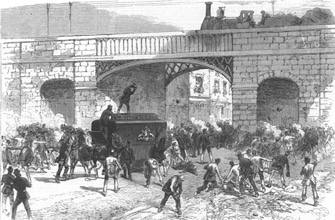
The Fenian Rising of 1867, a rebellion against British rule in Ireland organised by the Irish Republican Brotherhood (IRB), begins in Dublin, Cork, Limerick, Clare, and Tipperary on March 5, 1867.

The Irish Republican Brotherhood is founded in Dublin by James Stephens in 1858. After the end of the American Civil War, the IRB hopes to recruit willing Irish veterans of that war for an insurrection in Ireland aimed at the foundation of an Irish Republic.

In 1865, the Fenians begin preparing for a rebellion by collecting firearms and recruiting men willing to fight. In September 1865, the British move to close down the Fenian newspaper The Irish People and arrest many of the leadership. In 1866, habeas corpus is suspended in Ireland and there are hundreds more arrests of Fenian activists.

In early 1867, prior to the March 5 rising, Thomas J. Kelly, Stephens’ successor as leader of the IRB, tries to launch an insurrection but it proves uncoordinated and fizzles in a series of skirmishes. In February 1867, there is an unsuccessful rising in County Kerry.

The largest of the March 5 engagements takes place at Tallaght, when several hundred Fenians, on their way to the meeting point at Tallaght Hill, are attacked by the Royal Irish Constabulary (RIC) near the police barracks and are driven away after a firefight. A total of twelve people are killed across the country on this day. When it becomes apparent that the coordinated rising that had been planned is not transpiring, most rebels simply go home.

The rising fails as a result of lack of arms and planning, but also because of the British authorities’ effective use of informers. Most of the Fenian leadership is arrested before the rebellion takes place.

Though the Rising of 1867 is unsuccessful, they proclaim an Irish Republic, almost 50 years before the Proclamation of the Irish Republic in Easter 1916. This proclamation sheds some light on early Fenianism as it is centered with the ideas of republican democracy but is, however, flavoured with socialist ideals and a class revolution rather than a nationalist revolution per se. The proclamation claims that their war is “against the aristocratic locusts, whether English or Irish” which denotes that their ideology at this time is in some way embedded in class differences against the landed aristocracy rather than merely against British rule.

The rising itself is a total military failure, but it does have some political benefits for the Fenian movement. There are large protests in Ireland against the execution of Fenian prisoners, many of whose death sentences are, as a result, reprieved. In 1873, the Irish Republican Brotherhood adopts a new constitution, which states that armed rebellion will not be pursued again until it has mass backing from the people. The Fenians cooperate with the Irish National Land League in the land agitation from the 1870s onwards and in the rise of the Irish Parliamentary Party. Not all Fenians agree with the new policy and several breakaway groups emerge that continue to believe in the use of political violence in pursuit of republican objectives.


Leave a comment

Birth of Tipperary Hurling Legend John Doyle

john-doyle

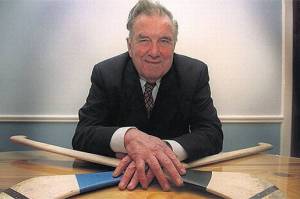
John Doyle, Irish sportsperson and politician, hailed as one of the best defenders in hurling and his county’s most iconic player upon his death, is born in Holycross, County Tipperary, on February 12, 1930.

Doyle first excels at hurling while at school in Thurles CBS. Regarded as too good for CBS Primary School team, he is drafted into the secondary school’s under-15 Croke Cup team in 1942. Doyle plays at wing-forward as Thurles CBS wins the championship that year.

Doyle arrives on the inter-county scene at the age of sixteen when he first links up with the Tipperary minor team. He makes his senior debut in the 1947-48 National League. A 5-6 to 4-2 defeat of Cork in the provincial decider gives him his first Munster medal. Tipperary retains their provincial crown in 1947, with Doyle collecting a second Munster medal following a 2-4 to 1-2 defeat of Waterford. Doyle goes on to play a key role for Tipperary during a hugely successful era for the team, winning eight All-Ireland medals, ten Munster medals, and ten National Hurling League medals.

On June 26, 1949, Doyle makes his senior championship debut in a Munster quarter-final replay against Cork. As a member of the Munster inter-provincial team for fifteen years, Doyle wins six Railway Cup medals. At club level he wins three championship medals with Holycross-Ballycahill.

After surrendering their provincial crown in 1966, Tipperary bounces back the following year, with Doyle winning a record tenth Munster medal following a 4-12 to 2-6 defeat of Clare. On September 3, 1967, Tipperary faces Kilkenny in the All-Ireland decider, a game which presents Doyle win the opportunity of making history by winning a record-breaking ninth All-Ireland medal. Despite leading at halftime 2-6 to 1-3, Kilkenny goalkeeper Ollie Walsh makes a series of spectacular saves in the second half and Kilkenny is victorious 3-8 to 2-7 and lays to rest a bogey that Tipperary has had over the team since 1922. The defeat brings the curtain down on Doyle’s inter-county career.

For almost fifty years Doyle, together with Christy Ring, hold a unique record as the only players to win eight All-Ireland medals on the field of play. This record is subsequently surpassed by Henry Shefflin on September 30, 2012. His record of National League medals has yet to be equalled. Throughout his career, Doyle makes 54 championship appearances, a Tipperary record which stands until August 9, 2009 when it is surpassed by Brendan Cummins.

In retirement from inter-county hurling, Doyle continues to work on his farm in Holycross. In later years he enters politics. He stands unsuccessfully as a Fianna Fáil candidate at the 1969 general election for the Tipperary North constituency, but is subsequently elected to Seanad Éireann on the Agricultural Panel. He serves until 1973 when he loses his seat.

Doyle is widely regarded as one of the greatest hurlers in the history of the game. During his playing days he wins two Cú Chulainn awards, and is named Texaco Hurler of the Year in 1964. He is repeatedly voted onto teams made up of the sport’s greats, including as left corner-back on the Hurling Team of the Century in 1984 and the Hurling Team of the Millennium in 2000.

John Doyle dies on December 29, 2010. Taoiseach Brian Cowen is among those who pay tribute saying “He was an immense hurler and an incredibly decent man, his love of the GAA was matched by his concern for his country and his own community, he was a Tipperary legend and a proud Irishman.” Doyle is buried at Holy Cross Abbey outside Thurles on December 31, 2010.


Leave a comment

Birth of Revolutionary Leader Thomas MacDonagh

thomas-macdonagh

Thomas MacDonagh, political activist, poet, playwright, educationalist, revolutionary leader, and one of the seven leaders of the Easter Rising of 1916, is born in Cloughjordan, County Tipperary, on February 1, 1878.

MacDonagh grows up in a household filled with music, poetry, and learning and is instilled with a love of both English and Irish culture from a young age. He attends Rockwell College and spends several years in preparation for a missionary career but soon realizes that it isn’t the life for him and leaves the college. He teaches briefly at St. Kieran’s College in Kilkenny and, from 1903, is employed as a professor of French, English, and Latin at St. Colman’s College, Fermoy, County Cork, where he forms a branch of the Gaelic League. He moves to Dublin and establishes strong friendships with such men as Eoin MacNeill and Patrick Pearse.

In Dublin, MacDonagh joins the staff St. Enda’s School upon its establishment in 1908, as a French and English teacher and Assistant Headmaster. In January 1912 he marries Muriel Gifford and takes the position of lecturer in English at the National University, while continuing to support St Enda’s. MacDonagh remains devoted to the Irish language and, in 1910, he becomes tutor to a younger member of the Gaelic League, Joseph Plunkett.

In 1913, MacDonagh and Plunkett attend the inaugural meeting of the Irish Volunteers and join its Provisional Committee. MacDonagh is later appointed Commandant of Dublin’s 2nd battalion and eventually made commandant of the entire Dublin Brigade. MacDonagh develops strong republican beliefs and joins the Irish Republican Brotherhood (IRB) in the summer of 1915. Around this time, Tom Clarke asks MacDonagh to plan the grandiose funeral of Jeremiah O’Donovan Rossa, which is a resounding propaganda success largely due to the graveside oration delivered by Pearse.

MacDonagh joins the secret Military Council that is planning the rising in April 1916, just weeks before the rising takes place. Although joining the Council during the late stages of the planning process, MacDonagh is, nevertheless, a signatory of the Proclamation of the Irish Republic.

During the rising, MacDonagh’s battalion is stationed at the massive Jacob’s Biscuit Factory complex. On the way to this destination the battalion encounters veteran Fenian John MacBride, who joins the battalion as second-in-command.

Although MacDonagh’s battalion is one of the strongest, they see little fighting as the British Army avoids the factory and establishes positions in central Dublin. MacDonagh receives the order to surrender on April 30, although his entire battalion is fully prepared to continue the engagement. Following the surrender, MacDonagh is court martialled and executed by firing squad at Kilmainham Gaol in Dublin on May 3, 1916, at the age of thirty-eight.