seamus dubhghaill

Promoting Irish Culture and History from Little Rock, Arkansas, USA


Leave a comment

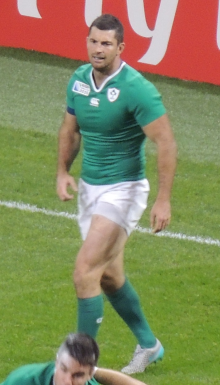
Birth of Rob Kearney, Former Rugby Union Player

Robert Kearney, former rugby union player, is born on a dairy farm on March 26, 1986, on the Cooley Peninsula in County Louth. He plays for 15 years for Leinster followed by a six-month stint in Australia, playing for Perth based side Western Force. He also plays over a decade for the Ireland national rugby union team with whom he earns 95 caps and goes on two British & Irish Lions tours in 2009 and 2013. As a youth he also plays rugby union for Clongowes Wood College and Gaelic football for Louth in the All-Ireland Minor Football Championship.

Kearney is the third of five children. He has an older brother, Richard, a younger brother Dave (who plays for Leinster) and a sister, Sara, the youngest of the five children. His elder brother Ross dies at the age of six following an accident in 1988. He is a seventh cousin of former U.S. President Joe Biden.

Like many of his peers, Kearney gets involved in athletics at an early age. The dominant sport in the area is Gaelic football. As a youth, he plays Gaelic for Naomh Muire, and in the Cooley Kickhams underage setup, before graduating to the Cooley senior football team at the age of 17 in 2004 and also Louth at minor level.

Kearney attends Clongowes Wood College in County Kildare for his secondary education. After his Leaving Certificate he moves to University College Dublin (UCD) on a sports scholarship, where he plays for the rugby team. He graduates in April 2010 with a Bachelor of Arts degree in economics. In 2005 he helps the U-20s team win the McCorry Cup, beating Dublin University Football Club (DUFC) in the final. In 2018, he is awarded the UCD Alumni Award in Sport.

Kearney plays for Leinster at both schoolboy and U-19 level before going on to represent them as a senior. He scores a hat-trick of tries on his debut for Leinster in a pre-season friendly win over Parma.

Kearney makes his Celtic League debut for Leinster in 2005 in a 22–20 defeat away to the Ospreys. He makes 32 appearances in the competition, scoring eight tries, with three penalties during a period in September 2006, when usual place kicker, Felipe Contepomi, is injured. He plays in his first Heineken Cup game in a 19–22 defeat against Bath at the Royal Dublin Society (RDS) on October 22, 2005. It is the first of ten appearances scoring ten tries in the process. He is part of Leinster’s Heineken Cup winning team in 2009 but misses the 2011 final due to injury. On May 21, 2012, the day after Leinster wins their second straight Heineken Cup, he is announced as the ERC Player of the Year for 2012. During the 2011–12 campaign he starts all nine European matches scoring six tries. He is crowned Leinster player of the year for the 2011–12 season. He confirms his departure from Leinster on September 24, 2020.

In late September 2020, it is confirmed that Kearney has signed a one-year contract with Australian side Western Force. He makes his Force debut in an 11–27 defeat to the Brumbies on February 19, 2021. He announces his retirement from rugby after one season with Western Force in Super Rugby AU and Super Rugby Trans-Tasman. Following his retirement, he returns to Louth GAA club Cooley Kickhams where he begins training in August 2021 for the first time since 2005.

Kearney represents Ireland at schoolboy and U-19 level, and tours with Ireland A in the 2006 Churchill Cup. He is first called into the Irish training squad for 2005’s autumn internationals but does not play. He is named in the Irish squad to the 2007 summer tour of Argentina and earns his first cap against Argentina on June 2, 2007, in a 16–0 defeat. During the 2008 Six Nations Championship he scores two tries, one against Scotland and one against England. He is a member of the victorious Ireland team that wins the 2009 Six Nations Championship, Triple Crown and Grand Slam. One of the most famous incidents in his career is a high tackle incident involving Italy‘s Andrea Masi in the first minute of a game. The incident is taken as an indication of the danger posed by Kearney in attack. He misses almost a year – from November 2010 until August 2011 – due to a knee injury that requires surgery.

In the 2011 Rugby World Cup, Kearney is selected but is injured for the first game against the United States. However, he plays in all the other matches which take Ireland through to the quarterfinals, in which they are knocked out by Wales, 22–10. He is selected in the Ireland squad for the 2012 Six Nations Championship and named in the starting team to play Wales in the opening match. He plays in all the other games, which see Ireland finish third in the table. He is also in the first Irish rugby team in 39 years to beat Australia on Australian soil, in the 2018 summer series. He is named in the Ireland squad for the 2019 Rugby World Cup in Japan, starting three of Ireland’s five matches and splitting time at fullback with Jordan Larmour.

Kearney is named in the British & Irish Lions squad for the 2009 tour to South Africa. He makes his Lions test debut as a substitute in the 26–21 first test defeat in Durban. Due to an injury to Lee Byrne, he is selected again for the second test in Pretoria. He scores the only try for the Lions in a 28–25 defeat. He then plays in the final test in Johannesburg which the Lions win 28–9. On April 30, 2013, he is named in his second British & Irish Lions squad.

Kearney marries Jess Redden in 2021, and their son is born in 2023.


Leave a comment

Ireland Wins the Rugby Triple Crown for First Time

Ireland wins the rugby Triple Crown for first time on March 10, 1894. In rugby union, the Triple Crown (Irish: An Choróin Triarach) is an honour contested annually by the national teams of England, Scotland, Ireland, and Wales as part of the Six Nations Championship. If any one team manages to win all their games against the other three then they win the Triple Crown.

The history of the Ireland national rugby union team begins in 1875, when Ireland plays its first international match, a 0–7 loss against England. Ireland has competed in the Six Nations (formerly known as the Five Nations and originally known as the Home Nations) rugby tournament since 1883. Ireland has also competed at the Rugby World Cup every four years since its inception.

Dublin University is the first organised rugby football club in Ireland, having been founded in 1854. The club is organised by students who have learned the game while at English public schools. During the third quarter of the nineteenth century, and following the adoption of a set of official rules in 1868, rugby football begins to spread quickly throughout Ireland, resulting in the formation of several other clubs which are still in existence, including North of Ireland F.C. (1868), Wanderers F.C. (1869), Queen’s University RFC (1869), Youghal RFC (1869), Lansdowne F.C. (1873), Dungannon RFC (1873), County Carlow F.C. (1873), University College Cork RFC (1874) and Ballinasloe RFC (1875) which amalgamates with Athlone RFC to form Buccaneers RFC.

In 1874, the Irish Football Union. reconstituted as the Irish Rugby Football Union after unification with the North of Ireland Union, is formed by Dublin University Football Club, Wanderers F.C., Engineers F.C., Lansdowne F.C., Bray, Portora, Dungannon RFC and Monaghan. Ireland loses their first test match against England 0-7 at The Oval on February 15, 1875. Both teams field twenty players in this match, as is customary in the early years of rugby union. It was not until 1877 that the number of players is reduced from twenty to fifteen. Ireland’s first home game is also against England in the same year. It is held at the Leinster Cricket Club in Rathmines as Lansdowne Road is deemed unsuitable. The first match at Lansdowne Road is held on March 11, 1878, with England beating Ireland by 2 goals and 1 try to nil.

It is not until 1881 that Ireland first wins a test, beating Scotland at Ormeau Cricket Ground in Belfast. Ireland turns up two men short for their game in Cardiff in 1884 and has to borrow two Welsh players. The first victory Ireland has at Lansdowne Road takes place on February 5, 1887. It is also their first win over England, by two goals to nil. On March 3, 1888, Ireland records their first win over Wales with a goal, a try and a drop goal to nil.

In 1894, Ireland follows the Welsh model of using seven backs instead of six for the first time. After victory over England at Blackheath, Ireland wins back-to-back matches for the first time when recording their first win over Scotland on February 24, 1894. Ireland goes on to beat Wales in Belfast on March 10, 1894, and wins the Triple Crown for the first time.

In the 1890s, rugby is primarily a game for the Protestant middle class, the only Catholic in Edmund Forrest’s 1894 team is Thomas Crean. Of the eighteen players used in the three games, thirteen are from three Dublin clubs – Wanderers, Dublin University and Bective Rangers – and the remaining five are from Ulster. They go on to win the Home international championship twice more before the century is out (1896 and 1899), so that by 1901 all four of the Home Unions have tasted success at a game that is growing in popularity with players and spectators.

(Pictured: The 1894 Ireland Rugby Union team, Kildare Observer, Irish News Archives)


Leave a comment

Death of Lucius Gwynn, Academic & Sportsman

Lucius Henry Gwynn, Irish academic and sportsman who is noted for his prowess in both rugby union football and cricket, dies in Davos Platz, Switzerland, on December 23, 1902.

Gwynn is born in Ramelton, County Donegal, on May 5, 1873. He is a member of a family well known in Dublin at the time for its academic and sporting achievements. He is the fourth son of the Very Rev. John Gwynn, Regius Professor of Divinity at Trinity College Dublin (TCD), and Lucy Josephine, daughter of the Irish patriot William Smith O’Brien. He and his three immediate younger brothers, Arthur, Robin and Jack, all in turn captain their school and university cricket teams and play the game at first class level. He is also a talented rugby player.

Gwynn’s academic career outshines even his sporting achievements. He enters Trinity College Dublin as a foundation Scholar and achieves a double first in his degree finals. In 1899 he is elected a Fellow of Trinity College and commences what promises to be a distinguished academic career.

At school Gwynn is mainly a bowler, his brother Arthur being the superior bat, though this inequality is ironed out at university. He is captain of the Dublin University Cricket Club XI for two seasons, 1894 and 1895, then plays under Arthur’s captaincy. The three brothers make up a formidable threesome in those years.

Primarily noted for his bowling prowess during early outings with the Dublin University XI, Gwynn takes 44 wickets at an average of 8.14 in Trinity’s annus mirabilis of 1893, a season which witnesses victories over Leicestershire, Oxford University, Warwickshire (dismissed for a paltry total of 15 runs) and a draw against Essex.

Gwynn, a right-handed batsman, who records the highest first-class average (56.87) among those batsmen who complete ten innings or more during the English season of 1895, enjoys another remarkably productive season in 1896, plundering over a thousand runs in Trinity flannels, a superlative effort complemented by a haul of 93 wickets at 9.37. His irrepressible form reputedly earns him an invitation to represent England against Australia in the second Ashes Test at Old Trafford in July 1896. However, concurrent university examinations render him unable to participate. Instead, English cricket is introduced to the wizardry of K. S. Ranjitsinhji, who takes Gwynn’s place.

Gwynn makes his debut for Ireland against I Zingari in July 1892 and goes on to play for Ireland 13 times, his last game coming in May 1902 against Marylebone. Two of his matches for Ireland have first-class status.

Gwynn also plays first-class cricket in two Gentlemen v Players matches, representing the gentlemen, and four matches for Dublin University in 1895, for whom he makes his top score of 153 not out against Leicestershire. In all, he amasses 3,195 runs and 311 wickets for Dublin University, in addition to 499 runs and 14 wickets for Ireland.

Remarkably, Gwynn also represents Ireland seven times at rugby union, debuting against Scotland at Belfast in February 1893. He features in all three legs of Ireland’s 1894 Triple Crown-winning campaign.

In 1901 Gwynn marries Katharine Rawlins of Bristol. He is already suffering from persistent symptoms of debility and fatigue. A few months later a Harley Street physician diagnoses tuberculosis. He is admitted to a sanatorium at Davos Platz in Switzerland, but the illness has progressed too far for any treatment to succeed. He dies on December 23, 1902, at the age of 29. The couple’s only child, a daughter named Rhoda, is born in September 1902, just three months before his death.


Leave a comment

Death of Moss Keane, Gaelic & Rugby Union Footballer

Maurice Ignatius “Moss” Keane, Gaelic footballer and a rugby union footballer who plays for Ireland and the British & Irish Lions, dies in Portarlington, County Laois, on October 5, 2010. The great Scottish rugby commentator Bill McClaren refers to Keane in his prime, “Maurice Ignatius Keane. Eighteen and a half stone of prime Irish beef on the hoof, I don’t know about the opposition but he frightens the living daylights out of me.”

Born at Currow, County Kerry on July 27, 1948, Keane starts out as a Gaelic footballer, playing at college level for University College Cork and in the process winning a number of medals including three Sigerson Cups, one Cork County Championship and a Munster Club Championship. He also plays in an All-Ireland Club Final. He represents Kerry Gaelic footballer’s at U-21 and Junior level as a full back, winning Munster Championships at both levels, playing in an All -Ireland at Junior level. In 2011 the Kerry County Board names the cup for the winners of the Intermediate Shield after him.

Keane then discovers rugby through a friend in college, playing for the UCC junior rugby team as ‘Moss Fenton,’ during the Gaelic Athletic Association‘s (GAA) ban on foreign games. When asked his first thoughts about rugby he answers, “It was like watching a pornographic movie – very frustrating for those watching and only enjoyable for those participating.” He makes his international debut for Ireland on January 19, 1974 against France in Paris, a game Ireland loses 9–6 in the 1974 Five Nations Championship.

Keane becomes the third Irish forward after Willie John McBride and Fergus Slattery to reach 50 international appearances. He scores his one and only test try in a 22–15 victory over Scotland in February 1980. He plays his 51st and final international against Scotland on March 3, 1984 in Dublin. Ireland loses the match 32–9. He is also a part of the famous Munster side that defeats the All Blacks in Thomond Park in 1978.

Keane tours New Zealand with Phil Bennett‘s British & Irish Lions in 1977, making one Test appearance, and is also a key man in Ireland’s 1982 Five Nations Championship win and their historic Triple Crown victory in 1982.

In 2005 Keane writes, with Billy Keane (no kin), his autobiography, called Rucks, Mauls and Gaelic Football.

Having gained a master’s degree in dairy science, Keane works for the Department of Agriculture during his rugby playing career and retires in July 2010. He keeps active playing golf on a weekly basis. In 1993 he is the victim of a vicious mugging.

In 2009 it is reported that Keane is being treated for colorectal cancer. He dies at the age of 62 on October 5, 2010. His funeral takes place on October 7 in St. Michael’s Church in Portarlington. Former Ireland international players, including Willie John McBride, Ollie Campbell, Tony Ward, Mick Galwey, Dick Spring, Donal Lenihan, Donal Spring and Ciaran Fitzgerald are in attendance. His coffin is adorned with the jerseys of Ireland, Munster, UCC, Kerry and Currow.

Many tributes are made including Taoiseach Brian Cowen saying, “one of the great gentleman of Irish sport would be sadly missed by his many fans and admirers worldwide. Moss Keane was one of the finest rugby players Ireland has ever produced. He was among rugby’s best known characters and a legend of the game at home and abroad.” Describing him as one of Irish rugby’s “most genuine characters and legends of the game,” the Irish Rugby Football Union (IRFU) pays tribute to Keane, “Moss had ability on the field that no one could doubt from his record at club, provincial and international level.” IRFU President Caleb Powell says, “UCC, Lansdowne, Munster, Ireland and the British & Irish Lions all benefited from his presence and ensured that his reputation will live long in the memories of not only Irish rugby, but world rugby.”

Keane is survived by his wife Anne and his two daughters Sarah and Anne Marie.