seamus dubhghaill

Promoting Irish Culture and History from Little Rock, Arkansas, USA


Leave a comment

Birth of James Craig, Loyalist Paramilitary

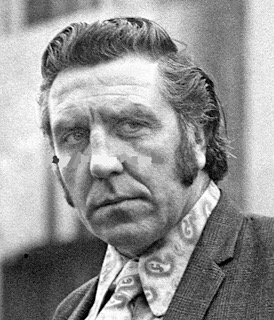
James Pratt Craig, Northern Irish loyalist paramilitary during the Troubles in Northern Ireland, is born in Belfast on November 17, 1941.

Craig, known as Jim, grows up in an Ulster Protestant family on the Shankill Road. In the early 1970s, he, a former boxer, is sent to the HM Prison Maze for a criminal offence unrelated to paramilitary activities. While serving his sentence at the Maze he joins the Ulster Defence Association (UDA), and is asked by the organisation’s commander at the time, Charles Harding Smith, to take control of the UDA prisoners inside, on account of his reputation as a “hard man.”

After his release in 1976, Craig sets up a large protection racket and becomes the UDA’s chief fundraiser. By 1985, he has managed to blackmail and extort money from a number of construction firms, building sites, as well as pubs, clubs, and shops in Belfast and elsewhere in Northern Ireland, whose intimidated owners pay protection money out of fear of Craig and his associates. It is alleged that the UDA receives hundreds of thousands of pounds, some of which also find their way inside Craig’s pockets as part of his “commission.” He is acquitted on a firearm charge and Ulster Freedom Fighters (a cover name for the UDA) membership on March 18, 1982. In 1985, he is brought to court after a number of businessmen decide to testify against him, with the condition that their identities remained hidden. The case falls apart when Craig’s defence argues that his client’s rights were violated by the concealment of the witnesses’ identities.

Craig allegedly is involved in the double killing of a Catholic man and a Protestant man on the Shankill Road in 1977. The men, both colleagues, had entered a loyalist club and were later stabbed, shot and put into a car which was set on fire. By this time the UDA West Belfast Brigade no longer wants him in their ranks, as they claim they can no longer “afford him.” Craig, who is ordered to leave the Shankill Road, goes on to join forces with John McMichael’s South Belfast Brigade. In addition to being the principal fundraiser, he also sits on the UDA’s Inner Council. He usually travels in the company of his bodyguard, Artie Fee, a UDA member from the Shankill Road.

The rival Ulster Volunteer Force (UVF) carries out an investigation after it is rumoured Craig has been involved in the death of UVF major William Marchant, who is gunned down by Provisional Irish Republican Army gunmen from a passing car on the Shankill Road on April 28, 1987. Marchant is the third high-ranking UVF man to be killed by the IRA during the 1980s. Although their inquiries reveal that Craig had quarrelled with Marchant as well as Lenny Murphy and John Bingham prior to their killings, the UVF feel that there is not enough evidence to warrant an attack on such a powerful UDA figure as Craig.

In December 1987, when UDA South Belfast brigadier John McMichael is blown up by an IRA booby-trap car bomb outside his home in Lisburn‘s Hilden estate, it is believed that Craig had organised his death with the IRA. Allegedly Craig fears McMichael is about to expose his racketeering business, thus putting an end to his lucrative operation. McMichael reportedly sets up an inquiry and discovers that Craig is spending money on a lavish scale, going on holidays at least twice a year and indulging in a “champagne lifestyle.” At the same time, it is suggested that Craig has made certain deals with Irish republican paramilitary groups, dividing up the rackets in west Belfast, and he would be doing the IRA a favour by helping them to eliminate a high-profile loyalist such as McMichael. Craig has established links with republicans during his time in prison, and the profitable deals and exchanges of information between them ensures he will most likely not be a target for IRA assassination.

Craig is named as an extortionist in Central Television’s 1987 programme The Cook Report. He plans to sue the programme’s producers for libel. In January 1988, Jack Kielty (father of future television presenter Patrick Kielty), a building contractor from County Down who had promised to testify as a key witness against Craig, is murdered by the UDA. This killing is attributed to Craig, although it is never proven.

Craig is shot dead by two gunmen from the UDA in “The Castle Inn” (later called “The Bunch of Grapes”), a pub in Beersbridge Road, east Belfast on October 15, 1988, where he has been lured in the belief that there is to be a UDA meeting. He is playing pool in the pub at the time of his fatal shooting by the two men, both of whom are wearing boilersuits and ski masks and carrying automatic weapons. Upon spotting Craig they open fire, spraying the room with gunfire. Craig dies instantly. A bystander pensioner is also murdered in the attack, and four other bystanders are wounded by stray bullets. The UDA claims the killing is carried out due to Craig’s “treason” and involvement in John McMichael’s murder as they know he had provided the IRA with information to successfully carry out the assassination. They apologise for the unintentional death of the pensioner. Craig is not given a paramilitary funeral, and none of the UDA’s command attend it.


Leave a comment

The Killing of Richard Jameson, Businessman & Loyalist

Richard Jameson, Northern Irish businessman and loyalist, who serves as the leader of the paramilitary Ulster Volunteer Force‘s (UVF) Mid-Ulster Brigade, is killed on January 10, 2000, outside his home in Portadown, County Armagh, Northern Ireland, during a feud with the rival Loyalist Volunteer Force (LVF). Following his death, the feud between the UVF and LVF escalates into a series of retaliatory killings. These go on intermittently until the LVF disbands in 2005.

Jameson is born in Portadown to a Protestant Church of Ireland family in about 1953, one of five sons. He has a twin brother, Stuart. A former reservist in the Royal Ulster Constabulary (RUC) (1973-81), he works as a manager in the Jameson Group, a building firm which is a family-owned business. The building firm is regularly awarded government contracts to carry out work for the security forces and it is for this reason that his brother David loses a leg in a 1991 Provisional Irish Republican Army bombing attack. He is a member of the Orange Order‘s Drumherriff Star of Erin LOL 8 Portadown district.

It is not known exactly when Jameson becomes a member of the Ulster Volunteer Force (UVF) nor the leader of its Mid-Ulster Brigade. The Portadown unit of the Mid-Ulster Brigade had been officially stood down by the Brigade Staff in Belfast in August 1996 when it carried out an unauthorised sectarian killing while the UVF were on ceasefire. The Mid-Ulster Brigade’s commander at the time, Billy Wright, was expelled from the UVF. Wright brazenly defies a Combined Loyalist Military Command (CLMC) order to leave Northern Ireland or face execution by establishing the breakaway Loyalist Volunteer Force (LVF), taking most of the Portadown Mid-Ulster UVF with him. The units of the Mid-Ulster Brigade that remain loyal to the Brigade Staff continue to operate and Jameson becomes commander. He is said by The Guardian to be a “staunch supporter of the Good Friday Agreement.”

In the weeks prior to his killing, Jameson is in a violent street altercation with LVF member Muriel Gibson, whom he accuses of involvement in drugs and slaps forcefully in the face. This is followed by a fracas at the Portadown F.C. Social Club on December 27, 1999, where LVF members are commemorating the death of their comrade Billy Wright, shot and killed inside the Maze Prison by the Irish National Liberation Army (INLA) exactly two years previously. When he enters the club, several LVF men begin to push and jostle him and challenge him to a fight, telling him to hit them instead of women. Deeply offended, he leaves and soon returns with a UVF gang armed with pickaxe handles and baseball bats. In the violent brawl that ensues, twelve people, including three LVF prisoners out on Christmas parole, receive severe injuries. The LVF leaders subsequently make the decision that Jameson is to pay for the attack with his life.

One of the LVF members, who lives near Dungannon, gets in touch with a family of north Belfast loyalists who had been members of the UVF but who had left after Wright’s expulsion. From these former UVF members the LVF obtains the gun with which to shoot Jameson. On the evening of January 10, 2000, Jameson returns from work and drives his Isuzu Trooper jeep into the driveway outside his home on the Derrylettiff Road near Portadown. Waiting in ambush, a single gunman suddenly approaches from the passenger side of the parked jeep. Before Jameson can emerge from the vehicle and with the engine still running, the gunman opens fire through the window with a 9mm semi-automatic pistol, shooting Jameson five times in the head and chest. His assassin escapes to a nearby getaway car. He is rushed to Craigavon Area Hospital but dies of his wounds minutes after his arrival. The RUC immediately begins a murder inquiry. Within hours of the killing, the UVF Brigade Staff convene an emergency meeting at “the Eagle,” their headquarters on the Shankill Road, where they compile a list of all those they believe to be involved in Jameson’s death and plan their retaliation against the LVF.

Among those who condemn the killing is Northern Ireland’s First Minister David Trimble who releases the following statement: “This is exactly the sort of thing we thought we had finally put behind us. I’m shocked by the news.”

Jameson’s funeral is held on January 13 at the Tartaraghan Parish Church and attended by several thousand mourners including Progressive Unionist Party (PUP) leaders David Ervine and Billy Hutchinson. Drumcree Orangeman Harold Gracey and Gary McMichael, the son of slain Ulster Defence Association (UDA) brigadier John McMichael, also attend as does local politicians representing the Ulster Unionist Party (UUP) and Democratic Unionist Party (DUP). The service is officiated by Reverend David Hilliard who speaks out against vengeance and describes Jameson as a “man admired and loved by many” and who “had been so cruelly murdered.” He is buried in the adjacent churchyard.

Despite Reverend Hilliard’s pleas and LVF leader Mark “Swinger” Fulton‘s claim that his organisation had nothing to do with Jameson’s shooting, the UVF/LVF feud intensifies. In the immediate aftermath members of Jameson’s family are filmed angrily defacing LVF murals in Portadown. A month after his killing, two Protestant teenagers, Andrew Robb (19) and David McIlwaine (18), are savagely beaten and repeatedly stabbed to death in a country lane outside Tandragee, County Armagh by a local UVF gang. The young men, believed to have been LVF members, are targeted by their UVF killers after they leave a nightclub together in search of a party. However, neither teenager is part of any paramilitary organisation and only Robb had tenuous links to the LVF. It is reported in the Belfast Telegraph that according to court hearings Robb had made disparaging remarks about Jameson’s death. Two of the UVF men, Stephen Leslie Brown and Noel Dillon, are infuriated by the comments and afterward Brown drives the victims to Druminure Road where he, Dillon and another man carry out the double killing. One of Jameson’s brothers, Bobby, is among the mourners at David McIlwaine’s funeral. The West Belfast Brigade of the Ulster Defence Association, whose brigadier Johnny Adair is close to the LVF, briefly becomes involved in the feud after Adair attends Andrew Robb’s funeral and joins LVF members at the Drumcree conflict. After the UVF track down Jameson’s killer to the Oldpark area of Belfast and attempt to shoot him, he is taken away under the protection of the West Belfast Brigade. The tit-for-tat killings continue intermittently until 2005 when the UVF makes a final assault against the LVF, leaving four members dead and the LVF leadership with no alternative but to order its military units to permanently disband.

Jameson’s family has persistently denied that he was a UVF member. They maintain that he was a vigilante who was murdered in retaliation for the firm stand he had taken against drug dealing in the Portadown area. The late PUP leader David Ervine expressed the same opinion the day after the killing by stating, “Mr. Jameson had been murdered by drug dealers masquerading as loyalists because he had been a bulwark in his community against dealers.” Ervine also described him as having been a “fine and honourable man, widely respected in the community.” Northern Ireland security sources, however, have repeatedly named Jameson as the Mid-Ulster UVF commander. He is listed as a UVF member in the CAIN: Sutton Index of Deaths, an online University of Ulster-sponsored project which chronicles the Northern Ireland conflict. It also emerges that for several days prior to his killing, he had been working at the Ballykinler British Army base. Immediately after his murder by the LVF, his family begins an anti-drug campaign in Portadown by putting up posters and handing out leaflets to passing motorists.


Leave a comment

The Shankill Road Bombing

The Shankill Road bombing is carried out by the Provisional Irish Republican Army (IRA) on October 23, 1993 and is one of the most notorious incidents of the Troubles in Northern Ireland.

During the early 1990s, loyalist paramilitaries drastically increase their attacks on the Irish Catholic and Irish nationalist community and, for the first time since the beginning of the Troubles, are responsible for more deaths than the republicans. The Ulster Defence Association‘s (UDA) West Belfast brigade, and its commander, Johnny Adair, play a key role in this. Adair had become the group’s commander in 1990.

The UDA’s Shankill headquarters is above Frizzell’s fish shop on the Shankill Road. The UDA’s Inner Council and West Belfast brigade regularly meets there on Saturdays. Peter Taylor says it is also the office of the Loyalist Prisoners’ Association (LPA), and on Saturday mornings is normally crowded, as that is when money is given to prisoners’ families. According to Henry McDonald and Jim Cusack, the IRA have had the building under surveillance for some time. They say that the IRA decides to strike when one of their scouts spots Adair entering the building on the morning of Saturday, October 23, 1993. Later, in a secretly-recorded conversation with police, Adair confirms that he had been in the building that morning.

The IRA’s Belfast Brigade launches an operation to assassinate the UDA’s top commanders, whom it believes are at the meeting. The plan allegedly is for two IRA members to enter the shop with a time bomb, force out the customers at gunpoint and flee before it explodes, killing those at the meeting. As they believe the meeting is being held in the room above the shop, the bomb is designed to send the blast upwards. IRA members maintain that they would have warned the customers as the bomb was primed. It has an eleven-second fuse, and the IRA state that this would allowed just enough time to clear the downstairs shop but not enough for those upstairs to escape.

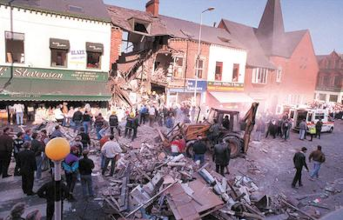
The operation is carried out by Thomas Begley and Seán Kelly, two IRA members in their early twenties from Ardoyne. They drive from Ardoyne to the Shankill in a hijacked blue Ford Escort, which they park on Berlin Street, around the corner from Frizzell’s. Dressed as deliverymen, they enter the shop with the five-pound bomb in a holdall. It is shortly after 1:00 PM on a Saturday afternoon and the area is crowded with mostly women and children. While Kelly waits at the door, Begley makes his way through the customers towards the counter, where the bomb detonates prematurely. Forensic evidence shows that Begley had been holding the bomb over the refrigerated serving counter when it exploded. Begley is killed along with nine other people, two of them children. They are the owner John Frizzell (63), his daughter Sharon McBride (29), Leanne Murray (13), UDA member Michael Morrison (27), his partner Evelyn Baird (27) and their daughter Michelle (7), George Williamson (63) and his wife Gillian (49), and Wilma McKee (38). The force of the blast causes the old building to collapse into a pile of rubble. The upper floor comes down upon those inside the shop, crushing many of the survivors under the rubble, where they remain until rescued some hours later by volunteers and emergency services. About 57 people are injured. At the scene during the rescue operation are several senior loyalists, including Adair and Billy McQuiston. The latter had been in a pub on the nearest corner when the bomb went off. Among those rescued from the rubble is the badly-wounded Seán Kelly.

Unknown to the IRA, if a UDA meeting had taken place, it had ended early and those attending it had left the building before the bomb exploded. McDonald and Cusack state that Adair and his men had stopped using the room for important meetings, allegedly because a sympathiser within the Royal Ulster Constabulary (RUC) told Adair that the police had it bugged.

There was great anger and outrage in the Shankill in the wake of the bombing. Billy McQuiston tells journalist Peter Taylor that “anybody on the Shankill Road that day, from a Boy Scout to a granny, if you’d given them a gun they would have gone out and retaliated.” Many Protestants see the bombing as an indiscriminate attack on them. Adair believes that the bomb was meant for him. Two days after the bombing, as Adair is driving away from his house, he stops and tells a police officer, “I’m away to plan a mass murder.”

In the week following the bombing, the UDA and UVF launch a wave of “revenge attacks,” killing 14 civilians. The UDA shoots a Catholic delivery driver in Belfast after luring him to a bogus call just a few hours after the bombing. He dies on October 25. On 26 October, the UDA shoots dead another two Catholic civilians and wounds five in an indiscriminate attack at a Council Depot on Kennedy Way, Belfast. On October 30, UDA members enter a pub in Greysteel frequented by Catholics and again open fire indiscriminately. Eight civilians, six Catholics and two Protestants, are killed and 13 are wounded. This becomes known as the Greysteel massacre. The UDA states it is a direct retaliation for the Shankill Road bombing.

Seán Kelly, the surviving IRA member, is badly wounded in the blast, having lost his left eye and is unable to move his left arm. Upon his release from hospital, however, he is arrested and convicted of nine counts of murder, each with a corresponding life sentence. In July 2000, he is released under the terms of the Good Friday Agreement. In an interview shortly after his release, he says he had never intended to kill innocent people and regrets what happened.


Leave a comment

The Greysteel Massacre

The Greysteel massacre is a mass shooting that takes place on the evening of October 30, 1993 in Greysteel, County Londonderry, Northern Ireland.

On October 23, 1993, an Irish Republican Army (IRA) bomb prematurely explodes as the bombers carry it into a fishmongers on the Shankill Road in Belfast. The IRA’s intended target is a meeting of Ulster Defence Association (UDA) leaders, including brigadier Johnny Adair, which is to take place in a room above the shop. Unknown to the IRA, the meeting had been rescheduled. Eight Protestant civilians, a UDA member and one of the IRA bombers are killed in the blast. This became known as the Shankill Road bombing.

The UDA launches a number of “revenge attacks” for the bombing. Later that day, it fatally shoots a Catholic delivery driver after luring him to a bogus call at Vernon Court, Belfast. On October 26, the UDA shoots dead another two Catholic civilians and wounds five in an attack at the Council Depot at Kennedy Way, Belfast.

The massacre is carefully planned. The order for the attack comes from the UDA leadership and it is believed Greysteel is chosen partly because it is well away from Belfast, where security force activity is intense after the Shankill bombing. Those involved in planning and organising it include Billy McFarland, ‘Brigadier’ of the UDA’s North Antrim & Londonderry Brigade. Stephen Irwin, Geoffrey Deeney and Torrens Knight, all members of the brigade, are to carry out the shooting. The gunmen are first briefed on the plans for the massacre on October 27 in an office owned by the Ulster Democratic Party at Bond’s Place, Londonderry. Before the massacre, the gunmen go to the pub to familiarise themselves with the layout and choose the best positions to shoot from.

On Saturday, October 30, the gunmen drive to the pub in an Opel Kadett, with UDA member Brian McNeill driving a ‘scout car’ in front. Just before 10:00 PM the three gunmen, wearing blue boilersuits and balaclavas, enter the “Rising Sun Bar” in Greysteel. There are at least 70 people inside attending a Halloween party and at first some believe the men are playing a Halloween prank. Stephen Irwin yells “trick or treat” as he opens fire with a vz. 58 assault rifle on the packed crowd in the lounge. He keeps shooting until the magazine empties, quickly reloads and continues shooting. Geoffrey Deeney opens fire with a 9mm handgun at a fleeing woman, but it jams after one shot. Torrens Knight, armed with a shotgun, guards the entrance while the shooting is taking place. There is panic and screaming as people scramble for cover and women plead for mercy. The scene in the Rising Sun is described as “hell-like”; bodies lay everywhere and the lounge and dancefloor are covered with blood and broken glass. The gunmen, laughing, then make their escape in the Opel Kadett driven by Knight. While driving away from Greysteel, the getaway car’s wing mirror is hit by a police car speeding towards the scene. The gunmen drive the Kadett to a pick-up point near Eglinton, where they meet McNeill and burn the car.

Seven people are killed outright and nineteen are wounded, with another later dying of his wounds. The dead are Karen Thompson (19), Steven Mullan (20), Moira Duddy (59), Joseph McDermott (60), James Moore (81), John Moyne (50), John Burns (54) and Victor Montgomery (76). Six of those killed are Catholic civilians and two are Protestant civilians.

The following day, the UDA claims responsibility for the attack using the cover name “Ulster Freedom Fighters” (UFF). Its statement says that the “Greysteel raid” is “the continuation of our threats against the nationalist electorate that they would pay a heavy price for last Saturday’s slaughter of nine Protestants.” A UDA West Belfast Brigade member claims that his organisation “had information that senior IRA men drank in the Rising Sun… Unfortunately they were not there on Halloween but our boys acted on the briefing they had been given.” Afterwards, the gunmen are said to have boasted about the killings.

The UDA members involved are arrested shortly after the massacre. During their first court appearance, Knight is filmed laughing, taunting and shouting abuse at the victims’ relatives as he is led from the building. In February 1995, Irwin, Deeney, Knight and McNeill are sentenced to life imprisonment for their involvement in the attack. Knight is also convicted for the Castlerock killings. In 2000, they are released early, along with other paramilitary prisoners, under the terms of the Good Friday Agreement.

The pub is still open in Greysteel. There is a memorial to the victims outside the building that says: “May their sacrifice be our path to peace.”


Leave a comment

Sean Graham Bookmaker’s Shop Shooting

sean-graham-bookmakers-shop

A mass shooting takes place at the Sean Graham bookmaker‘s shop on the Lower Ormeau Road in Belfast, Northern Ireland on February 5, 1992. Members of the Ulster Defence Association (UDA), a loyalist paramilitary group, open fire on the customers, killing five civilians and wounding another nine. The shop is in an Irish nationalist area, and all of the victims are local Catholic civilians. The UDA claims responsibility using the cover name “Ulster Freedom Fighters”, and says the shooting is retaliation for the Teebane bombing, which had been carried out by the Provisional Irish Republican Army (IRA) less than three weeks earlier.

The start of 1992 witnesses an intensification in the campaign of violence being carried out by the Ulster Defence Association (UDA) under their UFF covername. However, the Inner Council of the UDA, which contains the six brigadiers that control the organisation, feel that one-off killings are not sending a strong enough message to republicans and so it sanctions a higher-profile attack in which a number of people will be killed at once. On this basis the go-ahead is given to attack Sean Graham bookmaker’s shop on the Irish nationalist Lower Ormeau Road, which is near the UDA stronghold of Annadale Flats. The bookmaker’s shop is chosen by West Belfast Brigadier and Inner Council member Johnny Adair because he has strong personal ties with the commanders of the Annadale UDA. A 1993 report commissioned by the Royal Ulster Constabulary (RUC) Special Branch also claims that Adair is the driving force behind the attack.

The attack occurs at 2:20 in the afternoon. A car parks on University Avenue facing the bookmakers and two men, wearing boilersuits and balaclavas, leave the car and cross the Ormeau Road to the shop. One is armed with a vz.58 Czechoslovak assault rifle and the other with a 9mm pistol. They enter the shop and unleash a total of 44 shots on the fifteen customers. Five Catholic men and boys are killed and nine others are wounded, one critically.

In a separate incident, a unit of the Ulster Volunteer Force (UVF) travels to the area at the time of the attack with the intention of killing a local Sinn Féin activist based on intelligence they had received that he returns home about that time every day. The attack is abandoned, however, when the car carrying the UVF members is passed by speeding RUC vehicles and ambulances. The UVF members, who had already retrieved their weapons for the attack, are said to be livid with the UDA for not coordinating with them beforehand and effectively spoiling their chance to kill a leading local republican.

A UDA statement in the aftermath of the attack claims that the killings are justified as the Lower Ormeau is “one of the IRA’s most active areas.” The statement also includes the phrase “remember Teebane”, suggesting that the killings are in retaliation for the Teebane bombing in County Tyrone less than three weeks earlier. In that attack, the IRA had killed eight Protestant men who were repairing a British Army base. The same statement had also been yelled by the gunmen as they ran from the betting shop.

On February 5, 2002 a plaque is erected on the side of the bookmaker’s shop in Hatfield Street carrying the names of the five victims and the Irish language inscription Go ndéana Dia trócaire ar a n-anamacha (“May God have mercy on their souls”). A small memorial garden is later added. The unveiling ceremony, which takes place on the tenth anniversary of the attack, is accompanied by a two-minute silence and is attended by relatives of the dead and survivors of the attack. A new memorial stone is laid on February 5, 2012 to coincide with the publication of a booklet calling for justice for the killings.