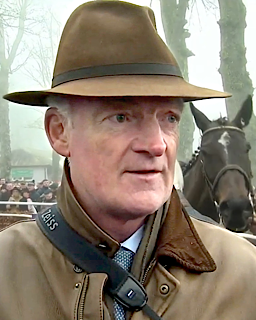
Mullins is the trainer of the 2005 Grand National winner “Hedgehunter” and the 2011 and 2013 Champion Hurdle winner “Hurricane Fly.” He also trains “Vautour” in the 2016 Ryanair Chase. He is also trainer of the six-time David Nicholson Mares’ Hurdle champion, “Quevega.” In the 2015 Cheltenham Festival, he trains eight winners, a joint record at the Cheltenham Festival which Gordon Elliott equals in 2018. He is the leading-most winning trainer at the Cheltenham Festival, becoming the first trainer to saddle 100 winners when “Jasmin De Vaux” wins the 2024 Champion Bumper. In 2022, he trains a new record of ten winners at the festival.
Mullins’ longlasting relationship with Gigginstown House Stud comes to an end on September 28, 2016. Despite this he is the Irish Champion trainer in the 2016/17 season.
Mullins wins both the 2005 Grand National with “Hedgehunter” and the 2019 Irish Grand National with “Burrows Saint,” each of which is ridden by Ruby Walsh. In the 2022/23 season he becomes Irish National Hunt Champion trainer for the 17th time.
Mullins wins the British jump racing Champion Trainer title in the 2023–24 season, becoming the first trainer based in Ireland to win the championship since Vincent O’Brien in 1954. He successfully defends his title in 2024-25, beating long-time leader Dan Skelton on the last afternoon of the National Hunt season.
Mullins son, Patrick, is an amateur jockey riding mainly in Ireland for his father and acting as assistant trainer to him. Patrick rides “Nick Rockett” to the 2025 Grand National title. Mullins’ wife, Jackie, is a successful amateur rider. With his wife, he is invited to ride in the King’s procession at Royal Ascot 2023.
O’Brien is born in Dublin on May 9, 1871, where he lives all his life. He is an important figure in early 20th-century Irish music. For some, he is mainly known as the first teacher of singers such as John McCormack, Margaret Burke Sheridan and the writer James Joyce.
O’Brien is the eldest child of a Roman Catholic church musician. In 1885, he first appears in a public piano recital and, later in the year, becomes the organist of Rathmines parish church, a position he holds until 1888. He holds another organist’s position at the Dublin Carmelite church from 1897 to 1899 but is chiefly known as organist and choir director of Dublin’s largest Roman Catholic Church, St. Mary’s Pro-Cathedral, between 1903 and 1946. In 1898, he is the founder and first director of the Palestrina Choir, originally all-male, which is still active, and which is financed for many years by Edward Martyn.
O’Brien studies with Robert Prescott Stewart at the Royal Irish Academy of Music (1888-90), where he is the first winner of the Coulson Scholarship and frequently performs as both tenor singer, piano accompanist, and organist in many public concerts during the 1890s. As a church musician, he becomes particularly involved in the Cecilian Movement, conducting works by Michael Haller and others, and also pursuing their artistic ideals in his own sacred choral compositions.
O’Brien is the founding conductor of the Dublin Oratorio Society (1906), the Brisan Opera Company (1916) and conducts at many ad hoc events. In 1925, he becomes the first music director of Radio Éireann (originally called 2RN), a position he holds until 1941. He singles out his work as music director for the 31st International Eucharistic Congress in Dublin (1932) as his most prized personal achievement. As late as 1945, he founds Our Lady’s Choral Society, a large oratorio choir still in existence, which originally is recruited mainly from the various Roman Catholic church choirs in Dublin.
Among his teaching positions, O’Brien teaches at the diocesan seminary at Holy Cross College, is Professor of Gregorian Chant at the missionary seminary of All Hallows College from 1903, and Professor of Music at the Ladies’ Teacher-Training College at Carysfort Park, Blackrock, County Dublin, from 1908 until his death in Dublin on June 21, 1948. As a much-demanded vocal coach, he teaches at his home, his best-known pupils including John McCormack, Margaret Burke Sheridan and James Joyce. He performs the piano accompaniments for McCormack’s first gramophone recordings and accompanies him during his 1913–14 Australasian tour of 60 performances in three months, during which he also gives organ recitals at the Irish-dominated Catholic cathedrals of Sydney and Melbourne.
Of his two sons, Oliver O’Brien (1922–2001) largely follows in his father’s footsteps, as organist and director of the Palestrina Choir, of Our Lady’s Choral Society, music teacher at Carysfort College and as teacher in various Dublin schools. His other son, Colum O’Brien, is organist in the Pro-Cathedral.
Before his work for the Palestrina Choir, O’Brien’s musical interests are very broad, culminating in 1893 in the composition of the full-scale opera Hester. As a church music composer, he follows Cecilian ideals, with a number of hymns, motets and other choral works. He also composes a number of songs for voice and piano, with The Fairy Tree (1930) being a particular favourite of John McCormack’s.
Sheridan is born in Castlebar, County Mayo, on October 15, 1889. She has her early vocal training while at school at the Dominican Convent in Eccles Street, Dublin, with additional lessons from Vincent O’Brien. In 1908, she wins a gold medal at the Feis Ceoil. From 1909 to 1911 she studies at the Royal Academy of Music in London, during which time she is introduced to the Italian inventor Guglielmo Marconi, who is instrumental in arranging further studies for her in opera in Rome.
Sheridan returns to Italy, where her career continues to grow, with performances at the Teatro Dal Verme in Milan and at the Teatro di San Carlo in Naples, primarily in Puccini roles. In 1922 she first sings at La Scala, Milan, in La Wally by Alfredo Catalani under the direction of Arturo Toscanini. For the next few years, she sings at La Scala with great success. Perhaps her greatest role is Madama Butterfly, which she sings extensively in Italy and at Covent Garden. When she plays the part of Madama Butterfly, Puccini is said to be spellbound.
Despite her successes, Sheridan’s career is short. Suffering vocal difficulties, she goes into retirement around 1930 except for a few concerts. Bríd Mahon, in her 1998 book While Green Grass Grows, states that “It was rumoured that an Italian whose overtures she had rejected had blown his brains out in a box in La Scala, Milan, while she was on stage and that after the tragedy, she never sang in public again.”
Margaret Sheridan dies in relative obscurity on April 16, 1958, having lived in Dublin for many years, and her remains are buried in Glasnevin Cemetery, Dublin.
(Pictured: Margaret Burke Sheridan meets Italian conductor Vincenzo Bellezza in London, 1938. Photograph by Erich Salomon)
O’Brien is the eldest child of a Roman Catholic church musician. In 1885, he first appears in a public piano recital and, later in the year, becomes the organist of Rathmines parish church, a position he holds until 1888. He holds another organist’s position at the Dublin Carmelite church from 1897 to 1899 but is chiefly known as organist and choir director of Dublin’s largest Roman Catholic Church, St. Mary’s Pro-Cathedral, between 1903 and 1946. In 1898, he is the founder and first director of the Palestrina Choir, originally all-male, which is still active, and which is financed for many years by Edward Martyn.
O’Brien studies with Robert Prescott Stewart at the Royal Irish Academy of Music (1888-90), where he is the first winner of the Coulson Scholarship and frequently performs as both tenor singer, piano accompanist, and organist in many public concerts during the 1890s. As a church musician, he becomes particularly involved in the Cecilian Movement, conducting works by Michael Haller and others, and also pursuing their artistic ideals in his own sacred choral compositions.
O’Brien is the founding conductor of the Dublin Oratorio Society (1906), the Brisan Opera Company (1916) and conducts at many ad hoc events. In 1925, he becomes the first music director of Radio Éireann (originally called 2RN), a position he holds until 1941. He singles out his work as music director for the 31st International Eucharistic Congress in Dublin (1932) as his most prized personal achievement. As late as 1945, he founds Our Lady’s Choral Society, a large oratorio choir still in existence, which originally is recruited mainly from the various Roman Catholic church choirs in Dublin.
Among his teaching positions, O’Brien teaches at the diocesan seminary at Holy Cross College, is Professor of Gregorian Chant at the missionary seminary of All Hallows College from 1903, and Professor of Music at the Ladies’ Teacher-Training College at Carysfort Park, Blackrock, County Dublin, from 1908 until his death in Dublin on June 21, 1948. As a much-demanded vocal coach, he teaches at his home, his best-known pupils including John McCormack, Margaret Burke Sheridan and James Joyce. He performs the piano accompaniments for McCormack’s first gramophone recordings and accompanies him during his 1913–14 Australasian tour of 60 performances in three months, during which he also gives organ recitals at the Irish-dominated Catholic cathedrals of Sydney and Melbourne.
Of his two sons, Oliver O’Brien (1922–2001) largely follows in his father’s footsteps, as organist and director of the Palestrina Choir, of Our Lady’s Choral Society, music teacher at Carysfort College and as teacher in various Dublin schools. His other son, Colum O’Brien, is organist in the Pro-Cathedral.
Before his work for the Palestrina Choir, O’Brien’s musical interests are very broad, culminating in 1893 in the composition of the full-scale opera Hester. As a church music composer, he follows Cecilian ideals, with a number of hymns, motets and other choral works. He also composes a number of songs for voice and piano, with The Fairy Tree (1930) being a particular favourite of John McCormack’s.
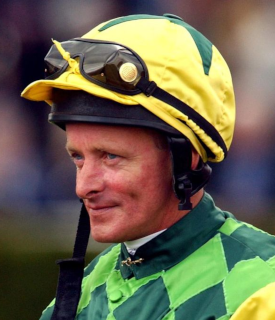
Patrick (Pat) James John Eddery, flat racingjockey and trainer, is born on March 18, 1952, in Newbridge, County Kildare, near the Curragh Racecourse. He is the fifth of twelve children of Jimmy Eddery, a jockey who is Irish Flat Champion in 1954 and 1955, and who rides Panaslipper to win the Irish Derby in 1955. His mother, Josephine, is the daughter of Jack Moylan, also a jockey. His brother Paul goes on to become a successful jockey also. He initially attends the Patrician Brothers’ Primary School in Newbridge, later enrolling in Oatlands Primary School in Stillorgan when the family moves to Blackrock, Dublin.
Devoted from his earliest years to riding horses, Eddery has little interest in school. He begins his career on his fourteenth birthday as an apprentice jockey in Ireland (1966–67) with the stable of Seamus McGrath. In 1967, he moves to England where he is apprenticed to Frenchie Nicholson until 1972. After riding for more than a season without success, he records his first win on April 24, 1969, at Epsom Downs Racecourse on a horse named Alvaro, trained by Major Michael Pope. Alvaro provides Eddery with six wins in succession during the 1969 season.
Eddery finishes the 1971 season as champion apprentice with seventy-one winners, and in 1972 has his first Derby ride, the 50–1 chance Pentland Firth, who finishes third behind Roberto and Rheingold. In 1972 he also has his first victory in a Group 1 race via Erimo Hawk, when awarded the Ascot Gold Cup following the disqualification of Rock Roi for interference.
Eddery rides for the Newmarket trainer Geoffrey Barling in 1972 before becoming the stable jockey for leading trainer, Peter Walwyn, later that year. For Walwyn, he wins his first two English classic races on Polygamy (Oaks) and Grundy (Derby) and is Champion Jockey in four consecutive seasons from 1974 to 1977. While under retainer with Walwyn, he clinches the first of these titles when just twenty-two years old, a record in the post-war era. In 1975, after winning the Irish Derby on Grundy, he rides the horse to a hard-fought victory over Bustino in the King George VI and Queen Elizabeth Stakes at Ascot in what is described by many at the time as “the race of the century.”
Eddery remains as stable jockey to Walwyn for eight years, before joining the Ballydoyle racehorse training facility of legendary Irish trainer Vincent O’Brien, for whom he rides a string of big-race winners, including the brilliant Golden Fleece, owned by Robert Sangster, in the 1982 Epsom Derby.
The O’Brien–Eddery combination experiences controversial defeat in the 1984 Epsom Derby when Eddery rides then unbeaten 2000 Guineas Stakes-winner El Gran Senor and seems to be cruising to victory in the final furlong, only to be caught on the line and beaten by a short head by Secreto, trained by O’Brien’s son David. He later admits that he should have won the race, but when the horses in front of him fell away early in the straight he was left in front too soon and was unable to repel Secreto’s late challenge. He later wins the Irish Derby on El Gran Senor, beating the subsequent Prix de L’Arc de Triomphe winner, Rainbow Quest. During 1984, he also partners the O’Brien-trained and subsequent outstanding stallion, Sadler’s Wells, to two of his three Group 1 successes.
The 1980s represent the pinnacle of Eddery’s career and include victories in the 1983 Arlington Million in Chicago on Tolomeo, the 1985 Breeders’ Cup Turf at Aqueduct Racetrack, New York, on Pebbles, and the 1986 Japan Cup on Jupiter Island, the latter two horses being trained by Clive Brittain. He also has four victories in the Prix de l’Arc de Triomphe: on Detroit in 1980, Rainbow Quest in 1985, the great Dancing Brave, on whom he also wins the King George VI and Queen Elizabeth Stakes in 1986, and Trempolino in 1987. The field for the 1986 ‘Arc’ is extremely strong and Dancing Brave’s late winning run a thrilling spectacle. The race is voted “the greatest ever horserace” in a poll conducted by the Racing Post in 2022.
Rainbow Quest and Dancing Brave are both owned by the Saudi Prince Khalid Abdullah, whose Juddmonte Farms is by then one of the world’s largest racing and breeding organisations. In 1987, Eddery becomes Abdullah’s retained jockey. Highlights of their association, which lasts until 1994, include Quest for Fame winning the 1990 Epsom Derby, and Zafonic, winner of the 1993 2000 Guineas Stakes.
Meanwhile, Eddery continues to win the jockeys’ championships, a task made easier by being retained by Juddmonte in England rather than commuting regularly to Ireland to ride for Vincent O’Brien. His highest seasonal total of wins is 209 in 1990, which is the first time a jockey has exceeded 200 since Sir Gordon Richards in 1952. His epic battle for the championship in 1987 with American Steve Cauthen is particularly intense, with Cauthen securing the title with 197 winners and Eddery coming close at 195. The title would have been shared at 196 winners apiece but for a successful objection by the rider of the third horse to the winner after the last definitive race between Eddery and Cauthen when they finished first and second, respectively. In 1988, Eddery retains the title with 183 winners from just over 480 rides, a remarkable strike rate of over thirty-eight per cent. He wins the championship for the eleventh and final time in 1996. His final classic win is on Silver Patriarch in the St. Leger Stakes of 1997.
Eddery rides major winners outside Europe and the United States, including Jupiter Island in the 1986 Japan Cup, and French Glory in the Canadian International Stakes. He teams up with Lester Piggott, Joe Mercer and French jockeys Freddie Head and Yves Saint-Martin to take part in a series of challenge races under the Ritz Club Challenge Trophy at Singapore and other Asian cities starting in 1983 for several years. His overall total of winners in the UK, Ireland, mainland Europe and overseas, exceeds 6,000. Although fiercely competitive on the racetrack, he is popular with fellow jockeys, trainers, owners and racegoers, who respond to his good-natured personality, courtesy and sense of humour.
Eddery has a distinctive riding style that is not classically elegant but undoubtedly effective and strong in a finish. He rides a number of truly outstanding racehorses including Dancing Brave, El Gran Senor and Pebbles, but maintains that the brilliant and undefeated Derby winner, Golden Fleece, is the greatest of all the horses he partnered throughout his career.
Eddery continues to ride into his fifties, finally retiring in 2003. He is appointed an honorary Order of the British Empire (OBE) in 2005. He sets up an owners’ syndication business and takes out a training licence but has difficulty adjusting to life out of the saddle and becomes increasingly dependent upon alcohol. His training career meets with limited success, though he does train Hearts of Fire to win the Group 1 Gran Criterium of Italy in 2009.
Eddery marries Carolyn Mercer in November 1978. She is the daughter of flat jockey Manny Mercer, niece of jockey Joe Mercer, and granddaughter of jockey Harry Wragg. They have two daughters, Nichola and Natasha, and a son Harry. He has a son from an extramarital relationship, Toby Atkinson, who also becomes a jockey. The marriage with Carolyn breaks down in 2008 and the couple divorces in 2009.
Shortly after his marriage breaks down, Eddery begins living with Emma Owen, a former stable employee, at his 100-acre Musk Hill stud farm near Aylesbury, Buckinghamshire. He becomes progressively estranged from his children due to his continued alcoholism.
Eddery dies of a heart attack at the age of 63 on November 10, 2015. He leaves his £1.3 million estate to Emma Owen. His funeral takes place on December 8, 2015, and his remains are cremated at Oxford. Throughout his career, Eddery rode the winners of 4,632 British flat races, a figure exceeded only by Sir Gordon Richards and was UK Champion Jockey on eleven occasions and Irish Champion Jockey once. A plaque in his honour is unveiled by his children Nichola, Natasha and Harry at Ascot Racecourse in 2016, where he had been champion jockey at the Royal meeting on six occasions. He is inducted into the Qipco British Champions Series Hall of Fame in 2021, the second jockey after Lester Piggott to be so honoured.
(From: “Eddery, Patrick (Pat) James John” by P. Gerry McKenna, Dictionary of Irish Biography, http://www.dib.ie, September 2022)
McCormack is born on June 14, 1884, in Athlone, County Westmeath, the second son and fifth of the 11 children of Andrew McCormack and his wife Hannah Watson. His parents are both from Galashiels, Scotland, and work at the Athlone Woolen Mills, where his father is a foreman. He is baptised in St. Mary’s Church, Athlone, on June 23, 1884.
McCormack receives his early education from the Marist Brothers in Athlone and later attends Summerhill College, Sligo. He sings in the choir of the old St. Peter’s Church in Athlone under his choirmaster Michael Kilkelly. When the family moves to Dublin, he sings in the choir of St. Mary’s Pro-Cathedral where he is discovered by Vincent O’Brien. In 1903 he wins the coveted gold medal of the Dublin Feis Ceoil. He marries Lily Foley in 1906 and they have two children, Cyril and Gwen.
In March 1904, McCormack becomes associated with James Joyce, who at the time has singing ambitions himself. He persuades Joyce to enter the Feis Ceoil that year, where the not yet famous writer is awarded the Bronze Medal.
Fundraising activities on his behalf enable McCormack to travel to Italy in 1905 to receive voice training by Vincenzo Sabatini, father of the novelist Rafael Sabatini, in Milan. Sabatini finds McCormack’s voice naturally tuned and concentrates on perfecting his breath control, an element that becomes part of the basis of his renown as a vocalist.
In 1906, McCormack makes his operatic début at the Teatro Chiabrera, Savona. The next year, he begins his first important operatic performance at Covent Garden in Pietro Mascagni‘s Cavalleria rusticana, becoming the theatre’s youngest principal tenor. In 1909, he begins his career in the United States.
In February 1911, McCormack plays Lieutenant Paul Merrill in the world premiere of Victor Herbert‘s opera Natoma with Mary Garden in the title role. Later that year, he tours Australia after DameNellie Melba engages him, then at the height of his operatic career, aged 27, as a star tenor for the Melba Grand Opera Season. He returns for concert tours in subsequent years.
By 1912, McCormack is beginning to become involved increasingly with concert performances, where his voice quality and charisma ensures that he becomes the most celebrated lyric tenor of his time. He does not, however, retire from the operatic stage until after his performance of 1923 in Monte Carlo, although by then the top notes of his voice have contracted. Famous for his extraordinary breath control, he can sing 64 notes on one breath in Mozart‘s “Il mio tesoro” from Don Giovanni, and his Handelian singing is just as impressive in this regard.
McCormack makes hundreds of recordings, his best-known and most commercially successful series of records being those for the Victor Talking Machine Company during the 1910s and 1920s. He is Victor’s most popular Red Seal recording artist after tenor Enrico Caruso. In the 1920s, he sings regularly on radio and later appears in two sound films, Song o’ My Heart (1930), playing an Irish tenor, and as himself appearing in a party scene in Wings of the Morning (1937), the first British three-strip Technicolor feature.
McCormack is one of the first artists to record the popular ballad “I Hear You Calling Me” written in 1908 by Harold Harford and Charles Marshall. He records it twice for Odeon Records starting in 1908 and a further four times for Victor between 1910 and 1927, becoming his best seller. He is the first artist to record the famous World War I song “It’s a Long Way to Tipperary” in 1914. He also records a best-selling version of another popular World War I tune, “Keep the Home Fires Burning,” in 1917. He also sings songs expressive of Irish nationalism and endorses the Irish Nationalist estrangement from the United Kingdom. He is associated particularly with the songs of Thomas Moore, notably “The Harp That Once Through Tara’s Halls,” “The Minstrel Boy,” “Believe Me If All (Those Endearing Young Charms),” and “The Last Rose of Summer.” Between 1914 and 1922, he records almost two dozen songs with violin accompaniment provided by Fritz Kreisler, with whom he also tours. He records songs of Hugo Wolf for the Hugo Wolf Society in German. In 1918, he records the song “Calling Me Home to You.”
In 1917, McCormack becomes a naturalised citizen of the United States. In June 1918, he donates $11,458 toward the U.S. World War I effort. By then, his career is a huge financial success, earning millions in his lifetime from record sales and appearances.
By 1920, Edwin Schneider has become McCormack’s accompanist and the two are “inseparable.” When Schneider retires, Gerald Moore takes over as accompanist from 1939 to 1943.
In 1927, McCormack moves into Moore Abbey, Monasterevin, County Kildare, and adopts a very opulent lifestyle by Irish standards. He also owns apartments in London and New York. He hopes that one of his racehorses, such as Golden Lullaby, would win The Derby, but this never occurs.
McCormack also purchases Runyon Canyon in Hollywood in 1930 from Carman Runyon. He sees and likes the estate while there filming Song o’ My Heart (1930), an early all-talking, all-singing picture. He uses his salary for this movie to purchase the estate and builds a mansion he calls ‘San Patrizio,’ after Saint Patrick. He and his wife live in the mansion until they return to England in 1938.
McCormack tours often, and in his absence, the mansion is often let to celebrities such as Janet Gaynor and Charles Boyer. The McCormacks make many friends in Hollywood, among them Errol Flynn, Will Rogers, John Barrymore, Basil Rathbone, Ronald Colman, Charles E. Toberman and the Dohenys. After his farewell tour of America in 1937, the McCormacks deed the estate back to Carman Runyon expecting to return to the estate at a later date. World War II intervenes and he does not return.
McCormack originally ends his career at the Royal Albert Hall in London, during 1938. However, one year after that farewell concert, he is back singing for the Red Cross and in support of the war effort. He gives concerts, tours, broadcasts and records in this capacity until 1943 when poor health finally forces him to retire permanently.
Ill with emphysema, McCormack purchases a house near the sea, “Glena,” Booterstown, Dublin. After years of increasingly poor health, and a series of infectious illnesses, including influenza and pneumonia, he dies at his home in Booterstown on September 16, 1945. He is buried in Deans Grange Cemetery, St. Patrick’s section, plot reference E/120.
The McShains move to Ireland in 1960, buying Killarney House in County Kerry and a large portion of the Kenmare estate, which had been owned by the Earls of Kenmare since the 16th century. They gift Innisfallen Island and the ruins of an abbey to the Irish state in 1973, bestowing guardianship of Ross Island and its castle to the state. For a nominal fee, they turn over the entire estate to the state in 1979, stipulating a life tenancy of the house and some land, with the rest of the land being incorporated into Killarney National Park.
McShain is a Dame of Malta and a Lady of the Grand Cross of the Holy Sepulchre. She receives the Pro Ecclesia et Pontifice cross in 1976. She is awarded two honorary doctorates in 1977, one from LaSalle University in Philadelphia and one from her alma mater, Rosemont College.
McShain dies at Killarney House on December 2, 1998. She is buried beside her husband in Holy Cross Cemetery, Philadelphia. Her daughter, Pauline McShain, is a sister of the Society of the Holy Child Jesus and dies on March 8, 2019 due to complications of pneumonia.
(Pictured: John and Mary McShain with Lakes of Killarney in the background sometime in the late 1950s)
Sheridan has her early vocal training while at school at the Dominican Convent in Eccles Street, Dublin, with additional lessons from Vincent O’Brien. In 1908, she wins a gold medal at the Feis Ceoil. From 1909 to 1911 she studies at the Royal Academy of Music in London, during which time she is introduced to the Italian inventor Guglielmo Marconi, who is instrumental in arranging further studies for her in opera in Rome.
Sheridan returns to Italy, where her career continues to grow, with performances at the Teatro Dal Verme in Milan and at the Teatro di San Carlo in Naples, primarily in Puccini roles. In 1922 she first sings at La Scala, Milan, in La Wally by Alfredo Catalani under the direction of Arturo Toscanini. For the next few years, she sings at La Scala with great success. Perhaps her greatest role is Madama Butterfly, which she sings extensively in Italy and at Covent Garden. When she plays the part of Madama Butterfly, Puccini is said to be spellbound.
Despite her successes, Sheridan’s career is short. Suffering vocal difficulties, she goes into retirement around 1930 except for a few concerts. Bríd Mahon, in her 1998 book While Green Grass Grows, states that “It was rumoured that an Italian whose overtures she had rejected had blown his brains out in a box in La Scala, Milan, while she was on stage and that after the tragedy, she never sang in public again.”
Margaret Sheridan dies in relative obscurity on April 16, 1958, having lived in Dublin for many years, and her remains are buried in Glasnevin Cemetery, Dublin.
John McCormack, an Irish tenor celebrated for his performances of the operatic and popular song repertoires and renowned for his diction and breath control, is born in Athlone, County Westmeath, on June 14, 1884.
McCormack receives his early education from the Marist Brothers in Athlone, and later attends Summerhill College in Sligo. He sings in the choir of the old St. Peters church in Athlone under choirmaster Michael Kilkelly. When the family moves to Dublin, he sings in the choir of St. Mary’s Pro-Cathedral where he is discovered by composer Vincent O’Brien. In 1903 he wins the coveted gold medal of the Dublin Feis Ceoil.
Fundraising activities on his behalf enable McCormack to travel to Italy in 1905 to receive voice training by Vincenzo Sabatini in Milan. In 1906, he makes his operatic début at the Teatro Chiabrera, Savona. The next year he begins his first important operatic performance at Covent Garden in Mascagni‘s Cavalleria rusticana, becoming the theatre’s youngest principal tenor.
In less than three years he is singing opera in the United States, as well as beginning a career on the recital stage that makes him one of the most successful singers of all time. In 1917 he becomes a citizen of the United States, his adopted country, where his concert appeal has proven to be nearly universal and unrelenting.
McCormack originally ends his career in 1938 at the Royal Albert Hall in London. However, one year after that farewell concert he is back singing for the Red Cross and in support of the war effort. He concertizes, tours, broadcasts, and records in this capacity until 1943 when failing health forced him to permanently retire.
Ill with emphysema, he purchases a house near the sea at Booterstown, County Dún Laoghaire–Rathdown, just south of Dublin. After a series of infectious illnesses, including influenza and pneumonia, McCormack dies on September 16, 1945. He is mourned by his countrymen, his English public who had taken him to their hearts as well, a vast number of his fellow citizens in the United States, and music lovers all over the world. He is buried in Deansgrange Cemetery.





 seamus dubhghaill