seamus dubhghaill

Promoting Irish Culture and History from Little Rock, Arkansas, USA


Leave a comment

Birth of Sister Anthony, Mary Ellen O’Connell

Mary Ellen O’Connell, Roman Catholic Religious Sister better known as Sister Anthony, S.C., is born in Limerick, County Limerick, on August 14, 1814.

Connell is the daughter of William O’Connell (1769-1841) and Catherine Murphy (-1821). In 1821, she emigrates with her family to Boston, and attends the Ursuline Academy in Charlestown, Massachusetts. On June 5, 1835, she enters the novitiate of the American Sisters of Charity in St. Joseph’s Valley, Maryland, founded by Saint Elizabeth Seton, and is professed in 1837, taking the name of Sister Anthony. Soon after, she goes to Cincinnati, Ohio.

Sister Anthony arrives in Cincinnati in 1837 to begin her work at St. Peter’s Orphan Asylum and School for girls. Given charge of St. Joseph’s Orphan Asylum for boys when it is begun in 1852, she later oversees the combining of the two asylums in the Cincinnati neighborhood of Cumminsville. She is in Cincinnati through 1852, when the Sisters in Cincinnati become independent of their founding motherhouse in Emmitsburg, Maryland. She is placed in charge of St. John’s Hostel for Invalids, a new hospital.

At the outbreak of the American Civil War, the Sisters volunteer as nurses. More than one-third of the community, which by then has more than one hundred members, serve. In June 1861, Sister Anthony is one of six Sisters of Charity who go to Camp Dennison, about 15 miles from Cincinnati. A request is made from Cumberland, Virginia for nursing assistance, and eight sisters are sent to serve the wounded of both armies.

The Battle of Shiloh brings ten sisters to the scene including Sister Anthony. Some describe her word as being law with officers, doctors, and soldiers once she has established herself as a prudent and trusted administrator and nurse. She and other sisters often are picked to treat wounded prisoners of war since they show no bias in serving rebel, yank, white, or black soldiers.

When Sister Anthony serves at Shiloh she becomes known as the “Angel of the Battlefield” and “the Florence Nightingale of America.” She goes out to the battlefield to help bring in the sick and dying and also develops the Battlefield Triage. Her method is “the first recognizably modern triage techniques in war zones, saved countless lives through faster hospital treatment and won her praise from President Lincoln.” Her medical skills allow her to intervene to save soldiers’ limbs from amputation.

Sister Anthony also serves at the battlefields of Winchester, VA, the Cumberland Gap, TN, Richmond, VA, Nashville, TN, Gallipolis, OH, Culpeper Court House, VA, Murfreesboro, TN, Pittsburg Landing, TN, and Lynchburg, VA. She also serves on a hospital ship on the Ohio River. She sees no distinction between Union and Confederate soldiers. She becomes personally acquainted with Jefferson Davis and knows a number of generals on both sides of the conflict.

After the war, in 1866, Joseph C. Butler and a friend, Louis Worthington, purchase a large building at Sixth and Lock Street, to present to Sister Anthony as a gift in recognition of the sisters’ service during the war. There are two conditions: that no one be excluded from the hospital because of color or religion, and that the hospital be named “The Hospital of the Good Samaritan,” to honor the sisters’ kindness. It opens that same year as the St. Joseph Foundling and Maternity Hospital. It still serves as St. Joseph Hospital, a residential facility for children and adults with severe mental and multiple physical disabilities.

Sister Anthony is also recognized for her work during the yellow fever epidemic of 1877. She retires from active service in 1880, and dies in 1897 in Cumminsville, Cincinnati, Ohio.

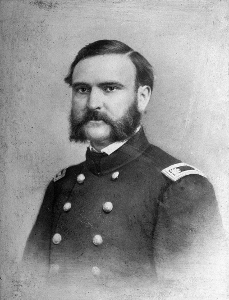
Sister Anthony’s portrait hangs in the Smithsonian Institution in Washington, D.C.

Leave a comment

Death of Charles G. Halpine, Journalist, Author & Soldier

Charles Graham Halpine (Halpin), Irish journalist, author and soldier during the American Civil War, dies on August 3, 1868, in New York City.

Born at Oldcastle, County Meath, on November 20, 1829, Halpine is the son of the Rev. Nicholas John Halpin. He is educated at Trinity College, Dublin, until 1846, with original intentions for the medical profession, but ultimately prefers the law. In his leisure time he writes for the press. The sudden death of his father and his own early marriage compel him to adopt journalism as a profession.

In 1851 he emigrates to the United States, and takes up residence in Boston, where he becomes assistant editor of The Boston Post, and, with Benjamin Penhallow Shillaber, commences a humorous journal called The Carpet Bag, which is unsuccessful. Afterwards he resides in Washington, D.C., where he acts as the correspondent of The New York Times.

After moving back to New York, he secures employment with the New York Herald, and in a few months establishes relations with several periodicals. He undertakes a great variety of literary work, most of which is entirely ephemeral. He next becomes associate editor of The New York Times, for which he writes in 1855 and 1856 the Nicaragua correspondence at the time of William Walker‘s filibustering expedition. In 1857 he becomes principal editor and part proprietor of the New York Leader, which under his management rapidly increases in circulation.

At the beginning of the American Civil War in April 1861, he enlists in the 69th New York Infantry, in which he is soon elected a lieutenant, and serves during the three months for which he has volunteered. He is then transferred to the staff of General David Hunter as assistant-adjutant-general with the rank of major, and soon afterwards goes with him to Missouri to relieve General John Charles Frémont. He accompanies General Hunter to Hilton Head, and while there writes a series of burlesque poems in the assumed character of an Irish private. Several of them are contributed to the New York Herald in 1862 under the pseudonym of “Miles O’Reilly,” and with additional articles are issued in two volumes entitled Life and Adventures, Songs, Services, and Speeches of Private Miles O’Reilly, 47th Regiment New York Volunteers (1864), and Baked Meats of the Funeral, a Collection of Essays, Poems, Speeches, and Banquets, by Private Miles O’Reilly, late of the 47th Regiment New York Volunteer Infantry, 10th Army Corps. Collected, revised, and edited, with the requisite corrections of punctuation, spelling, and grammar, by an Ex-Colonel of the Adjutant-General’s Department, with whom the Private formerly served as Lance-Corporal of Orderlies (1866).

Halpine is subsequently assistant-adjutant-general on General Henry W. Halleck‘s staff with the rank of colonel in 1862 and accompanies General David Hunter as a staff-officer on his expedition up the Shenandoah Valley in the spring of 1864. On his return to New York, he resigns his commission in consequence of his bad eyesight, receiving the brevet of brigadier-general of volunteers.

He then makes New York his home and resumes his literary work. He becomes editor and, later, proprietor of the Citizen, a newspaper issued by the citizens’ association to advocate reforms in the civil administration of New York City. In 1867 he is elected registrar of the county of New York by a coalition of republicans and democrats. Incessant labour brings on insomnia. He has recourse to opiates, and his death in New York City on August 3, 1868, is caused by an undiluted dose of chloroform.


Leave a comment

Founding of the Ancient Order of Hibernians in America

The Ancient Order of Hibernians (AOH) is founded in the United States on May 4, 1836, at St. James’ Roman Catholic Church in New York City, near the old Five Points neighbourhood. A branch is formed the same year at Pottsville, Pennsylvania. The existence and activities of the Order are concealed for some years.

During the late 1860s and early 1870s many of the lodges of the order in Pennsylvania are infiltrated by the Molly Maguires. However, the Molly Maguires and their criminal activities are condemned at the 1876 national convention of the AOH, and the Order is reorganised in the Pennsylvania coal areas.

In 1884 there is a split in the organisation. The Order has previously been governed by the Board of Erin, which has governed the order in Ireland, Great Britain and the United States, but is composed of officers selected exclusively by the organisations in Ireland and Great Britain. The majority leave in 1884 and become the Ancient Order of Hibernians of America, while the small group calls itself Ancient Order of Hibernians, Board of Erin. In 1897 the Ancient Order of Hibernians, Board of Erin, has approximately 40,000 members concentrated in New YorkNew JerseyOhioIllinois, and Michigan, while the Ancient Order of Hibernians of America has nearly 125,000 members scattered throughout nearly every state in the union. The two groups reunite in 1898.

female auxiliary, the Daughters of Erin, is formed in 1894, and has 20,000 members in 1897. It is attached to the larger, “American” version of the order. The AOH has 181,000 members in 1965 and 171,000 in 736 local units of “Divisions” in 1979. John F. Kennedy joins the AOH in 1947.

The Ladies Ancient Order of Hibernians (LAOH) raises $50,000 to build the Nuns of the Battlefield sculpture in Washington, D.C., which the United States Congress authorises in 1918. The Irish American sculptor, Jerome Connor, ends up suing the Order for non-payment.

In 1982, in a revival of Hibernianism, the Thomas Francis Meagher Division No. 1 forms in Helena, Montana, dedicated to the principles of the Order and to restoring a historically accurate record of Brigadier General Meagher’s contributions to Montana. Soon after, six additional divisions form in Montana.

The Order organises the New York City St. Patrick’s Day Parade for 150 years, emphasising a conservative Catholic interpretation of the Irish holiday. In 1993 control is transferred to an independent committee amid controversy over the exclusion of Irish American gay and lesbian groups.

The Brothers of St. Patrick Division of the Ancient Order of Hibernians in America is established at Brother’s of St. Patrick in Midway City, California, in 1995.

In 2013, The Ancient Order of Hibernians raises and distributes over $200,000 to aid victims of Hurricane Sandy.

In 2014, the AOH calls for a boycott of Spencer’s Gifts, for selling products the AOH says promote anti-Irish stereotypes and irresponsible drinking.

On May 10, 2014, a memorial to Commodore John Barry, an immigrant from Wexford who is a naval hero of the American Revolution and who holds commission number one in the subsequent United States Navy, is dedicated on the grounds of the United States Naval Academy. The memorial and associated “Barry Gate” are presented to the Academy by the members of the Ancient Order of Hibernians.

Several buildings of the Ancient Order of Hibernians are listed on the U.S. National Register of Historic Places or are otherwise notable.


Leave a comment

Death of Lily Kempson, Last Survivor of the Rising

lily-kempson

Lily Kempson, aged 99, the last surviving participant in the 1916 Easter Rising, dies in Seattle, Washington, on January 22, 1996. Born into the ranks of Dublin’s poor, Elizabeth Ann `Lily’ Kempson shares two rooms with her 92-year-old grandmother, her parents, and eight siblings.

Early on the morning of April 24, 1916, Lily dresses quietly so as to not disturb the other family members. Leaving undetected, Lily never returns home.

When Lily arrives at Liberty Hall, preparations for the Rising are already well underway. Weeks earlier Constance Markievicz and other women members of the Citizens Army, perhaps Lily amongst them, had stacked grenades and ammunition in the basement. Now this weaponry, already dispersed throughout the city, is to be used to defend the proclamation of an Irish Republic.

The initial plan for women to primarily take care of the wounded is scrapped. Attached to the Red Cross unit, Lily Kempson and her female comrades are swiftly incorporated within the main body of the fight. Lily is armed with a revolver. A handful of women, who have already played a key role in securing access to St. Stephens Green, set about evacuating civilians and guarding the gates. The insurgents dig in but they were unable to secure surrounding buildings because of a chronic shortage of personnel.

As dawn breaks on Tuesday morning, Lily is awakened by the rattle of machine gun fire. The British have occupied the Shelbourne, a hotel overlooking the park. The insurgents hold the Green for less than twenty hours. Throughout the week-long siege of Dublin, Kempson acts as a courier for Patrick Pearse and the other men inside the General Post Office (GPO).

The superior firepower of the British and the strategic advantage of the Shelbourne make evacuation of the park as inevitable as it is urgent. A line of retreat has been secured. In an advance party of three men and three women, Lily Kempson accompanies Constance Markievicz and Mary Hyland to seize the College of Surgeons, a sturdy building overlooking the north of the Green. It is here the Green’s contingent makes their heroic last stand, holding the ground for five days. They surrendered only after receiving a dispatch directly from the General Post Office. As their contingent prepares to surrender, Lily is chosen to carry the garrison’s last dispatches to addresses throughout the city.

In the immediate aftermath of The Rising, the Kempsons’ Dublin home is raided by the British army, but Lily is not to be found. Lily makes the decision to leave Ireland when her name appears on a British list of wanted suspects. Using her sister’s passport, she travels to England and boards a ship to New York. From New York, she then sails on to Seattle where she meets and marries a fellow Irishman, Matt McAlerney. They have seven children, 34 grandchildren, and 116 great-grandchildren by the time Lily passes away.

In her final years she attracts the attention of the local American press. Each Easter she briefly becomes a celebrity as her story of being the last survivor is retold.