
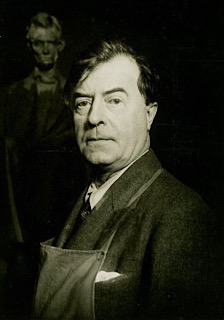
Andrew O’Connor, an American-Irish sculptor, is born in Worcester, Massachusetts, on June 7, 1874. His work is represented in museums in the United States, Ireland, Britain, and France.
O’Connor’s father, Andrew O’Connor (1846–1924), of Lanarkshire, Scotland, is a stonecutter who becones a professional sculptor. As a teenager, he apprentices to his father, helping him to design monuments for cemeteries.
For a time, O’Connor is in the London studio of the painter John Singer Sargent, and later works for the architects McKim, Mead & White in America and with the sculptor Daniel Chester French. Settling in Paris in the early years of the 20th century, he exhibits annually at the Paris Salon. In 1906 he is the first foreign sculptor to win the Second Class medal for his statue of General Henry Ware Lawton, now in Garfield Park in Indianapolis, Indiana. In 1928 he achieves a similar distinction by being awarded the Gold Medal for his Tristan and Iseult, a marble group now in the Brooklyn Museum. His work is also part of the sculpture event in the art competition at the 1928 Summer Olympics in Amsterdam.
A number of his plaster casts are in the Hugh Lane Gallery, Dublin, and there are works in Tate Britain, the Walters Art Museum, Baltimore, the Corcoran Gallery of Art, the Metropolitan Museum of Art and the Musée d’Art Moderne, Paris.
O’Connor is involved in a minor controversy in 1909 when he is commissioned to design a statue for Commodore John Barry, of the American Revolutionary-era navy. His first design is heatedly attacked by Irish American groups. He submits a second version, but it too is ultimately rejected, and the sculptor John J. Boyle received the commission.
O’Connor dies in Dublin on June 9, 1941.


