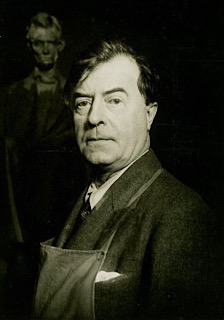
O’Connor’s father, Andrew O’Connor (1846–1924), of Lanarkshire, Scotland, is a stonecutter who becones a professional sculptor. As a teenager, he apprentices to his father, helping him to design monuments for cemeteries.
O’Connor is involved in a minor controversy in 1909 when he is commissioned to design a statue for Commodore John Barry, of the American Revolutionary-era navy. His first design is heatedly attacked by Irish American groups. He submits a second version, but it too is ultimately rejected, and the sculptor John J. Boyle received the commission.
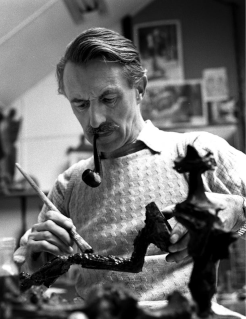
Frederick Edward McWilliamCBERA, Northern Irish surrealistsculptor, dies in London on May 13, 1992. He works chiefly in stone, wood and bronze. His style of work consists of sculptures of the human form contorted into strange positions, often described as modern and surreal.
McWilliam is born in Banbridge, County Down,on April 30, 1909, the son of Dr. William McWilliam, a local general practitioner. Growing up in Banbridge has a great influence on his work. He makes references to furniture makers such as Carson the Cooper and Proctors in his letters to his friend, Marjorie Burnett.
McWilliam attends Campbell College in Belfast and later attends Belfast College of Art from 1926. After 1928, he continues to study at the Slade School of Fine Art in London. He originally intends to become a painter, but influenced by Alfred Horace Gerrard, head of the sculpture department at the Slade, and by Henry Moore whom he meets there, he turns to sculpture. He receives the Robert Ross Leaving Scholarship which enables him and his wife, Beth (née Crowther), to travel to Paris where he visits the studio of Constantin Brâncuși.
During the first year of World War II, he joins the Royal Air Force and is stationed in England for four years where he is engaged in interpreting aerial reconnaissance photographs. He is then posted to India. While there he teaches art in the Hindu Art School in New Delhi.
After his return from India, McWilliam teaches for a year at the Chelsea School of Art. He is then invited by A. H. Gerrard to teach sculpture at the Slade. He continues in this post until 1968.
During the Northern IrelandTroubles McWilliam produces a series of bronzes in 1972 and 1973 known as Women of Belfast in response to the bombing at the Abercorn Tea-Rooms.
In 1964 McWilliam is awarded an Honorary Doctor of Letters from Queen’s University Belfast. In 1966 he is appointed CBE and in 1971 he wins the Oireachtas Gold Medal. He is represented in many public collections, including the Museum of Modern Art in New York City and Tate Britain in London. In 1984 the National Self-Portrait Gallery purchases a McWilliam self-portrait amongst acquisitions from fellow Northerners Brian Ballard, Brian Ferran and T. P. Flanagan.
Frederick Edward McWilliamCBERA, Northern Irish surrealistsculptor, is born in Banbridge, County Down, on April 30, 1909. He works chiefly in stone, wood and bronze. His style of work consists of sculptures of the human form contorted into strange positions, often described as modern and surreal.
McWilliam is the son of Dr. William McWilliam, a local general practitioner. Growing up in Banbridge has a great influence on his work. He makes references to furniture makers such as Carson the Cooper and Proctors in his letters to his friend, Marjorie Burnett.
McWilliam attends Campbell College in Belfast and later attends Belfast College of Art from 1926. After 1928, he continues to study at the Slade School of Fine Art in London. He originally intends to become a painter, but influenced by Alfred Horace Gerrard, head of the sculpture department at the Slade, and by Henry Moore whom he meets there, he turns to sculpture. He receives the Robert Ross Leaving Scholarship which enables him and his wife, Beth (née Crowther), to travel to Paris where he visits the studio of Constantin Brâncuși.
During the first year of World War II, he joins the Royal Air Force and is stationed in England for four years where he is engaged in interpreting aerial reconnaissance photographs. He is then posted to India. While there he teaches art in the Hindu Art School in New Delhi.
After his return from India, McWilliam teaches for a year at the Chelsea School of Art. He is then invited by A. H. Gerrard to teach sculpture at the Slade. He continues in this post until 1968.
During the Northern IrelandTroubles McWilliam produces a series of bronzes in 1972 and 1973 known as Women of Belfast in response to the bombing at the Abercorn Tea-Rooms.
In 1964 McWilliam is awarded an Honorary Doctor of Letters from Queen’s University Belfast. In 1966 he is appointed CBE and in 1971 he wins the Oireachtas Gold Medal. He is represented in many public collections, including the Museum of Modern Art in New York City and Tate Britain in London. In 1984 the National Self-Portrait Gallery purchases a McWilliam self-portrait amongst acquisitions from fellow Northerners Brian Ballard, Brian Ferran and T. P. Flanagan.