Rokeby is born at Kirk Sandall, eldest of the five sons of John Rokeby (died 1506). His younger brother, Sir Richard Rokeby (died 1523), is Comptroller of the Household to CardinalThomas Wolsey and later Treasurer of Ireland. He retains a deep affection for Kirk Sandall and returns there to die. He goes to school at Rotherham, studies at the University of Oxford and becomes a fellow of King’s Hall, later Trinity College, Cambridge. He becomes vicar of his home parish in 1487 and is transferred to Halifax, another town for which he has a deep attachment, in about 1499. In 1507 he is made Bishop of Meath.
On the death of Walter Fitzsimon in 1511, Rokeby becomes Archbishop of Dublin. It has been suggested that his elevation is due at least in part to his English birth, as the Crown is anxious to place Englishmen high up in the Irish hierarchy. No doubt his brother’s close connection to Wolsey also plays a part. He is Lord Chancellor of Ireland from 1512 to 1513 and from 1516 to 1522.
As Archbishop Rokeby makes a reputation as a peacemaker, settling a long and bitter dispute between the Dean and Chapter of St. Patrick’s Cathedral, Dublin. He gives permission to Gerald FitzGerald, 9th Earl of Kildare, for the original foundation of Maynooth College, which is suppressed in 1535. He is frequently at the English Court, so often indeed that he is accused of neglecting his official duties back in Ireland. He participates in the christening of the future Queen Mary I in 1516 and the ceremony by which Wolsey receives his cardinal’s hat.
As Archbishop of Dublin, Rokeby is best remembered for the Synod of 1518. The Synod prohibits the use of any tin chalice at Mass, and the disposal of Church property by laymen; and attempts to regulate the procedure for dealing with intestate estates, the payment of tithes and burial fees and the rules for admission to the clergy. Rather comically, he strictly forbids clergymen to play football.
Rokeby is appointed Archdeacon of Surrey on March 27, 1519. By 1521 his health is failing, and he retires to Kirk Sandall, where he dies on November 29. In his will he leaves £200 to rebuild St. Mary’s Church, Beverley, whose tower had collapsed the previous year.
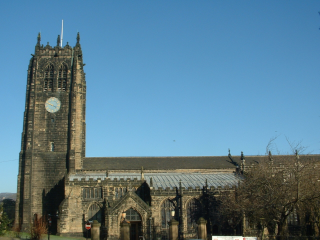
Rokeby makes elaborate provisions in his will for the disposal of his remains. In accordance with his wishes, his body is buried in St. Oswald’s Church, Kirk Sandall, but his heart and bowels are buried in the Church of St. John the Baptist, Halifax (now known as Halifax Minster). Mortuary chapels are erected at both spots, which still exist today.
O’Flanagan praises Rokeby as a good man, a good bishop and, so far as we can tell from the scanty records, a good judge. Irish author F. Elrington Ball, while acknowledging his good qualities, suggests that he was a failure as Irish Lord Chancellor, due partly to his frequent absences in England.
(Pictured: Halifax Minster, where Rokeby’s heart is buried)
O’Connor is educated in St. Mary’s College, Dublin, and then in Clongowes Wood College, County Kildare, a public school run by the Jesuit order. It is also attended by the man who later condemns O’Connor to death, his close friend Kevin O’Higgins. He studies experimental physics, logic, and metaphysics. He also attends the College of Science, Merrion Street. He takes a BA (1906) and receives a B.Eng (1911). In 1910, he takes his Bachelor of Engineering and Bachelor of Arts degrees at University College Dublin (UCD), then known as the National University. Prominent in the university’s Literary and Historical Society, he advocates militant constitutional nationalism as one of the many society members active in the Young Ireland branch of the United Irish League.
During the subsequent Irish War of Independence (1919-21) O’Connor is Director of Engineering of the Irish Republican Army (IRA), a military organisation descended from the Irish Volunteers. The specialist skills of engineering and signaling are essential to the development of the 5th Battalion, Dublin Brigade. Its men are forbidden frontline duty as their contribution is regarded as vital, their number too small. But units only expand on an incremental local basis, disappointing General Richard Mulcahy.
O’Connor is also involved in the Republican breakout from Strangeways Prison in Manchester, England, on October 25, 1919. Michael Collins takes a particular interest in the escape and actually visits Austin Stack in the prison under a false name to finalise the arrangements. IRA men hold up traffic while a ladder is propped up against the outside of a prison wall. In all six prisoners escape, among them Piaras Beaslaí.
O’Connor refuses to accept the Anglo-Irish Treaty of 1921, which establishes the Irish Free State. It is ratified by a narrow vote in Dáil Éireann, the Irish parliament. He and many like him feel that the Treaty copper-fastens the partition of the six counties of Northern Ireland and undermines the Irish Republic declared in 1916.
On January 10, a meeting is held at O’Connor’s home in Monkstown, Dublin. In attendance are all senior anti-Treaty IRA officers except Liam Mellows. O’Connor is appointed to chair this grouping, known as the Republican Military Council. It is agreed that an IRA convention should be called without delay; failing this, a separate GHQ will be formed. At a further meeting in O’Connor’s office on March 20, a temporary IRA GHQ staff is elected under Liam Lynch as chief of staff. O’Connor remains in charge of engineering.
On March 26, 1922, the anti-Treaty officers of the IRA hold a convention in Dublin, in which they reject the Treaty and repudiate the authority of the Dáil. However, they are prepared to discuss a way forward. The convention meets again on April 9. It creates a new army constitution and places the army under a newly elected executive of 16 men, including O’Connor, that are to choose an army council and headquarters staff. Asked by a journalist if this development means the anti-Treatyites ware proposing a “military dictatorship” in Ireland, O’Connor replies, “You can take it that way if you want.”
On April 14, 1922, O’Connor is one of a number of IRA leaders in a 200-strong force that occupies the Four Courts building in the centre of Dublin in defiance of the Provisional Government. They intend to provoke the British troops, who are still in the country, into attacking them, which they believe will restart the war with Britain and re-unite the IRA against their common enemy. They also occupy other smaller buildings regarded as being associated with the former British administration, such as the Ballast Office and the Freemasons‘ Hall in Molesworth Street, but the Four Courts remains the focus of interest. On June 15, O’Connor sends out men to collect the rifles that belong to the mutineers of the Civic Guards.
Michael Collins tries desperately to persuade the IRA men to leave the Four Courts. At the Third IRA Convention on June 18, the Executive is split over whether the Irish Government should demand that all British troops leave within 72 hours. A motion to this effect, opposed by Lynch, is narrowly defeated, whereupon O’Connor and others leave the meeting to set up a separate GHQ. The IRA effectively splits into two factions opposed to the government.
On June 22, 1922, Sir Henry Wilson is assassinated in London by two IRA men, Reginald Dunne and Joseph O’Sullivan, each a former British soldier. Some now argue that this was done on the orders of Michael Collins, who had been a close friend of Dunne’s in the London Irish Republican Brotherhood (IRB). Prime MinisterDavid Lloyd George writes an angry letter to Collins, which includes the line “…still less can Mr. Rory O’Connor be permitted to remain his followers and his arsenal in open rebellion in the heart of Dublin… organizing and sending out from this centre enterprises of murder not only in the area of your Government…”
On June 28, 1922, after the Four Courts garrison has kidnapped J. J. “Ginger” O’Connell, a general in the National Army, Collins gives orders for the shelling of the Four Courts with borrowed artillery lent by Winston Churchill. The shelling leads to the Four Courts catching fire, damaging parts of the building in addition to destroying numerous government documents. O’Connor is one of 130 men that surrender on June 30, some of whom are arrested and imprisoned in Mountjoy Prison. This incident marks the official start of the Irish Civil War, as fighting breaks out openly around the country between pro- and anti-Treaty factions.
On December 8, 1922, along with three other republicans, Liam Mellows, Richard Barrett and Joe McKelvey, captured with the fall of the Four Courts, O’Connor is executed by firing squad in reprisal for the anti-Treaty IRA’s killing of Free State Teachta Dála (TD) Sean Hales. The execution order is signed by Kevin O’Higgins. O’Connor had been best man at O’Higgins’s wedding on October 27, 1921. Their deaths remain a symbol of the bitterness and division of the Irish Civil War. O’Connor, one of 77 republicans executed by the Provisional Government, is seen as a martyr by the Republican movement in Ireland.
On O’Connor’s execution, the equestrienne Joan de Sales La Terriere, a close friend of his, names her son in his honour. “Rory O’Connor Place” in Arklow is named in his honour. There is also a pub in Crumlin, Dublin, named after him and a housing estate near Dún Laoghaire, County Dublin, called “Rory O’Connor Park.” A Sinn Féincumann (UCD) is named after him.
(Pictured: Rory O’Connor addressing members of the IRA’s Dublin City Brigade at Smithfield, April 1922)
Quinn founds the national supermarket chain Superquinn (originally Quinn’s Supermarkets), of which he remains non-executive president for some years after his family sells out their interest in August 2005 for over €400 million. Superquinn is known for its focus on customer service and pioneers a number of innovations, including Ireland’s first supermarket loyalty card in 1993, SuperClub. It also introduces self-scanning of goods by customers in a number of its outlets. Superquinn becomes the first supermarket in the world to guarantee the absolute traceability of all its beef from pasture to plate, using DNA TraceBack, a system developed at Trinity College, Dublin by IdentiGEN.
Quinn becomes the chairman of the Interim Board for Posts and serves as chairman of its successor An Post (the Irish postal administration) until 1989. He also serves on several other public authorities and boards. From 1993 to 1998, he chairs the steering committee which oversees the development of the Leaving Certificate Applied. In 2006, he is appointed an Adjunct Professor in Marketing at National University of Ireland Galway. He is also chairman of Springboard Ireland.
Quinn is a former President of EuroCommerce, the Brussels-based organisation which represents the retail, wholesale and international trade sectors in Europe. He also serves on the board of directors of CIES, the Food Business Forum based in Paris, as well as the American-based Food Marketing Institute.
In 2009, Quinn works with independent shops and helps them to revamp, modernise and stave off stiff competition from multi-national retailers. It airs as RTÉ‘s six-part television series, Feargal Quinn’s Retail Therapy. A second series airs in 2011, and a third series airs in 2012. In 2011, he fronts RTÉ’s Local Heroes campaign in Drogheda, County Louth, which is an assembled team of experts to kick-start the local economy. It airs as RTÉ One‘s six-part television series, Local Heroes – A Town Fights Back.
Quinn is first elected as a senator in 1993 from the National University of Ireland constituency and is re-elected in 1997, 2002, 2007 and 2011. He is a member of the Joint Oireachtas Committee on European Affairs, the Joint Committee on Finance and Public Service and is an Oireachtas member of the National Economic and Social Forum, along with the Joint Committee on Jobs and Innovation.
Quinn is one of the co-founders and is a driving force behind Democracy Matters – a civil society group that is formed to oppose the Government’s plans to abolish Seanad Éireann. In May 2013, with Senators Katherine Zappone and Mary Ann O’Brien, he introduces the Seanad Bill 2013 to reform the system of electing the elected members of Seanad Éireann (as provided for in Article 18.10 of the Constitution of Ireland) through a one-person, one vote franchise. The Seanad Bill 2013 succeeds in being passed at Second Stage in the Seanad. During the Seanad abolition referendum campaign, the Bill demonstrates to the electorate, in a very palpable way, that reform of the Seanad is achievable if they vote for its retention. In a referendum held in October 2013 on the Abolition of Seanad Éireann, the people vote to retain the Seanad by 51.7%.
In 2014, Quinn reveals that since being first elected to Seanad Éireann, he has donated his entire salary to charity and in more recent years he has refused to accept any salary. In March 2015, he opposes the Marriage Equality bill in the Seanad, and votes ‘No’ in the referendum. He serves as Chairman of the Independent Alliance. He does not contest the 2016 Seanad election.
Quinn dies peacefully at his home in Howth, County Dublin, on April 24, 2019, following a short illness. His funeral Mass takes place at St. Fintan’s Church in Sutton, north County Dublin. In attendance is PresidentMichael D. Higgins, a representative for TaoiseachLeo Varadkar, Minister for Children Katherine Zappone, Senator Michael McDowell, and a host of other current and former politicians, business figures, and past colleagues of the “Superquinn family.” Fittingly, the coffin is carried from the church to the tune of Frank Sinatra’s “My Way.”
The ten-judge court is established in 2014. President of the Court of Appeal, Justice Sean Ryan, says the court has achieved major success in dealing with criminal appeals. He says the court is also committed to realising the hopes and expectations of the people when they established the new court and to making whatever changes are necessary.
Justice Ryan says the new court has inherited 660 cases from the Court of Criminal Appeal and has taken on 287 new appeals up to the previous July. Two hundred eighty have been disposed of and all cases ready for hearing are listed for hearing next term.
On the civil side Justice Ryan says the total number of civil appeals disposed of is 468. New civil appeals number 60 a month. He adds that he and his colleagues have achieved a remarkable amount in a short space of time.
President Higgins pays tribute to the work of the court to date. He says it inherited a significant workload from the Supreme Court and the initial priority is to reduce the backlog of criminal cases. Inroads have also been made into reducing the waiting times for dealing with civil appeals.
President Higgins says that the courts play a vital role in the function of the State and there are also plans to faciltate a second court to hear civil appeals which will make further progress in reducing waiting times. He says the effectiveness and efficiency in the court system is also underscored by Ireland’s obligations under a number of international agreements, including Article 6 of the European Convention on Human Rights, which guarantees citizens a right to a fair and speedy trial.
Chief JusticeSusan Denham says the occasion is a significant one for the people of Ireland who decided there should be a Court of Appeal. She adds that it is an important day for all involved in the law and that the new judges of the court have “done trojan work on this great project for the people of Ireland.”
(From: “President opens new Court of Appeals building,” Raidió Teilifís Éireann (RTÉ), http://www.rte.ie, November 26, 2015 | Pictured: President Michael D. Higgins (left) pays tribute to the work of the court to date)
The Shankill Butchers gang is based in the Shankill area and is responsible for the deaths of at least 23 people, most of whom are killed in sectarian attacks. The gang is notorious for kidnapping, torturing and murdering random or suspected Catholic civilians. Each victim is beaten ferociously and has their throat hacked with a butcher knife. Some are also tortured and attacked with a hatchet. The gang also kills six Ulster Protestants over personal disputes, and two other Protestants mistaken for Catholics.
The commander of the Shankill Butchers gang is Lenny Murphy. He is the youngest of three sons of Joyce (née Thompson) and William Murphy from the loyalist Shankill Road area of Belfast. At school he is known as a bully and threatens other boys with a knife or with retribution from his two older brothers. Soon after leaving school at 16, he joins the UVF. He often attends the trials of people accused of paramilitary crimes, to become well acquainted with the laws of evidence and police procedure.
On September 28, 1972, Murphy shoots and kills William Edward “Ted” Pavis at the latter’s home in East Belfast. Pavis is a Protestant whom the UVF say has been selling weapons to the Provisional Irish Republican Army (PIRA). Murphy and an accomplice, Mervyn Connor, are arrested shortly afterwards and held on remand in Belfast’s Crumlin Road Gaol. After a visit by police to Connor, fellow inmates suspect that he might cut a deal with the authorities with regard to the Pavis killing. On April 22, 1973, Connor dies by ingesting a large dose of cyanide. Before he dies, he writes a confession to the Pavis murder, reportedly under duress from Murphy. Murphy is brought to trial for the Pavis murder in June 1973. The court hears evidence from two witnesses who had seen Murphy pull the trigger and had later picked him out of an identification parade. The jury acquits him due in part to Murphy’s disruption of the line-up. His freedom is short-lived as he is arrested immediately for a number of escape attempts and imprisoned, then interned, for three years.
In May 1975, Murphy is released from prison. He spends much of his time frequenting pubs on the Shankill Road and assembling a paramilitary team that will enable him to act with some freedom at a remove from the UVF leadership (Brigade Staff). His inner circle consists of two “personal friends.” These are a “Mr. A” and John Murphy, one of Lenny’s brothers, referred to as “Mr. B.” Further down the chain of command are his “sergeants,” William Moore and Bobby “Basher” Bates, a UVF man and former prisoner.
Moore, formerly a worker in a meat-processing factory, had stolen several large knives and meat-cleavers from his old workplace, tools that are later used in more murders. Another prominent figure is Sam McAllister, who uses his physical presence to intimidate others. On October 2, 1975, the gang raids a drinks premises in nearby Millfield. On finding that its four employees, two females and two males, are Catholics, Murphy shoots three of them dead and orders an accomplice to kill the fourth. By now Murphy is using the upper floor of the Brown Bear pub, at the corner of Mountjoy Street and the Shankill Road near his home, as an occasional meeting-place for his unit.
On November 25, 1975, using the city’s sectarian geography to identify likely targets, Murphy roams the areas nearest the Catholic New Lodge in the hope of finding someone likely to be Catholic to abduct. Francis Crossen, a 34-year-old Catholic man and father of two, is walking towards the city centre at approximately 12:40 a.m. when four of the Butchers, in Moore’s taxi, spot him. As the taxi pulls alongside Crossen, Murphy jumps out and hits him with a lug wrench to disorient him. He is dragged into the taxi by Benjamin Edwards and Archie Waller, two of Murphy’s gang. As the taxi returns to the safety of the nearby Shankill area, Crossen suffers a ferocious beating. He is subjected to a high level of violence, including a beer glass being shoved into his head. Murphy repeatedly tells Crossen, “I’m going to kill you, you bastard,” before the taxi stops at an entry off Wimbledon Street. Crossen is dragged into an alleyway and Murphy, brandishing a butcher knife, cuts his throat almost through to the spine. The gang disperses. Crossen, whose body is found the following morning by an elderly woman, is the first of three Catholics to be killed by Murphy in this “horrific and brutal manner.” “Slaughter in back alley” is the headline in the city’s major afternoon newspaper that day. A relative of Crossen says that his family was unable to have an open coffin at his wake because the body was so badly mutilated.
Most of the gang are eventually caught and, in February 1979, receive the longest combined prison sentences in United Kingdom legal history. However, gang leader Lenny Murphy and his two chief “lieutenants” escape prosecution. Murphy is murdered in November 1982 by the Provisional IRA, likely acting with loyalist paramilitaries who perceive him as a threat. The Butchers brought a new level of paramilitary violence to a country already hardened by death and destruction. The judge who oversaw the 1979 trial describes their crimes as “a lasting monument to blind sectarian bigotry.”
On November 24, 1974, British police charge six men in connection with the Birmingham pub bombings three days earlier. Hugh Callaghan, Patrick Hill, Robert Hunter, Noel McIlkenny, William Power and John Walker are accused of the murder of the youngest victim of the attacks, Jane Davis, age 17, who is one of 19 people killed when bombs explode on November 21 in the Mulberry Bush at the foot of the Rotunda, and the Tavern in the Town, a basement pub in New Street.
A massive security operation is launched in Birmingham the following day when the six accused men appear in a hearing at the Victoria Law Courts. Assistant Chief Constable Maurice Buck, who is leading the investigation, says the six had been apprehended on the night of the attacks.
Five of the alleged bombers, who are from Northern Ireland but have been resident in England for at least eleven years, are arrested on the Belfast ferry at Heysham. Callaghan is arrested in Birmingham. All of the men had been living in the city, but Buck declines to give their addresses “for security reasons.”
The assistant chief constable tells reporters that the alleged bombers will be charged soon in connection with the deaths of the other 18 victims. “We are satisfied that we have found the men primarily responsible, but our inquiries will continue,” he says.
The so-called Birmingham Six are found guilty in August 1975 of carrying out the bombings and sentenced to life imprisonment. They are released after 16 years in jail when their convictions are quashed by the Court of Appeal in May 1991. One of the six, Paddy Hill states on his release, “The police told us from the start they knew we hadn’t done it. They didn’t care who had done it.” The real bombers have never been prosecuted and no group has ever admitted planting devices.
Three detectives are charged with perjury and conspiracy in connection with the investigation, but their trial is halted in 1993 on the grounds of prejudicial media coverage.
The six men finally agree on undisclosed compensation settlements in June 2002 – more than ten years after they had been freed.
Ryan emigrates to the United States in 1947 to work for Time, where he reports on the postwar tests of atomic weapons carried out by the United States in the Pacific. He then reports for Time on the Arab-Israeli war in 1948. This is followed by work for other magazines, including Collier’s Weekly and Reader’s Digest.
Ryan marries Kathryn Morgan, a novelist, and becomes a naturalized citizen of the United States in 1951.
On a trip to Normandy in 1949 Ryan becomes interested in telling a more complete story of Operation Overlord than has been produced to date. He begins compiling information and conducting over 1,000 interviews as he gathers stories from both the Allies and the Germans, as well as the French civilians.
In 1956 Ryan begins to write down his World War II notes for The Longest Day: 6 June 1944 D-Day, which tells the story of the D-Day Invasion of Normandy, published three years later in 1959. It is an instant success, and he assists in the writing of the screenplay for the 1962 film of the same name. Darryl F. Zanuck pays the author U.S.$175,000 for the screen rights to the book.
Ryan’s 1957 book One Minute to Ditch! is about the successful ocean ditching of a Pan AmericanBoeing 377 Stratocruiser. He had written an article about the ditching for Collier’s in their December 21, 1956, issue and then expanded it into the book.
Ryan’s next work is The Last Battle (1966), about the Battle of Berlin. The book contains detailed accounts from all perspectives: civilian, American, British, Russian and German. It deals with the fraught military and political situation in the spring of 1945, when the forces of the western allies and the Soviet Union contend for the chance to liberate Berlin and to carve up the remains of Germany.
This work was followed by A Bridge Too Far (1974), which tells the story of Operation Market Garden, the ill-fated assault by allied airborne forces on the Netherlands culminating in the Battle of Arnhem. It is made into a major 1977 film of the same name.
Ryan is awarded the French Legion of Honour and an honorary Doctor of Literature degree from Ohio University, where the Cornelius Ryan Collection is housed in the Alden Library. He is diagnosed with prostate cancer in 1970 and struggles to finish A Bridge Too Far during his illness. He dies in Manhattan on November 23, 1974, while on tour promoting the book, only two months after publication. He is buried in the Ridgebury Cemetery in northern Ridgefield, Connecticut.
Four years after his death, Ryan’s struggle with prostate cancer is detailed in A Private Battle, written by his widow, from notes he had secretly left behind for that purpose.
McCarthy is educated in Cork. He begins his career as a journalist at the age of 18 in Cork. From 1853 to 1859 he is in Liverpool, on the staff of the Northern Daily Times. In March 1855, he marries Charlotte Ailman. In 1860 he moves to London, as parliamentary reporter to the Morning Star, of which he becomes editor in 1864. He gives up his post in 1868 and, following a lecturing tour in the United States, joins the staff of The Daily News as leader-writer in 1870. In this capacity he becomes one of the most useful and respected upholders of the liberal politics of the time. He lectures again in America in 1870–71 and in 1886–87.
At the 1886 United Kingdom general election, McCarthy is returned unopposed in North Longford, but also stands in Londonderry City, where he is declared the loser to the Irish Unionist Alliance candidate by the narrow margin of 1778 votes to 1781. However, the result is later overturned on petition and McCarthy opts to sit for Londonderry City. During the divorce controversy surrounding Charles Stewart Parnell in November 1890, the British Prime MinisterWilliam Ewart Gladstone expresses a warning, given to McCarthy as intermediary, that if Parnell retains leadership of the Irish Parliamentary Party, it will mean the loss of the next election, the end of their alliance and Home Rule. When the annual party leadership election meeting is called later that month, the threat is somehow not conveyed to the members, who re-elect Parnell leader of the Party.
After a further historical meeting of the Irish Party MPs in early December, Parnell refuses to retire and the Party divides. McCarthy becomes chairman of the Anti-Parnellite group, the Irish National Federation, for a year in 1891–92. His nationalism is of a temperate and orderly kind, and though his personal distinction singles him out for the chairmanship during the party dissensions of this period, he is in no active sense the political leader.
It is claimed that McCarthy’s true vocation is literature. His earliest publications are novels, some of which, such as A Fair Saxon (1873), Dear Lady Disdain (1875), Miss Misanthrope (1878), and Donna Quixote (1879), attain considerable popularity. His most important work is his History of Our Own Times, which treats of the period between Queen Victoria‘s accession and her Diamond Jubilee. He begins a History of the Four Georges (1884–1901) and the latter half is written by his son, Justin Huntly McCarthy.
Justin McCarthy dies at the age of 81 in Folkestone, Kent, England on April 24, 1912.
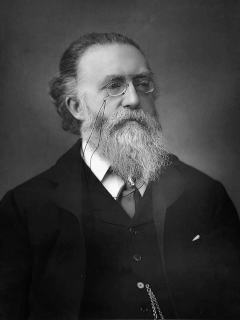
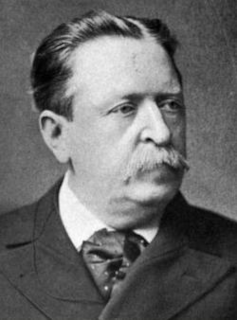
(Pictured: Portrait style photograph of Irish politician Justin McCarthy, taken in 1891 by Herbert Rose Barraud)
The tunnel is originally built by the Great Southern and Western Railway company to connect Kingsbridge station (now Heuston Station) to the Dublin Docklands and is primarily used for freight. Historically the line has not been used for regular passenger trains, with most traffic through the tunnel being freight or carriages and engines shunted between Connolly and Heuston for maintenance. It has occasionally been used for special passenger services, including traffic for major Gaelic Athletic Association fixtures.
The tunnel reopens to regular passenger traffic on November 21, 2016. As of late 2018, this traffic is predominantly weekday services.
(Pictured: Southern end of the Phoenix Park Tunnel, Dublin, Ireland)
Young is invited to accompany President Ulysses S. Grant on Grant’s famous 1877-79 world tour, chronicled in Young’s book Around the World with General Grant. He impresses Grant, especially in China where he strikes up a friendship with Li Hongzhang. Grant persuades President Chester A. Arthur to appoint Young minister to China in 1882. In this position he distinguishes himself by mediating and settling disputes between the United States and China and France and China. Unlike many other diplomats, he opposes the policy of removing Korea from Chinese suzerainty.
In 1885 Young resumes working for the New York Herald in Europe. In 1890 he returns to Philadelphia. In 1897 President William McKinley appoints him Librarian of Congress, the first librarian confirmed by Congress. During his tenure, the library begins moving from its original home in the United States Capitol building to its own structure, an accomplishment largely the responsibility of his predecessor, Ainsworth Rand Spofford. Spofford serves as Chief Assistant Librarian under Young. Young holds the post of librarian until his death.
Young’s brother is Congressman James Rankin Young. His son is Brigadier General Gordon Russell Young, who is Engineer Commission of the District of Columbia from 1945-51 and a recipient of the Distinguished Service Medal and the Legion of Merit.





 seamus dubhghaill