seamus dubhghaill

Promoting Irish Culture and History from Little Rock, Arkansas, USA


Leave a comment

Birth of Watercolourist Michael Angelo Hayes

Painter Michael Angelo Hayes is born in Waterford on July 25, 1820. Probably the best 19th century painter of animals in Ireland, Hayes is most accomplished as a watercolourist, although he occasionally uses oils.

Hayes is the son and pupil of Tipperary watercolour miniaturist Edward Hayes RHA. It is clear from his christening that he is expected to become an artist.  Fortunately, the younger Hayes is a talented draughtsman, and by his late teens has acquired something of a reputation as a painter of horses and military subjects.

Hayes begins showing at the Royal Hibernian Academy (RHA) in 1837, then for three years 1840-1842.  In 1842, he is appointed Military Painter-in-ordinary to the Lord Lieutenant.  He passes the next few years in London, where he exhibits watercolours at the New Society of Painters in Water Colours, of which he is elected an Associate Member in 1848, the same year he makes his one and only contribution to the Royal Academy of Arts.

Returning to Dublin, Hayes resumes exhibiting at the RHA, at the same time becoming involved in its administration.  He is elected an Associate member in 1853, a full Academician the following year, and Secretary in 1856.  The affairs of the Academy are totally disorganized at the time, inducing Hayes and others to resolve the situation.  His efforts to reform the institution and secure its finances meets with entrenched opposition from older members, which results in Hayes being removed from his post, although he is successfully reinstated in 1861.

Not long afterwards he is appointed secretary to the Lord Mayor of Dublin, Peter McSwiney, who happens to be his brother-in-law, and later becomes City Marshal in 1867.  He continues as Secretary of the RHA until he resigns in 1870, and continues showing until 1874.

Hayes makes a special study of horses in motion, and in 1876 publishes his conclusions in an illustrated pamphlet, The Delineation of Animals in Rapid Motion.  One of his Dublin paintings, Sackville Street, Dublin, depicts a view of Dublin’s premier street in the 1850s. The painting is a documentary of social life in Dublin. It achieves widespread popularity when reprinted as a lithograph.

Michael Angelo Hayes dies prematurely in 1877 in a tragic drowning accident at his home.


Leave a comment

Birth of Thomas Bodkin, Art Historian & Collector

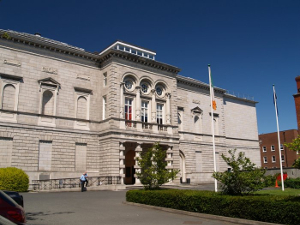
Professor Thomas Patrick Bodkin, lawyer, art historian, art collector and curator, is born in Dublin on July 21, 1887. He serves as Director of the National Gallery of Ireland in Dublin from 1927 to 1935 and founding Director of the Barber Institute of Fine Arts in Birmingham, England from 1935 until 1952, where he acquires the nucleus of the collection described by The Observer as “the last great art collection of the twentieth century.”

Bodkin is the eldest son of Matthias McDonnell Bodkin, a nationalist journalist, judge and Member of Parliament. Graduating from the Royal University of Ireland in 1908 he practises law from 1911 until 1916 while collecting art privately, influenced by his uncle Sir Hugh Lane. With the death of Lane in the sinking of the RMS Lusitania in 1915, Bodkin is charged with ensuring that Lane’s collection of art is displayed in Dublin, a dispute that would only finally be settled in 1957 and about which Bodkin is to write Hugh Lane and his Pictures in 1932.

Bodkin leaves the legal profession in 1916 to become a Governor of the National Gallery of Ireland, being appointed Director in 1927. He also serves in 1926 on the committee that commissions the design of the new coinage of the Republic of Ireland from Percy Metcalfe.

In 1935 Bodkin leaves Ireland upon being appointed Director of the newly established Barber Institute of Fine Arts and Barber Professor of Fine Art at the University of Birmingham. The funds available to the Barber Institute for the purchase of new works compare favourably even to some national museums and Bodkin is able to make a string of exceptional purchases in the depressed art market around the time of World War II. The collection that in 1935 numbers just seven works, by 1939 holds major pieces such as Tintoretto‘s Portrait of a Youth (1554), Simone Martini‘s St. John the Evangelist (1320), Nicolas Poussin‘s Tancred and Erminia (1634) and James Abbott McNeill Whistler‘s Symphony in White No. III (1867). Bodkin retires in 1952 but retains control over acquisitions until 1959. His successor as Director and Professor, Ellis Waterhouse, wistfully refers to Bodkin’s wayward later purchases as “Acts of Bod.”

Bodkin is also an active broadcaster and author, publishing personal reminiscences and translations of modern French poetry as well as works of art history and criticism. In particular, his The Approach to Painting (1927), an introduction for a popular audience, runs through many editions over the succeeding thirty years.

A few years before his death Bodkin appears on the BBC panel show Animal, Vegetable or Mineral? identifying curiosities from around the world, along with museum curator Hugh Shortt and archaeologist Mortimer Wheeler.

Bodkin is awarded the Civil Division of the Order of St. Gregory the Great for services to his church. A bust of Bodkin, previously exhibited at the Royal Academy in 1958, is donated to the Barber Institute of Fine Arts by its sculptor, Sir Charles Wheeler, President of the Royal Academy and a personal friend of Bodkin’s, on the latter’s death.

Bodkin is the subject of This Is Your Life in March 1960 when he was surprised by Eamonn Andrews at the BBC’s Costa Green Studios in Birmingham.

Thomas Bodkin dies in Birmingham, England on April 24, 1961. His remains are interred in Glasnevin Cemetery, Dublin.


2 Comments

Birth of Sculptor Seamus Murphy

Seamus Murphy, Irish sculptor and stone carver best known for designing the Church of the Annunciation, Blackpool, Cork, is born near Mallow, County Cork on July 15, 1907.

Murphy is the son of James Murphy, a railway employee, and Margaret Sheehan of Little Island, County Cork. He attends Saint Patrick’s School on Gardiner’s Hill. In 1921 he enrolls as a part-time student at the Crawford School of Art, Emmet Place, Cork. In 1922 he finds work as an apprentice stone-carver at John Aloysius O’Connell’s Art Marble Works, Watercourse Road, Blackpool. There he specialises in architectural and foliage carving while continuing his studies at Crawford by night.

Murphy studies at the Académie Colarossi and at the Académie de la Grande Chaumière in Paris in 1932-1933 where he is befriended by the Irish American sculptor Andrew O’Connor. He opens his studio/workshop on Watercourse Road, Blackpool, Cork in 1934.

He is elected associate of the Royal Hibernian Academy in 1944, elected a full member in 1954, and appointed Royal Hibernian Academy Professor of Sculpture in 1964.

Also in 1944, he married Maighread Higgins, daughter of the Cork sculptor Joseph Higgins, and they go on to have three children – the knitwear designer Bebhinn Marten, the novelist Orla Murphy and the painter and De Dannan member Colm Murphy.

Murphy designs the Church of the Annunciation on Great William O’Brien Street in Blackpool, Cork, for William Dwyer in 1945. The stonework in the church is mostly by Murphy himself. It is officially dedicated on October 7, 1945.

Seamus Murphy dies in Cork on October 2, 1975. He is buried in Rathcooney, County Cork.

Examples of Murphy’s unique carvings of statues, gravestones, monuments and plaques can be seen around Cork and Ireland, including a signed panel of the four evangelists outside the entrance of the church of Our Lady and Saint John in Carrigaline, County Cork.


Leave a comment

Death of Richard Brinsley Sheridan, Playwright & Satirist

Richard Brinsley Butler Sheridan, Irish satirist, playwright, poet, and long-term owner of London‘s Theatre Royal, Drury Lane, dies on July 7, 1816, at 14 Savile Row, London.

Sheridan is born on October 30, 1751, in Dublin, where his family has a house on then fashionable Dorset Street. While in Dublin Sheridan attends the English Grammar School in Grafton Street. The family moves permanently to England in 1758 where he is a pupil at Harrow School from 1762 to 1768. After his period in Harrow School, his father employs a private tutor to directs his studies.

In 1775, Sheridan’s first play, The Rivals, is produced at London’s Covent Garden Theatre. It is a failure on its first night. He casts a more capable actor in the lead for its second performance, and it is a smash which immediately establishes the young playwright’s reputation and the favour of fashionable London. It has gone on to become a standard of English literature.

Shortly after the success of The Rivals, Sheridan and his father-in-law, Thomas Linley the Elder, a successful composer, produce the opera, The Duenna. This piece is accorded such a warm reception that it plays for seventy-five performances.

The following year, Sheridan, his father-in-law, and one other partner purchase a half-interest in the Drury Lane theatre and, two years later, buy out the other half. Sheridan is the manager of the theatre for many years and later becomes sole owner with no managerial role.

His most famous play, The School for Scandal (Drury Lane, May 8, 1777), is considered one of the greatest comedies of manners in English. It is followed by The Critic (1779), an updating of the satirical Restoration comedy The Rehearsal. He has a rivalry with his fellow playwright Richard Cumberland and includes a parody of Cumberland in The Critic. In 1778, Sheridan writes The Camp, which comments on the ongoing threat of a French invasion of Britain.

In 1780, Sheridan entered Parliament as the ally of Charles James Fox on the side of the American Colonials in the political debate of that year. He remains in Parliament for 32 years.

On February 24, 1809, despite the much-vaunted fire safety precautions of 1794, the theatre burns down. On being encountered drinking a glass of wine in the street while watching the fire, Sheridan is famously reported to have said, “A man may surely be allowed to take a glass of wine by his own fireside.”

When he fails to be re-elected to Parliament in 1812, his creditors close in on him and his last years are harassed by debt and disappointment. On hearing of his debts, the United States Congress offers Sheridan £20,000 in recognition of his efforts to prevent the American Revolutionary War. The offer is refused.

In December 1815 Sheridan becomes ill and is largely confined to bed. He dies in poverty on July 7, 1816, and is buried in the Poets’ Corner of Westminster Abbey. His funeral is attended by dukes, earls, lords, viscounts, the Lord Mayor of London, and other notables.


Leave a comment

Death of Samuel Lover, Songwriter & Painter

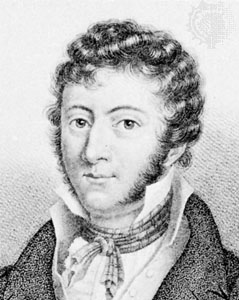
Samuel Lover, Irish songwriter, composer, novelist, and a painter of portraits, chiefly miniatures, dies on July 6, 1868. He was the grandfather of composer, cellist, and conductor Victor Herbert.

Lover is born at number 60 Grafton Street, Dublin and goes to school at Samuel Whyte’s at 79 Grafton Street, now home to Bewley’s, an Irish hot beverage company. By 1830 he is secretary of the Royal Hibernian Academy and lives at number 9 D’Olier Street. In 1835 he moves to London and begins composing music for a series of comic stage works. To some of them, like the operetta Il Paddy Whack in Italia (1841), he contributes both words and music, for others he merely contributes a few songs.

Lover produces a number of Irish songs, of which several – including The Angel’s Whisper, Molly Bawn, and The Four-leaved Shamrock – attain great popularity. He also writes novels, of which Rory O’Moore and Handy Andy are the best known, and short Irish sketches which, with his songs, he combines into a popular entertainment called Irish Nights or Irish Evenings. With the latter, he tours North America between 1846 and 1848. He joins with Charles Dickens in founding Bentley’s Magazine.

Lover’s grandson is composer Victor Herbert whose mother is Lover’s daughter Fanny. Irish-born and German-raised, Herbert is best known for his many successful musicals and operettas that premiere on Broadway. As a child he stays with the Lovers in a musical environment following the death of his father.

Samuel Lover dies on July 6, 1868, in Saint Helier on Jersey. A memorial in St. Patrick’s Cathedral, Dublin summarises his achievements:

Poet, painter, novelist and composer, who, in the exercise of a genius as distinguished in its versatility as in its power, by his pen and pencil illustrated so happily the characteristics of the peasantry of his country that his name will ever be honourably identified with Ireland.


Leave a comment

Birth of Dramatist George Shiels

George Shiels, Irish dramatist whose plays are a success both in his native Ulster and at the Abbey Theatre in Dublin, is born in Ballymoney, County Antrim on June 24, 1881. His most famous plays are The Rugged Path, The Passing Day, and The New Gossoon.

Shiels is born to Robert Shiels and Eileen (née MacSweeney). He emigrates to Canada as a young man. While working on the building of the Canadian Pacific Railway in 1913, he is involved in a serious accident that leaves him in a wheelchair for the rest of his life. He returns to Ballymoney and starts a shipping company with his brother and also begins writing. Starting with poems and short stories, he soon progresses to plays, which he provides to the Ulster Literary Theatre under the pen name of George S. Morsheils.

Starting with Bedmates (1921), his plays begin to be regularly accepted by the Abbey Theatre for production. His 1930 work The New Gossoon is so well-received that the Abbey’s touring company, The Abbey Theatre Irish Players, bring the play to Broadway for limited runs three times, in 1932, 1934, and 1937. In 1940, a production of Shiels’ The Rugged Path sets an Abbey record by attracting a total audience of 25,000 people over eight weeks.

When his success as a playwright allows him, he leaves the shipping business and moves to Carnlough on the coast of County Antrim, where he lives from 1932 until his death on September 19, 1949.


Leave a comment

Birth of Denis Johnston, Writer & Playwright

Irish writer William Denis Johnston is born in Ballsbridge, Dublin on June 18, 1901. He primarily writes plays, but also works of literary criticism, a book-length biographical essay of Jonathan Swift, a memoir and an eccentric work on cosmology and philosophy.

Johnston is a protégé of William Butler Yeats and George Bernard Shaw, and has a stormy friendship with Seán O’Casey. He is a pioneer of television and war reporting. He works as a lawyer in the 1920s and 1930s before joining the BBC as a writer and producer, first in radio and then in the fledgling television service. His broadcast dramatic work include both original plays and adaptation of the work of many different writers.

Johnston’s first play, The Old Lady Says “No!”, helps establish the worldwide reputation of the Dublin Gate Theatre. His second, The Moon in the Yellow River, has been performed around the globe in numerous productions featuring such actors as Jack Hawkins, Claude Rains and Errol Flynn, although not all in the same production. He plays a role in the 1935 film version of John Millington Synge‘s Riders to the Sea.

During World War II Johnston serves as a BBC war correspondent, reporting from El Alamein to Buchenwald. For this he is awarded an OBE, a Mentioned in Despatches and the Yugoslav Partisans Medal. He then becomes Director of Programmes for the television service.

Johnston later moves to the United States and teaches at Mount Holyoke College, Smith College and other universities. He keeps extensive diaries throughout his life, now deposited in the Library of Trinity College, Dublin. These, together with his many articles and essays, give a distinctive picture of his times and the people he knows. Another archive of his work is held at the library of Ulster University at Coleraine. He receives honorary degrees from the Ulster University and Mount Holyoke College and is a member of Aosdána.

The Denis Johnston Playwriting Prize is awarded annually by Smith College Department of Theatre for the best play, screen play, or musical written by an undergraduate at Smith, Mount Holyoke, Amherst College, Hampshire College and the University of Massachusetts Amherst.

Johnston’s war memoir Nine Rivers from Jordan reaches The New York Times Bestseller List and is cited in the World Book Encyclopedia‘s 1950s article on World War II under “Books to Read”, along with Churchill, Eisenhower et al. Joseph Ronsley cites an unnamed former CBS Vietnam correspondent who calls the book the “Bible”, carrying it with him constantly, “reading it over and over in the field during his tour of duty.”

Denis Johnston dies on August 8, 1984, in Ballybrack, Dublin. His daughter Jennifer Johnston is a respected novelist and playwright.


Leave a comment

Birth of Walter Frederick Osborne, Landscape & Portrait Painter

Walter Frederick Osborne, impressionist and Post-Impressionism landscape and portrait painter, is born in Rathmines, Dublin on June 17, 1859.

Most of Osborne’s paintings are figurative and focus on women, children, the elderly, the poor, and the day-to-day life of ordinary people on Dublin streets, as well as series of rural scenes. He also produces city-scapes, which he paints from both sketches and photographs. A prolific artist, he produces oils, watercolours, and numerous pencil sketches. He is best known for his documentary depictions of late 19th century working class life.

Osborne is the second of three sons of William Osborne, a successful animal painter who specialises in portraying horses and dogs for the then prosperous Irish landlords. He is educated at Rathmines School and at the Royal Hibernian Academy school. He learns from his father that there is money to be earned from painting animals. He produces quite a few, including of children with their pets, notably his 1885 A New Arrival, and a series of impressionistic works on cows.

Osborne wins the Taylor Prize in 1881 and 1882, the highest student honour in Ireland of the time, while studying at the Royal Academy of Fine Arts in Antwerp. He is influenced by the Flemish painter Peter Paul Rubens, and the French realist, plein-air painter, Jules Bastien-Lepage, as well as Berthe Morisot.

In 1883, Osborne moves from Antwerp to Brittany where he paints his famous Apple Gathering, Quimperlé, now in the National Gallery of Ireland. Soon after, he moves to England where he works alongside Nathaniel Hill and Augustus Burke at Walberswick. During his period, he often returns to Dublin to make preparatory sketches for what becomes his most renowned series, of the everyday lives of the city’s poor. Although highly regarded today, these documentary street paintings are not commercially successful, and Osborne supplements his income through portrait paintings of the middle class, which are not as artistically satisfying.

In 1886, he is elected to the Royal Hibernian Academy and receives many commissions for portraits. This is an important source of income, as he has no private means of his own. After his sister dies, he is involved in looking after her daughter, and his own parents become increasingly financially dependent on him.

In 1892, he returns to Ireland to live in the family residence, and he also keeps a studio at No. 7 St. Stephen’s Green. He spends a considerable amount of time painting outdoors, in Dublin around St. Patrick’s Cathedral or in the country. He is well liked in social circles and counts the surgeon Sir Thornely Stoker, brother of Bram Stoker, among his best friends.

Osborne’s mother becomes ill in the early 1900s, and Walter spends significant periods caring for her. In 1903, while gardening, he overheats himself and catches a chill, which he neglects, and which develops into pneumonia. He dies prematurely from the illness at the age of 43 on April 24, 1903. He is buried in Mount Jerome Cemetery in Dublin.

Some critics have suggested that at the time of his death he is on the brink of his artistic maturity. His final work Tea in the Garden, a fusion of naturalism and impressionism, remains unfinished at his death and is now in the collection of the Hugh Lane Gallery in Dublin. Today his work is highly sought after by collectors.


2 Comments

Birth of Charles Wood, Composer & Teacher

Charles Wood, composer and teacher, is born in Vicars’ Hill in the Cathedral precincts of Armagh, County Armagh on June 15, 1866. His pupils include Ralph Vaughan Williams at Cambridge and Herbert Howells at the Royal College of Music. For most of his adult life he lives in England, but preserves a lively interest in Ireland.

Wood is the fifth child and third son of Charles Wood, Sr. and Jemima Wood. He is a treble chorister in the choir of the nearby St. Patrick’s Cathedral. His father sings tenor as a stipendiary “Gentleman” or “Lay Vicar Choral” in the Cathedral choir and is also the Diocesan Registrar of the church. He is a cousin of Irish composer Ina Boyle.

Wood receives his early education at the Cathedral Choir School and also studies organ with two Organists and Masters of the Boys of Armagh Cathedral, Robert Turle and his successor Dr. Thomas Marks. In 1883 he becomes one of fifty inaugural class members of the Royal College of Music, studying composition with Charles Villiers Stanford and Charles Hubert Hastings Parry primarily, and horn and piano secondarily. Following four years of training, he continues his studies at Selwyn College, Cambridge through 1889, where he begins teaching harmony and counterpoint.

In 1889 he attains a teaching position at Gonville and Caius College, Cambridge, first as organ scholar and then as fellow in 1894, becoming the first Director of Music and Organist. He is instrumental in the reflowering of music at the college, though more as a teacher and organiser of musical events than as composer. After Stanford dies in 1924, Wood assumes his mentor’s vacant role as Professor of Music in the University of Cambridge.

Like his better-known colleague Stanford, Wood is chiefly remembered for his Anglican church music. As well as his Communion Service in the Phrygian mode, his settings of the Magnificat and Nunc dimittis are still popular with cathedral and parish church choirs, particularly the services in F, D, and G, and the two settings in E flat. During Passiontide his St. Mark Passion is sometimes performed, and demonstrates Wood’s interest in modal composition, in contrast to the late romantic harmonic style he more usually employs.

Wood’s anthems with organ, Expectans expectavi, and O Thou, the Central Orb are both frequently performed and recorded, as are his unaccompanied anthems Tis the day of Resurrection, Glory and Honour and, most popular of all, Hail, gladdening light and its lesser-known equivalent for men’s voices, Great Lord of Lords. All of Wood’s a cappella music demonstrates fastidious craftsmanship and a supreme mastery of the genre, and he is no less resourceful in his accompanied choral works which sometimes include unison sections and have stirring organ accompaniments, conveying a satisfying warmth and richness of emotional expression appropriate to his carefully chosen texts.

Wood collaborates with priest and poet George Ratcliffe Woodward in the revival and popularisation of renaissance tunes to new English religious texts, notably co-editing three books of carols. He also writes eight string quartets, and is co-founder of the Irish Folk Song Society in 1904.

He marries Charlotte Georgina Wills-Sandford, daughter of W. R. Wills-Sandford, of Castlerea, County Roscommon on March 17, 1898. Their son is killed in World War I.

Charles Wood dies on July 12, 1926 and is buried at the Ascension Parish Burial Ground in Cambridge alongside his wife.


Leave a comment

Birth of Andy Irvine, Musician & Singer-Songwriter

Andrew Kennedy Irvine, known as Andy Irvine, Irish folk musician and singer-songwriter, is born on June 14, 1942 in St. John’s Wood, London, England to an Irish mother from Lisburn, County Antrim, and a Scottish father from Glasgow. He is a founding member of popular bands Sweeney’s Men, Planxty, Patrick Street, Mozaik, LAPD and Usher’s Island. He plays the mandolin, mandola, bouzouki, harmonica and hurdy-gurdy.

Irvine has been influential in folk music for over five decades, during which he records a large repertoire of songs and tunes he assembles from books, old recordings and folk-song collectors rooted in the Irish, English, Scottish, Eastern European, Australian and American old-time and folk traditions. He sets these songs to new music and also writes songs about his personal experiences or the lives and struggles of his heroes, including Tom Barker, Michael Davitt, Mother Jones, Douglas Mawson, Raoul Wallenberg, and Emiliano Zapata.

Imbued with a sense of social justice, Irvine often selects or writes songs that are based on historical events and presented from the victim’s perspective. Some of these songs chronicle the abject living and working conditions imposed on groups of people such as the emigrants, the brutalized migrant workers, the exploited textile strikers or coalminers. Other songs recall the archetypal experiences of single individuals – the woman seduced by an unfaithful man or disowned by her father, the destitute young man ostracized or murdered on the order of his sweetheart’s rich father, the down-on-his-luck farmer or the unemployed worker, the young man inveigled by the army’s recruiting sergeant, the scapegoats. Irvine’s songs also denounce worker deaths and industrial diseases, and lament the plight of hunted animals. His repertoire includes humorous songs, but also bittersweet ones of unrequited love, or of lovers cruelly separated or dramatically reunited. He also sings about famous racehorses, men or women masquerading in various disguises, a fantastical fox preying on young maidens, and the violent lives of outlaws.

As a child actor, Irvine hones his performing talent from an early age and learns the classical guitar. He switches to folk music after discovering Woody Guthrie, also adopting the latter’s other instruments, the harmonica and mandolin. While extending Guthrie’s guitar picking technique to the mandolin, he further develops his playing of this instrument and, later, of the mandola and the bouzouki, into a decorative, harmonic style and embraces the modes and rhythms of Bulgarian folk music. Along with Johnny Moynihan and Dónal Lunny, Irvine is one of the pioneers who adapts the Greek bouzouki into an Irish instrument. He contributes to advancing the design of his instruments in cooperation with English luthier Stefan Sobell, and he occasionally plays a hurdy-gurdy made for him in 1972 by Peter Abnett, another English luthier.

Although touring mainly as a soloist, Irvine has also enjoyed great success in pursuing collaborations through many projects that have influenced contemporary folk music. He continues to tour and perform extensively in Ireland, Great Britain, Europe, North and South America, Japan, Australia and New Zealand.