Republican activists James Murphy and Patrick Kennedy are murdered in Dublin on February 9, 1921.
Murphy and Kennedy are arrested by Auxiliaries in Dublin and are in the custody of ‘F’ Company of the Auxiliary Division of the Royal Irish Constabulary (ADRIC). Two hours later, constables of the Dublin Metropolitan Police find the two men lying shot, with pails on their heads, in Clonturk Park, Drumcondra. Kennedy is dead and Murphy is dying. Murphy dies in Mater Hospital, Dublin on February 11, but just before dying he testifies that Captain William Lorraine King, commanding officer of ‘F’ Company ADRIC, had taken them and stated that they were “just going for a drive.” King is arrested for the killings. King and two of his men, H. Hinchcliffe and F.J. Welsh are court-martialed on February 13-15 but are acquitted after Murphy’s dying declaration is ruled inadmissible, and two officers from ‘F’ Company provide perjured alibis for Captain King at the time of the shootings.
King is implicated and court-martialed for the deaths of Conor Clune, Peader Clancy, and Dick McKee, the latter two leading lights in the Dublin Irish Republican Army (IRA), the former a luckless Gaelic League member. All three are captured in Dublin on November 20, 1920, the day before Bloody Sunday. Clune is caught at Vaughn’s Hotel in Parnell Square, Dublin and the two IRA leaders at Lower Gloucester St., complete with British army officer uniforms and detonators. Sometime between then and the next day, as news no doubt filters in of the deaths of several British intelligence officers, the prisoners are killed in questionable circumstances in the Dublin Castle guard room. According to an official report from Dublin Castle, the prisoners attempt to grab rifles and hurl unfused grenades and are killed in that action. The guards of ‘F’ Company in the room at the time are cleared of wrongdoing by a court inquiry. A Major Reynolds of ‘F’ Company is said to pass details of the killers to Michael Collins. The Times notes that it seems as if the prisoners had been lined up and shot. In a later novel, Major Jocelyn Lee Hardy more or less confesses to the killing of one of the prisoners.
Ironically, Captain King is on Michael Collins list of British Intelligence officers to be executed on the morning of November 20, 1920. He is not in his room when the assassins arrive as he is interrogating the prisoners in Dublin Castle.
(Pictured: Major William Lorraine King, ‘F’ Company Auxiliary Division of the Royal Irish Constabulary)
At least seven bombs explode in Central London on January 29, 1977. One person is injured. The Irish Republican Army (IRA) later claims responsibility.
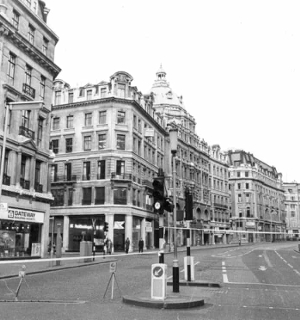
Hundreds of police seal off the Oxford Street area as Selfridges department store is set ablaze and one man is injured. The explosions occur over a two-mile area within 50 minutes. The bombs wreck buildings in Oxford Street, Regent Street, and Wardour Street, causing hundreds of thousands of pounds worth of damage and burying a taxi under the rubble, injuring the driver. Another man is trapped in a basement in Selfridges after the blast.
The attacks come less than 72 hours before the IRA commemoration of the Bloody Sunday massacre in Londonderry and, according to the police, bear all the hallmarks of the IRA. The bombs, left in doorways of shops and offices, are similar to those used in firebomb attacks on the centre of Belfast and Londonderry over the previous four years.
Hundreds of police are drafted into the Oxford Street area within minutes of the first blast, shortly after midnight. Police using sniffer dogs examine hundreds of cars stretched along Oxford Street and residents are warned to evacuate by police and fire officers using bullhorns. Dozens of fire engines respond to the resulting blaze in the huge department store.
A two-mile area around Oxford Street is cordoned off by police roadblocks shortly after the first explosions. Scotland Yard and the Fire Brigade are unable to keep pace with the bombs and fires as news reports flood in.
The first explosions occur in Wardour Street where two bombs blow out the front of a publishing office and a travel agency, hurling glass and furniture into the street. Within 20 minutes, three other bombs explode in Oxford Street, Regent Street, Poland Street and in the side-streets of Soho. The fire brigade simultaneously fights two major fires within a mile of each other, in Selfridges and in a building in Berwick Street, Soho. Debris from the bombs is littered around as bomb squad officers and police patrols begin examining all suspicious cars and packages in the area. Several bomb squad officers are standing within yards of a building when the fourth bomb, fortunately a small one, goes off.
The Assistant Commissioner for Crime, Jock Wilson, joins Bomb Squad officers in a special mobile control unit. A senior police officer says that many of the bombs are crammed through letterboxes in the business premises. However, the bomb at Selfridges is placed in the basement, police believe, on previous afternoon.
(Pictured: Police cordon off Regent Street following IRA bombs in the West End, London, January 1977. Photograph: ANL/REX/Shutterstock)
On Friday, January 21, 1921, eight men from the 1st Battalion IRA, set out to stage an ambush at Binn’s Bridge on Lower Drumcondra Road. The plan is to attack a Royal Irish Constabulary (RIC) patrol which uses the road to travel from their base at Gormanston, County Meath, near Drogheda.
Led by Lieutenant Francis “Frank” Flood (19), Michael Francis ‘Mick’ Magee (24) Patrick Doyle (29), Thomas Bryan (24), Bernard ‘Bertie’ Ryan (21) and Dermott O’Sullivan (17) set off at 8:30 AM for Binn’s Bridge. They are to ambush RIC Auxiliaries (Black and Tans) travelling into Dublin from Gormanston. However, the Auxiliaries do not arrive. The witness statement of Harry Colley, former Adjutant, IRA Dublin Brigade 1920-21, says “they had actually been sent to carry out the ambush at Binn’s Bridge, but for some reason of their own, when they reached the position, moved up beyond Tolka Bridge, to Clonturk Park.” According to Dermott O’Sullivan, the only survivor, when it appears that the Black and Tans will not be coming their way, the party leaves the Binn’s Bridge site and heads to Tolka Bridge in Drumcondra.
However, the police receive a tip-off from Sergeant Singleton of the Dublin Metropolitan Police (DMP). It is also said, that as the British army unit is approaching the bridge over the River Tolka in Drumcondra, they are warned by a man by the name Robert Pike from Tolka Cottages.
The ambushers commence an attack upon two lorries of RIC constables, who return fire until the vehicles are able to accelerate out of range. Then the Black and Tans arrive in motor lorries and an armored car at the rear of their position to cut off their escape. Some volunteers manage to dash across fields to safety but others are arrested as they attempted to seek refuge in houses in the vicinity. All of the prisoners are found in possession of revolvers and ammunition, and Frank Flood is also found to have a grenade in his pocket.
In an attempt to escape the Auxiliaries, Michael Magee and Séan Burke run across a field of garden allotments in Clonturk Park. The Auxiliaries shoot Magee, mortally wounding him in the legs and lower torso. Magee is captured but soon dies of his wounds.
So at the end of the day, of the eight men involved in the action at Drumcondra, two men, Burke and Dunne, escape the scene. The five remaining, Frank Flood, Thomas Bryan, Bernard Ryan, Patrick Doyle and Dermot O’Sullivan are captured and Magee dies of his wounds. The captives are tried by a court-martial that lasts two days. All of the accused are convicted of High Treason and sentenced to death.
On March 14, 1921, all of the men, save Dermot O’Sullivan, are hanged at Mountjoy Prison. Citing his age of only 17 years, the British commute O’Sullivan’s sentence to life in prison. He is released from Portland Gaol at the end of August 1921.
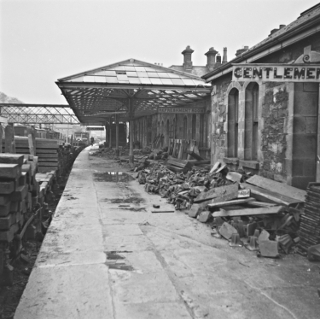
Forty Republicans burn the railway station in Sligo, County Sligo on January 11, 1923 during the Irish Civil War, destroying it and badly damaging seven engines and forty carriages. Seven engines are sent down the line to the quay and one crashes through a concrete wall into the harbour.
The Great Southern and Western Railway Company releases a report detailing the damage Anti-Treaty forces have caused to their property over the previous six months – 375 lines damaged, 42 engines derailed, 51 over-bridges and 207 under-bridges destroyed, 83 signal cabins, and 13 other buildings destroyed. In the same month, Republicans destroy the railway stations at Ballybunion and Listowel.
The Sligo station opens on December 3, 1862 when Sligo acquires rail links to Dublin. The Sligo, Leitrim and Northern Counties Railway link to Enniskillen to the north in 1881. A link to Limerick and the south follows in 1895. The line to Enniskillen closes in 1957 and passenger services to Limerick close in 1963. For many years CIÉ keeps the latter line open for freight traffic, and although it is now disused, it forms part of the Western Rail Corridor redevelopment project.
Today, Sligo Mac Diarmada station is a mainline railway station which serves the town of Sligo. It is a terminal station, with two platforms. There is a passing loop at the approach to the station. Iarnród Éireann, Ireland’s national railway operator, runs inter-city rail services between Sligo and Dublin on the Dublin-Sligo railway line.
Galvin serves as the publicity director for the New York-based NORAID, an Irish American group fundraising organization which raises money for the families of Irish republican prisoners, but is also accused by the American, British, and Irish governments to be a front for the supply of weapons to the Provisional Irish Republican Army
Galvin becomes a publisher of The Irish People in the 1980s. He is banned from Northern Ireland because of a speech he gives that seems to endorse terrorism. In August 1984 he defies the ban and enters Northern Ireland from the Republic of Ireland. The following year he returns to Northern Ireland to attend a funeral for an IRA member killed when a makeshift grenade launcher he is trying to fire at a Royal Ulster Constabulary barracks explodes. In 1989 Galvin is arrested and deported for violating the exclusion ban yet again.
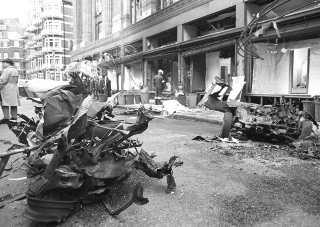
A Provisional Irish Republican Army (PIRA) car bomb kills six and injures ninety outside London‘s Harrods department store, a large, upmarket department store in the affluent Knightsbridge district near Buckingham Palace on December 17, 1983. The IRA Army Council claims that it has not authorised the attack and expresses regret for the civilian casualties. After the bombing, the IRA changes its tactic to focus on military targets on the mainland.
Harrods had been the target of an earlier IRA bomb on December 21, 1974, which was placed in the northeast corner of the first floor. There was a very short warning, and the store was in the process of being cleared when it exploded. It was also the target of a much smaller IRA bomb almost ten years later, in January 1993, which injured four people.
From 1973 the Provisional IRA has carried out waves of bombing attacks on commercial targets in London and elsewhere in England as part of its “economic war.” The goal is to damage the economy and cause disruption, which would put pressure on the British government to withdraw from Northern Ireland. On December 10, 1983, the IRA carries out its first attack in London in some time when a bomb explodes at the Royal Artillery Barracks, injuring three British soldiers.
One week later, on the afternoon of December 17, IRA members park a car bomb near the side entrance of Harrods, on Hans Crescent. The bomb contains 25 to 30 lbs. of explosives and is set to be detonated by a timer. It is left in a 1972 blue Austin 1300 GT four-door sedan. At 12:44 PM a man using an IRA codeword phones the central London branch of the Samaritans charity. The caller says there is a car bomb outside Harrods and another bomb inside Harrods and gives the car’s registration plate. According to police, he does not give any other description of the car.
The bomb explodes at about 1:21 PM, as four police officers in a car, an officer on foot and a police dog-handler near the suspect vehicle. Three officers and three bystanders are killed, and 90 others are injured, including 14 police officers. The blast damages 24 cars and all five floors on the side of Harrods, sending a shower of glass down onto the street. The police car absorbs much of the blast and this likely prevents further casualties.
Five people die at the scene of the bombing and a sixth later dies in the hospital. The bystanders who die are Philip Geddes (24), a journalist who had heard about the alert and went to the scene, Jasmine Cochrane-Patrick (25) and Kenneth Salvesen (28), a United States citizen. The Metropolitan Police Service officers killed are Sergeant Noel Lane (28) and Constable Jane Arbuthnot (22). A third officer, Inspector Stephen Dodd (34), dies in the hospital from his injuries on December 24. Constable Jon Gordon survives but loses both legs and part of a hand in the blast.
At the time of the explosion, a second warning call is made by the IRA. The caller says that a bomb has been left in the C&A department store at the east end of Oxford Street. Police clear the area and cordon it off, but this claim is found to be false. In the aftermath of the attack, hundreds of extra police and mobile bomb squads are drafted into London. Aleck Craddock, chairman of Harrods, reports that £1 million in turnover has been lost as a result of the bombing. Despite the damage, Harrods re-opens three days later, proclaiming it will not be “defeated by acts of terrorism.” Denis Thatcher, the husband of British Prime MinisterMargaret Thatcher, visits the store and tells reporters “no damned Irishman is going to stop me going there.”
During the subsequent Irish War of Independence (1919-1921) O’Connor is made Director of Engineering of the Irish Republican Army (IRA) – a military organisation descended from the Irish Volunteers.
O’Connor does not accept the Anglo-Irish Treaty of 1921, which establishes the Irish Free State and abolishes the Irish Republic declared in 1916, which he and his comrades had sworn to uphold. On March 26, 1922, the anti-treaty officers of the IRA hold a convention in Dublin in which they reject the Treaty compromise and repudiate the authority of the Dáil, the elected Irish Parliament. Asked by a journalist if this means they are proposing a military dictatorship in Ireland, O’Connor replies, “you can take it that way if you want.”
On April 14, 1922, O’Connor, with 200 other hardline anti-treaty IRA men under his command, takes over the Four Courts building in the centre of Dublin in defiance of the new Irish government. They want to provoke the British troops, who are still in the country, into attacking them, which they believe will restart the war with Britain and re-unite the IRA against their common enemy. Michael Collins tries desperately to persuade O’Connor and his men to leave the building before fighting breaks out.
On June 28, 1922, after the Four Courts garrison has kidnapped JJ “Ginger” O’Connell, a general in the new Free State Army, Collins shells the Four Courts with borrowed British artillery. O’Connor surrenders after two days of fighting and is arrested and held in Mountjoy Prison. This incident sparks the Irish Civil War as fighting breaks out around the country between pro and anti-treaty factions.
On December 8, 1922, along with Liam Mellows, Richard Barrett and Joe McKelvey, three other republicans captured with the fall of the Four Courts, Rory O’Connor is executed by firing squad in reprisal for the anti-treaty IRA’s killing of Free State member of parliament Sean Hales. The execution order is given by Kevin O’Higgins, who less than a year earlier had appointed O’Connor to be best man at his wedding, symbolising the bitterness of the division that the Treaty has caused. O’Connor, one of 77 republicans executed by the Cumann na nGaedheal government of the Irish Free State, is seen as a martyr by the Republican movement in Ireland.
As dusk falls the ambush takes place on a road at Dus a’ Bharraigh in the townland of Shanacashel, Kilmichael Parish, near Macroom.
Just before the Auxiliaries in two lorries come into view, two armed IRA volunteers, responding late to Barry’s mobilisation order, drive unwittingly into the ambush position in a horse and sidecar, almost shielding the British forces behind them. Barry manages to avert disaster by directing the car up a side road and out of the way. The Auxiliaries’ first lorry is persuaded to slow down by the sight of Barry placing himself on the road in front of a concealed Command Post, wearing an IRA officer’s tunic given to him by Paddy O’Brien. Concealed on the south side of the road are six riflemen, whose instructions are to prevent the enemy taking up positions on that side. Another six riflemen are positioned some way off as an insurance group, should a third Auxiliary lorry appear.
The first lorry, containing nine Auxiliaries, slows almost to a halt close to their intended ambush position, at which point Barry gives the order to fire. He throws a Mills bomb that explodes in the open cab of the first lorry. A savage close-quarter fight ensues. According to Barry’s account, some of the British are killed using rifle butts and bayonets in a brutal and bloody encounter. This part of the engagement is over relatively quickly with all nine Auxiliaries dead or dying.
While this part of the fight is going on, a second lorry also containing nine Auxiliaries has driven into the ambush position. This lorry’s occupants, at a more advantageous position than Auxiliaries in the first lorry because of their distance from the ambushing group, dismount to the road and exchange fire with the IRA, killing Michael McCarthy. Barry then brings the Command Post soldiers who had completed the attack on the first lorry to bear on this group. Barry claimed these Auxiliaries called out a surrender and that some dropped their rifles but opened fire again with revolvers when three IRA men emerged from cover, killing volunteer Jim O’Sullivan instantly and mortally wounding Pat Deasy. Barry then orders his men to open fire and not stop until told to do so. Barry ignores a subsequent attempt by remaining Auxiliaries to surrender and keeps his men firing until he believes all the Auxiliaries are dead.
At the conclusion of the fight, it is observed that two IRA volunteers, Michael McCarthy and Jim O’Sullivan, are dead and that Pat Deasy, brother of Liam Deasy, is mortally wounded. Although the IRA fighters think they had killed all of the Auxiliaries, two actually survive, one very badly injured and another who escapes and is later captured and shot dead. Among the 16 British dead on the road at Kilmichael is Francis Crake, commander of the Auxiliaries in Macroom, probably killed at the start of the action by Barry’s Mills bomb.
Many IRA volunteers are deeply shaken by the severity of the action, referred to by Barry as “the bloodiest in Ireland,” and some are physically sick. Barry attempts to restore discipline by making them form-up and perform drill, before marching away. Barry himself collapses with severe chest pains on December 3 and is secretly hospitalized in Cork. It is possible that the ongoing stress of being on the run and commander of the flying column, along with a poor diet as well as the intense combat at Kilmichael contribute to his illness, diagnosed as heart displacement.
The political fallout from the Kilmichael ambush outweighs its military significance. While the British forces in Ireland can easily absorb 18 casualties, the fact that the IRA had been able to wipe out a whole patrol of elite Auxiliaries is for them deeply shocking. The British forces in the West Cork area take their revenge on the local population by burning several houses, shops and barns in Kilmichael, Johnstown and Inchigeelagh, including all of the houses around the ambush site. On December 3, three IRA volunteers are arrested by the British Essex Regiment in Bandon, beaten and killed, and their bodies dumped on the roadside.
For the British government, the action at Kilmichael is an indication that the violence in Ireland is escalating. Shortly after the ambush, barriers are placed on either end of Downing Street to protect the Prime Minister‘s office from IRA attacks. On December 10, as a result of Kilmichael, martial law is declared for the counties of Cork, Kerry, Limerick and Tipperary.
The British military now has the power to execute anyone found carrying arms and ammunition, to search houses, impose curfews, try suspects in military rather than civilian courts and to intern suspects without trial. On December 11, in reprisal for Kilmichael and other IRA actions, the centre of Cork city is burned by Auxiliaries, British soldiers and Black and Tans, and two IRA men are assassinated in their beds. In separate proclamations shortly afterwards, the authorities sanction “official reprisals” against suspected Sinn Féin sympathisers and the use of hostages in military convoys to deter ambushes.
(Pictured: The Kilmichael Ambush Monument at the ambush site)
Ross and his twin brother Norris become sports journalists in 1950. In 1951, they found an agency to provide facts and figures to Fleet Street, setting out, in Norris McWhirter’s words “to supply facts and figures to newspapers, yearbooks, encyclopaedias and advertisers.” In the same year they publish Get to Your Marks.
While building up their accounts, they both work as sports journalists. One of the athletes they know and cover is runner Christopher Chataway, an employee at Guinness who recommends them to Hugh Beaver. After an interview in 1954 in which the Guinness directors enjoy testing the twins’ knowledge of records and unusual facts, the brothers agree to start work on the book that becomes The Guinness Book of Records. In August 1955, the first 198-page green volume is at the bookstalls, and in four more months it is the UK’s number one non-fiction best-seller. Both brothers are regulars on the BBC show Record Breakers. They are noted for their encyclopedic memories, enabling them to provide detailed answers to questions from the audience about entries in The Guinness Book of Records. Norris continues on the programme after Ross’s death.
In the early 1960s, McWhirter is a Conservative Party activist and seeks, unsuccessfully, the seat of Edmonton in the 1964 general election. Following his killing, his brother and others found the National Association for Freedom (later The Freedom Association).
McWhirter advocates various restrictions on the freedom of the Irish community in Britain, such as making it compulsory for all of them to register with the local police and to provide signed photographs of themselves when renting flats or booking into hotels and hostels. In addition, he offers a £50,000 reward for information leading to a conviction for several recent high-profile bombings in England that were publicly claimed by the Provisional Irish Republican Army (IRA). In doing so, he recognises that he might then be a target himself. This is considered a “bounty” by the IRA Army Council, a view that leads directly to the events that follow, although the idea is not originally his, but that of John Gouriet.
At 6:45 PM on November 27, 1975, McWhirter is shot and killed by two IRA volunteers, Harry Duggan and Hugh Doherty, both of whom are members of what becomes known as the Balcombe Street Gang, the group for whose capture McWhirter had offered the reward. He is shot with a .357 Magnum revolver at close range in the head and chest outside his home in Village Road, Bush Hill Park. He is taken to Chase Farm Hospital but dies soon after being admitted. His killers are captured and charged with his and nine other murders. They are sentenced to life imprisonment but freed in 1999 under the terms of the Good Friday Agreement.
Nationalists throughout Ireland wish to see the end of the IRA. In a response to a major speech by Adams, Mark Durkan, leader of the Social Democratic and Labour Party (SDLP), says IRA activity is playing into the hands of anti-Agreement unionists and calls on the IRA to cease all activity.
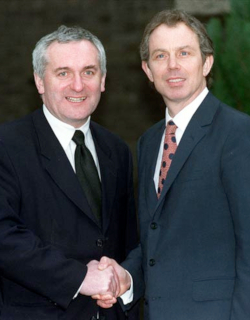
Adams tells elected Sinn Féin representatives from both sides of the Irish border in Monaghan that he can envision a future without the IRA. He also admits that “alleged” IRA activities are boosting the cause of those opposing the Northern Ireland peace process. However, he also tells Tony Blair that the IRA will never disband in response to ultimatums.
“He needs to recognise, however, that the Agreement requires an end to paramilitarism and that nationalists throughout this island fervently want one. It is time that republicans took heed of their call.”
The former Deputy First Minister in the devolved administration at Stormont says he welcomes Adams’ recognition that IRA activity is exacerbating the difficulties within unionism. “The reality is that IRA activity is playing right into the hands of anti-Agreement unionists. And letting the nationalist community badly down,” he said.
“It is also welcome that Gerry Adams has begun to recognise Sinn Féin’s credibility crisis. Too often republican denials have proved to be false in the past – be it over Colombia or Florida. This too has served only to create distrust and destabilise the Good Friday Agreement,” he adds.
In a major speech billed by his party as a considered response to the Prime Minister’s demand for an end to Republican-linked violence, Adams declares “Our view is that the IRA cessations effectively moved the army out of the picture – and allowed the rest of us to begin an entirely new process.” His speech is understood to have been handed in advance to both the British and Irish governments.
Adams says the continued IRA ceasefire and decommissioning initiatives demonstrated the organisation’s commitment to the peace process. “I do not pretend to speak for the army (IRA) on these matters, but I do believe that they are serious about their support for a genuine peace process. They have said so. I believe them,” he said. He adds, “The IRA is never going to respond to ultimatums from the British government or David Trimble.”
Fianna Fáil leader Bertie Ahern later says he welcomes and is encouraged by many aspects of Adams’ speech. He says the Sinn Féin leader’s strong statement of determination to keep the peace process intact and the recognition of the need to bring closure to all the key issues is a positive contribution at this difficult time in the Northern Ireland peace process.