seamus dubhghaill

Promoting Irish Culture and History from Little Rock, Arkansas, USA


Leave a comment

The Deal Barracks Bombing

deal-barracks-bombing

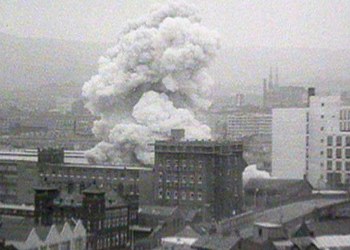
The Deal barracks bombing, an attack by the Provisional Irish Republican Army (IRA) on the Royal Marines School of Music building at the Royal Marine Depot in Deal, England, takes place on September 22, 1989. The building collapses, killing eleven marines from the Royal Marines Band Service and wounds 21 others.

Throughout the 1980s, the IRA has been waging a paramilitary campaign against targets in Britain and Northern Ireland with the stated aim of achieving the separation of Northern Ireland from the rest of the United Kingdom. These operations have included an attempt to kill British Prime Minister Margaret Thatcher in 1984 and a similar attack on a military band in London in 1982.

At 8:22 AM on September 22, 1989, a 15 lb. time bomb detonates in the recreational centre changing room at the Royal Marines School of Music. The blast destroys the recreational centre, levels the three-story accommodation building next to it, and causes extensive damage to the rest of the base and nearby civilian homes. The blast is heard several kilometres away, shaking windows in the centre of Deal, and creating a large pall of smoke over the town. Most of the personnel who use the building as a barracks have already risen and are practising marching on the parade ground when the blast occurs. These marines witness the buildings collapse and many of the personnel are in a state of shock for days afterwards.

Some marines remain behind in the building and thus receive the full force of the explosion. Many are trapped in the rubble for hours and military heavy lifting equipment is needed to clear much of it. Kent Ambulance Service voluntarily agrees to end its industrial strike action to aid those wounded by the blast. Ten marines die at the scene with most trapped in the collapsed building, although one body is later found on the roof of a nearby house. Another 21 are seriously injured and receive treatment at hospitals in Dover, Deal, and Canterbury. One of these men, 21-year-old Christopher Nolan, dies of his wounds on October 18, 1989. Three of those killed are buried nearby at the Hamilton Road Cemetery in Deal.

The IRA claims responsibility for the bombing, saying it is a continuation of their campaign to rid Northern Ireland of all British troops who have been deployed there since 1969. Many British people are shocked at the attack, carried out on a ceremonial military band whose only military training is geared towards saving lives.

The British Government also condemns the IRA’s attack. Prime Minister Margaret Thatcher makes a statement from Moscow, where she is on an official visit, saying that she is “shocked and extremely sad.” Leader of the Official Opposition, Neil Kinnock, describes the attack as an “awful atrocity” and says, “Even the people who say they support what the IRA calls its cause must be sickened by the way in which such death and injury is mercilessly inflicted.”

One week after the bombing, the staff and students at the School of Music march through the town of Deal, watched and applauded by thousands of spectators. They maintain gaps in their ranks to mark the positions of those unable to march through death or serious injury.

4 Comments

Founding of “The Squad” (“The Twelve Apostles”)

the-squad

The Squad, originally nicknamed the Twelve Apostles, an Irish Republican Army (IRA) unit founded by Michael Collins to counter British intelligence efforts during the Irish War of Independence, is officially established on September 19, 1919, at 46 Rutland Square although by this time it has already been in operation for two months and has already carried out two killings.

On April 10, 1919, the First Dáil announces a policy of ostracism of Royal Irish Constabulary men. At the time Sinn Féin official policy is against acts of violence. Boycotting, persuasion, and mild intimidation succeed against many officers. However, others escalate their activities against republicans and in March 1920 Collins asks Dick McKee to select a small group to form an assassination unit.

When the squad is formed, it comes directly under the control of the Director of Intelligence or his deputy and under no other authority. The Squad is commanded by Mick McDonnell.

The original ‘Twelve Apostles’ are Mick McDonnell, Tom Keogh, Jimmy Slattery, Paddy Daly, Joe Leonard, Ben Barrett, Vincent Byrne, Sean Doyle, Paddy Griffin, Eddie Byrne, Mick Reilly, and Jimmy Conroy. After some time, the Squad is strengthened with the addition of Ben Byrne, Frank Bolster, Mick Keogh, Mick Kennedy, Bill Stapleton, and Sam Robinson. They are employed full-time and receive a weekly wage.

Sometimes the squad is strengthened as occasion demands by members of the Intelligence staff, the Active Service Unit, munition workers, and members of the Dublin Brigade.

On July 30, 1919, the first assassination authorised by Michael Collins is carried out when Detective Sergeant “the Dog” Smith is shot near Drumcondra, Dublin. The Squad continues targeting plainclothes police, members of the G Division of the Dublin Metropolitan Police, and occasionally, problematic civil servants. Organisationally it operates as a subsection of Collins’ Intelligence Headquarters. Two of the executions by The Squad are the killing on January 21, 1920, of RIC Inspector William Redmond of the DMP “G” Division and on March 2, 1920, of British double agent John Charles Byrnes.

One of the Apostles’ particular targets is the Cairo Gang, a deep-cover British intelligence group, so called since it has either been largely assembled from intelligence officers serving in Cairo or from the Dublin restaurant called The Cairo, which the gang frequents. Sir Henry Wilson brings in the Cairo Gang in mid-1920, explicitly to deal with Michael Collins and his organization. Given carte blanche in its operations by Wilson, the Cairo Gang adopts the strategy of assassinating members of Sinn Féin unconnected with the military struggle, assuming that this would cause the IRA to respond and bring its leaders into the open.

The most well-known operation executed by the Apostles occurs on Bloody Sunday, November 21, 1920, when British MI5 officers, linked to the Cairo Gang and significantly involved in spying, are shot at various locations in Dublin. Fourteen are killed and six are wounded. In addition to the Twelve Apostles, a larger number of IRA personnel are involved in this operation. The only IRA man captured during the operation is Frank Teeling. In response to the killings, the Black and Tans retaliate by shooting up a Gaelic football match between Dublin and Tipperary at Croke Park, killing fourteen civilians including one of the players, Michael Hogan, and wounding sixty-eight. The Hogan stand at Croke Park is named after him.

In May 1921, after the IRA’s Dublin Brigade takes heavy casualties during the burning of the Custom House, the Squad and the Brigade’s Active Service Unit are combined into the Dublin Guard, under the direction of Paddy Daly. Under the influence of Daly and Michael Collins, most of the Guard takes the Free State side and joins the Irish Army in the Irish Civil War of 1922-23. During this conflict some of them are attached to the Criminal Investigation Department and are accused of multiple assassinations of Anti-Treaty fighters.

(Pictured: Squad Members Mick McDonnell, Liam Tobin, Vinny Byrne, Paddy Daly, and Jim Slattery)


Leave a comment

Birth of Hunger Striker Edward Martin Hurson

edward-martin-hurson

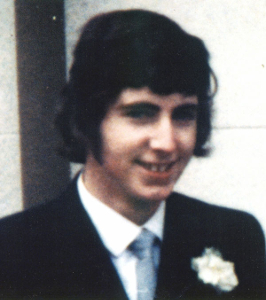
Edward Martin Hurson, Irish republican hunger striker and a volunteer in the East Tyrone Brigade of the Provisional Irish Republican Army (IRA), is born in Cappagh, County Tyrone, on September 13, 1956.

Hurson is one of nine children born to Johnnie and Mary Ann Hurson. Both of his parents come from the Cappagh district, and every member of the family is born into the white-washed farmhouse perched precipitously on top of the thirty hilly acres of rough land. Martin is close to the land as he grows up. He is educated to a primary level at Crosscavanagh Primary School in Galbally and at secondary level in St. Patrick’s, Galbally. When he is not at school, he is more often than not helping out about the farm, driving a tractor, helping to rear “croppy pigs,” or looking after cattle.

After leaving school, he works as an apprentice fitter welder for a while before going to Manchester, England where he stays for eighteen months with his brother Francis and works in the building trade. Returning to County Tyrone around Christmas of 1974, both he and his brother spend time in Bundoran, County Donegal, a known IRA training and supply centre.

Hurson, together with Kevin O’Brien, Dermot Boyle, Peter Kane, and Pat O’Neill are arrested and taken to the Omagh Royal Ulster Constabulary (RUC) barracks on November 11, 1976. He is beaten about the head, back, and testicles, spread-eagled against a wall and across a table, slapped, punched, and kicked. Under torture Martin signs statements admitting involvement in republican activity. On Saturday night, November 13, Martin is charged with a landmine explosion at Galbally in November 1975.

This charge is later dropped, but he is then further charged with IRA membership and explosive offences. Hurson spends a year on remand before being convicted in November 1977 and sentenced to 20 years for possession of landmines and conspiracy. He appeals his conviction on the grounds that the judge had ignored medical evidence about his ill-treatment.

The appeal is dismissed but he is granted a retrial. At the four-day trial in September 1979, the Omagh statements are ruled inadmissible, but instead of Martin walking free the judge goes on to accept the admissibility of the Cookstown statements, themselves extracted under threat of renewed torture. Following his retrial, he appeals his conviction once again, challenging the admissibility of the Cookstown statements, but his appeal is disallowed in June 1980.

Hurson becomes engaged to his long-term girlfriend, Bernadette Donnelly, while in prison. He is part of the blanket protest and joins the 1981 Irish Hunger Strike on May 28, replacing South Derryman Brendan McLaughlin who withdraws following a perforated stomach ulcer.

He loses the ability to hold down water after approximately 40 days on hunger strike and suffers a horrifically agonising death due to dehydration at 4:30 AM on July 13, after only 46 days on hunger strike, considerably shorter than any other hunger striker. Near the end his family considers the possibility of intervening to save his life, but they are told that he will likely have permanent brain damage.


Leave a comment

The Assassination of Michael Collins

michael-collins

Michael Collins, soldier and politician who is a leading figure in the struggle for Irish independence in the early 20th century, is shot and killed in ambush at Béal na Bláth, County Cork, on August 22, 1922.

In August 1922, the Irish Civil War seems to be winding down. The Irish Free State has regained control of most of the country and Collins is making frequent trips to inspect areas recently recovered from anti-Treaty forces.

His plan to travel to his native Cork on August 20 is considered particularly dangerous and he is strenuously advised against it by several trusted associates. County Cork is an Irish Republican Army (IRA) stronghold, much of it still held by anti-Treaty forces. Yet he seems determined to make the trip without delay. He has fended off a number of attempts on his life in the preceding weeks and has acknowledged more than once, in private conversation, that the Civil War might end his life at any moment. On several occasions Collins assures his advisors that they will not shoot him in his own county.

On August 22, 1922, Collins sets out from Cork City on a circuitous tour of West Cork. He passes first through Macroom then takes the Bandon road via Crookstown. This leads through Béal na Bláth, an isolated crossroads. There they stop at a local pub, now known as the The Diamond Bar, to ask a question of a man standing at the crossroad. The man turns out to be an anti-Treaty sentry. He and an associate recognise Collins in the back of the open-top car. As a result, an ambush is laid by an anti-Treaty column at that point, on the chance that the convoy might come through again on their return journey.

Shortly before 8:00 PM, Collins’ convoy approaches Béal na Bláth for the second time. By that time most of the ambush party has dispersed and gone for the day, leaving just five or six men on the scene. Two are disarming a mine in the road, while three on a laneway overlooking them, provide cover. A dray cart, placed across the road, remains at the far end of the ambush site.

Shots are exchanged. Collins, who suffers a head wound, is the only fatality. Almost every other detail of what happens is uncertain, due to conflicting reports from participants and other flaws in the record.

michael-collins-body

Some of the most disputed details include how the shooting starts, what kind of fire the convoy comes under, where the ambushers’ first shots strike, where Collins is and what he is doing when he is hit, whether anyone else is wounded, whether the armoured car’s machine gun is fully functional throughout the engagement, who moves Collins’ body, and who is nearby when Collins falls.

Many questions have been raised concerning the handling of Collins’s remains immediately following his death. Among them are the inordinately long time the convoy takes to cover the twenty miles back to Cork City, who searched his clothes, and what became of documents he is known to have been carrying on his person.

Collins’s body is transported by sea from Cork to Dublin. He lay in state for three days in Dublin City Hall where tens of thousands of mourners file past his coffin to pay their respects, including many British soldiers departing Ireland who had fought against him. His funeral mass takes place at Dublin’s Pro Cathedral where a number of foreign and Irish dignitaries are in attendance. Some 500,000 people attend his funeral, almost one fifth of the country’s population at that time.

No official inquiry is ever undertaken into Collins’s death and consequently there is no official version of what happened, nor are there any authoritative, detailed contemporary records.

An annual commemoration ceremony takes place each year in August at the ambush site at Béal na Bláth, County Cork, organised by The Béal na mBláth Commemoration Committee. There is also a remembrance ceremony in Dublin’s Glasnevin Cemetery at Collins’s grave on the anniversary of his death.


Leave a comment

IRA Announces End of 36-Year Armed Campaign

ira-ends-armed-campaignThe Irish Republican Army (IRA) issues a statement on July 28, 2005, announcing the end of its 36-year armed campaign and its resumption of disarmament. The campaign of armed conflict has a cost 3,500 lives, 1,800 of them at the hands of the Provisionals.

The IRA says its members have been ordered to pursue peaceful means and not to “engage in any other activities whatsoever” – a reference to the low-level paramilitary activities which have angered not just unionists, but the London and Dublin governments. The IRA gives no indication that it will disband.

Sinn Féin president Gerry Adams calls it an “emotional day” and, flanked by senior members of Sinn Féin, speaks directly to IRA volunteers by saying, “National liberation struggles have different phases – a time for struggle, a time for war, and also a time to engage, to put the war behind us all – this is that time.” He declares the IRA statement means the group is now committed to “purely peaceful and democratic methods” and calls it “a direct challenge to the Democratic Unionist Party (DUP) to decide if they want to put the past behind them and make peace with the rest of the people of the island.”

The DUP reserves judgment, although an initial “holding statement” on their website from the party leader, Rev. Ian Paisley, criticises the failure to declare clearly they will end all criminal activity.

Taoiseach Bertie Ahern says the British and Irish governments have worked for 11 years for this outcome. He says, “The war is over, the IRA’s armed campaign is over, paramilitarism is over and I believe that we can look to the future of peace and prosperity based on mutual trust and reconciliation and a final end to violence.”

Praising the “clarity” of the IRA statement, British Prime Minister Tony Blair says, “This may be the day when finally, after all the false dawns and dashed hope, peace replaces war, politics replaces terror on the island of Ireland.”

The IRA statement follows the release the previous night of IRA bomber Sean Kelly by the British government “on the expectation” of a move by the terrorist group.


Leave a comment

Bloody Friday in Belfast

bloody-friday-1972

At least twenty Provisional Irish Republican Army (IRA) bombs explode in Belfast on July 21, 1972, during the Troubles in what has become known as “Bloody Friday.” Most of the bombs are car bombs and most target infrastructure, especially the transport network. Nine people are killed, including two British soldiers and five civilians, while 130 are injured.

In late June and early July 1972, a British government delegation led by William Whitelaw holds secret talks with the Provisional IRA leadership. As part of the talks, the IRA agrees to a temporary ceasefire beginning on June 26. The IRA leaders seek a peace settlement that includes a British withdrawal from Northern Ireland by 1975 and the release of republican prisoners. However, the British refuse and the talks break down. The ceasefire comes to an end on July 9.

Bloody Friday is the IRA’s response to the breakdown of the talks. According to the IRA’s Chief of Staff, Seán Mac Stíofáin, the main goal of the bombing operation is to wreak financial harm. It is a “message to the British government that the IRA could and would make a commercial desert of the city unless its demands were met.” Some also see it as a reprisal for Bloody Sunday in Derry six months earlier. The attack is carried out by the IRA’s Belfast Brigade and the main organiser is Brendan Hughes, the brigade’s Officer Commanding.

The bombings occur during an 80-minute period on the afternoon of Friday, July 21. At least 24 bombs are planted. At least 20 explode and the rest fail to detonate or are defused. At the height of the bombing, the middle of Belfast “resembled a city under artillery fire; clouds of suffocating smoke enveloped buildings as one explosion followed another, almost drowning out the hysterical screams of panicked shoppers.” According to The Guardian, “for much of the afternoon, Belfast was reduced to near total chaos and panic. Thousands streamed out of the stricken city…and huge traffic jams built up. All bus services were cancelled, and on some roads, hitchhikers frantically trying to get away lined the pavements.”

Nine people are killed and 130 are injured, some of them horrifically mutilated. Of those injured, 77 are women and children. All of the deaths are caused by two of the bombs – at Oxford Street bus depot and at Cavehill Road. The Oxford Street bomb kills two British soldiers and four Ulsterbus employees. One employee is a Royal Ulster Constabulary (RUC) reservist, one is an Ulster loyalist paramilitary, and the other two are civilians. The Cavehill Road bomb kills three civilians.

The IRA’s Belfast Brigade claims responsibility for the bombings and says that it had given warnings to the security forces before the bombs exploded. It says that the Public Protection Agency, the Samaritans and the press “were informed of bomb positions at least 30 minutes to one hour before each explosion.” Mac Stíofáin says, “It required only one man with a loud hailer to clear each target area in no time” and alleged that the warnings for the two bombs that claim lives are deliberately ignored by the British for “strategic policy reasons.”


Leave a comment

Death of Francis McCloskey, First Fatality of “The Troubles”

the-troubles

Francis McCloskey, a 67-year-old Catholic civilian, dies on July 14, 1969, one day after being hit on the head with a baton by an officer of the Royal Ulster Constabulary (RUC) during street disturbances in Dungiven, County Derry. McCloskey is sometimes considered to be the first fatality of The Troubles.

McCloskey is found unconscious on July 13 near the Dungiven Orange Hall following a police baton charge against a crowd who had been throwing stones at the hall. Witnesses later say they had seen police beating a figure with batons in the doorway where McCloskey is found, although police claim he had been unconscious before the baton charge and may have been hit with a stone.

The Troubles is the common name for the ethno-nationalist conflict in Northern Ireland that begins in the late 1960s and is deemed by most to end with the Good Friday Agreement of 1998. Although the Troubles mainly take place in Northern Ireland, violence spills over at times into parts of the Republic of Ireland, England, and mainland Europe.

The conflict is primarily political, but it also has an ethnic or sectarian dimension, although it is not a religious conflict. A key issue is the constitutional status of Northern Ireland. Unionists and loyalists, who are mostly Protestants and consider themselves British, generally want Northern Ireland to remain within the United Kingdom. Irish nationalists and republicans, who are mostly Catholic and consider themselves Irish, generally want it to leave the United Kingdom and join a united Ireland. The conflict begins amid a campaign to end discrimination against the Catholic/nationalist minority by the Protestant/unionist government and police force in 1968. The campaign is met with violence, eventually leading to the deployment of British troops and subsequent warfare.

The main participants in the Troubles are republican paramilitaries such as the Provisional Irish Republican Army (IRA) and Irish National Liberation Army (INLA), loyalist paramilitaries such as the Ulster Volunteer Force (UVF) and Ulster Defence Association (UDA), the British Army and Royal Ulster Constabulary (RUC), and political activists and politicians. The security forces of the Republic of Ireland play a smaller role. More than 3,500 people are killed in the conflict, of whom 52% were civilians, 32% are members of the British security forces, and 16% are members of paramilitary groups. There has been sporadic violence since the signing of the Good Friday Agreement, including a campaign by anti-ceasefire republicans.


1 Comment

Edward Martin Hurson Dies on Hunger Strike

edward-martin-hursonEdward Martin Hurson, a volunteer in the East Tyrone Brigade of the Provisional Irish Republican Army (IRA), dies on July 13, 1981, after 46 days on hunger strike.

Hurson, from Cappagh, County Tyrone, Northern Ireland, is one of nine children born to Johnnie and Mary Ann Hurson. He is educated to a primary level at Crosscavanagh Primary School in Galbally and at secondary level in St. Patrick’s, Galbally.

After leaving school, he works as a welder for a while before going to England where he stays for eighteen months with his brother Francis and works in the building trade. Returning to County Tyrone at the end of 1974, both he and his brother spend time in Bundoran, County Donegal, a known IRA training and supply centre.

In November 1976, Hurson, together with Kevin O’Brien, Dermot Boyle, Peter Kane, and Pat O’Neill are arrested. Hurson is tried and convicted of involvement in three IRA landmine incidents, one at Cappagh in September, one at Galbally, County Tyrone in November 1975 and a third at Reclain in February 1976, when several members of the Royal Ulster Constabulary and Ulster Defence Regiment narrowly escape being killed. He receives concurrent sentences of twenty, fifteen, and five years for these convictions.

Hurson becomes engaged to his long-term girlfriend, Bernadette Donnelly, while in prison. He is part of the blanket protest and joins the 1981 Irish Hunger Strike on May 28, replacing Brendan McLaughlin who withdraws following a perforated stomach ulcer.

He loses the ability to hold down water after about 40 days on hunger strike, and dies of dehydration after only 46 days, considerably shorter than any other hunger striker (the next shortest is Francis Hughes at 59 days). Near the end, his family considers the possibility of intervening to save his life, but they are told that he would probably have permanent brain damage.


Leave a comment

The Springhill Massacre

springhill-massacre

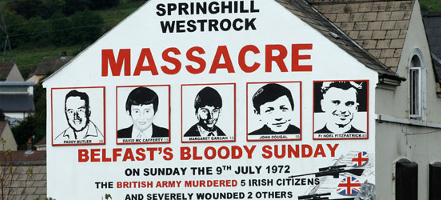
The Springhill Massacre, a shooting incident which claims five lives in the Springhill estate in west Belfast, takes place on July 9, 1972. Three civilians, including a Catholic priest, and two members of Fianna Éireann are shot dead by British Army snipers firing from a timber yard.

The Northern Ireland Troubles have been raging for three years and hundreds have already been killed by the two warring factions in Northern Ireland, unionists, including Ulster loyalists and the British Army, and Irish republicans wanting unification with the Republic of Ireland. Violence has been taking place all day and the five dead are part of ten people killed on that day.

According to a Provisional Irish Republican Army (IRA) statement on July 10, British Army snipers take up sniping positions in Corry’s timber yard and reinforced them with sandbags. Two cars pull into Springhill and the snipers fire two shots at them. One of the cars flees while the other drives a short distance and stops. The occupants get out and the snipers open fire again, seriously wounding one with a shot in the back of the head. A resident rushes to help the injured man but is immediately shot in the arm. This man’s brother and a friend run to the downed occupant, but both are shot by the snipers. At some point during this time a 13-year-old girl is fatally shot by the snipers. The parish priest, waving a white cloth, and a passer-by rush to her but a sniper kills both with a single bullet that passes through both their heads. All of the victims are unarmed.

The British Army disputes the IRA’s version of events and claims its troops were fired on first by the IRA, ending a temporary IRA ceasefire. A British Army spokesman states, “There has been a heavy exchange of fire between the IRA and troops. Some of the dead and wounded were undoubtedly caught in the crossfire.” On July 10, the British Army claims that it has killed terrorists. An open verdict is recorded at the inquest into the events.

No British soldier has been held accountable for these murders.


Leave a comment

Cathal Brugha Fatally Wounded by Sniper

cathal-brugha

Cathal Brugha, a leading figure in the Anti-Treaty Irish Republican Army (IRA), is shot by a sniper on July 5, 1922, as he appears in the doorway of the Hammam Hotel during the Irish Civil War. He dies two days later.

Brugha is born in Dublin of mixed Roman Catholic and Protestant parentage. He is the tenth of fourteen children and is educated at the Jesuit Belvedere College but is forced to leave at the age of sixteen because of the failure of his father’s business.

In 1899, Brugha joins the Gaelic League, and subsequently changes his name from Charles Burgess to Cathal Brugha. He becomes actively involved in the Irish Republican Brotherhood (IRB) and in 1913 he becomes a lieutenant in the Irish Volunteers. He leads a group of twenty Volunteers to receive the arms smuggled into Ireland in the Howth gun-running of 1914.

Brugha is second-in-command at the South Dublin Union under Commandant Éamonn Ceannt in the Easter Rising of 1916. On the Thursday of Easter Week, being badly wounded, he is unable to leave when the retreat is ordered. Brugha, weak from loss of blood, continues to fire upon the enemy and is found by Éamonn Ceannt singing God Save Ireland with his pistol still in his hands. Initially not considered likely to survive, he recovers over the next year but is left with a permanent limp.

During the War of Independence, Brugha organises an amalgamation of the Irish Volunteers and the Irish Citizen Army into the Irish Republican Army (IRA). He proposes a Republican constitution at the 1917 Sinn Féin convention which is unanimously accepted. In October 1917, he becomes Chief of Staff of the Irish Republican Army and holds that post until March 1919.

Brugha is elected speaker of Dáil Éireann at its first meeting on January 21, 1919, and he reads out the Declaration of Independence in Irish. On the following day, he is appointed president of the ministry pro tempore and retains this position until April 1, 1919, when Éamon de Valera takes his place.

In the months between the Anglo-Irish Treaty debates and the outbreak of Civil War, Brugha attempts to dissuade his fellow anti-treaty army leaders, including Rory O’Connor, Liam Mellows, and Joe McKelvey, from taking up arms against the Free State. When the IRA occupies the Four Courts, he and Oscar Traynor call on them to abandon their position. When they refuse, Traynor orders the occupation of the area around O’Connell Street in the hope of easing the pressure on the Four Courts and of forcing the Free State to negotiate.

On 28 June 1922, Brugha is appointed commandant of the forces in O’Connell Street. The outbreak of the Irish Civil War ensues in the first week of July when Free State forces commence shelling of the anti-treaty positions.

Most of the anti-Treaty fighters under Oscar Traynor escape from O’Connell Street when the buildings they were holding catch fire, leaving Brugha in command of a small rearguard. On 5 July, he orders his men to surrender but refuses to do so himself. He then approaches the Free State troops, brandishing a revolver. He sustains a bullet wound to the leg which severs a major artery, ultimately causing him to bleed to death on July 7, 1922, eleven days before his 48th birthday. He is buried in Glasnevin Cemetery.