seamus dubhghaill

Promoting Irish Culture and History from Little Rock, Arkansas, USA


Leave a comment

Death of Kevin Boland, Fianna Fáil Politician

Kevin Boland, Fianna Fáil politician who serves as Leader of Aontacht Éireann from 1971 to 1976, Minister for Social Welfare from 1961 to 1966 and 1969 to 1970, Minister for Local Government from 1966 to 1970 and Minister for Defence from 1957 to 1961, dies in Dublin on September 23, 2001. He also serves as a Teachta Dála (TD) from 1957 to 1970. He is one of six TDs appointed as a Minister on their first day in the Dáil Éireann.

Boland is born in Dublin on October 15, 1917. He attends St. Joseph’s, Fairview, leaving in 1933. He is the son of Gerald Boland, a founder-member of Fianna Fáil, and the nephew of Harry Boland. Despite this, he fails to get elected to Dáil Éireann on his first two attempts, standing in the Dublin County constituency at the 1951 Irish general election and again at the 1954 Irish general election. Double success follows at the 1957 Irish general election, when he is not only elected to the 16th Dáil but is appointed to the cabinet as Minister for Defence on his very first day in the Dáil. This is due to the retirement of his father who had served in every Fianna Fáil government since 1932.

The Defence portfolio is largely considered a safe and uncontroversial position, so Boland makes only a small impact. As a Minister, he proudly displays a fáinne (gold ring) on the lapel of his jacket, which indicates that he is able and willing to speak the Irish language. He frequently conducts his governmental business in Irish. In 1961, he is moved from Defence to become the Minister for Social Welfare. He remains there until the retirement in 1966 of the Taoiseach, Seán Lemass, when Fianna Fáil faces the first leadership contest in its history. He is then appointed Minister for Local Government which post he holds until he leaves government in 1970.

The leadership race immediately erupts as a two-horse battle between Charles Haughey and George Colley. Both of these men epitomise the new kind of professional politician of the 1960s. Things change when Neil Blaney indicates his interest in running. Boland supports him in his campaign, as both men hail from the republican and left wing of the party. There is talk at one point of Boland himself entering the leadership race. In the end Jack Lynch is chosen as a compromise, and he becomes the new Taoiseach. Boland is made Minister for Local Government in the new cabinet.

In 1969, events in Northern Ireland cause political chaos over the border in Ireland. It is the start of The Troubles in Northern Ireland and Fianna Fáil’s policy with regard to the North is coming into question. One crisis meeting is held after another, in which the possibility of decisive action is discussed. The “hawks” in the cabinet urge a symbolic invasion of Northern Ireland to protect nationalists near the border, and to draw international attention, while the “doves”, who ultimately prevail, urged caution. These cabinet meetings are heated events. On one occasion Boland is alleged to have been so angry that he resigns not only his cabinet position but also his Dáil seat and goes home to his farm in County Dublin to make hay. The resignations are rejected by Taoiseach Jack Lynch after a calming-down period. In what becomes known as the Arms Crisis, two ministers, Charles Haughey and Neil Blaney, are sacked from the government in May 1970, for allegedly being involved in a plot to import arms for Republicans in the North. Boland resigns in solidarity with them and in protest about the government’s position on the North. Later that year his criticism of the Taoiseach (whom Boland and many others within the Party maintain had authorized the arms importation) leads to his expulsion from the Fianna Fáil party.

One of Boland’s most famous incidents takes place at the Fianna Fáil Ardfheis in 1971. Just before Jack Lynch’s speech Boland storms a nearby podium, interrupting Patrick Hillery in the middle of his speech. He openly defies the party leadership and his opponents, holding his arms wide open and shouting to the crowd, “Come on up and put me down.” While there is a lot of booing and clapping in an effort to drown him out, many of his supporters start cheering and chanting “We want Boland.” An enraged Patrick Hillery grabs his microphone and famously replies, “If you want a fight, you can have it…You can have Boland, but you can’t have Fianna Fáil.” At this point the government supporters are ecstatic with cheering and Boland is carried out of the hall.

After this episode Boland founds his own political party, Aontacht Éireann (Irish Unity). It wins very little support, and he fails to be elected to the Dáil in 1973, which effectively ends his political career. He and his colleagues resign from the party in 1976 after it is taken over by a number of far-right individuals. He remains an outspoken critic of the Republic’s Northern Ireland policy, particularly the Sunningdale Agreement. He makes one last attempt to reclaim a Dáil seat, standing unsuccessfully in the Dublin South-West constituency at the 1981 Irish general election. He then retires from public life completely.

In 1996, Boland sues the Irish Independent for libel after a January 20, 1993, article incorrectly states that he had appeared before the court in the Arms Trial in 1970 and had been dismissed as a Minister by Taoiseach Jack Lynch. He is awarded £75,000 in damages.

Kevin Boland dies at the age of 83 in Dublin on September 23, 2001, following a short illness.


Leave a comment

Death of Seán MacBride, Politician & Chief of Staff of the IRA

Seán MacBride, Irish government minister, prominent international politician, and a former Chief of Staff of the Irish Republican Army (IRA), dies in Dublin at the age of 83 on January 15, 1988.

MacBride is born in Paris on January 26, 1904. He is the son of Major John MacBride and Maud Gonne. After his father’s execution for his participation in the Easter Rising of 1916, MacBride is sent to school at Mount St. Benedict’s, Gorey, County Wexford in Ireland. In 1919, at the age of 15, he joins the Irish Volunteers, which fights as part of the Irish Republican Army, and takes part in the Irish War of Independence. He is imprisoned by the Irish Free State but is released in 1924 and resumes his IRA activities. He returns to Dublin in 1927 and becomes the Director of Intelligence of the IRA.

Toward the end of the 1920s, after many supporters have left the IRA to join Fianna Fáil, some members start pushing for a more left-wing agenda. After the IRA Army Council votes down the idea, MacBride launches a new movement, Saor Éire (“Free Ireland”), in 1931. Although it is a non-military organisation, Saor Éire is declared unlawful along with the IRA, Cumann na mBan, and nine other organizations.

In 1936, MacBride becomes Chief of Staff of the IRA after Moss Twomey is sent to prison for three years. At the time, the movement is in a state of disarray, with conflicts between several factions and personalities. In 1937, he is called to the bar and then resigns from the IRA when the Constitution of Ireland is enacted later that year. As a barrister, he frequently defends IRA political prisoners, but is not unsuccessful in stopping the execution of Charlie Kerins in 1944 who is convicted of killing Garda Detective Dennis O’Brien in 1942. In 1946, during the inquest into the death of Seán McCaughey, he embarrasses the authorities by forcing them to admit that the conditions in Portlaoise Prison are inhumane.

In 1946, MacBride founds the republican/socialist party Clann na Poblachta, hoping it would replace Fianna Fáil as Ireland’s major political party. In October 1947, he wins a seat in Dáil Éireann at a by-election in the Dublin County constituency. However, at the 1948 Irish general election Clann na Poblachta wins only ten seats.

MacBride is serving as Minister of External Affairs when the Council of Europe drafts the European Convention on Human Rights. He serves as President of the Committee of Ministers of the Council of Europe from 1949 to 1950 and is credited with being a key force in securing the acceptance of this convention, which is finally signed in Rome on November 4, 1950. He is instrumental in the implementation of the repeal of the External Relations Act and the passing of the Republic of Ireland Act 1948 which comes into force in 1949.

Clann na Poblachta is reduced to only two seats after the 1951 Irish general election. MacBride keeps his seat and is re-elected again at the 1954 Irish general election. Opposing the internment of IRA suspects during the Border Campaign (1956–62), he contests both the 1957 and 1961 Irish general elections but fails to be elected both times. He then retires from politics but continues practicing as a barrister. He expresses interest in running as an independent candidate in the 1983 Irish presidential election, but does not receive sufficient backing and ultimately does not enter the contest.

Throughout the 1950s, 1960s, and 1970s, MacBride works tirelessly for human rights worldwide. He is a founding member of Amnesty International and serves as its International chairman from 1961 until 1975. During the 1980s, he initiates the Appeal by Lawyers against Nuclear War which is jointly sponsored by the International Peace Bureau and the International Progress Organization.

MacBride is awarded the Nobel Peace Prize in 1974 as a man who “mobilised the conscience of the world in the fight against injustice.” He later receives the Lenin Peace Prize (1975–76) and the UNESCO Silver Medal for Service (1980).

In his later years, MacBride lives in his mother’s home, Roebuck House, that served as a meeting place for many years for Irish nationalists, as well as in the Parisian arrondissement where he grew up with his mother, and enjoyed strolling along boyhood paths. In 1978, he receives the Golden Plate Award of the American Academy of Achievement.

MacBride dies in Dublin on January 15, 1988, just eleven days shy of his 84th birthday. He is buried in a simple grave in Glasnevin Cemetery, Dublin, with his mother, and wife who died in 1976.


Leave a comment

Death of Michael Butler Yeats, Barrister & Politician

Michael Butler Yeats, barrister, Fianna Fáil politician and only son of the poet William Butler Yeats, dies on January 3, 2007, in Dún Laoghaire, County Dublin. He serves two periods as a member of Seanad Éireann.

Yeats is born on August 22, 1921, in Thame, Oxfordshire, England to W. B. Yeats, who also served in the Seanad, and his mother, Georgie Hyde-Lees. His sister Anne Yeats is a painter and designer, as is his uncle Jack Butler Yeats. He is educated at Trinity College, Dublin and is an officer in the College Historical Society. He unsuccessfully stands for election to Dáil Éireann at the 1948 Irish general election and the 1951 Irish general election for the Dublin South-East constituency.

Following the 1951 election, Yeats is nominated to the 7th Seanad by the Taoiseach Éamon de Valera. He stands at the subsequent 1954 Irish general election for the 8th Seanad but is not elected.

From 1961 to 1980 Yeats is a member of Seanad Éireann. In 1961 he is elected to the 10th Seanad by the Labour Panel. In 1965 he is nominated by the Taoiseach Seán Lemass to the 11th Seanad. In 1969 he is elected to the 12th Seanad by the Cultural and Educational Panel where he serves as Cathaoirleach (chair) until 1973. He is re-elected to the 13th Seanad in 1973. In 1977, he is nominated by the Taoiseach Jack Lynch to the 14th Seanad. He resigns from the Seanad on March 12, 1980.

While a senator, Yeats serves as a Member of the European Parliament from 1973 to 1979, being appointed to Ireland’s first, second and third delegations. He stands at the first direct elections in 1979 for the Dublin constituency but is not elected.

Yeats is married to Gráinne Ni hEigeartaigh, a singer and Irish harpist. They have four children: daughters Caitríona (a concert harpist), Siobhán (a patents professional) and Síle (a broadcaster with RTÉ who also dies in 2007), and a son, Pádraig (an engineer).

Yeats dies on January 3, 2007, in St. Michael’s Hospital in Dún Laoghaire. His funeral service takes place in St. Patrick’s Church, Harbour Road, Dalkey, on January 8, 2007, followed by burial in Shanganagh Cemetery.


Leave a comment

The Founding of Clann na Poblachta

sean-macbride

Clann na Poblachta, a radical new republican party, is founded in Barry’s Hotel, Dublin, on July 6, 1946, by former members of the Irish Republican Army (IRA) who are very unhappy at the treatment of IRA prisoners during “The Emergency” and who are prepared to try and engage in parliamentary politics. The party lasts 19 years but fails in its objectives due to internal feuds and lack of unity.

The group includes people such as Con Lehane and former IRA Chief of Staff Seán MacBride. Some members of Fianna Fáil also join the party, many of whom have become disillusioned with the leadership of Éamon de Valera, the party’s approach to partition and its economic policies.

Clann na Poblachta realises that it has to place an emphasis on practical improvements to living standards and welfare issues such as public health. These policies attract a number of younger members such as Noël Browne and Jack McQuillan. One potential problem for the future is that almost the entire Provisional Executive is resident in Dublin and the party has no organisation in the six counties of Northern Ireland.

In 1948, Éamon de Valera dissolves the Dáil and calls an election for February. Clann na Poblachta wins only ten seats in the 1948 Irish general election, fewer than the breakthrough expected, caused in part by the error of running multiple candidates in many constituencies. The party believes there will be a landslide in their favour like the 1918 Westminster election but 48 of their 93 candidates lose their deposits. The party wins 13.3% of the vote but only 6.8% of the seats. Of their ten Teachtaí Dála (TD), six are elected in Dublin constituencies, two in Tipperary and one each in Cavan and Roscommon.

The party surprises everyone by joining the first Inter-Party Government with Fine Gael on condition that Richard Mulcahy, against whom many members had fought during the Irish Civil War, does not become Taoiseach. As a result, John A. Costello becomes Taoiseach without being leader of his party, the only time to date that this has happened. Seán MacBride becomes Minister for External Affairs and Noël Browne is named Minister for Health.

The party is the driving force behind the 26 counties exiting the Commonwealth of Nations and the all-party Anti-Partition Campaign.

The controversy of the “Mother and Child Scheme,” a progressive healthcare programme opposed by the Catholic Church, helps bring down the government and leads to the disintegration of the party. Many of the party’s TDs resign in solidarity with Noël Browne and his scheme, so the official party wins only two seats in the 1951 Irish general election.

In 1954, Clann na Poblachta agrees to give outside support to the Fine Gael-led government. In this election, three TDs are returned – MacBride, John Tully and John Connor. Controversy dogs the party as Liam Kelly, a Northern-based Clann na Poblachta senator, is also active in Saor Uladh and leads a number of military raids in County Fermanagh and County Tyrone against the Royal Ulster Constabulary (RUC).

Clann na Poblachta withdraws its support from the Government in late 1956 due to its anti-IRA stance. The party wins only one seat at the 1957 Irish general election with MacBride being defeated by Fianna Fáil. John Tully remains the only Clann TD until his retirement in 1961, after he loses his seat. However, Joseph Barron is elected in Dublin South-Central on his fourth attempt.

In 1965, Tully wins back his seat, but he is in effect an Independent as the party only stands four candidates. There had been negotiations between MacBride and Brendan Corish, the new Labour Party leader about forming a political alliance but this does not come to fruition.

A special Ardfheis, held on July 10, 1965, agrees to dissolve Clan na Poblachta.

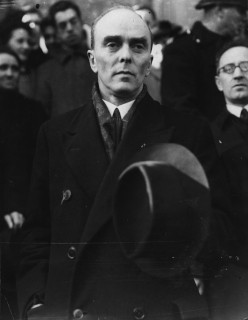
(Pictured: Sean MacBride, former Chief of staff of the Irish Republican Army and founder of Clann na Poblachta)