
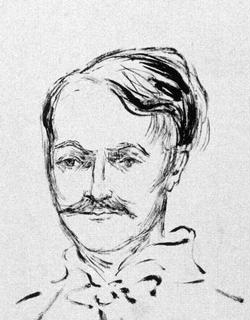
James Henry Cousins, Irish writer, playwright, actor, critic, editor, teacher and poet, is born in Belfast on July 22, 1873, a descendant of Huguenot refugees. He uses several pseudonyms including Mac Oisín and the Hindu name Jayaram.
Largely self-educated at night schools, Cousins works some time as a clerk and becomes private secretary and speechwriter to Sir Daniel Dixon, 1st Baronet, the Lord Mayor of Belfast. In 1897 he moves to Dublin where he becomes part of a literary circle which includes William Butler Yeats, George William Russell and James Joyce. It is believed that he serves as a model for the Little Chandler character in Joyce’s short story collection Dubliners.
Cousins is significantly influenced by Russell’s ability to reconcile mysticism with a pragmatic approach to social reforms and by the teachings of Helena Blavatsky. He has a lifelong interest in the paranormal and acts as reporter in several experiments carried out by William Fletcher Barrett, Professor of physics at the University of Dublin and one of the founders of the Society for Psychical Research.
Cousins produces several books of poetry while in Ireland as well as acting in the first production of Cathleen ní Houlihan, under the stage name of H. Sproule, with the famous Irish revolutionary and beauty Maud Gonne in the title role. His plays are produced in the first years of the twentieth century in the Abbey Theatre, the most famous being “the Racing Lug”. After a dispute with W.B. Yeats, who objects to “too much Cousins,” the Irish National Theatre movement splits with two-thirds of the actors and writers siding with Cousins against Yeats.
Cousins also writes widely on the subject of Theosophy and in 1915 travels to India with the voyage fees paid for by Annie Besant, the President of the Theosophical Society. He spends most of the rest of his life in the sub-continent, apart from a year as Professor of English Literature at Keio University in Tokyo and another lecturing in New York. Toward the end of his life, he converts to Hinduism. At the core of Cousins’s engagement with Indian culture is a firm belief in the “shared sensibilities between Celtic and Oriental peoples.”
While in India he becomes friendly with many key Indian personalities including poet Rabindranath Tagore, Indian classical dancer Rukmini Devi Arundale, painter Abdur Rahman Chughtai and Mahatma Gandhi. He is the person who brings change into the life of poetry of the great renowned Kannada poet and writer Kuvempu. He writes a joint autobiography with his wife Margaret Elizabeth Cousins, a suffragette and one of the co-founders of the Irish Women’s Franchise League and All India Women’s Conference (AIWC).
In his The Future Poetry Sri Aurobindo acclaims Cousins’ New Ways in English Literature as “literary criticism, which is of the first order, at once discerning and suggestive, criticism which forces us both to see and think.” He also acknowledges that he learned to intuit deeper being alerted by Cousins’ criticisms of his poems. In 1920 Cousins comes to Pondicherry to meet the Mother and Sri Aurobindo.
James Cousins dies on February 20, 1956, in Madanapalle, Andhra Pradesh, India at the age of 82.


