seamus dubhghaill

Promoting Irish Culture and History from Little Rock, Arkansas, USA


Leave a comment

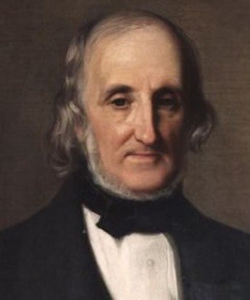
Death of George Petrie, Painter & Musician

george-petrie

George Petrie, Irish painter, musician, antiquary and archaeologist of the Victorian era dies on January 17, 1866.

Petrie is born and grows up in Dublin, living at 21 Great Charles Street, just off Mountjoy Square. He is the son of the portrait and miniature painter James Petrie, a native of Aberdeen, Scotland, who had settled in Dublin. He is interested in art from an early age. He is sent to the Royal Dublin Society‘s schools, being educated as an artist, where he wins the silver medal in 1805 at the age of fourteen.

After an abortive trip to England in the company of Francis Danby and James Arthur O’Connor, both of whom are close friends of his, he returns to Ireland where he works mostly producing sketches for engravings for travel books including among others, George Newenham Wright‘s guides to Killarney, Wicklow and Dublin, Thomas Cromwell‘s Excursions through Ireland, and James Norris Brewer‘s Beauties of Ireland.

In the late 1820s and 1830s, Petrie significantly revitalises the Royal Irish Academy‘s antiquities committee. He is responsible for their acquisition of many important Irish manuscripts, including an autograph copy of the Annals of the Four Masters, as well as examples of insular metalwork, including the Cross of Cong. His writings on early Irish archaeology and architecture are of great significance, especially his essay on the Round Towers of Ireland, which appear in his 1845 book titled The Ecclesiastical Architecture of Ireland. He is often called “the father of Irish archaeology.” His survey of the tombs at Carrowmore still informs study of the site today.

From 1833 to 1843 Petrie is employed by Thomas Frederick Colby and Thomas Larcom as head of the Topographical Department of the Irish Ordnance Survey. Amongst his staff are John O’Donovan, one of Ireland’s greatest ever scholars, and Eugene O’Curry. A prizewinning essay submitted to the Royal Irish Academy in 1834 on Irish military architecture is never published, but his seminal essay On the History and Antiquities of Tara Hill is published by the Academy in 1839. During this period Petrie is himself the editor of two popular antiquarian magazines, the Dublin Penny Journal and, later, the Irish Penny Journal.

Another major contribution of Petrie’s to Irish culture is the collection of Irish traditional airs and melodies which he records. William Stokes’s contemporary biography includes detailed accounts of Petrie’s working methods in his collecting of traditional music: “The song having been given, O’Curry wrote the Irish words, when Petrie’s work began. The singer recommenced, stopping at a signal from him at every two or three bars of the melody to permit the writing of the notes, and often repeating the passage until it was correctly taken down …”

As an artist, Petrie’s favourite medium is watercolour which, due to the prejudices of the age, is considered inferior to oil painting. Nonetheless, he can be considered as one of the finest Irish Romantic painters of his era. Some of his best work is in the collections of the National Gallery of Ireland, such as his watercolour painting Gougane Barra Lake with the Hermitage of St. Finbarr, County Cork (1831).

Petrie is awarded the Royal Irish Academy’s prestigious Cunningham Medal three times: firstly in 1831 for his essay on the round towers, secondly in 1834 for the now lost essay on Irish military architecture, and thirdly in 1839 for his essay on the antiquities of Tara Hill.

The closing years of Petrie’s life are devoted to the publication of a portion of his collection of Irish music. He dies at the age of 77 at Rathmines, Dublin, on January 17, 1866. He is buried in Mount Jerome Cemetery.

Leave a comment

Death of John O’Mahony, Founder of the Fenian Brotherhood

john-omahony

John Francis O’Mahony, Gaelic scholar and the founding member of the Fenian Brotherhood in the United States, sister organisation to the Irish Republican Brotherhood, dies in New York City on February 7, 1877.

O’Mahony is born in 1816 in Kilbeheny, County Limerick. His father and uncle were members of the Society of United Irishmen and took part in the Irish Rebellion of 1798. On the death of an elder brother, he inherits a property which yields £300 per annum. He enters Trinity College, Dublin, where he studies Sanskrit, Hebrew, and Irish. He becomes an accomplished Gaelic scholar, and later teaches Greek and Latin, and contributes articles to Irish and French journals. He leaves Trinity without getting a degree.

In 1843, O’Mahony joins Daniel O’Connell‘s movement for the Repeal of the Acts of Union 1800, but quickly becomes dissatisfied with the lack of progress and joins the Young Ireland movement which William Smith O’Brien leads and takes part in the failed Young Ireland Rebellion of 1848. His participation in the rebellion obligates him to leave Ireland, and he settles for a time in Paris, where he lives in great poverty. In 1854, he joins John Mitchel in New York City, and takes part in the Emigrant Aid Association, the Emmet Monument Association, and other Irish organisations.

In 1857, O’Mahony publishes History of Ireland, by Geoffrey Keating, D. D., translated from the Original Gaelic, and Copiously Annotated (New York, 1857). O’Mahony’s notes are copied from John O’Donovan‘s translations of Annals of the Four Masters, and it is on this ground that Hodges & Smith procures an injunction against the sale of the book in the United Kingdom. The mental strain to which O’Mahony is subjected in the preparation of this work, which brings him no pecuniary gain, affects his reasoning and he is removed by his friends for a short time to a lunatic asylum.

In 1860, O’Mahony organises the Fenian Brotherhood, also known as the Irish Republican Brotherhood. The object of the association is to secure the freedom of Ireland. The name is probably derived from O’Mahony’s Gaelic studies, the Fenians having been a military body in pagan Ireland, celebrated in the songs of Ossian. The organisation of the new society is completed at conventions that are held in Chicago in 1864 and in Cincinnati in January 1865.

At the time of the Cincinnati convention, O’Mahony holds the rank of colonel of the 69th Regiment of New York State Militia, recruited mainly from the ranks of the Brotherhood, which has also furnished a large proportion of Thomas Francis Meagher‘s Irish Brigade, Michael Corcoran‘s legion, and Irish regiments engaged in the American Civil War. The rapid growth in membership of the Fenian Brotherhood renders it impossible for O’Mahony to retain the colonelcy of the 69th regiment, which he has held for some time. He resigns in order to give all his attention to the spread of Fenianism.

The close of the civil war in the spring of 1865 gives a great impetus to the Fenians, owing to the number of Irish American soldiers that are disbanded and anxious to see service elsewhere. Money pours into the Fenian exchequer. Many differences occur between O’Mahony and James Stephens and the Central Council relative to the policy to be pursued for the attainment of their object, but O’Mahony remains president of the organisation for several years. He does not take any part personally in the attempted insurrection in Ireland or in the raids on Canada, although his advice counts for much in these enterprises.

He devotes the last years of his life to literary pursuits, but suffers from ill health, and he has a hard struggle to secure the bare means for subsistence. However, visionary may have been his objectives, he is honest, and although thousands have passed through his hands, he is often at a loss for a dollar. When his poverty is discovered, he declines to receive assistance in any form. He dies in New York City on February 7, 1877, and soon after his death his remains are returned to Ireland and interred with the honors of a public funeral in Glasnevin Cemetery in Dublin.


Leave a comment

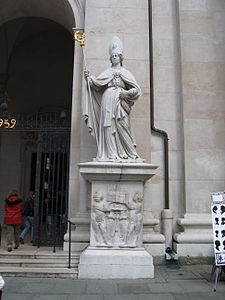
Death of Vergilius of Salzburg, Churchman & Astronomer

virgilius-of-salzburg

Vergilius of Salzburg, also known as Virgilius, Feirgil or Fergal, Irish churchman and early astronomer, dies on November 27, 784, in Salzburg, Austria. He serves as abbot of Aghaboe, bishop of Ossory and bishop of Salzburg. He is called “the Apostle of Carinthia” and “the geometer.”

He originates from a noble family of Ireland, where his name is Feirgil, and is said to have been a descendant of Niall of the Nine Hostages. Feirgil is likely educated at the Iona monastery.

In the Annals of the Four Masters and the Annals of Ulster he is mentioned as Abbot of Aghaboe, in County Laois, where he is known as “the Geometer” because of his knowledge of mathematics.

Around 745 Vergilius leaves Ireland, intending to visit the Holy land but, like many of his countrymen who seem to have adopted this practice as a work of piety, he settles down in France, where he is received with great favour by Pepin the Short, who is then Mayor of the Palace under Childeric III of Franconia. He serves as an adviser to Pepin. He probably uses a copy of the Collectio canonum Hibernensis, an Irish collection of canon law, to advise him to receive royal unction in 751, to assist his recognition as king Pippin III after the deposition of Childeric. After spending two years at Cressy, near Compiègne, he goes to Bavaria, at the invitation of Duke Odilo, where he founds the monastery of Chiemsee, and within a year or two is made Abbot of St. Peter’s at Salzburg. Among his notable accomplishments is the conversion of the Alpine Slavs and the dispatching of missionaries to Hungary.

While Abbot of St. Peter’s, Vergilius comes into collision with Saint Boniface. A priest, through ignorance, confers the Sacrament of Baptism using, in place of the correct formula, the words “Baptizo te in nomine patria et filia et spiritu sancta.” Vergilius holds that the sacrament has been validly conferred, but Boniface complains to Pope Zachary. The latter, however, decides in favour of Vergilius. Later on, Boniface accuses Vergilius of spreading discord between himself and Duke Odilo of Bavaria and of teaching a doctrine in regard to the rotundity of the earth, which is “contrary to the Scriptures.” Pope Zachary’s decision in this case is that “if it shall be clearly established that he professes belief in another world and other people existing beneath the earth, or in another sun and moon there, thou art to hold a council, and deprive him of his sacerdotal rank, and expel him from the church.”

Unfortunately, we no longer possess the treatise in which Vergilius expounds his doctrine. Two things, however, are certain: first, that there is involved the problem of original sin and the universality of redemption; secondly, that Vergilius succeeds in freeing himself from the charge of teaching a doctrine contrary to Scripture. It is likely that Boniface, already biased against Vergilius because of the preceding case, misunderstands him, taking it for granted, perhaps, that if there are antipodes, the “other race of men” are not descendants of Adam and are not redeemed by Christ.

After the martyrdom of Boniface, Vergilius is made Bishop of Salzburg in 766 or 767. Until his death in 784, he labours successfully for the upbuilding of his diocese as well as for the spread of Christianity in neighbouring heathen countries, especially in Carinthia.

Vergilius is venerated as a saint in the Orthodox Church and the Roman Catholic Church. In 1233 he is formally canonized by Pope Gregory IX. Aside from being personally associated with Abbey of Aghaboe and Salzburg Cathedral, a number of parishes around the world are dedicated to him, mostly being founded by small populations of far-flung Irish Catholics, like himself. There is a church still bearing his name dedicated to him in Broad Channel, Queens, New York. A parish in Morris Plains, New Jersey is also dedicated to him.