Crown forces hope to burn the town of Ballinalee as a reprisal for the deaths of several Royal Irish Constabulary (RIC) personnel in the preceding days. This includes the killing of an RIC inspector, Philip St. Johnstone Howlett Kelleher, the previous week and an RIC Constable, Peter Cooney, the previous day. Cooney had been suspected of being a spy and his execution is reputedly ordered by Michael Collins. At the time of his killing, Cooney is allegedly carrying coded dispatches with the names of Longford IRA men.
The Crown forces, numbering 100 men in eleven trucks, are defeated by about twenty-five IRA members, of which four are involved in the main battle. Mac Eoin had placed several groups at the roads leading into the village, including one at a house, Rose Cottage, on the approach to the village centre. This group, referred to in some sources as the “Rose Cottage Four,” engage the much larger RIC force using rifle fire and grenades, and force their retreat after a two and a half hour gunfight.
McCorley is one of three children born to Roger Edmund McCorley, a meat carver in a hotel, and Agnes Liggett. He has two elder brothers, Vincent and Felix. He joins the Fianna in his teens. His family has a very strong republican tradition, and he claims to be the great-grandson of the United Irishmen folk hero Roddy McCorley, who was executed for his part in the Irish Rebellion of 1798.
McCorley is noted for his militancy, as he is in favour of armed attacks on British forces in Belfast. The Brigade’s leaders, by contrast, in particular, Joe McKelvey, are wary of sanctioning attacks for fear of loyalist reprisals on republicans and the Catholic population in general. In addition, McCorley is in favour of conducting an armed defense of Catholic areas, whereas McKelvey does not want the IRA to get involved in what he considers to be sectarian violence. McCorley writes later that in the end, “the issue settled itself within a very short space of time, when the Orange mob was given uniforms, paid for by the British, and called the Ulster Special Constabulary (USC).” The role of the USC, a temporary police force raised for counter-insurgency purposes, in the conflict is still debated, but republicans maintain that the organization was responsible for the indiscriminate killings of Catholics and nationalists.
On January 26, 1921, McCorley, is involved in the fatal shooting of three Auxiliary Division officers in their beds in the Railway View hotel in central Belfast. Shortly afterwards, he and another IRA man, Seamus Woods, organize an active service unit (ASU) within the first battalion of the Belfast Brigade, with the intention of carrying out attacks, with or without the approval of the Brigade leadership. The unit consists of 32 men. McCorley later writes, “I issued a general order that, where reprisal gangs [State forces] were cornered, no prisoners were to be taken.” In March 1921, he personally leads the ASU in the killing of three Black and Tans in Victoria Street in central Belfast. He is responsible for the deaths of two more Auxiliaries in Donegall Place in April. In reprisal for these shootings, members of the RIC assassinate two republican activists, the Duffin brothers in Clonard Gardens in west Belfast. On June 10, 1921, both and Woods and McCorley units are involved in the killing a RIC man who is suspected in the revenge killings of the Duffin brothers. Two RIC men and a civilian are also wounded in that attack.
Thereafter, there is what historian Robert Lynch has described as a “savage underground war” between McCorley’s ASU and RIC personnel based in Springfield Road barracks and led by an Inspector Ferris. Ferris is accused of murdering the Lord Mayor of Cork Thomas MacCurtain and had been posted to Lisburn for his safety. Ferris himself is among the casualties, being shot in the chest and neck, but surviving. McCorley claims to have been one of the four IRA men who shot Ferris. In addition, his men bomb and burn a number of businesses including several cinemas and a Reform Club. In May 1921, however, thirteen of his best men are arrested when surrounded by British troops during an operation in County Cavan. They are held in Crumlin Road Gaol and sentenced to death.
On June 3, McCorley organizes an attack on Crumlin Road Gaol in an attempt to rescue the IRA men held there before they are executed. The operation is not a success; however, the condemned men are reprieved after a truce is agreed between the IRA and British forces in July 1921. On Bloody Sunday (July 10, 1921), he is a major leader in the defense of nationalist areas from attacks by both the police and loyalists. On that day twenty people are killed before he negotiates a truce beginning at noon on July 11. At least 100 people are wounded, about 200 houses are destroyed or badly damaged – most of them Catholic homes, leaving 1,000 people homeless.
In April 1922, McCorley becomes leader of the IRA Belfast Brigade after Joe McKelvey goes south to Dublin to join other IRA members who are against the Anglo-Irish Treaty. With McKelvey’s departure, Seamus Woods becomes Officer Commanding of the IRA’s 3rd Northern Division, which has up to 1,000 members, with McCorley designated as Vice Officer Commanding. McCorley for his part, supports the Treaty, despite the fact that it provides for the partition of Ireland and the continued British rule in Northern Ireland. The reason for this is that Michael Collins and Eoin O’Duffy have assured him that this is only a tactical move and indeed, Collins sends men, money and weapons to the IRA in the North throughout 1922.
However, McCorley’s command sees the collapse of the Belfast IRA. In May 1922, the IRA launches an offensive with attacks all across Northern Ireland. In Belfast, he carries out an assault on Musgrave Street RIC barracks. He also conducts an arson campaign on businesses in Belfast. His men also carry out a number of assassinations, including that of Ulster Unionist PartyMPWilliam J. Twaddell, which causes the internment of over 200 Belfast IRA men.
To escape from the subsequent repression, McCorley and over 900 Northern IRA men flee south, to the Irish Free State, where they are housed in the Curragh. McCorley is put in command of these men. In June 1922, the Irish Civil War breaks out between Pro and Anti-Treaty elements of the IRA. He takes the side of the Free State and Michael Collins. After Collins is killed in August 1922, his men are stood down. About 300 of them join the National Army and are sent to County Kerry to put down anti-Treaty guerrillas there. In the Spring of 1923, bitterly disillusioned by the brutal counterinsurgency against fellow republicans, he resigns his command.
McCorley later asserts that he “hated the Treaty” and only supported it because it allowed Ireland to have its own armed forces. Both he and Seamus Woods are severe critics of the Irish Free State inertia towards Northern Ireland after the death of Michael Collins. He comments that when Collins was killed “the Northern element gave up all hope.”
In 1936 McCorley is instrumental in the establishment of the All-Ireland Old IRA Men’s Organization, serving as Vice-President with President Liam Deasy (Cork No. 3 Brigade) and Secretary George Lennon (Waterford No. 2 Brigade).
Recruitment begins for the Black and Tans (Irish: Dúchrónaigh), Britain’s unofficial auxiliary army, on January 2, 1920. They are constables recruited into the Royal Irish Constabulary (RIC) as reinforcements during the Irish War of Independence. Recruitment begins in Great Britain and about 10,000 men enlist during the conflict. The vast majority are unemployed former British soldiers who had fought in World War I. Some sources count a small number of Irishmen as Black and Tans.
The British administration in Ireland promotes the idea of bolstering the RIC with British recruits. They are to help the overstretched RIC maintain control and suppress the Irish Republican Army (IRA), although they are less well trained in ordinary policing. The nickname “Black and Tans” arises from the colours of the improvised uniforms they initially wear, a mixture of dark green RIC (which appears black) and khaki British Army. They serve in all parts of Ireland, but most are sent to southern and western regions where fighting is heaviest. By 1921, Black and Tans make up almost half of the RIC in County Tipperary, for example.
The Black and Tans gain a reputation for brutality and become notorious for reprisal attacks on civilians and civilian property, including extrajudicial killings, arson and looting. Their actions further sway Irish public opinion against British rule and draw condemnation in Britain.
The Black and Tans are sometimes confused with the Auxiliary Division, a counterinsurgency unit of the RIC, also recruited during the conflict and made up of former British officers. However, sometimes the term “Black and Tans” covers both groups. The Ulster Special Constabulary (USC) is founded to reinforce the RIC in Northern Ireland.
More than a third leave the service before they are disbanded along with the rest of the RIC in 1922, an extremely high wastage rate, and well over half receive government pensions. Over 500 members of the RIC die in the conflict and more than 600 are wounded. Some sources state that 525 police, including 152 Black and Tans and 44 Auxiliaries, are killed in the conflict.
Many Black and Tans are left unemployed after the RIC is disbanded and about 3,000 are in need of financial assistance after their employment in Ireland is terminated. About 250 Black and Tans and Auxiliaries, among over 1,300 former RIC personnel, join the Royal Ulster Constabulary. Another 700 join the Palestine Police Force which is led by former British Chief of Police in Ireland, Henry Hugh Tudor. Others are resettled in Canada or elsewhere by the RIC Resettlement branch. Those who return to civilian life sometimes have problems re-integrating. At least two former Black and Tans are hanged for murder in Britain, and another wanted for murder commits suicide before the police can arrest him.
Due to the Tans’ behaviour in Ireland, feelings continue to run high regarding their actions. The term can still stir bad reactions because of their remembered brutality. One of the best-known Irish Republican songs is Dominic Behan‘s “Come Out, Ye Black and Tans.” The Irish War of Independence is sometimes referred to as the “Tan War” or “Black-and-Tan War.” This term is preferred by those who fought on the anti-Treaty side in the Irish Civil War and is still used by Republicans today. The “Cogadh na Saoirse” (“War of Independence”) medal, awarded since 1941 by the Irish government to IRA veterans of the War of Independence, bears a ribbon with two vertical stripes in black and tan.
Some sources say the Black and Tans were officially named the “RIC Special Reserve”, but this is denied by other sources, which say they were not a separate force but “recruits to the regular RIC” and “enlisted as regular constabulary.” Canadian historian D. M. Leeson has not found any historical documents that refer to the Black and Tans as the “Royal Irish Constabulary Special Reserve.”
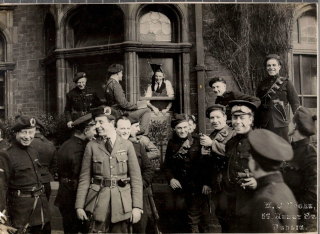
(Pictured: A group of Black and Tans and Auxiliaries outside the London and North Western Hotel in Dublin following an attack by the IRA, April 1921)
Traynor works as a boot maker and is married with ten children. At the time of his death the eldest is 18 years and the youngest 5 months. The eldest son, Frank, represents Ireland at the 1928 Summer Olympics in Amsterdam, competing as a bantamweight boxer.
Traynor is captured during an ambush on Auxiliaries in Brunswick Street, Dublin, on March 14, 1921, and is tried on April 5 at City Hall. He is part of a party of IRA volunteers keeping watch outside a meeting at 144 Brunswick Street that includes Seán MacBride. During the fight an IRA volunteer, Leo Fitzgerald, is killed, as are Constable James O’Farrell and Cadet Bernard Beard of the Dublin Metropolitan Police. Traynor is reportedly badly beaten by members of the Igoe Gang.
Traynor is hanged in Mountjoy Prison in Dublin on April 25, 1921, one of a group of men, commonly referred to as the Forgotten Ten, hanged in Mountjoy Prison from 1920–21, during the Irish War of Independence. He is 38 years old at the time of his death.
Mark Sturgis, assistant to the Under-Secretary for Ireland, writes, “Traynor, captured red handed with an attacking party when Auxiliaries were killed in Brunswick Street, was executed this morning. I don’t think they will make much fuss as there is no sort of ‘alibi’ business this time – nor is he the usual ‘youth’, dear to ‘The Freeman‘, as he is over 40 and has a pack of children, the poor deluded idiot.”
On the day following Traynor’s death, Gilbert Potter, a Royal Irish Constabulary (RIC) District Inspector based in Cahir, County Tipperary, and being held for Traynor’s safe treatment is executed in reprisal by members of the 3rd Tipperary Brigade of the IRA. Another IRA volunteer, Jack Donnelly, captured with Traynor, is sentenced to death but is reprieved by the declaration of an impending truce in June 1921.
In 1965 a statue is erected to honor Traynor in his native town of Tullow. The Ballad of Thomas Traynor is written in his memory.
The Black and Tans (Irish: Dúchrónaigh), special constables recruited into the Royal Irish Constabulary (RIC) as reinforcements during the Irish War of Independence, arrive in Ireland on March 25, 1920. Recruitment begins in Great Britain in January 1920 and about 10,000 men enlist during the conflict. The vast majority are unemployed former British soldiers from Britain who had fought in World War I. Some sources count a small number of Irishmen as Black and Tans.
The British administration in Ireland promotes the idea of bolstering the RIC with British recruits. They are to help the overstretched RIC maintain control and suppress the Irish Republican Army (IRA), although they are less well trained in ordinary policing. The nickname “Black and Tans” arises from the colours of the improvised uniforms they initially wear, a mixture of dark green RIC (which appears black) and khaki British Army. They serve in all parts of Ireland, but most are sent to southern and western regions where fighting is heaviest. By 1921, Black and Tans make up almost half of the RIC in County Tipperary, for example.
Few Black and Tans are sent to what becomes Northern Ireland, however. The authorities there raise their own reserve force, the Ulster Special Constabulary (USC). For the most part, the Black and Tans are “treated as ordinary constables, despite their strange uniforms, and they live and work in barracks alongside the Irish police.” They spend most of their time manning police posts or on patrol—”walking, cycling, or riding on Crossley Tenders.” They also undertake guard, escort and crowd control duties. While some Irish constables get along well with the Black and Tans, “it seems that many Irish police did not like their new British colleagues” and se them as “rough.”
Alexander Will, from Forfar in Scotland, is the first Black and Tan to die in the conflict. He is killed during an IRA attack on the RIC barracks in Rathmore, County Kerry, on July 11, 1920.
The Black and Tans gain a reputation for brutality and become notorious for reprisal attacks on civilians and civilian property, including extrajudicial killings, arson and looting. Their actions further sway Irish public opinion against British rule and draw condemnation in Britain.
The Black and Tans are sometimes confused with the Auxiliary Division, a counterinsurgency unit of the RIC, also recruited during the conflict and made up of former British officers. However, sometimes the term “Black and Tans” covers both groups. Some sources say the Black and Tans are officially named the “RIC Special Reserve,” but this is denied by other sources, which say they are not a separate force but “recruits to the regular RIC” and “enlisted as regular constabulary.”
More than a third leave the service before they are disbanded along with the rest of the RIC in 1922, an extremely high wastage rate, and well over half receive government pensions. Over 500 members of the RIC died in the conflict and more than 600 are wounded. Some sources state that 525 police are killed in the conflict, including 152 Black and Tans and 44 Auxiliaries. This figure of total police killed also includes 72 members of the Ulster Special Constabulary killed between 1920 and 1922 and 12 members of the Dublin Metropolitan Police.
Many Black and Tans are left unemployed after the RIC is disbanded and about 3,000 are in need of financial assistance after their employment in Ireland is terminated. About 250 Black and Tans and Auxiliaries, among over 1,300 former RIC personnel, join the Royal Ulster Constabulary. Another 700 joined the Palestine Police Force which is led by former British Chief of Police in Ireland, Henry Hugh Tudor. Others are resettled in Canada or elsewhere by the RIC Resettlement branch. Those who return to civilian life sometimes have problems re-integrating. At least two former Black and Tans are hanged for murder in Britain and another, Scott Cullen, wanted for murder, commits suicide before the police can arrest him.
(Pictured: Sir Hamar Greenwood inspects a group of Black and Tans in 1921)
According to a study of the region, Cork is “by far the most violent county in Ireland” during the War of Independence and has several active guerrilla brigades. Of these, the 3rd Cork Brigade is one of the most effective and it is a unit from this Brigade that carries out the Upton ambush.
Up until the end of 1920, the British had been unable to move troops by train, due to a nationwide boycott by railway workers of trains carrying the British military. However, the strike is lifted in December 1920. While this helps the British military’s mobility, it also gives the IRA a new target: trains carrying soldiers. A week before the Upton ambush, the local IRA had made a successful attack on a train travelling from Killarney to Millstreet near Drishanbeg, killing one sergeant and wounding five more soldiers.
Five days after the Drishanbeg ambush, plans are made for an attack at Upton and Innishannon railway station on a train traveling between Cork city and Bandon. The ambushers, led by Charlie Hurley, are thirteen strong. Seven are armed with rifles and the remainder with revolvers or semi-automatic pistols. They take up position at the station ten minutes before the train pulls in, imprisoning the station master, clearing the station and taking cover behind sacks of grain and flour taken from a store.
The train is carrying approximately 50 British soldiers of the Essex Regiment, who are mingled with civilian passengers throughout the train’s carriages. The IRA party is therefore quite heavily outnumbered and out-gunned, but are unaware of this, as two IRA scouts, who were supposed to have been on the train and signaled to them the British numbers, never turn up. They also wrongly believe that the British troops are all in the central carriage. As a result, when the IRA opens fire on the train, there are heavy civilian casualties, including two commercial travelers killed by the first volley. The New York Times reports that “a shower of bullets was rained on the train, practically every compartment being swept.”
The firefight lasts only ten minutes, but in that time six civilian passengers are killed and ten wounded. Six British soldiers are injured, three of them seriously. Two IRA volunteers are killed outright and another is fatally wounded. Two more are badly wounded but survive. Charlie Hurley, who had led the ambush, is struck in the face by a bullet. IRA leader Tom Barry later writes, “Through some miracle, the nine unwounded and two wounded got away across country, in small parties, with the British following close behind.” Three civilian passengers, one unwounded and two wounded, are detained by the British on suspicion of belonging to the ambush party.
The Upton ambush is part of what Tom Barry describes as “twelve dark days” for the 3rd Cork Brigade of the IRA. Between February 4 and February 16, eleven members of the Brigade are killed. One is shot dead by British troops when they raid a safehouse on February 4, another dies in an accidental shooting on February 7, two more (brothers James and Timothy Coffey) are assassinated in their beds on February 14 by Black and Tans or Auxiliaries, three die at Upton on February 15 and four are killed on February 16 when they are arrested by the Essex Regiment in Kilbrittain while digging a trench and shot dead. Of the eleven dead, only those at Upton are killed in combat.
The Upton attack also highlights the dangers, and particularly the risk to civilians, of attacking trains carrying troops. Only a month later at the Headford Ambush in neighbouring County Kerry, an IRA column successfully attacks a train-load of troops, but again, there are civilian casualties alongside the IRA and British Army losses. One of the three men captured by the British at Upton is reported to give information leading to the 3rd Cork Brigade’s main column of over 100 fighters almost being encircled at the Crossbarry Ambush. Hurley is killed in this action.
The Upton ambush is later made famous in a popular 1960s Irish ballad titled “The Lonely Woods of Upton.”
(Pictured: A portion of the cover of an Italian magazine from 1921 that reported on the Upton ambush)
The Clonfin Ambush is carried out by the Irish Republican Army (IRA) on February 2, 1921, during the Irish War of Independence. It takes place in the townland of Clonfin between Ballinalee and Granard in County Longford. The IRA ambushes two lorries carrying members of the British Auxiliary Division, sparking a lengthy gun battle in which four Auxiliaries are killed and eight wounded. The Auxiliaries eventually surrender, and their weapons are seized. The IRA commander, Seán Mac Eoin, wins some praise for helping the wounded Auxiliaries. Following the ambush, British forces burn a number of houses and farms in the area, and shoot dead an elderly farmer.
The IRA’s North Longford Flying Column, twenty-one strong and led by Seán Mac Eoin, is formed in late 1920. In that year they kill four Royal Irish Constabulary (RIC) constables. In November, a company of the Auxiliary Division – a paramilitary police force made up of ex-military officers – has been stationed in the county to put down the local IRA and are reinforced in January 1921. Whereas previously the IRA had tried to operate in relatively large numbers, often attacking police barracks, from this point forward, their GHQ in Dublin orders smaller but more frequent attacks to be made.
The ambush site, on the road between Granard and Ballinalee, is well chosen. Mac Eoin selects a position where the ambushers have excellent cover and are barely visible to the British. The plan is to explode a mine as the lorries pass. The British assessment is that “the ambush was most cleverly laid.”
The IRA detonates the roadside improvised explosive device (IED) as two British lorries are passing a bridge, killing the driver of the first lorry instantly. The IRA unit then opens fire on the lorries, triggering a firefight lasting two hours. One of the Auxiliaries gets away and manages to summon reinforcements.
During the fighting, four members of the IRA party work their way around the flank of the Auxiliaries, killing their commander, Lt. Commander Francis Craven. After his death, the remaining policemen surrender. A total of four Auxiliaries are killed and eight wounded.
MacEoin’s treatment of his prisoners is humane. He congratulates them on the fight they had put up and prevents his fighters from assaulting the Auxiliaries. He also has water brought from nearby houses for the British wounded. When he is later captured by the British, three Auxiliaries testify at his court-martial to his generous treatment of them at Clonfin. Mac Eoin’s humane treatment reportedly delays the IRA’s getaway, and they are almost caught by 14 lorries of British reinforcements as they escape across Clonfin Wood. The IRA had captured 18 rifles, 20 revolvers ammunition, a Lewis gun and 800 rounds of ammunition.
In the aftermath of the ambush, British forces raid the nearby towns of Killoe, Ballinamuck, Drumlish, Ballinalee, Edgeworthstown, Granard and Ardagh. A number of houses and farms are burned. They shoot dead an elderly farmer, Michael Farrell, in reprisal for the ambush.
The IRA flying column lays low after the ambush and does not attempt any more attacks until the end of the month. MacEoin, the Longford IRA leader, is captured at Mullingar railway station in early March and charged with the murder of RIC DI MGrath. He is released in July under the terms of the Truce which ends hostilities. In his absence, the Longford IRA are not able to sustain the intensity of their campaign.
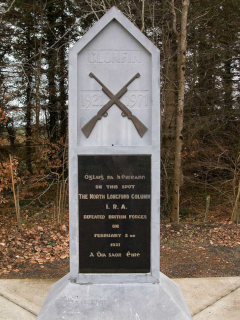
A stone monument is erected at the site of the ambush in 1971 to mark the 50th anniversary of the event. The IRA combatants are MacEoin (Ballinalee), Sean Duffy (Ballinalee), James J. Brady (Ballinamuck), Tom Brady (Cartronmarkey), Paddy Callaghan (Clonbroney), Seamus Conway (Clonbroney), Pat Cooke (Tubber), Seamus Farrelly (Purth), Paddy Finnegan (Molly), Larry Geraghty (Ballymore), Mick Gormley (Killoe), Hugh Hourican (Clonbroney), Jack Hughes (Scrabby), Mick Kenny (Clonbroney), Paddy Lynch (Colmcille), John McDowell (Clonbroney), Jack Moore (Streete), Mick Mulligan (Willsbrook), Michael F. Reynolds (Killoe), Sean Sexton (Ballinalee) and Jim Sheeran (Killoe).
(Pictured: The stone monument located at Clonfin, near the village of Ballinalee, County Longford, marking the site of the ambush. Erected in 1971 to mark the 50th anniversary of the event, the limestone monument features strong military, anti-British language and symbolism.)
The ambush is carried out by the IRA’s South Leitrim Brigade on a British Army and Auxiliary Division convoy. The British force suffers casualties and admits one fatality, a captain in the Bedfordshire and Hertfordshire Regiment, although some local sources claim several more are killed.
On Friday morning, March 4, 1921, as the congregation makes their way out of the ‘First Friday Mass’ in the Roman Catholic parish church in Gowel, they are met by three lorries carrying 30–40 Auxiliaries, Royal Irish Constabulary (RIC), and British Army members. The men are lined up for searching on one side while a ‘female searcher’ attends to the women. There is no panic and as nothing is found and there are no arrests. The church had been identified as a likely place for volunteers of the IRA’s South Leitrim Brigade to attend. Father Edward O’Reilly, the church’s curate, is openly friendly towards the volunteers. After they search the church interior, the police and soldiers remount their lorries and continue back to Carrick-on-Shannon.
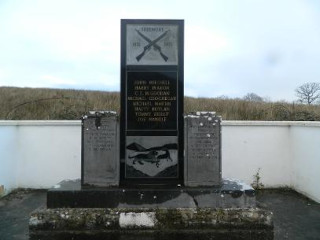
About 2 kilometres down the road, on the slopes of Sheemore, volunteers of the South Leitrim Brigade await them. The day before, the Brigade had received word from Joe Nangle from Drumshanbo of the British operation. They take up position behind a low wall which runs on the brink of an eighty-foot-high rock face on the side of Sheemore. It is four hundred yards from the road. There are seven volunteers – Brigadier Seán Mitchel (who was in command), Charles E. McGoohan (from Ballinamore), Michael Geoghegan (from Aughacashel), Mattie Boylan (from Carrick-on-Shannon), Michael Martin (from Ballinamore), Joe Nangle and Harry McKeon.
At the command from Mitchell, the IRA opens fire on the convoy. The members of the convoy jump from their lorries, and take cover behind a wall which runs along the road. The police run despite the shouts from the soldiers to stand their ground. The officer in command tries to use field glasses to spot the positions of the IRA. After a forty-five-minute gunfight the IRA withdraws, and the British make no attempt to follow them. Instead they gather up their casualties and return to Carrick-on-Shannon, where Black and Tans later undertake reprisals, burning and looting, and burn both the premises of the Leitrim Observer newspaper and the local rowing club to the ground. They also burn the Temperance Hall in Gowel.
Nurse Alice Grey (or Gray), the ‘female searcher,’ who is a member of the ambushed convoy, is recognised by the British authorities for her role in the incident.
Contemporary newspaper reports indicate that one officer and four men of the Bedfordshire Regiment were wounded, as were two members of the RIC. The British officer died the following day, and some people reportedly left the area for fear of reprisals.
(Pictured: Monument in memory of the Volunteers who took part in the Sheemore Ambush)
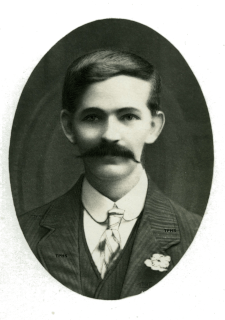
Mac Eoin is born John Joseph McKeon on September 30, 1893, at Bunlahy, Granard, County Longford, the eldest son of Andrew McKeon and Catherine Treacy. After a national school education, he trains as a blacksmith at his father’s forge and, on his father’s death in February 1913, he takes over the running of the forge and the maintenance of the McKeon family. He moves to Kilinshley in the Ballinalee district of County Longford to set up a new forge.
Mac Eoin comes to prominence in the Irish War of Independence as leader of an Irish Republican Army (IRA) flying column. In November 1920, he leads the Longford brigade in attacking Crown forces in Granard during one of the periodic government reprisals, forcing them to retreat to their barracks. On October 31, Inspector Philip St. John Howlett Kelleher of the RIC is shot dead in the Greville Arms Hotel in Granard. Members of the British Auxiliary Division set fire to parts of the town. The following day, Mac Eoin holds the village of Ballinalee situated on the Longford Road between Longford and Granard. They stand against superior British forces, forcing them to retreat and abandon their ammunition. In a separate attack on November 8, he leads his men against the RIC at Ballinalee. One constable is killed, and two others are wounded.
On the afternoon of January 7, 1921, a joint RIC and British Army patrol consisting of ten policemen appears on Anne Martin’s street. According to Mac Eoin’s own testimony at his trial he is in the house in partial uniform, wearing Sam Browne belt and revolver with two Mills No. 4 bombs in his pocket. Owing to some females being in the house, he has to get out as to not endanger them. He steps out on the street and opens fire with his revolver. The leading file falls and the second file brings their rifles to the ready. He then throws a bomb, after which he sees that the entire force has cleared away, save the officer who was dead or dying on the street.
On February 2, 1921, the Longford IRA ambushes a force of the Auxiliaries on the road at Clonfin, using a mine it had planted. Two lorries are involved, the first blown up, and the second strafed by rapid rifle fire. Four auxiliaries and a driver are killed and eight wounded. The IRA volunteers capture 18 rifles, 20 revolvers and a Lewis gun. At the Clonfin Ambush, Mac Eoin orders his men to care for the wounded British, at the expense of captured weaponry, earning him both praise and criticism. He is admired by many within the IRA for leading practically the only effective column in the midlands.
Mac Eoin is captured at Mullingar railway station on March 1, 1921, imprisoned and sentenced to death for the murder of an RIC district inspector in the shooting at Anne Martin’s street in January 1921.
In June 1921, Henry Wilson, the British Chief of the General Staff (CIGS), is petitioned for clemency by Mac Eoin’s mother, his brother Jemmy, and the local Church of Irelandvicar, but passes on the appeals out of respect for the latter two individuals. Three auxiliaries had already given character references on his behalf after he had treated them chivalrously at the Clonfin Ambush in February 1921. However, Nevil Macready, British Commander-in-Chief, Ireland, confirms the death sentence describing Mac Eoin as “nothing more than a murderer.”
While imprisoned Mac Eoin is elected to Dáil Éireann at the 1921 Irish elections, as a TD for Longford–Westmeath. He is eventually released from prison, along with all other members of the Dáil, after Michael Collins threatens to break off treaty negotiations with the British government unless they are freed.
Mac Eoin joins the National Army and is appointed GOC Western Command in June 1922. His military career soars after the Irish Civil War. He is appointed GOC Curragh Training Camp in August 1925, Quartermaster General in March 1927, and Chief of Staff in February 1929.
Mac Eoin resigns from the Army in 1929 and is elected at a by-election to Dáil Éireann for the Leitrim–Sligo constituency, representing Cumann na nGaedheal. At the 1932 Irish general election, he returns to the constituency of Longford–Westmeath and continues to serve the Longford area as TD until he is defeated at the 1965 Irish general election.
Irish Republican Army (IRA) volunteers occupying a farmhouse in Clonmult, County Cork are surrounded by a force of British Army, Royal Irish Constabulary (RIC) and Auxiliaries. In the action that follows, twelve IRA volunteers are killed, four wounded and four captured. A total of 22 people die in the ambush and subsequent executions – fourteen IRA members, two Black and Tans and six suspected informers.
The 4th battalion of the IRA First Cork Brigade, under Diarmuid O’Hurley and based around Midleton, Youghal and Cobh, had been a successful unit up until the Clonmult ambush. They had captured three RIC barracks and carried out an ambush in Midleton itself. In January 1921, the unit takes possession of a disused farmhouse overlooking the village of Clonmult. O’Hurley plans to ambush a military train at Cobh Junction on Tuesday, February 22, 1921 and at the time of the Clonmult action is scouting a suitable ambush site. However, according to historian Peter Hart, they “had become over-confident and fallen into a traceable routine.” An intelligence officer of the British Army Hampshire Regiment traces them to their billet at a farmhouse in Clonmult.
British troops, a party of the 2nd Battalion, Hampshire Regiment under the command of Lieutenant A. R. Koe, surround the house. Two IRA volunteers notice the advancing troops and open fire. Both are killed, but the shooting warns those sheltering inside the house, and a siege begins. A sortie from the house is attempted in the hope of gaining reinforcements from the local IRA company.
The acting IRA commander, Captain Jack O’Connell, manages to get away but three other volunteers are killed in the attempt. But O’Connell is unable to bring help in time. The Volunteers trapped inside make a desperate but unsuccessful attempt to escape through a narrow opening in the gable. Their hopes are dashed when British reinforcements arrive instead — regular RIC police, Black and Tans and Auxiliaries. The police also bring petrol, which an Army officer uses to set the thatched roof of the farmhouse on fire. With the farmhouse burning around them, an attempt is then made by the IRA to surrender.
What happens next is disputed. In his after-action report, Lieutenant Koe reports that at 6:30 PM six or seven rebels come out of the house with their hands up. As the Crown Forces go to meet them the remaining rebels in the house open fire. Some of the rebels outside the house are killed or wounded by the crossfire that ensues. The Crown Forces rush the house and the eight rebels inside are taken prisoner. By contrast, the surviving Volunteers claim that their men had surrendered in good faith, and had come out with their hands up, only to be shot by the police without any provocation. Opinion is divided amongst historians as to which version of the story to believe.
A total of twelve IRA Volunteers are killed in the action, with four more wounded and only four taken prisoner unscathed. Two of the IRA prisoners, Maurice Moore and Paddy O’Sullivan, are later executed in the Cork military barracks on April 28. Patrick Higgins, an IRA man who survived the killings, is sentenced to death but is reprieved due to the truce that ends the war on July 11. Hampshire Regiment historian Scott Daniell notes on the action that “like all the Irish operations, it was hateful to the British troops.”
The IRA suspects that an informer had led the British to the billet of the column wiped out at Clonmult, and over the following week, six alleged spies are executed by the IRA in the surrounding area. Mick Leahy, a local IRA officer, states that “things went to hell in the battallion” after Clonmult. Diarmuid O’Hurley, the commander of the battalion, is not at Clonmult but is later killed on May 28, 1921.





 seamus dubhghaill