seamus dubhghaill

Promoting Irish Culture and History from Little Rock, Arkansas, USA


Leave a comment

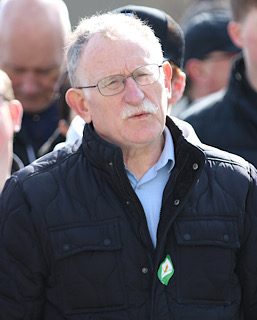
Birth of Dessie Ellis, Sinn Féin Politician

Desmond Ellis, Sinn Féin politician who has been a Teachta Dála (TD) for the Dublin North-West constituency since the 2011 Irish general election, is born in Finglas, Dublin, on September 23, 1953.

Ellis is from an Irish republican family, and both of his grandfathers fought in the Easter Rising in 1916. He later owns a television repair business.

Ellis is a former Provisional Irish Republican Army prisoner. He is arrested in 1981, when explosives and bomb making equipment are found under his bed. He is charged with possession of explosives. He jumps bail, but is arrested in Buffalo, New York in February 1982 and extradited to the Republic of Ireland, where in April 1983, he is sentenced to ten years’ imprisonment in Portlaoise Prison. He is convicted of possessing multiple power-timer units for IRA bombs, including those suspected of being used in the Hyde Park and Regent’s Park bombings. In 1983, his fingerprints are found on a huge cache of IRA explosives found in a forest outside the Berkshire town of Pangbourne. The cache is linked to the Harrods and Hyde Park bombings. On November 14, 1990, after thirty-five days on hunger strike, he becomes the first person extradited from the Republic of Ireland to the United Kingdom under the 1987 Extradition Act. He goes on hunger strike to protest efforts to send him to Britain, but is extradited in the sixth week of his fast. His hunger strike draws considerable domestic and international attention, and at one point Taoiseach Charles Haughey intervenes, asking Ellis’ parents to ask him to give it up, but they refuse. He is acquitted at his trial in London in October 1991.

Ellis is first elected to Dublin City Council in 1999, for the Finglas local electoral area. He unsuccessfully contests the 2002 Irish general election in the Dublin North-West constituency, and receives 4,781 first-preference votes (18.3%). He is again unsuccessful at the 2007 Irish general election in the same constituency, receiving 4,873 votes (15.7%). At the 2011 Irish general election, he is elected to the 31st Dáil with 7,115 (21.7%) of the first-preference votes.

In October 2014, following claims made by Máiría Cahill that she had been raped as a 17-year-old by a member of the Provisional IRA, Ellis states that “If an allegation was made against a volunteer it would have to be investigated [internally]…To be honest they were not qualified to deal with something like sexual abuse”. Based on this, Philip Ryan of the Irish Independent accuses Ellis of admitting that the IRA ran “kangaroo courts.”

In 2015, Ellis refuses to comment on if Sinn Féin leader Gerry Adams should distance himself from Thomas ‘Slab’ Murphy, an Irish republican found guilty of tax fraud and an allegedly a former IRA Chief of Staff.

At the 2016 Irish general election Ellis is again elected with 7,571 (20.5%) of the first-preference votes.

In September 2016, a bill is put forward, which if passed would criminalise hare coursing. Sinn Féin supports the legalisation of hare coursing and decides to apply the party whip. As Ellis opposes it he declines to vote. He defies party instructions by not informing party whip Aengus Ó Snodaigh that he will not be taking part in the vote so he could be excused. He is subsequently given a written warning.

In December 2016, during a session of the Dáil, Ellis and his fellow Sinn Féin TD Martin Ferris are accused by Fine Gael TD Alan Farrell of having information in relation to the shooting of Brian Stack, the chief prison officer at Portlaoise Prison, in 1983. Sinn Féin leader Gerry Adams had just delivered an address to the Dáil in relation to Stack when Farrell rises and uses Dáil privilege to state Gerry Adams had listed Ellis and Ferris as amongst people who may have information about the Stack death in an e-mail to the Garda Commission in February 2014, and ask that the two should also address the Dáil on the matter. Ellis immediately responds by stating, “I refute [sic] any allegations. For the information, the man in question claims to be a solicitor, I was actually in jail for the period. In Portlaoise, and before that in America, so you should check your facts. You’re a disgrace.” Ferris follows Ellis, and states, “On the record of this house; In 2013, I met with gardaí at their request regarding the death of Brian Stack, I co-operated fully with them and I have nothing to answer for, and it’s a disgrace what you have come in here naming. You should be ashamed of yourself.” In December 2016, Ellis states he had received death threats following the exchange in the Dáil.

In February 2018, Ellis is censured by Sinn Féin after he states publicly that fellow party member and councillor for Ballymun Noeleen Reilly is “not fit to represent Sinn Féin” and that she had waged a social media campaign against him. For her part, Reilly is suspended by the party for six months.

At the 2020 Irish general election Ellis is again elected with 14,375 first-preference votes (44.4%). He is a poll topper in the 2020 general election along with many Sinn Féin TDs in the 2020 election. He is criticised for joining his supporters singing “Come Out, Ye Black and Tans” at the count, but he dismisses the suggestion it is inappropriate.

At the 2024 Irish general election, Ellis is re-elected to the Dáil.

Ellis is in favour of the abolition of the local property tax. He supports the repealing of the Eighth Amendment, which forbids abortion in the Republic of Ireland. He believes refugees should have the right to work in Ireland and believes the system of direct provision should come to an end.

In 2012, the Irish Independent, citing released internal documents held by the British government that were previously sealed for 30 years, alleges that by 1982 British authorities believe Ellis to be linked to “50 murders” as part of his time in the Provisional IRA. The allegation specifically cites a telegraph from the British embassy in Washington, D.C., to American counterparts in which they claim that Ellis is linked by “forensic evidence to some 50 murders” across Northern Ireland and the Republic of Ireland. The Irish Independent claims another document states that Ellis is a “leading member” of the Provisional IRA.

Sinn Féin denounces the allegations as an “Indo Smear” and releases a statement declaring, “This is not the first time such unsubstantiated allegations have been made and Dessie Ellis rejects them as he has repeatedly done. Following a prolonged hunger strike in the 1990s to protest his extradition to Britain, Dessie successfully beat these trumped-up charges in court. Dessie Ellis has made no secret of his involvement in the republican struggle over many decades, including within the ranks of the IRA. Dessie has also been an important persuader for the Peace Process for many years.” Ellis does not make any personal statement on the allegations and refers journalists to Sinn Féin’s official statement.

Ellis is proficient in karate, holding a black belt, and teaches martial arts to young people. He is married to Anne Ellis (née Dunne) with grown up children.


2 Comments

Birth of Jack “Legs” Diamond, Irish American Gangster

Jack “Legs” Diamond, an Irish American gangster in Philadelphia and New York City during the Prohibition era also known as John Nolan and Gentleman Jack, is born in Philadelphia on July 10, 1897, to Sara and John Moran, who emigrated from Ireland to Philadelphia in 1891. A bootlegger and close associate of gambler Arnold Rothstein, he survives a number of attempts on his life between 1916 and 1931, causing him to be known as the “clay pigeon of the underworld.” In 1930, his nemesis Dutch Schultz remarks to his own gang, “Ain’t there nobody that can shoot this guy so he don’t bounce back?”

In 1899, Diamond’s younger brother Eddie is born. He and Eddie both struggle through grade school, and their mother suffers from severe arthritis and other health problems. She passes away on December 24, 1913, following complications brought on by a bacterial infection and a high fever. John Moran then moves his family to Brooklyn, New York.

Diamond soon joins a Manhattan street gang called the Hudson Dusters. His first arrest for burglary occurs when he breaks into a jewelry store on February 4, 1914. He serves in the United States Army in World War I but is convicted and jailed for desertion in 1918 or 1919. He serves two years of a three- to five-year sentence at Leavenworth Military Prison. After being released in 1921, he becomes a hired thug and later personal bodyguard for crime boss Arnold Rothstein.

Diamond is known for leading a rather flamboyant lifestyle. He is an energetic individual, his nickname “Legs” derived either from his being a good dancer or from how fast he could escape his enemies. His wife Alice is never supportive of his life of crime but does not do much to dissuade him from it. He is a womanizer, with his best-known mistress being a showgirl and dancer, Marion “Kiki” Roberts.

In the late 1920s, Prohibition is in force, and the sale of beer and other alcoholic beverages is illegal in the United States. Diamond travels to Europe to acquire beer and narcotics but fails. However, he does obtain liquor, which is dumped overboard in partially full barrels that float to Long Island as ships enter New York Harbor. He pays children a nickel for every barrel they bring to his trucks.

Following the death of Jacob “Little Augie” Orgen, Diamond oversees illegal alcohol sales in downtown Manhattan via the Hotsy Totsy Club, an establishment partly owned by Diamond on Broadway. This work brings him into conflict with Dutch Schultz, who wants to move beyond his base in Harlem. He also runs into trouble with other gangs in the city. On July 14, 1929, he and fellow gang member Charles Entratta shoot three drunken brawlers in the Hotsy Totsy Club. Two of the brawlers, William Cassidy and Simon Walker, are killed, while the survivor, Peter Cassidy, is severely wounded. The club’s bartender, three waiters, and the hat check girl vanish, with one of them being found shot dead in New Jersey. He is not charged but is forced to close the club.

In 1930, Diamond and two henchmen kidnap truck driver Grover Parks in Cairo, New York, demanding to know where he had obtained his load of hard cider. When Parks denies carrying anything, Diamond and his men beat and tortured Parks, eventually letting him go. A few months later, he is charged with the kidnapping of James Duncan. He is sent to Catskill, New York, for his first trial, but is acquitted. However, he is convicted in a federal case on related charges and sentenced to four years in jail. He is tried in December 1931 in Troy, New York, also for kidnapping, and is once again acquitted.

On August 23, 1930, Diamond, under the false name John Nolan, boards the ocean liner SS Belgenland, bound for Europe. The New York City Police Department (NYPD) suspect that he might have left the U.S. aboard RMS Olympic or RMS Baltic, but he is not found on either ship when they reach Europe. The NYPD then sends a wireless telegraph message to the crew of SS Belgenland, who reply that a man similar to Diamond’s description is among the passengers. Diamond spends much of the voyage in the ship’s smoking-room playing poker, with one report claiming that he won thousands of dollars in this game. The SS Belgenland‘s officers, however, refute this, saying his winnings were small.

The NYPD telegraphs police in England, France and Belgium with the warning that Diamond is an undesirable character. When SS Belgenland reaches Plymouth on August 31, Scotland Yard officers tell Diamond he will not be allowed to land in England. He tells reporters that he wants to travel to the French spa town of Vichy for “the cure.” He disembarks in Antwerp on September 1, where Belgian police take him to their headquarters. Eventually, he agrees to voluntarily leave Belgium and is put on a train to Germany. When his train reaches Aachen, German police arrest him. On September 6, the German government decides to deport Diamond. He is driven to Hamburg and put on the cargo ship Hannover for passage to Philadelphia.

On September 23, Hannover arrives in Philadelphia, and Diamond is immediately arrested by the Philadelphia police. At a court hearing that day, the judge says he will release him if he leaves Philadelphia within the hour. Diamond agrees.

On October 24, 1924, Diamond is shot and wounded by shotgun pellets, reportedly after trying to hijack liquor trucks belonging to a rival crime syndicate.

On October 16, 1927, Diamond tries to stop the murder of “Little Augie” Orgen. His brother Eddie is Orgen’s bodyguard, but Diamond substitutes for Eddie that day. As Orgen and he are walking down a street on Manhattan’s Lower East Side, three young men approach them and start shooting. Orgen is fatally wounded, and Diamond is shot twice below the heart. He is taken to Bellevue Hospital, where he eventually recovers. Police interview him in the hospital, but he refuses to identify any suspects or help the investigation in any way. Police initially suspect that he is an accomplice and charge him with homicide, but the charge is dropped. The assailants are supposedly hired by Lepke Buchalter and Jacob “Gurrah” Shapiro, who are seeking to encroach on Orgen’s garment-district labor rackets.

On October 12, 1930, Diamond is shot and wounded at the Hotel Monticello on Manhattan’s West Side. Two men force their way into his room and shoot him five times. Still in his pajamas, he staggers into the hallway and collapses. When asked later by the police commissioner how he managed to walk out of the room, he says he drank two shots of whiskey first. He is rushed to the Polyclinic Hospital, where he eventually recovers. He is discharged from Polyclinic on December 30, 1930.

On April 21, 1931, Diamond is arrested in Catskill on assault charges for the Parks beating in 1930. Two days later, he is released from the county jail on $25,000 bond. Five days later, he is again shot and wounded at the Aratoga Inn, a roadhouse near Cairo. After eating in the dining room with three companions, he is shot three times and collapses by the front door. A local resident drives him to a hospital in Albany, where he eventually recovers. On May 1, while he is still in the hospital, the New York State Police seize over $5,000 worth of illegal beer and alcohol from his hiding places in Cairo and at the Aratoga Inn.

In August 1931, Diamond and Paul Quattrocchi go on trial for bootlegging. The same month, he is convicted and sentenced to four years in state prison. In September 1931, he appeals his conviction.

On December 18, 1931, Diamond’s enemies finally catch up with him. He is staying in a rooming house on Dove Street in Albany while on trial for kidnapping in Troy. On the night of his acquittal, December 17, he and his family and friends visit a restaurant in Albany. At 1:00 a.m., he and mistress, Marion “Kiki” Roberts, entertain themselves at the Rain-Bo Room of the Kenmore Hotel on North Pearl Street.

At 4:30 a.m., Diamond drunkenly goes back to the rooming house and passes out on his bed. Two gunmen enter his room about an hour later. One man holds Diamond down and the other shoots him three times in the back of the head.

There is much speculation as to who is responsible for the murder. Likely candidates include Schultz, the Oley Brothers, the Albany Police Department, and relatives of Red Cassidy, another Irish American gangster at the time. According to author William Kennedy in his book O Albany, Dan O’Connell, who runs the local Democratic political machine, orders Diamond’s execution, which is carried out by the Albany police.

Given the power that the O’Connell machine holds in Albany and its determination to prevent organized crime, other than their own, from threatening their monopoly of vice in the city, some accept this account of the story. For those believing this theory, William Fitzpatrick’s promotion to chief of police is said to be a reward for executing Diamond. In 1945, Chief Fitzpatrick is shot and killed in his own office by John McElveney, an Albany police detective. McElveney is sentenced to 20 years to life in prison. He is released in 1957 when his sentence is commuted by Governor W. Averell Harriman.

On December 23, 1931, Diamond is buried at Mount Olivet Cemetery in Maspeth, Queens. There is no church service or graveside ceremony. Family and spectators numbering 200 attend the interment. No criminal figures are spotted.

On July 1, 1933, Alice Kenny Diamond, Diamond’s 33-year-old widow, is found shot to death in her Brooklyn apartment. It is speculated that she is shot by Diamond’s enemies to keep her quiet.


Leave a comment

The Sallins Train Robbery

The Sallins Train robbery occurs on March 31, 1976 when the Cork to Dublin mail train is robbed near Sallins in County Kildare. Approximately £200,000 is stolen. Five members of the Irish Republican Socialist Party, Osgur Breatnach, Nicky Kelly, Brian McNally, Mick Plunkett, and John Fitzpatrick, are arrested in connection with the robbery.

After the failure of the authorities to produce a “book of evidence” against them, the four are released but are immediately re-arrested. During interrogation in Garda Síochána custody, all except Plunkett sign alleged confessions, presenting with extensive bruising and injuries they claim are inflicted by members of the Gardaí.

While awaiting trial, Fitzpatrick jumps bail and leaves the country. The trial of McNally, Kelly, and Breatnach in the Special Criminal Court becomes the longest-running trial in Irish criminal history, at 65 days, before it collapses due to the death of one of the three judges, Judge John O’Connor of the Circuit Court.

Medical evidence of beatings is presented to the court, both during the initial trial and the second trial. The court rejects this evidence, finding that the beatings have been self-inflicted or inflicted by the co-accused. Anticipating a conviction, Kelly flees before the conclusion of the second trial. The three are found guilty, solely on the basis of their confessions, and sentenced to between nine and twelve years in prison. Kelly is sentenced in absentia.

In May 1980, Breatnach and McNally are acquitted on appeal on the grounds that their statements had been taken under duress. The same month, the Provisional Irish Republican Army claims responsibility for the robbery. Kelly returns to Ireland from the United States in June 1980, expecting to be acquitted. Instead he is incarcerated in the maximum-security Portlaoise Prison and spends the next four years proclaiming his innocence, including a 38-day period on hunger strike.

After a campaign by the Irish Council for Civil Liberties, Amnesty International, and others and a song, Wicklow Boy, by the popular folk singer Christy Moore, Kelly is eventually released on “humanitarian grounds” in 1984. He is given a presidential pardon in 1992 and receives £1,000,000 in compensation. Breatnach and McNally are also given compensation.