seamus dubhghaill

Promoting Irish Culture and History from Little Rock, Arkansas, USA


Leave a comment

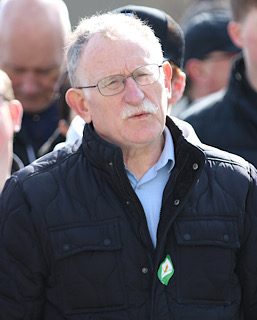
Birth of Dessie Ellis, Sinn Féin Politician

Desmond Ellis, Sinn Féin politician who has been a Teachta Dála (TD) for the Dublin North-West constituency since the 2011 Irish general election, is born in Finglas, Dublin, on September 23, 1953.

Ellis is from an Irish republican family, and both of his grandfathers fought in the Easter Rising in 1916. He later owns a television repair business.

Ellis is a former Provisional Irish Republican Army prisoner. He is arrested in 1981, when explosives and bomb making equipment are found under his bed. He is charged with possession of explosives. He jumps bail, but is arrested in Buffalo, New York in February 1982 and extradited to the Republic of Ireland, where in April 1983, he is sentenced to ten years’ imprisonment in Portlaoise Prison. He is convicted of possessing multiple power-timer units for IRA bombs, including those suspected of being used in the Hyde Park and Regent’s Park bombings. In 1983, his fingerprints are found on a huge cache of IRA explosives found in a forest outside the Berkshire town of Pangbourne. The cache is linked to the Harrods and Hyde Park bombings. On November 14, 1990, after thirty-five days on hunger strike, he becomes the first person extradited from the Republic of Ireland to the United Kingdom under the 1987 Extradition Act. He goes on hunger strike to protest efforts to send him to Britain, but is extradited in the sixth week of his fast. His hunger strike draws considerable domestic and international attention, and at one point Taoiseach Charles Haughey intervenes, asking Ellis’ parents to ask him to give it up, but they refuse. He is acquitted at his trial in London in October 1991.

Ellis is first elected to Dublin City Council in 1999, for the Finglas local electoral area. He unsuccessfully contests the 2002 Irish general election in the Dublin North-West constituency, and receives 4,781 first-preference votes (18.3%). He is again unsuccessful at the 2007 Irish general election in the same constituency, receiving 4,873 votes (15.7%). At the 2011 Irish general election, he is elected to the 31st Dáil with 7,115 (21.7%) of the first-preference votes.

In October 2014, following claims made by Máiría Cahill that she had been raped as a 17-year-old by a member of the Provisional IRA, Ellis states that “If an allegation was made against a volunteer it would have to be investigated [internally]…To be honest they were not qualified to deal with something like sexual abuse”. Based on this, Philip Ryan of the Irish Independent accuses Ellis of admitting that the IRA ran “kangaroo courts.”

In 2015, Ellis refuses to comment on if Sinn Féin leader Gerry Adams should distance himself from Thomas ‘Slab’ Murphy, an Irish republican found guilty of tax fraud and an allegedly a former IRA Chief of Staff.

At the 2016 Irish general election Ellis is again elected with 7,571 (20.5%) of the first-preference votes.

In September 2016, a bill is put forward, which if passed would criminalise hare coursing. Sinn Féin supports the legalisation of hare coursing and decides to apply the party whip. As Ellis opposes it he declines to vote. He defies party instructions by not informing party whip Aengus Ó Snodaigh that he will not be taking part in the vote so he could be excused. He is subsequently given a written warning.

In December 2016, during a session of the Dáil, Ellis and his fellow Sinn Féin TD Martin Ferris are accused by Fine Gael TD Alan Farrell of having information in relation to the shooting of Brian Stack, the chief prison officer at Portlaoise Prison, in 1983. Sinn Féin leader Gerry Adams had just delivered an address to the Dáil in relation to Stack when Farrell rises and uses Dáil privilege to state Gerry Adams had listed Ellis and Ferris as amongst people who may have information about the Stack death in an e-mail to the Garda Commission in February 2014, and ask that the two should also address the Dáil on the matter. Ellis immediately responds by stating, “I refute [sic] any allegations. For the information, the man in question claims to be a solicitor, I was actually in jail for the period. In Portlaoise, and before that in America, so you should check your facts. You’re a disgrace.” Ferris follows Ellis, and states, “On the record of this house; In 2013, I met with gardaí at their request regarding the death of Brian Stack, I co-operated fully with them and I have nothing to answer for, and it’s a disgrace what you have come in here naming. You should be ashamed of yourself.” In December 2016, Ellis states he had received death threats following the exchange in the Dáil.

In February 2018, Ellis is censured by Sinn Féin after he states publicly that fellow party member and councillor for Ballymun Noeleen Reilly is “not fit to represent Sinn Féin” and that she had waged a social media campaign against him. For her part, Reilly is suspended by the party for six months.

At the 2020 Irish general election Ellis is again elected with 14,375 first-preference votes (44.4%). He is a poll topper in the 2020 general election along with many Sinn Féin TDs in the 2020 election. He is criticised for joining his supporters singing “Come Out, Ye Black and Tans” at the count, but he dismisses the suggestion it is inappropriate.

At the 2024 Irish general election, Ellis is re-elected to the Dáil.

Ellis is in favour of the abolition of the local property tax. He supports the repealing of the Eighth Amendment, which forbids abortion in the Republic of Ireland. He believes refugees should have the right to work in Ireland and believes the system of direct provision should come to an end.

In 2012, the Irish Independent, citing released internal documents held by the British government that were previously sealed for 30 years, alleges that by 1982 British authorities believe Ellis to be linked to “50 murders” as part of his time in the Provisional IRA. The allegation specifically cites a telegraph from the British embassy in Washington, D.C., to American counterparts in which they claim that Ellis is linked by “forensic evidence to some 50 murders” across Northern Ireland and the Republic of Ireland. The Irish Independent claims another document states that Ellis is a “leading member” of the Provisional IRA.

Sinn Féin denounces the allegations as an “Indo Smear” and releases a statement declaring, “This is not the first time such unsubstantiated allegations have been made and Dessie Ellis rejects them as he has repeatedly done. Following a prolonged hunger strike in the 1990s to protest his extradition to Britain, Dessie successfully beat these trumped-up charges in court. Dessie Ellis has made no secret of his involvement in the republican struggle over many decades, including within the ranks of the IRA. Dessie has also been an important persuader for the Peace Process for many years.” Ellis does not make any personal statement on the allegations and refers journalists to Sinn Féin’s official statement.

Ellis is proficient in karate, holding a black belt, and teaches martial arts to young people. He is married to Anne Ellis (née Dunne) with grown up children.


Leave a comment

Death of Katy French, Socialite, Model & TV Personality

Katy Ellen French, Irish socialite, model, writer, television personality and charity worker, dies on December 6, 2007, in Navan, County Meath, after collapsing at a friend’s house on December 2. According to the BBC, “in the space of less than two years, she had become one of Ireland’s best-known models and socialites.” Her cause of death is given as hypoxic ischemic brain injury caused by cocaine and ephedrine.

French is born on October 31, 1983, in Basel, Switzerland, to John and Janet French, from Australia and Britain respectively. At the age of two, she moves with her family to Ireland, briefly living in the Sandyford area before settling in Enniskerry, County Wicklow, and later to Stillorgan, County Dublin. She attends Alexandra College in Milltown, Dublin, from the age of seven. While still in school she works part-time as a hostess at the Dublin branch of the Planet Hollywood restaurant chain.

French studies psychology and marketing before working for the Assets Modelling Agency and later writing articles for several Dublin magazines and newspapers. She represents Sony Ericsson and Suzuki among many other brands, becoming more famous in 2007 as a result of her fiancé, restaurateur Marcus Sweeney, ending their relationship in a very public fashion after she is photographed for a lingerie shoot for the Sunday Independent in his restaurant in January of that year. As a result of this publicity, her image appears more regularly in daily Irish tabloid newspapers, and she makes numerous television appearances on shows such as RTÉ‘s The Podge and Rodge Show in April 2007 and Tubridy Tonight a week before her death.

French is known for deliberately courting controversy to promote her career. On Tubridy Tonight she speaks of her appearance on Celebrities Go Wild as well as her relationship break up with Sweeney. Mention is also made of her birthday party which she is to celebrate the following week, having missed her birthday due to Celebrities Go Wild. Host Ryan Tubridy is invited to the event. Footage is shown of the charity single “Down in the Bog” which is to be released as a Christmas single. She works for several Irish charities including Our Lady’s Children’s Hospital, Crumlin and GOAL in Calcutta, India. She writes a column for Social & Personal magazine.

In an interview with Hot Press‘s Jason O’Toole, French says that she would consider having an abortion if she became pregnant during the peak of her career, a controversial statement in Ireland where abortion is at that time effectively illegal, and that she loves fur despite being a “massive animal lover.” She also airs her religious beliefs, being a member of the Church of England as well as a practising Catholic and speaks highly of Islam and her Muslim friends saying, “When you read the Koran, you realise that Islam is a beautiful religion.” In the same interview she is asked if she has ever used cocaine and denies ever having done so. In November 2007, she tells an Irish tabloid that she has used cocaine but has stopped. A week before she dies, she celebrates her 24th birthday with celebrity and media friends.

French dies on the evening of December 6, 2007, in Our Lady’s Hospital, Navan, County Meath, having collapsed at a house in Kilmessan, County Meath, in the early hours of Sunday, December 2. There is widespread speculation in the media that her death is the result of a drug overdose. A postmortem finds she has suffered brain damage, and that traces of cocaine are found in her body. A senior Garda states, “We strongly suspect that drugs contributed to her death. This was a previously healthy person being brought to hospital in a collapsed state.” In 2010 two people are charged with supplying cocaine to French and in failing to get medical assistance in a timely fashion. She is buried in her hometown of Enniskerry, County Wicklow, on December 10. Taoiseach Bertie Ahern‘s aide de camp, Captain Michael Tracey, attends her funeral.

On November 13, 2012, two friends of French, Kieron Ducie and Ann Corcoran, plead guilty to possession of cocaine with intent to supply on the weekend of French’s death. Trim Circuit Court is told that a second charge against the pair is not being pursued, that they had intentionally or recklessly engaged in behaviour relating to the supply of cocaine to French and failed to get medical assistance in a timely fashion. In July 2013 the pair are sentenced to a 2-1⁄2 year suspended sentence and three-year good behaviour bond, and a two-year suspended sentence and two-year good behaviour bond respectively. At the verdict, French’s cause of death is given as hypoxic ischemic brain injury caused by cocaine and ephedrine.


Leave a comment

28th Amendment of the Constitution Bill 2008 Rejected by Irish Voters

The Twenty-eighth Amendment of the Constitution Bill 2008, a proposed amendment to the Constitution of Ireland, is rejected by voters on June 12, 2008, by a margin of 53.4% to 46.6%, with a turnout of 53.1%. The purpose of the proposed amendment is to allow the state to ratify the Treaty of Lisbon of the European Union.

The treaty had been intended to enter into force on January 1, 2009, but has to be delayed following the Irish rejection. However, the Lisbon treaty is approved by Irish voters when the Twenty-eighth Amendment of the Constitution of Ireland is approved in the second Lisbon referendum, held in October 2009.

The Treaty of Lisbon is signed by the member states of the European Union on December 13, 2007. It is in large part a revision of the text of the Treaty establishing a Constitution for Europe (TCE) after its rejection in referendums in France in May 2005 and in the Netherlands in June 2005. The Treaty of Lisbon preserves most of the content of the Constitution, especially the new rules on the functioning of the European Institutions but gives up any symbolic or terminologic reference to a constitution.

Because of the decision of the Supreme Court of Ireland in Crotty v. An Taoiseach (1987), an amendment to the Constitution is required before it can be ratified by Ireland. Ireland is the only one of the then fifteen EU member states to put the Treaty to the people in a referendum. Ratification of the Treaty in all other member states is decided upon by national parliaments alone.

On February 26, 2008, the Government of Ireland approves the text of the changes to the constitution. The Twenty-eighth Amendment of the Constitution Bill is proposed in Dáil Éireann by Minister for Foreign Affairs Dermot Ahern on April 2, 2008. It passes final stages in the Dáil on April 29, with Sinn Féin TDs and Independent TD Tony Gregory rising against, but with insufficient numbers to call a vote. It passes final stages in the Seanad on May 7.

A Referendum Commission is established by Minister for the Environment, Heritage and Local Government John Gormley. It is chaired by former High Court judge Iarfhlaith O’Neill. Its role is to prepare one or more statements containing a general explanation of the subject matter of the proposal and of the text of the proposal in the amendment bill.

The government parties of Fianna Fáil and the Progressive Democrats are in favour of the treaty, but the other government party, the Green Party, is divided on the issue. At a special convention on January 19, 2008, the leadership of the Green Party fails to secure a two-thirds majority required to make support for the referendum official party policy. As a result, the Green Party itself does not participate in the referendum debate, although individual members are free to be involved in whatever side they chose. All Green Party members of the Oireachtas support the Treaty. The main opposition parties of Fine Gael and the Labour Party are also in favour. Only one party represented in the Oireachtas, Sinn Féin, is opposed to the treaty, while minor parties opposed to it include the Socialist Party, the Workers’ Party and the Socialist Workers Party. Independent TD’s Tony Gregory and Finian McGrath, Independent MEP Kathy Sinnott, and Independent members of the Seanad from the universities David Norris, Shane Ross and Rónán Mullen advocate a “No” vote as well.

The Government sends bilingual booklets written in English and Irish, explaining the Treaty, to all 2.5 million Irish households. However, compendiums of the two previous treaties, of which the Lisbon Treaty is intended to be a series of reforms and amendments, remain unavailable in Ireland. Some commentators argue that the treaty remains essentially incomprehensible in the absence of such a compendium.

On March 12, 2008, the Libertas Institute, a lobby group started by businessman Declan Ganley, launches a campaign called Facts, not politics which advocates a “No” vote in the referendum. A month later, the German Chancellor, Angela Merkel, appeals to Irish people to vote “Yes” in the referendum while on a visit to Ireland. The anti-Lisbon Treaty campaign group accuses the government and Fine Gael of a U-turn on their previous policy of discouraging foreign leaders from visiting Ireland during the referendum campaign. The European Commissioner for Internal Market Charlie McCreevy admits he had not read the Treaty from cover to cover and says, “he would not expect any sane person to do so.”

At the start of May, the Irish Alliance for Europe launches its campaign for a “Yes” vote in the referendum this consists of trade unionists, business people, academics and politicians. Its members include Garret FitzGerald, Ruairi Quinn, Pat Cox and Michael O’Kennedy. The Taoiseach Brian Cowen states that should any member of the Fianna Fáil parliamentary party campaign against the treaty, they will likely be expelled from the party.

On May 21, 2008, the executive council of the Irish Congress of Trade Unions votes to support a “Yes” vote in the referendum. Rank and file members of the individual unions are not balloted, and the Technical, Engineering and Electrical Union (TEEU) advises its 45,000 members to vote “No.” The Irish bishops conference states the Catholic Church‘s declaration that the treaty will not weaken Ireland’s constitutional ban on abortion, however the conference does not advocate either a “Yes” or “No” vote. By the start of June, Fianna Fáil, Fine Gael and the Labour Party have united in their push for a “Yes” vote despite earlier divisions. The two largest farming organisations, the Irish Creamery Milk Suppliers Association (ICMSA) and the Irish Farmers’ Association call for a “Yes” vote, the latter giving its support after assurances from Taoiseach Brian Cowen that Ireland will use its veto in Europe if a deal on World Trade reform is unacceptable.

There were 3,051,278 voters on the electoral register. The vast majority of voting takes place on Thursday, June 12, between 7:00 a.m. and 10:00 p.m. Counting begins at 9:00 a.m. the following morning. Several groups vote before the standard polling day, with some casting postal votes before June 9. These include members of the Irish Defence Forces serving in United Nations peacekeeping missions, Irish diplomats and their spouses abroad, members of the Garda Síochána, those unable to vote in person due to physical illness or disability, those who are unable to vote in person due to their employment (including students) and prisoners.

On June 9, several islands off the coast of County Donegal vote: Tory Island, Inishfree, Gola, Inishbofin and Arranmore. These islands are all part of the Donegal South-West constituency. Around 37% of the 745 eligible votes. Two days later, several islands off the coast of counties Galway and Mayo vote: the Aran Islands (Inis Mór, Inis Meáin and Inis Oírr) and Inishboffin form part of Galway West constituency, while Inishturk, Inishbiggle and Clare Island form part of the Mayo constituency. The Galway islands have 1,169 eligible voters, while the Mayo islands have 197.

Votes are counted separately in each Dáil constituency. The overall verdict is formally announced by the Referendum Returning officer in Dublin Castle by accumulating the constituency totals.

(Pictured: Campaign posters in St. Stephen’s Green, Dublin)