seamus dubhghaill

Promoting Irish Culture and History from Little Rock, Arkansas, USA


Leave a comment

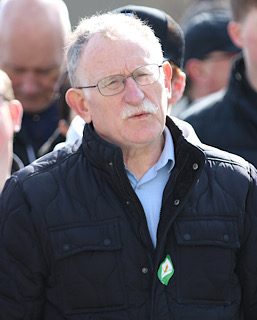
Birth of Dessie Ellis, Sinn Féin Politician

Desmond Ellis, Sinn Féin politician who has been a Teachta Dála (TD) for the Dublin North-West constituency since the 2011 Irish general election, is born in Finglas, Dublin, on September 23, 1953.

Ellis is from an Irish republican family, and both of his grandfathers fought in the Easter Rising in 1916. He later owns a television repair business.

Ellis is a former Provisional Irish Republican Army prisoner. He is arrested in 1981, when explosives and bomb making equipment are found under his bed. He is charged with possession of explosives. He jumps bail, but is arrested in Buffalo, New York in February 1982 and extradited to the Republic of Ireland, where in April 1983, he is sentenced to ten years’ imprisonment in Portlaoise Prison. He is convicted of possessing multiple power-timer units for IRA bombs, including those suspected of being used in the Hyde Park and Regent’s Park bombings. In 1983, his fingerprints are found on a huge cache of IRA explosives found in a forest outside the Berkshire town of Pangbourne. The cache is linked to the Harrods and Hyde Park bombings. On November 14, 1990, after thirty-five days on hunger strike, he becomes the first person extradited from the Republic of Ireland to the United Kingdom under the 1987 Extradition Act. He goes on hunger strike to protest efforts to send him to Britain, but is extradited in the sixth week of his fast. His hunger strike draws considerable domestic and international attention, and at one point Taoiseach Charles Haughey intervenes, asking Ellis’ parents to ask him to give it up, but they refuse. He is acquitted at his trial in London in October 1991.

Ellis is first elected to Dublin City Council in 1999, for the Finglas local electoral area. He unsuccessfully contests the 2002 Irish general election in the Dublin North-West constituency, and receives 4,781 first-preference votes (18.3%). He is again unsuccessful at the 2007 Irish general election in the same constituency, receiving 4,873 votes (15.7%). At the 2011 Irish general election, he is elected to the 31st Dáil with 7,115 (21.7%) of the first-preference votes.

In October 2014, following claims made by Máiría Cahill that she had been raped as a 17-year-old by a member of the Provisional IRA, Ellis states that “If an allegation was made against a volunteer it would have to be investigated [internally]…To be honest they were not qualified to deal with something like sexual abuse”. Based on this, Philip Ryan of the Irish Independent accuses Ellis of admitting that the IRA ran “kangaroo courts.”

In 2015, Ellis refuses to comment on if Sinn Féin leader Gerry Adams should distance himself from Thomas ‘Slab’ Murphy, an Irish republican found guilty of tax fraud and an allegedly a former IRA Chief of Staff.

At the 2016 Irish general election Ellis is again elected with 7,571 (20.5%) of the first-preference votes.

In September 2016, a bill is put forward, which if passed would criminalise hare coursing. Sinn Féin supports the legalisation of hare coursing and decides to apply the party whip. As Ellis opposes it he declines to vote. He defies party instructions by not informing party whip Aengus Ó Snodaigh that he will not be taking part in the vote so he could be excused. He is subsequently given a written warning.

In December 2016, during a session of the Dáil, Ellis and his fellow Sinn Féin TD Martin Ferris are accused by Fine Gael TD Alan Farrell of having information in relation to the shooting of Brian Stack, the chief prison officer at Portlaoise Prison, in 1983. Sinn Féin leader Gerry Adams had just delivered an address to the Dáil in relation to Stack when Farrell rises and uses Dáil privilege to state Gerry Adams had listed Ellis and Ferris as amongst people who may have information about the Stack death in an e-mail to the Garda Commission in February 2014, and ask that the two should also address the Dáil on the matter. Ellis immediately responds by stating, “I refute [sic] any allegations. For the information, the man in question claims to be a solicitor, I was actually in jail for the period. In Portlaoise, and before that in America, so you should check your facts. You’re a disgrace.” Ferris follows Ellis, and states, “On the record of this house; In 2013, I met with gardaí at their request regarding the death of Brian Stack, I co-operated fully with them and I have nothing to answer for, and it’s a disgrace what you have come in here naming. You should be ashamed of yourself.” In December 2016, Ellis states he had received death threats following the exchange in the Dáil.

In February 2018, Ellis is censured by Sinn Féin after he states publicly that fellow party member and councillor for Ballymun Noeleen Reilly is “not fit to represent Sinn Féin” and that she had waged a social media campaign against him. For her part, Reilly is suspended by the party for six months.

At the 2020 Irish general election Ellis is again elected with 14,375 first-preference votes (44.4%). He is a poll topper in the 2020 general election along with many Sinn Féin TDs in the 2020 election. He is criticised for joining his supporters singing “Come Out, Ye Black and Tans” at the count, but he dismisses the suggestion it is inappropriate.

At the 2024 Irish general election, Ellis is re-elected to the Dáil.

Ellis is in favour of the abolition of the local property tax. He supports the repealing of the Eighth Amendment, which forbids abortion in the Republic of Ireland. He believes refugees should have the right to work in Ireland and believes the system of direct provision should come to an end.

In 2012, the Irish Independent, citing released internal documents held by the British government that were previously sealed for 30 years, alleges that by 1982 British authorities believe Ellis to be linked to “50 murders” as part of his time in the Provisional IRA. The allegation specifically cites a telegraph from the British embassy in Washington, D.C., to American counterparts in which they claim that Ellis is linked by “forensic evidence to some 50 murders” across Northern Ireland and the Republic of Ireland. The Irish Independent claims another document states that Ellis is a “leading member” of the Provisional IRA.

Sinn Féin denounces the allegations as an “Indo Smear” and releases a statement declaring, “This is not the first time such unsubstantiated allegations have been made and Dessie Ellis rejects them as he has repeatedly done. Following a prolonged hunger strike in the 1990s to protest his extradition to Britain, Dessie successfully beat these trumped-up charges in court. Dessie Ellis has made no secret of his involvement in the republican struggle over many decades, including within the ranks of the IRA. Dessie has also been an important persuader for the Peace Process for many years.” Ellis does not make any personal statement on the allegations and refers journalists to Sinn Féin’s official statement.

Ellis is proficient in karate, holding a black belt, and teaches martial arts to young people. He is married to Anne Ellis (née Dunne) with grown up children.


Leave a comment

Birth of Bobby Molloy, Independent Politician

Robert Molloy, independent politician, is born in Galway, County Galway, on July 9, 1936.

Molloy’s father, Michael Edward Molloy, is originally from Ballyhaunis, County Mayo, and runs a successful wholesale drapery business in the city. His mother, Rita Stanley, hails from Clifden, County Galway. He is educated at Coláiste Iognáid and University College Galway. Before entering politics, he works for several years in printing, the clothing industry and his family’s drapery firm.

Molloy is first elected to Dáil Éireann as a Fianna Fáil TD for the Galway West constituency at the 1965 Irish general election. In 1968, he is also elected Mayor of Galway. The following year he was appointed as Parliamentary Secretary to the Minister for Education. 

Molloy’s early political career is marked by his loyalty to Fianna Fáil’s leadership under Taoiseach Jack Lynch. He quickly rises through the ranks and is appointed Minister for Local Government in 1970, a position he holds until 1973. His tenure as Minister for Local Government is characterised by his efforts to modernise and streamline local government structures in Ireland. His tenure in Fianna Fáil sees him as a stalwart of the party’s establishment, though tensions with its leadership grow over the years, particularly with Charles Haughey.

In opposition from 1973, Molloy serves as the frontbench spokesman, where he becomes involved in a high-profile dispute with James Tully, the Labour Minister for Local Government, over the controversial redrawing of constituencies, known as the “Tullymander.” Molloy, along with fellow Fianna Fáil member Brendan Crinion, used Dáil privilege to accuse Tully of having an improper commercial relationship with a builder in County Meath. The accusation is strongly denied by Tully and Molloy and Crinion later withdraw the charge. Despite this, Molloy faces severe repercussions, being forced to resign from his frontbench position. He is subsequently condemned by a judicial tribunal and censured by the Dáil for abusing parliamentary privilege.

When Fianna Fáil returns to office in 1977, Molloy becomes Minister for Defence in the final government of Jack Lynch.

Molloy supports George Colley in the 1979 Fianna Fáil leadership election. Charles Haughey wins the contest and drops Molloy, alongside other opponents, from the cabinet. Thereafter Molloy becomes a member of the Gang of 22 who oppose Haughey’s leadership of the party.

In 1986, Molloy resigns from Fianna Fáil and joins the newly formed Progressive Democrats, spearheaded by Haughey’s arch-rival Desmond O’Malley. Molloy’s move is seen as a major break from the political establishment, as the Progressive Democrats advocate for low-tax, market-oriented economic policies and a more liberal economic agenda. His decision is driven by his dissatisfaction with the direction of Fianna Fáil under Haughey’s leadership and his belief that the party has become increasingly alienating. 

In 1989, Molloy contests the European Parliament elections but is unsuccessful in his attempt. Following the 1989 Irish general election, Molloy, along with newly elected MEP for Munster Pat Cox, represents the Progressive Democrats in the lengthy negotiations with Fianna Fáil to form a coalition government. Once the negotiations conclude, he is reinstated in the Cabinet as Minister for Energy under Taoiseach Charles Haughey, who had previously caused Molloy’s political humiliation a decade earlier. Over the following three years, Molloy and his Progressive Democrat colleague Desmond O’Malley have a working relationship with their former Fianna Fáil colleagues, though tensions grow due to resentment over their presence in the Cabinet. The issue comes to a head when Molloy and O’Malley make it clear they will not serve in a Cabinet that includes Brian Lenihan Snr, following his controversial remarks during the 1990 Irish presidential election about alleged phone calls to President Patrick Hillery from 1982.

In January 1992, Haughey faces further complications when Seán Doherty reveals information about the phone tapping of journalists dating back to 1982. Despite this, the coalition government ends when Albert Reynolds, Haughey’s successor, calls for a general election after accusing O’Malley of giving “dishonest” evidence to the Beef Tribunal. Molloy strongly denounces Reynolds’ accusation, describing it as “outrageous,” and criticises him for what he perceives as a “lack of generosity” in recent North-South negotiations, in which Molloy had represented the Progressive Democrats in talks with British Unionists.

Molloy stands at the European Parliament elections again in 1994 but is again unsuccessful.

Following the 1997 Irish general election, Molloy is part of the negotiations that lead to the formation of a coalition government between the Progressive Democrats and Fianna Fáil. On that occasion, he is appointed as Minister of State at the Department of the Environment and Local Government and sits at cabinet as Minister of State to the Government.

Molloy resigns as a minister and quits politics just before the 2002 Irish general election amid controversy surrounding his involvement in the rape case of Barbara Naughton. The controversy stems from a letter Molloy sent to then Minister for Justice, John O’Donoghue, on behalf of a constituent whose relative had been convicted of rape. The letter, which requests the temporary release of the individual pending an appeal, leads to public criticism. The case is high-profile, involving a Connemara man sentenced to eleven years for the systematic abuse of his young daughter. During the trial, the judge, Philip O’Sullivan, notes that someone acting on Molloy’s behalf had tried to contact him in his chambers to clarify whether he had received certain correspondence from the victim’s sister, which the judge describes as “quite improper.” In response to the backlash, Molloy resigns, describing the letter as a “human error of judgment,” but insisting it was not intended to be dishonest. He retires from politics after the election.

Molloy is a member of Fianna Fáil for over 20 years, but his views are not always in line with the mainstream of the party, particularly under the leadership of Charles Haughey. His decision to leave Fianna Fáil in 1986 and join the Progressive Democrats is motivated by ideological differences, notably the party’s move toward a more conservative, state-controlled economy. Molloy, on the other hand, embraces a platform of fiscal conservatism, with an emphasis on reducing taxes, deregulation, and the liberalisation of the economy.

In terms of social issues, Molloy is ahead of his time in advocating for progressive policies, particularly on women’s rights. In a survey conducted in 1976 by the Women’s Political Association (WPA), Molloy scores among the highest of any member of the Dáil for his progressive stance on issues affecting women. He supports measures such as divorce, contraception, and family law reform, which are seen as highly controversial at the time. His responses to the WPA’s questions reveal that he holds views that are in stark contrast to many of his colleagues within Fianna Fáil. His progressive views on women’s rights are notable, as he is the only member of Jack Lynch’s cabinet who consistently supports reformist policies on issues like family law and the role of women in public life.

In 1972, Molloy marries Phyllis Barry, a Montessori teacher from Foxrock, County Dublin, whose father is a cousin of the executed revolutionary Kevin Barry. The couple meet while campaigning in a by-election in mid-Cork. Together, they have four children: Sinead, Sorcha, Donnacha, and Dara.

Molloy dies at the age of 80 on October 2, 2016, in Salthill, Galway, County Galway. He is buried at Bohermore Cemetery, Bohermore, Galway.