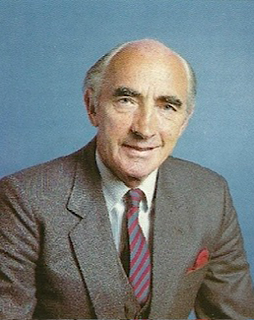
A snappy dresser who earns the nickname “the yellow rose of Finglas,” Tunney is sometimes seen as pompous, a perception possibly attributable to his acting background, which once leads to an audition at Dublin’s Abbey Theatre.
In 1963 Tunney joins Fianna Fáil, and stands for the party at the 1965 Irish general election but is not elected. He is elected to Dáil Éireann as a Fianna Fáil TD for the Dublin North-West constituency at the 1969 Irish general election. He serves continuously in the Dáil until losing his seat at the 1992 Irish general election, having been a TD for Dublin Finglas from 1977 to 1981 when Dublin constituencies are reconfigured as 3-seaters, before being returned for Dublin North-West in 1981.
During this period Tunney serves as Parliamentary Secretary to the Minister for Education (after 1978, Minister of State at the Department of Education) in three governments. He serves as Leas-Ceann Comhairle of Dáil Éireann from 1981 to 1982, and from 1987 to 1993. He is also chair of the Fianna Fáil parliamentary party for ten years. He is a member of Dublin City Council, and serves as Lord Mayor of Dublin from 1984 to 1985.
Following Tunney’s death, TaoiseachBertie Ahern describes him as “a parliamentarian and a gentleman who was passionately committed to serving his country.” Ahern adds, “he was not only a man of substance but one of style. From the flower that was always in his buttonhole to the elegance of his language in both Irish and English he had a commanding and stylish presence.”
Fine Gael leader Michael Noonan says Tunney had gained “the widespread affection and respect of colleagues of all political parties.”
Leader of the Labour PartyRuairi Quinn describes Tunney as a “thoughtful and courteous colleague” who carried out his duties with “fairness but also with wit and style.”
Gallagher is always on time. He often reprimands colleagues for their lack of punctuality. He arrives to sign on at the social security office on the Falls Road at exactly 11:00 a.m. every two weeks. Usually a friend goes with him, however, on this day he goes alone. He is talking to the woman at the counter when a man approaches from behind. He does not get a chance to turn around. Four bullets are fired into the back of his head. He slumps to the ground and dies instantly.
As the office descends into chaos, the killer calmly walks out. He is in his mid-20s but well disguised in a woolen cap, pony-tail wig and glasses. He was only 5’3″ tall.
The INLA vows revenge and immediately begins an investigation. Early on there are no concrete clues. “It was an unbelievably clean killing,” says one source in the Irish Republican Socialist Party (IRSP), the INLA`s political wing. “People in the dole office, the street, the houses nearby were all questioned. Nobody really saw anything. We don’t know if the gunman acted with others or alone. We don’t know where he drove to. No car has been found. He did a very professional job.”
In June 1994, Gallagher had shot dead three loyalists on the Shankill. But the INLA rules out possible retaliation by the Ulster Defence Association (UDA) or Ulster Volunteer Force (UVF), believing that a loyalist assassin would not move so confidently in a republican area.
The Royal Ulster Constabulary (RUC) and Sinn Féin politicians point to an INLA feud. The group has historically been riven by internal disputes and it suffered serious difficulties the previous April. A statement read aloud in a Dublin courtroom by four Northern Irish men arrested following an arms find in Balbriggan announces an unconditional INLA ceasefire.
Gallagher, supported by others, says that the men lack the authority to make the statement. He takes over as Chief-of-Staff, and the four are expelled from the republican socialist movement. They receive almost no internal backing, and a violent split is avoided.
The gut reaction of some members of the INLA is that people loyal to these former members could have carried out the attack on Gallagher. But others think it unlikely. “I don’t believe these people are leading suspects,” says one source. “They’re a beaten docket. It would be illogical anyway. They wanted an end to violence so why provoke conflict with us by killing Gino?”
Gallagher’s killing bears no resemblance to previous INLA feuds, when attacks were claimed by each faction. No one admits responsibility for his death. No splinter group is set up claiming to be the “real INLA” and no gang warfare breaks out on the streets.
There is some speculation that elements of British intelligence could be responsible. The INLA, which describes itself as Marxist, is the only paramilitary group in Northern Ireland which refuses to call a ceasefire. Although substantially smaller than the IRA, it is well armed. It has engaged in an 18-month suspension of violence, but there is a strong possibility it will eventually return to conflict. Gallagher had said that Irish unity and socialism could not be achieved through constitutional politics. He foresaw violence “having some part to play in our strategy.”
“He was a real threat to the state, and some of its agents could have wanted him out of the way before he caused any trouble,” says an IRSP source.
One of the most popular and controversial theories is that the IRA had killed Gallagher. In an internal IRSP document two weeks prior to his assassination, Gallagher expresses fear that his life is in danger from the IRA. He has also been warned by contacts in the Provisionals that he is at risk.
Gallagher was reorganising the INLA into a more formidable force than it had been in years. It was building a base in areas where it had been dormant. He had also taken over as the IRSP’s national organiser.
In December 1996, the IRSP refused to make a submission to the Mitchell Commission, saying to do so would be “collaborating” with the peace process. It had just started giving regular media interviews and had reopened offices on the Falls Road. It was considering contesting any elections to a talk’s convention in the North and challenging Sinn Féin in nationalist areas. Gallagher’s high profile as a gunman made him popular with IRA grassroots and it was feared that he could become a rallying point for dissidents.
“He led an organisation which was nowhere near the size of the Provos,” says one republican source, “but he really had them worried. He saw a vacuum emerging as republican supporters became disillusioned with the peace process and he wanted to fill it. Given time, he could have caused trouble. It wouldn’t be surprising if the Provos wanted to nip that in the bud.”
Notably, Sinn Féin does not condemn the killing. An unnamed spokesman, an unusual move, describes it as “tragic.” Similar language has been used about the assassination of drug dealers when the IRA has not wanted to admit responsibility.
The IRA issues a statement denying responsibility but, as one source says, “they aren’t likely to admit it.” If IRA involvement is established, the INLA will have to decide whether or not to retaliate. Arguments are made not to allow the Provisionals to walk over the INLA, but the organisation also fears being wiped out in a bitter republican feud.
If clues about the killing remain scarce, the less likely it is that former INLA members are involved. “They wouldn’t be able to fully cover their tracks,” says one source. “If the group responsible is able to do that, then it’s a really professional outfit. That points to the IRA or elements of British intelligence.”
(From: “Gallagher murder ‘an unbelievably clean killing'” by Susanne Breen, The Irish Times, http://www.irishtimes.com, February 3, 1996)


 seamus dubhghaill