seamus dubhghaill

Promoting Irish Culture and History from Little Rock, Arkansas, USA


Leave a comment

The Tricolour Riots

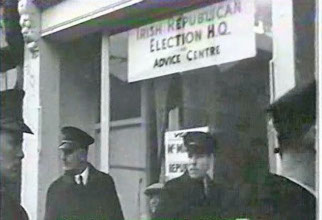
On the evening of the September 28, 1964, a detachment of the Royal Ulster Constabulary (RUC), acting on the direct instruction of Brian McConnell, the Minister of Home Affairs, attacks the Divis Street headquarters of the Republican Party (Sinn Féin had been outlawed earlier in the year) in West Belfast. Their perilous mission is to remove an Irish Tricolour.

This takes place during a general election for Westminster. Republicans have nominated Liam McMillan to contest in West Belfast. McConnell, under pressure from Ian Paisley and other unionists, holds a conference of his senior RUC officers on the morning of September 28 and orders that the tricolour flown at Liam McMillan’s headquarters be removed. Under the Flags and Emblems Display Act of 1954, it is an offence to display the tricolour anywhere in the six counties of Northern Ireland.

That evening, when it becomes known that the RUC are coming to seize the flag, more than 2,000 republican supporters block the roadway. Scores of RUC are rushed to the scene in armoured cars. The RUC, though heavily armed with sten guns, rifles, revolvers and riot batons, are made to look ridiculous by groups of children, who run about with miniature tricolour stickers which they stick on walls and police cars.

The RUC, using pickaxes, smashes down the doors of the Republican headquarters and takes the flag. They carry it away through a hail of stones and to the prolonged jeers of the people.

The following day the RUC clears Divis Street to make way for an armoured car. Their new perilous mission is to seize a new replacement tricolour. The armoured car stops outside the Republican headquarters, eight policemen emerge and begin another attack with crowbars and pickaxes. They fail to break down the door but one of them smashes the window, reaches in and pulls out the second tricolour.

By September 30, news of the events in Divis Street have spread throughout the media. Belfast begins attracting television reporters and newspaper men from all around the world. That night, thousands of republicans, armed with petrol bombs, sticks, stones and rotten vegetables, gather outside their headquarters to defend their identity and their flag. A battle begins at 11:00 PM when the RUC tries to disperse them. The television cameras are there to record all that happens. For the first time ever, people in many parts of the world are able to watch a sectarian police force in action.

When the republicans indicate that they will stand their ground, fifty RUC men, who had been held in reserve in the small streets between Falls Road and Shankill Road, are deployed but the republicans, in accordance with a pre-arranged strategy, drive them back. By midnight, the police have succeeded in sealing off Divis Street and dispersing the crowd but thirty people, including at least eighteen members of the RUC, have been injured.

One week later, on October 5, republicans carry the tricolour at the head of a parade of 5,000 people who march from Beechmount on Falls Road, through Divis Street, to an election rally near Smithfield. RUC men line the entire route but make no attempt to seize the flag.

(From: “The Tricolour Riots,” An Phoblacht (www.anphoblacht.com), September 23, 2004 edition)

Leave a comment

Birth of Sinn Féin President Gerry Adams

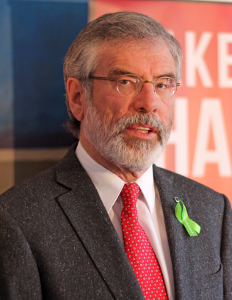
Gerard “Gerry” Adams, Irish republican politician who is the president of the Sinn Féin political party and a Teachta Dála (TD) for Louth since the 2011 general election, is born in Belfast, Northern Ireland, on October 6, 1948.

Adams attends St. Finian’s Primary School on the Falls Road, where he is taught by La Salle brothers. Having passed the eleven-plus exam in 1960, he attends St. Mary’s Christian Brothers Grammar School. He leaves St. Mary’s with six O-levels and becomes a barman. He is increasingly involved in the Irish republican movement, joining Sinn Féin and Fianna Éireann in 1964, after being radicalised by the Divis Street riots during that year’s general election campaign.

In the late 1960s, a civil rights campaign develops in Northern Ireland. Adams is an active supporter and joins the Northern Ireland Civil Rights Association in 1967. However, the civil rights movement is met with violence from loyalist counterdemonstrations and the Royal Ulster Constabulary. In August 1969, Northern Ireland cities like Belfast and Derry erupt in major rioting.

During the 1981 hunger strike, which sees the emergence of Sinn Féin as a political force, Adams plays an important policy-making role. In 1983, he is elected president of Sinn Féin and becomes the first Sinn Féin MP elected to the British House of Commons since Philip Clarke and Tom Mitchell in the mid-1950s. From 1983 to 1992 and from 1997 to 2011, he is an abstentionist Member of Parliament (MP) of the British Parliament for the Belfast West constituency.

Adams has been the president of Sinn Féin since 1983. Since that time the party has become the third-largest party in the Republic of Ireland, the second-largest political party in Northern Ireland and the largest Irish nationalist party in that region. In 1984, Adams is seriously wounded in an assassination attempt by several gunmen from the Ulster Defence Association (UDA), including John Gregg. From the late 1980s onwards, Adams is an important figure in the Northern Ireland peace process, initially following contact by the then-Social Democratic and Labour Party (SDLP) leader John Hume and then subsequently with the Irish and British governments.

In 1986, Sinn Féin, under Adams, changes its traditional policy of abstentionism towards the Oireachtas, the parliament of the Republic of Ireland, and later takes seats in the power-sharing Northern Ireland Assembly. In 2005, the Provisional Irish Republican Army (IRA) states that its armed campaign is over and that it is exclusively committed to democratic politics.

In 2014, Adams is held for four days by the Police Service of Northern Ireland for questioning in connection with the abduction and murder of Jean McConville in 1972. He is freed without charge and a file is sent to the Public Prosecution Service for Northern Ireland, which later states there is insufficient evidence to charge him.

In September 2017, Adams says Sinn Féin will begin a “planned process of generational change” after its November ardfheis and will allow his name to go forward for a one-year term as Uachtaran Shinn Fein (President Sinn Fein).


Leave a comment

Birth of Northern Ireland Politician Gerry Fitt

Gerard FittNorthern Ireland politician, is born in Belfast on April 9, 1926. He is a founder and the first leader of the Social Democratic and Labour Party (SDLP), a social democratic and Irish nationalist party.

Fitt is educated at a local Christian Brothers school in Belfast. He joins the Merchant Navy in 1941 and serves on convoy duty during World War II. His elder brother Geordie, an Irish Guardsman, is killed at the Battle of Normandy.

Living in the nationalist Beechmount neighbourhood of the Falls, he stands for the Falls as a candidate for the Dock Labour Party in a city council by-election in 1956, but loses to Paddy Devlin of the Irish Labour Party, who later becomes his close ally. In 1958, he is elected to Belfast City Council as a member of the Irish Labour Party.

In 1962, he wins a seat in the Parliament of Northern Ireland from the Ulster Unionist Party, becoming the only Irish Labour member. Two years later, he left Irish Labour and joined with Harry Diamond, the sole Socialist Republican Party Stormont MP, to form the Republican Labour Party. At the 1966 general election, Fitt won the Belfast West seat in the Westminster parliament.

Many sympathetic British Members of Parliament (MPs) are present at a civil rights march in Derry on October 5, 1968, when Fitt and others are beaten by the Royal Ulster Constabulary. Fitt also supports the 1969 candidacy of Bernadette Devlin in the Mid Ulster by-election who runs as an anti-abstentionist ‘Unity‘ candidate. Devlin’s success greatly increases the authority of Fitt in the eyes of many British commentators, particularly as it produces a second voice on the floor of the British House of Commons who challenge the Unionist viewpoint at a time when Harold Wilson and other British ministers are beginning to take notice.

In August 1970, Fitt becomes the first leader of a coalition of civil rights and nationalist leaders who create the Social Democratic and Labour Party (SDLP). By this time Northern Ireland is charging headlong towards near-civil war and the majority of unionists remain hostile.

After the collapse of Stormont in 1972 and the establishment of the Northern Ireland Assembly in 1973 Fitt becomes deputy chief executive of the short-lived Power-Sharing Executive created by the Sunningdale Agreement.

Fitt becomes increasingly detached from both his own party and also becomes more outspoken in his condemnation of the Provisional Irish Republican Army. He becomes a target for republican sympathisers in 1976 when they attack his home. He becomes disillusioned with the handling of Northern Ireland by the British government. In 1979, he abstains from a crucial vote in the House of Commons which brings down the Labour government, citing the way that the government had failed to help the nationalist population and tried to form a deal with the Ulster Unionist Party.

In 1979, Fitt is replaced by John Hume as leader of the SDLP and he leaves the party altogether after he agrees to constitutional talks with British Secretary of State Humphrey Atkins without any provision for an ‘Irish dimension’ and then sees his decision overturned by the SDLP party conference. Like Paddy Devlin before him, he claims the SDLP has ceased to be a socialist force.

In 1981, he opposes the hunger strikes in the Maze prison in Belfast. His seat in Westminster is targeted by Sinn Féin as well as by the SDLP. In June 1983, he loses his seat in Belfast West to Gerry Adams, in part due to competition from an SDLP candidate. The following month, on October 14, 1983, he is created a UK life peer as Baron Fitt, of Bell’s Hill in County Down. His Belfast home is firebombed a month later and he moves to London.

Gerry Fitt dies in London on August 26, 2005, at the age of 79, after a long history of heart disease.