
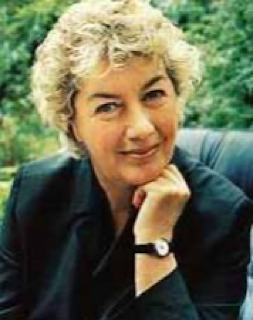
Nuala Brigid Anne O’Faolain, journalist and writer, dies in Blackrock, Dublin, on May 9, 2008. Her debut memoir, Are You Somebody?, published when she is in her mid-fifties, becomes a sensation in Ireland and a worldwide bestseller.
O’Faolain is born in Dublin on March 1, 1940, the second of nine children of Tomás O’Faolain and Kathleen O’Sullivan. Originally a schoolteacher and Army lieutenant, under the pen name Terry O’Sullivan, her father becomes a prominent social diarist for the Evening Press in Dublin. He is distant from his children and engages in extra-marital affairs which produce at least two half-siblings. Despite earning as much money as the newspaper’s editor, Douglas Gageby, he does not share his income with his family. The family lives in poor conditions, frequently going hungry. Her mother becomes an alcoholic, going to the pub every day at 4 p.m. and not returning home until midnight.
O’Faolain attends convent school in Dublin but is expelled at the age of fourteen after going home from dances with a married man. She then goes to a boarding school in County Monaghan, whose austere environment and strict educational standards benefit her. From there, she studies English literature at University College Dublin (UCD), where she runs in a social circle that includes Mary Lavin, John McGahern, Patrick Kavanagh, and Louis MacNeice. Although she drops out of her studies temporarily and spends time working menial jobs in England, with financial assistance from Lavin and others, she graduates in 1961. On scholarships, she studies medieval English at the University of Hull before completing a postgraduate degree in 19th-century English literature at the University of Oxford. She then returns to Dublin to work at UCD as an academic in the English literature department, which brings her into contact with the bohemian Dublin literary scene of the late 1960s and early 1970s.
In 1970, O’Faolain moves to London to work for the BBC. She is a producer at the Community Programme Unit, which seeks to allow members of the public to create programmes for national broadcast on human interest topics like transgender people, anti-pornography protests, and community organising in the Bogside. She also makes programmes with the arts faculty of the Open University, and teaches evening classes at Morley College. During this period, she shows little interest in Ireland, regarding the country as backward and unsophisticated, but a visit to the Merriman Summer School in County Clare in 1974 sparks new enthusiasm. In 1977, she moves back to Dublin to work for the public broadcaster, RTÉ, where she becomes a colleague of female journalists like Doireann Ní Bhriain, Marian Finucane, and Nell McCafferty – later her partner – who are making programmes about Irish society with a feminist bent. She Is the producer of Women Today, a pioneering radio programme, from 1983 to 1986. One series she works on, Plain Tales, a televised interview programme in which women speak directly to camera about their life experiences, wins a Jacob’s Award in 1985.
O’Faolain has an interest in books from an early age, and credits voracious reading for helping her through a difficult childhood. She works as a book reviewer for The Times. Between 1990 and 1993, she co-presents Booklines, a television programme about books for RTÉ, a programme she says “nobody ever watched because it was on terribly late at night.”
In 1986, Conor Brady, the editor of The Irish Times, offers O’Faolain a newspaper column after hearing her being interviewed by Gay Byrne on the radio. Brady is struck by her ability to “infuse ordinary people’s everyday activities with value and interest.” The column becomes a major success and she is awarded journalist of the year in 1986.
O’Faolain acts as a roving commentator for The Irish Times, covering the 1994 Cregg Wood murders in County Clare, and visiting Northern Ireland at the time of the Good Friday Agreement in 1998. Following periods of leave while she works on her books, she leaves the paper in 2002, and writes a column in the Sunday Tribune from 2005 until her death.
O’Faolain never marries and has no children. Although she writes about her relationships with men and women, she does not identify as bisexual, though others have described her as such. She suffers from alcoholism. After Are You Somebody?, she divides her time between Ireland and New York City. During the final years of her life, she is in a relationship with a Brooklyn-based lawyer, John Low-Beer, whom she meets on Match.com.
O’Faolain is diagnosed with metastatic cancer while living in New York City in early 2008. She experiences a strange feeling in the right side of her body and presents at the emergency department of a hospital, where she is told that she has primary tumours in her lungs which has spread to her brain and liver, and that her cancer is incurable. She refuses chemotherapy.
O’Faolain returns to Ireland and is interviewed by her friend, Marian Finucane, on her radio show about her terminal illness on April 12, 2008. Both O’Faolain and Finucane are in tears during the interview, which is recorded in Galway, where she is undergoing radiotherapy. She tells Finucane: “I don’t want more time. As soon as I heard I was going to die, the goodness went from life”. Her frank discussion of her illness leads to the interview being preceded by a warning that her comments may be upsetting to others with life-threatening conditions. She says that she does not believe in God or an afterlife, but as in the song “Thíos i Lár an Ghleanna,” she is asking for help she knows will not come from a god she does not believe in. The interview has a major public impact in Ireland. After Finucane’s death in 2020, the Irish Independent describes it as “one of the most extraordinary [interviews] in the history of Irish broadcasting.”
In the final weeks of her life, O’Faolain travels Europe with close friends and family, staying in the Ritz Hotel in Paris and visiting the Berlin State Opera and the Prado Museum in Madrid for the first time. She dies in a hospice in Blackrock, Dublin, late on May 9, 2008. Her funeral takes place in the Church of Our Lady of the Visitation in Fairview in north Dublin on May 13. Her ashes are buried in Kilbarrack Cemetery in north Dublin with her maternal grandparents, Terence and Marion O’Sullivan, and her brother, Dermot Phelan.

