
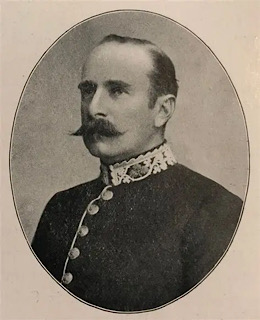
Andrew Alexander Watt, JP, DL, Irish landowner and businessman, dies on October 11, 1928, at Easton Hall in Lincolnshire, England. He has a net worth of over £900,000 at the time of his death, worth £51.8 million in 2016. The Watt family are, by origin, an Ulster Scots family from Ramelton in County Donegal.
Watt is born on November 4, 1853, to Samuel Watt of Thornhill House, then on the northern outskirts of Derry, and his wife Jane Newman, daughter of Captain Robert Newman, R.N.. He is educated at Foyle College in Derry and then at home by tutors. The Watt family are Ulster Scots gentry who had arrived at Claragh, on the outskirts of Ramelton in the north of County Donegal, during the Plantation of Ulster.
Watt is the owner of Watt’s Distillery, located on Abbey Street in the Bogside in Derry, one of the largest distilleries in Ireland, and the creator of many whiskies, including the famous Tyrconnell, which he names after his racehorse that wins the National Produce Stakes against the odds of 100 to 1. The horse itself is named after Tyrconnell (Irish: Tír Chonaill), the ancient túath or Gaelic kingdom that once covered most of what is now County Donegal in the west of Ulster.
During industrial unrest in 1921, brought about by World War I, prohibition in the United States, and the Irish War of Independence, Watt’s workers at the distillery in Derry are made redundant after challenging his authority. He is said to have stood on a barrel outside the gates to his distillery in the Bogside, while the workers are on strike, and shouted, “Well men, I shall put it to you like this …what is it to be? Will you open the gates?” To which the workers retorted, “The gates stay shut!” This prompts Watt to reply, “Shut they are, and shut they shall remain!” He subsequently closes down Watt’s Distillery, at great economic expense to Derry and neighbouring areas of County Donegal.
On October 7, 1875, Watt marries Violet Flora de Burgh, daughter of George de Burgh and Constance Matthews, with whom he had four sons and two daughters.
Watt serves as High Sheriff of County Londonderry from 1886 to 1887. He is a member of Boodle’s. He dies at Easton Hall in Lincolnshire, where he lives in England after he left Ireland. Easton Hall is later demolished in 1951.

