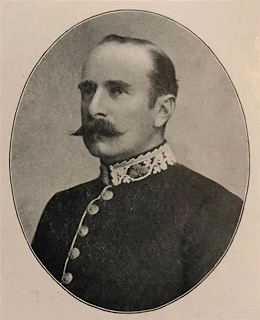
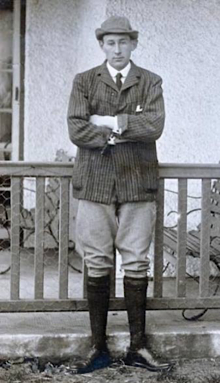
Watt is born on November 4, 1853, to Samuel Watt of Thornhill House, then on the northern outskirts of Derry, and his wife Jane Newman, daughter of Captain Robert Newman, R.N.. He is educated at Foyle College in Derry and then at home by tutors. The Watt family are Ulster Scots gentry who had arrived at Claragh, on the outskirts of Ramelton in the north of County Donegal, during the Plantation of Ulster.
Watt is the owner of Watt’s Distillery, located on Abbey Street in the Bogside in Derry, one of the largest distilleries in Ireland, and the creator of many whiskies, including the famous Tyrconnell, which he names after his racehorse that wins the National Produce Stakes against the odds of 100 to 1. The horse itself is named after Tyrconnell (Irish: Tír Chonaill), the ancient túath or Gaelic kingdom that once covered most of what is now County Donegal in the west of Ulster.
During industrial unrest in 1921, brought about by World War I, prohibition in the United States, and the Irish War of Independence, Watt’s workers at the distillery in Derry are made redundant after challenging his authority. He is said to have stood on a barrel outside the gates to his distillery in the Bogside, while the workers are on strike, and shouted, “Well men, I shall put it to you like this …what is it to be? Will you open the gates?” To which the workers retorted, “The gates stay shut!” This prompts Watt to reply, “Shut they are, and shut they shall remain!” He subsequently closes down Watt’s Distillery, at great economic expense to Derry and neighbouring areas of County Donegal.
On October 7, 1875, Watt marries Violet Flora de Burgh, daughter of George de Burgh and Constance Matthews, with whom he had four sons and two daughters.
Watt serves as High Sheriff of County Londonderry from 1886 to 1887. He is a member of Boodle’s. He dies at Easton Hall in Lincolnshire, where he lives in England after he left Ireland. Easton Hall is later demolished in 1951.
Babington is called to the Irish Bar in 1900. He briefly lectures in Equity at King’s Inns, and it is during this time, in 1910, that he re-arranges and re-writes R.E. Osborne’s Jurisdiction and Practice of County Courts in Ireland in Equity and Probate Matters. He takes silk in 1917.
In 1947, Babington chairs the Babington Agricultural Enquiry Committee, named in his honour, which is established in 1943 to examine agriculture in Northern Ireland. The committee’s first recommendation under Babington’s leadership is that Northern Ireland should direct all its energies to the production of livestock and livestock products and to their efficient processing and marketing.
Babington retires from the judiciary in 1949, taking up the chairmanship of the Northern Ireland Transport Tribunal, which exists until 1967, established under the Ulster Transport Act – promoting a car-centred transport policy – and which is largely responsible for the closure of the Belfast and County Down Railway. He endorses the closure on financial grounds and is at cross purposes with his co-chair, Dr. James Beddy, who advises against the closure, citing the disruption of life in the border region between the north and the south as his primary reason in addition to financial grounds.
Babington also chairs a government inquiry into the licensing of clubs, the proceeds of which results in new regulatory legislation at Stormont. While Attorney General, he is a proponent of renaming Northern Ireland as “Ulster.”
Babington is critical of the newly proposed Irish constitution, in which the name of the Irish state is changed to “Ireland,” laying claim to jurisdiction over Northern Ireland.
Michael McDunphy, Secretary to the President of Ireland, then Douglas Hyde, recalls Ernest Alton‘s correspondence with Babington on the question of Irish unity, in which Alton and Babington are revealed to be at cross purposes. The discussion is used as an example by Brian Murphy, in Forgotten Patriot: Douglas Hyde and the Foundation of the Irish Presidency, as an example of the office of the Irish President becoming embroiled in an initiative involving Trinity College Dublin and a senior Northern Ireland legal figure, namely Babington.
Babington writes to Alton, then Provost of Trinity College, Dublin, expressing his view that, as Murphy summarises, “… Severance between the two parts of Ireland could not continue, that it was the duty of all Irishmen to work for early unification and that in his opinion Trinity College was a very appropriate place in which the first move should be made.” When Alton arrives to meet with Hyde, it emerges, after conversing with Hyde’s secretary McDunphy, that he and Babington are at cross purposes. “It soon became clear that the united Ireland contemplated by Mr. [sic] Justice Babington of the Northern Ireland Judiciary was one within the framework of the British Commonwealth of Nations, involving recognition of the King of England as the Supreme Head, or as Dr. Alton put it, the symbol of unity of the whole system,” writes McDunphy.
Babington is a keen golfer. He is an international golfer from 1903 to 1913, during which he is runner-up in the Irish Amateur Golf Championships in 1909 and one of the Irish representatives at an international match in 1913. The Babington Room in the Royal Portrush Golf Club is named after him, as is the 18th hole on the course as a result of the key role he plays in shaping its history.
Babington dies at the age of 94 on April 10, 1972 at his home, Creevagh, Portrush, County Antrim.