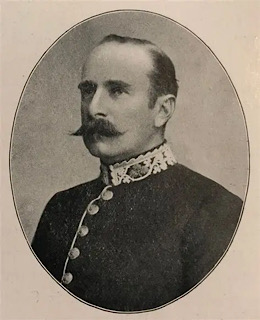
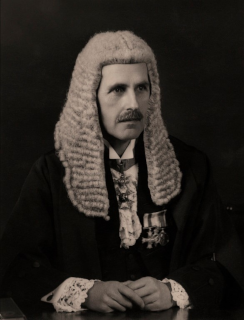
Watt is born on November 4, 1853, to Samuel Watt of Thornhill House, then on the northern outskirts of Derry, and his wife Jane Newman, daughter of Captain Robert Newman, R.N.. He is educated at Foyle College in Derry and then at home by tutors. The Watt family are Ulster Scots gentry who had arrived at Claragh, on the outskirts of Ramelton in the north of County Donegal, during the Plantation of Ulster.
Watt is the owner of Watt’s Distillery, located on Abbey Street in the Bogside in Derry, one of the largest distilleries in Ireland, and the creator of many whiskies, including the famous Tyrconnell, which he names after his racehorse that wins the National Produce Stakes against the odds of 100 to 1. The horse itself is named after Tyrconnell (Irish: Tír Chonaill), the ancient túath or Gaelic kingdom that once covered most of what is now County Donegal in the west of Ulster.
During industrial unrest in 1921, brought about by World War I, prohibition in the United States, and the Irish War of Independence, Watt’s workers at the distillery in Derry are made redundant after challenging his authority. He is said to have stood on a barrel outside the gates to his distillery in the Bogside, while the workers are on strike, and shouted, “Well men, I shall put it to you like this …what is it to be? Will you open the gates?” To which the workers retorted, “The gates stay shut!” This prompts Watt to reply, “Shut they are, and shut they shall remain!” He subsequently closes down Watt’s Distillery, at great economic expense to Derry and neighbouring areas of County Donegal.
On October 7, 1875, Watt marries Violet Flora de Burgh, daughter of George de Burgh and Constance Matthews, with whom he had four sons and two daughters.
Watt serves as High Sheriff of County Londonderry from 1886 to 1887. He is a member of Boodle’s. He dies at Easton Hall in Lincolnshire, where he lives in England after he left Ireland. Easton Hall is later demolished in 1951.
At the outbreak of war in 1939, Stronge joins the North Irish Horse as a lieutenant but has to relinquish his commission the following year due to ill health. He is then granted the rank of captain. Resuming his political career, he becomes Assistant Parliamentary Secretary at the Ministry of Finance (Assistant Whip) (1941–42) and then Parliamentary Secretary at the Ministry of Finance (Chief Whip) (1942–44). His period as Chief Whip is marked by more robust and “fluid” debate within the party and significant backbench discontent in early 1943. In June 1944 he is elected chairman of Armagh County Council, and in the following year is returned unopposed in the general election. He becomes Speaker of the House of Commons of Northern Ireland in 1945 and in this position he earns the respect of, and makes friends with, politicians of every hue, and is regarded as a moderating influence. It has been said of him that he disproved the myth that politicians at Stormont never spoke to each other. He is unopposed in every postwar election up to 1965, when he sees off the challenge of the Liberal candidate. He does not contest the 1969 general election. He is made Chevalier of the Order of Leopold in 1946 and in the same year is appointed to the Privy Council of Northern Ireland. A member of the Commonwealth Parliamentary Association, he is a delegate to its 1950 conference in New Zealand. Another interest is the Royal Over-Seas League, of which he is president for a time.
Stronge is closely associated with Sir Basil Brooke, Dame Dehra Parker and Sir Henry Mulholland. He is president of the Northern Ireland area council of the Royal British Legion, sovereign grand master of the Royal Black Institution, president of the Federation of Boys’ Clubs, and chairman of the Commercial Insurance Co. and of the Central Advisory Council for the Employment of the Disabled. It is this last position that causes a brief interruption of his speakership, with an act of parliament deemed necessary to remove any doubt about it having been an office of profit. A prominent member of the Orange Order, he is also chairman of the BBC appeals advisory committee and the Northern Ireland scout council. His retirement from public life in 1977 is marked by his investiture as a Knight of Grace by Prince Richard, Duke of Gloucester.
A leading member of the Church of Ireland, Stronge becomes Commander of the Order of Saint John in 1952 and is for many years on the Armagh diocesan synod and council. Until his death, he is a nominator for the position of rector and reads the lessons each Sunday morning in Tynan parish church. In September 1921 he marries Gladys Olive, daughter of Major Henry Thomas Hall of Knockbrack, Athenry, County Galway. They have three daughters and a son, James. In his later life he lives with James, a bachelor, on their 800-acre estate near the border. James is educated at Eton College and Christ Church, Oxford. He succeeds his father in the Mid Armagh constituency in 1969, serving as Ulster Unionist MP in the Stormont parliament until 1972. He is firmly opposed to the Sunningdale Agreement of December 1973, which he describes as a “great act of political appeasement.” Although both are known in the locality, neither seeks public attention and both live relatively quiet lives. Stronge likes to work in the garden but has little interest in the farm, most of which is let out to tenants.
Stronge and his son become prominent victims of the Troubles when a unit of the Provisional Irish Republican Army shoots them dead on January 21, 1981, at Tynan Abbey and sets the mansion alight, destroying it. The Provisional IRA statement describes them as “symbols of hated unionism” and their killings as “direct reprisal for a whole series of loyalist assassinations and murder attacks on nationalist people.” The killings come five days after an attempted assassination of the former MP Bernadette Devlin McAliskey and her husband. Tynan Abbey is long held to have been an easy target, given its relative isolation and its proximity to the border. In 1985 a man is tried for their murders but is acquitted. In 1999 the shell of Tynan Abbey is demolished.
(From: “Stronge, Sir Charles Norman Lockhart” by Tom Feeney, Dictionary of Irish Biography, http://www.dib.ie, October 2009)