

Kathleen Behan (née Kearney), Irish republican and folk singer, and mother of Irish authors Brendan, Brian and Dominic, is born on September 18, 1889, at 49 Capel Street, Dublin.
She is the fifth child and youngest daughter of pork butcher and grocer, John Kearney (1854–97), and his wife Kathleen Kearney (née McGuinness) (1860–1907). She has four brothers and two sisters. Her father is from Rosybrook, County Louth and her mother is from Rathmaiden, Slane, County Meath, both coming from prosperous farming families. Her father has a business on Lower Dorset Street, with a grocery, pub and a row of houses. Owing to his own poor management, by the time she is born he has a smaller business on Dolphin’s Barn Lane. Following his death in 1897, she and her sisters are placed in the Goldenbridge orphanage at Inchicore by their mother. She is there from 1898 to 1904 where she becomes an avid reader. When she leaves, she rejoins her family in a one-room tenement flat on Gloucester Street.
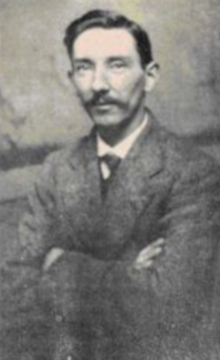
Her oldest sibling, Peadar Kearney, is an ardent republican who writes the lyrics to the song that becomes the Irish national anthem, ”Amhrán na bhFiann”(English: “The Soldier’s Song”). It is through him that she meets a printer’s compositor and member of the Irish Volunteers, Jack Furlong. They marry in 1916. She is an active member of Cumann na mBan, and serves as a courier to the General Post Office, Dublin and other outposts during the 1916 Easter Rising. At the same time, Furlong fights in the Jacob’s factory garrison. The couple has two sons: Roger Casement (Rory) Furlong (1917–87) and Sean Furlong (born March 1919). Sean is born six month’s after she is widowed when Furlong dies in the Spanish flu epidemic of 1918. She lives with her mother-in-law, who is also a republican and seamstress who makes Irish Volunteer uniforms. She is arrested for running an Irish Republican Army (IRA) safe house. She works for a short time for Maud Gonne as a housekeeper, where she meets W. B. Yeats and Sarah Purser. A study painted of her by Purser (above) is now in the National Gallery of Ireland entitled The Sad Girl. From 1918 to 1922 she works as a clerk in the Dublin Corporation, while also a caretaker in the Harcourt Street branch of the Irish White Cross republican aid association.
In 1922 she marries Stephen Behan, house painter, trade unionist and fellow republican. The couple has four sons and one daughter: Brendan (b. 1923), Seamus (b. 1925), Brian (b. 1926), Dominic (b. 1928), and Carmel (b. 1932). Brendan is born while his father is imprisoned during the Irish Civil War, and Behan claims that Michael Collins gives her money while she is pregnant. Stephen’s mother owns three slum tenements, so the Behans live rent-free in a one-room basement flat at 14 Russell Street. Owing to her disdain at gossiping on the house steps, she is nicknamed “Lady Behan” by her neighbours. When Stephen’s mother dies in 1936, the Behans moved to a newly built council house in Crumlin, living at 70 Kildare Road. The family finds the new house far from work and school, and the local area devoid of community.
The family experiences extreme poverty frequently, owing to Stephen’s unemployment and during the nine month long building strike of 1936. Behan attempts to claim a pension as her first husband had served in 1916, but her application is rejected. She had said the exposure to flour had effected Furlong’s lungs negatively. It is declined as she had remarried before the enactment of the Army Pensions Act 1923. Despite their circumstances, the house attracts conversation, music, books and politics. The Behan’s republican, socialist, labour activist and anti-clericalism have a strong effect on their sons, particularly Brendan and Dominic. Such is the volume of radical meetings that take place at the Behan home, it is dubbed “the Kremlin” by their neighbours, and a “madhouse” by Stephen. During The Emergency of 1939 to 1945 she fights against local shopkeepers who ignore price controls, and is labelled as “red” for her anti-Franco and pro-Stalin sympathies. Her reply to the branding of her as such is “I’m not red, I’m scarlet.”
From the 1950s onwards, Behan shares international fame with her sons Dominic and Brendan. She often travels to London to see their plays, eventually appearing on British and Irish television and cultivating her own following. She is badly injured when she is struck by a motorcycle, a day before Stephen’s death in 1967. Owing to the effect of these injuries, she moves in 1970 to the Sacred Heart Residence of the Little Sisters of the Poor, Sybil Hill, Raheny.
In 1981, she records an album When All the World Was Young. Taped conversations of her reminiscences are made into an autobiographic book, Mother of all the Behans, by her son Brian in 1984. A one-woman stage adaptation of the book by Peter Sheridan and starring Rosaleen Linehan is acclaimed in Ireland, Britain and North America.
Behan dies in the nursing home in Raheny on April 26, 1984, and is buried in Dean’s Grange Cemetery.
(Pictured: Portrait of Kathleen Behan by Sarah Purser, National Gallery of Ireland)
 seamus dubhghaill