seamus dubhghaill

Promoting Irish Culture and History from Little Rock, Arkansas, USA


Leave a comment

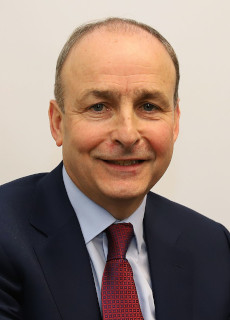
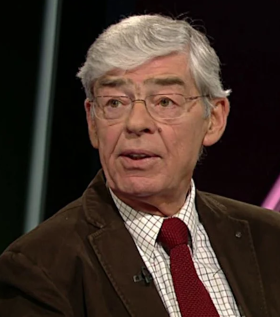
Birth of Alan Dukes, Former Fine Gael Politician

Alan Martin Dukes, former Fine Gael politician, is born in Drimnagh, Dublin, on April 20, 1945. He holds several senior government positions and serves as a Teachta Dála (TD) from 1981 to 2002. He is one of the few TDs to be appointed a minister on their first day in the Dáil.

His father, James F. Dukes, is originally from Tralee, County Kerry, and is a senior civil servant and the founding chairman and chief executive of the Higher Education Authority (HEA), while his mother is from near Ballina, County Mayo.

The Dukes family originally comes from the north of England. His grandfather serves with the Royal Engineers in World War I and settles in County Cork and then County Kerry afterward where he works with the Post Office creating Ireland’s telephone network.

Dukes is educated by the Christian Brothers at Coláiste Mhuire, Dublin, and is offered several scholarships for third level on graduation, including one for the Irish language. His interest in the Irish language continues to this day, and he regularly appears on Irish-language television programmes.

On leaving school he attends University College Dublin (UCD), where he captains the fencing team to its first-ever Intervarsity title.

Dukes becomes an economist with the Irish Farmers’ Association (IFA) in Dublin in 1969. After Ireland joins the European Economic Community (EEC) in 1973, he moves to Brussels where he is part of the IFA delegation. In this role, he is influential in framing Ireland’s contribution to the Common Agricultural Policy (CAP). He is appointed as chief of staff to Ireland’s EEC commissioner Richard Burke, a former Fine Gael politician.

In the 1979 European Parliament election, Dukes stands as a Fine Gael candidate in the Munster constituency. He has strong support among the farming community, but the entry of T. J. Maher, a former president of the IFA, as an independent candidate hurts his chances of election. Maher tops the poll.

He stands again for Fine Gael at the 1981 Irish general election in the expanded Kildare constituency, where he wins a seat in the 22nd Dáil. On his first day in the Dáil, he is appointed Minister for Agriculture by the Taoiseach, Garret FitzGerald, becoming one of only eight TDs so appointed. He represents Kildare for 21 years.

This minority Fine Gael–Labour Party coalition government collapses in February 1982 on the budget but returns to power with a working majority in December 1982. Dukes is again appointed to cabinet, becoming Minister for Finance less than two years into his Dáil career.

He faces a difficult task as finance minister. Ireland is heavily in debt while unemployment and emigration are high. Many of Fine Gael’s plans are deferred while the Fine Gael–Labour Party coalition disagrees on how to solve the economic crisis. The challenge of addressing the national finances is made difficult by electoral arithmetic and a lack of support from the opposition Fianna Fáil party led by Charles Haughey. He remains in the Department of Finance until a reshuffle in February 1986 when he is appointed Minister for Justice.

Fine Gael fails to be returned to government at the 1987 Irish general election and loses 19 of its 70 seats, mostly to the new Progressive Democrats. Outgoing Taoiseach and leader Garret FitzGerald steps down and Dukes is elected leader of Fine Gael, becoming Leader of the Opposition.

This is a difficult time for the country. Haughey’s Fianna Fáil runs on promises to increase spending and government services, and attacking the cutbacks favoured by Fine Gael. However, on taking office, the new Taoiseach and his finance minister Ray MacSharry immediately draw up a set of cutbacks including a spate of ward and hospital closures. This presents a political opportunity for the opposition to attack the government.

However, while addressing a meeting of the Tallaght Chamber of Commerce, Dukes announces, in what becomes known as the Tallaght Strategy that: “When the government is moving in the right direction, I will not oppose the central thrust of its policy. If it is going in the right direction, I do not believe that it should be deviated from its course, or tripped up on macro-economic issues.”

This represents a major departure in Irish politics whereby Fine Gael will vote with the minority Fianna Fáil Government if it adopts Fine Gael’s economic policies for revitalising the economy. The consequences of this statement are huge. The Haughey government is able to take severe corrective steps to restructure the economy and lay the foundations for the economic boom of the nineties. However, at a snap election in 1989, Dukes does not receive electoral credit for this approach, and the party only makes minor gains, gaining four seats. The outcome is the first-ever coalition government for Fianna Fáil, whose junior partner is the Progressive Democrats led by former Fianna Fáil TD Desmond O’Malley.

The party’s failure to make significant gains in 1989 leaves some Fine Gael TDs with a desire for a change at the top of the party. Their opportunity comes in the wake of the historic 1990 Irish presidential election. Fine Gael chooses Austin Currie TD as their candidate. He had been a leading member of the Northern Ireland Civil Rights Association (NICRA) movement in the 1960s and had been a member of the Social Democratic and Labour Party (SDLP) before moving south.

Initially, Fianna Fáil’s Brian Lenihan Snr is the favourite to win. However, after several controversies arise, relating to the brief Fianna Fáil administration of 1982, and Lenihan’s dismissal as Minister for Defence midway through the campaign, the Labour Party’s Mary Robinson emerges victorious. To many in Fine Gael, the humiliation of finishing third is too much to bear and a campaign is launched against Dukes’ leadership. He is subsequently replaced as party leader by John Bruton.

Bruton brings Dukes back to the front bench in September 1992, shortly before the November 1992 Irish general election. In February 1994, Dukes becomes involved in a failed attempt to oust Bruton as leader and subsequently resigns from the front bench. Bruton becomes Taoiseach in December 1994 and Dukes is not appointed to cabinet at the formation of the government.

In December 1996, Dukes returns as Minister for Transport, Energy and Communications following the resignation of Michael Lowry. At the 1997 Irish general election, he tops the poll in the new Kildare South constituency, but Fine Gael loses office. He becomes Chairman of the Irish Council of the European Movement. In this position, he is very involved in advising many of the Eastern European countries who are then applying to join the European Union.

In 2001, Dukes backs Michael Noonan in his successful bid to become leader of Fine Gael.

After 21 years, Dukes loses his Dáil seat at the 2002 Irish general election. This contest sees many high-profile casualties for Fine Gael, including Deputy Leader Jim Mitchell, former deputy leader Nora Owen and others. Many local commentators feel that Dukes’ loss is due to a lack of attention to local issues, as he is highly involved in European projects and has always enjoyed a national profile.

He retires from frontline politics in 2002 and is subsequently appointed Director General of the Institute of International and European Affairs. He remains active within Fine Gael and serves several terms as the party’s vice-president. From 2001 to 2011, he is President of the Alliance française in Dublin, and in June 2004, the French Government appoints him an Officer of the Legion of Honour. In April 2004, he is awarded the Commander’s Cross of the Order of Merit of the Republic of Poland.

In December 2008, Dukes is appointed by Finance Minister Brian Lenihan Jnr as a public interest director on the board of Anglo Irish Bank. The bank is subsequently nationalised, and he serves on the board until the Irish Bank Resolution Corporation (IBRC) is liquidated in 2013.

From 2011 to 2013, Dukes serves as chairman of the Board of Irish Guide Dogs for the Blind. In 2011, he founds the think tank Asia Matters, which inks an agreement with the Chinese People’s Association for Friendship with Foreign Countries in May 2019.

Dukes has lived in Kildare since first being elected to represent the Kildare constituency in 1981. His wife Fionnuala (née Corcoran) is a former local politician and serves as a member of Kildare County Council from 1999 until her retirement in 2009. She serves as Cathaoirleach of the council from 2006 to 2007, becoming only the second woman to hold the position in the body’s one-hundred-year history. They have two daughters.

Leave a comment

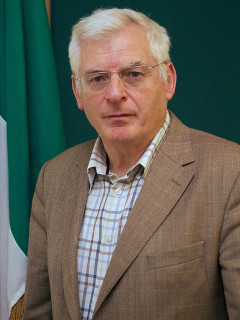
Birth of Joe Higgins, Politician & Member of the European Parliament

Joe Higgins, a former Socialist Party politician who serves as a Teachta Dála (TD) for the Dublin West constituency from 1997 to 2007 and from 2011 to 2016, is born in Lispole, County Kerry, on May 20, 1949. He serves as a Member of the European Parliament (MEP) for the Dublin constituency from 2009 to 2011.

One of nine children of a small farming family, Higgins goes to school in the Dingle Christian Brothers School, and after finishing he enrolls in the priesthood. As part of his training, he is sent to a Catholic seminary school in Minnesota, United States, in the 1960s. He becomes politicised at the time of anti-Vietnam War protests and the civil rights movement. He is a brother of Liam Higgins, who plays football with the Kerry GAA senior team in the 1960s and 1970s. He is bilingual in English and Irish.

Higgins returns to Ireland and attends University College Dublin (UCD), studying English and French. For several years he is a teacher in several Dublin inner city schools. While at university he joins the Labour Party and becomes active in the Militant Tendency, an entryist Trotskyist group that operates within the Labour Party. Throughout his time in the Labour Party, he is a strong opponent of coalition politics, along with TDs Emmet Stagg and Michael D. Higgins. He is elected to the Administrative Council of the Labour Party by the membership in the 1980s. In 1989, he is expelled alongside 13 other members of Militant Tendency by party leader Dick Spring. The group eventually leaves the party and forms Militant Labour, which becomes the Socialist Party in 1996.

Higgins spends over half his salary on the Socialist Party and causes he supports. He is elected to Dublin County Council in 1991 for the Mulhuddart electoral area and is until 2003 a member of Fingal County Council. In 1996, he campaigns against local authority water and refuse charges and contests the Dublin West by-election, losing narrowly to Brian Lenihan Jnr.

Higgins is first elected to Dáil Éireann at the 1997 Irish general election and re-elected at the 2002 general election. He loses his seat at the 2007 general election but regains it at the 2011 general election. From 2002 to 2007, he is a member of the Technical Group in the Dáil which consists of various independent TDs, Sinn Féin and the Green Party grouped together for better speaking time.

Higgins speaks out against the Iraq War while a TD, and addresses the Dublin leg of the March 20, 2003 International Day of Action. He is also prominent in the successful 2005 campaign to bring Nigerian school student Olukunle Eluhanla back to Ireland after he had been deported. He remains an opponent of the deportation policy.

Higgins uses his platform in the Dáil to raise the issue of exploitation of migrant and guest workers in Ireland. He and others claim that many companies are paying migrants below the minimum wage and, in some cases, not paying overtime rates. He expresses opposition in the Dáil to the jailing of the Rossport Five in July 2005. He raises the outsourcing of jobs by Irish Ferries in the Dáil in November 2005, requesting new legislation to regulate what he describes as “these modern slavers.”

Higgins successfully contests the 2009 European Parliament election for the Dublin constituency, beating two incumbents, Mary Lou McDonald of Sinn Féin and Eoin Ryan of Fianna Fáil, for the third and final seat. He is elected on the same day to Fingal County Council for the Castleknock electoral area, topping the poll. As Irish law prohibits politicians having a dual mandate, he vacates the council seat in July 2009 and is replaced by Matt Waine. He was a member of the European United Left–Nordic Green Left (EUL–NGL) group in the European Parliament, the European Parliament’s Committee on International Trade, and the delegation for relations with the countries of South Asia. He is also a substitute member of the Committee on Employment and Social Affairs, the Committee on Petitions and the delegation for relations with the Mercosur countries. Paul Murphy replaces him as an MEP when he is re-elected to the Dáil in 2011.

Higgins is elected again as TD for Dublin West at the 2011 Irish general election. He wins the third seat (of four) with 8,084 first preference votes. In his first speech in the 31st Dáil, he opposed the nomination of Fine Gael‘s Enda Kenny as Taoiseach. On May 4, 2011, Kenny is forced to apologise to Higgins in the Dáil after falsely accusing him of being a supporter of Osama bin Laden after Higgins offers criticism of his assassination by the CIA. He had asked the Taoiseach, “Is assassination only justified if the target is a reactionary, anti-democratic, anti-human rights obscurantist like bin Laden?”

In the Dáil, Higgins accuses Tánaiste Eamon Gilmore of doing nothing for the 14 Irish citizens being held “incommunicado” by Israel in November 2011. In December 2011, he describes as a disgraceful campaign of intimidation the fines imposed by the government on people who are unable to pay a new household charge brought in as part of the latest austerity budget and says to Enda Kenny that he will be “the new Captain Boycott of austerity in this country.” He asks that Minister for Finance Michael Noonan provide EBS staff with the 13th month end-of-year payment they are being denied.

In September 2012, Higgins publicly disagrees with former Socialist Party colleague Clare Daly, saying it is “unfortunate” that she has resigned from the party, but that it is impossible for Daly under the banner of the Socialist Party to continue to offer political support to Mick Wallace, who is at that time embroiled in scandal.

Higgins announces in April 2014 that he will not contest the next Dáil election. At the time he states his belief that the “baton of elected representation” should be carried by another generation of Socialist Party politicians — like Ruth Coppinger and Paul Murphy.


Leave a comment

Birth of Mary O’Rourke, Former Fianna Fáil Politician

Mary O’Rourke (née Lenihan), former Fianna Fáil politician, is born in Athlone, County Westmeath, on May 31, 1937.

O’Rourke is educated at St. Peter’s in Athlone, Loreto Bray Convent in County Wicklow, University College Dublin and St. Patrick’s College, Maynooth. She works as a secondary school teacher before beginning her political career.

O’Rourke begins her political career in local politics, serving on Athlone Urban District Council between 1974 and 1987 and on Westmeath County Council between 1979 and 1987. She is elected to Seanad Éireann in 1981 as a Senator for the Cultural and Educational Panel. She stands unsuccessfully for the Dáil at the February 1982 Irish general election but is subsequently re-elected to the Seanad. At the November 1982 Irish general election, she is first elected to Dáil Éireann as a Fianna Fáil TD for the Longford–Westmeath constituency, and from 1992 for the new Westmeath constituency.

In 1987, O’Rourke is appointed Minister for Education by Charles Haughey. She and her brother, Brian Lenihan Snr, become the first brother and sister in Irish history to serve in the same cabinet. In the November 1991 cabinet reshuffle, she becomes Minister for Health. In February 1992, Charles Haughey resigns as Taoiseach and Fianna Fáil leader, and she contests the subsequent leadership election along with Michael Woods and Albert Reynolds. Reynolds wins the election, and she is subsequently dropped from her ministerial position, but is appointed to a junior ministry as Minister of State for Labour Affairs at the Departments of Industry and Commerce, and later Enterprise and Employment.

In 1994, Bertie Ahern becomes party leader, and he appoints O’Rourke as deputy leader of Fianna Fáil, serving in the position until 2002. Following Ahern’s election as Taoiseach in June 1997, she becomes Minister for Public Enterprise, holding this position until she loses her Dáil seat at the 2002 Irish general election. This follows a vote management strategy from Fianna Fáil head office which restricts her from campaigning in her traditional areas around Kilbeggan, in an attempt to win 2 of the 3 seats in Westmeath. The loss of her Dáil seat is also attributed to her association with and the championing of, the privatisation of Telecom Éireann, which proves a financial disaster for many small investors, due to the share price falling radically, post privatisation. During this term as Minister, she also becomes the subject of public criticism by Ryanair chief executive Michael O’Leary. Following the loss of her Dáil seat, she is nominated to Seanad Éireann as a Senator by Taoiseach Bertie Ahern where she becomes Leader of the Seanad and leader of Fianna Fáil in the Seanad.

In January 2006, O’Rourke receives the party nomination to stand at the 2007 Irish general election. She narrowly defeats her nearest rival and Dáil election running mate, Kevin “Boxer” Moran of Athlone Town Council, causing a controversy when she thanks her election team for working “like blacks.” She is re-elected to the Dáil at the May 2007 Irish general election, with her highest ever vote.

In November 2008, during a march against the re-introduction of college fees, students from the Athlone Institute of Technology lay a funeral wreath at the door of O’Rourke’s constituency office. The card in the wreath states “Sincere sympathies on the death of free fees. We will remember this.” She describes the act as “heinous.” The wreath is placed there because she is not speaking at a rally against the fees.

In July 2010, O’Rourke concedes that she does not expect the party to be in power after the next general election. On RTÉ Radio‘s Today with Pat Kenny programme, she says the government is taking tough decisions to steer the country through the financial crisis and this will make it easy for the opposition. She says there is a general air of “crossness” within the Fianna Fáil party over their standing in the polls, but nobody is harboring leadership ambitions to challenge Brian Cowen.

In November 2010, O’Rourke says there is then more to unite her party and Fine Gael than to divide them. She points to the common approach of the two parties to Northern Ireland, Europe and the current financial crisis. In an address to the 1916–1921 Club in Dublin Castle, she says that most voters no longer defined themselves in terms of Civil War politics.

O’Rourke’s senior years lead her to often being referred to as the “Mammy of the Dáil.”

O’Rourke contests the 2011 Irish general election but is defeated on the poll. She had been critical of former Taoiseach Brian Cowen, saying that he should have resigned after his infamous “congested” radio interview. She supports the attack on Cowen by her nephew, former Finance Minister Brian Lenihan Jnr, who says he is “disappointed” by Cowen’s performance, and he had to provide the leadership when the Taoiseach did not.

As well as being a well-known politician, O’Rourke makes regular appearances in the media in a non-political capacity. She has been a contestant on RTÉ‘s reality series Celebrity Bainisteoir, as well as other shows such as Sex & Sensibility. She has guest presented Tonight with Vincent Browne.

In 2012, Just Mary: My Memoir is published. It wins the 2012 Irish Book Award in the “Listeners’ Choice” category.

O’Rourke comes from a strong political family, her father Patrick Lenihan serves as a TD for Longford–Westmeath from 1965 to 1970. Her brother Brian Lenihan is a senior government Minister and Tánaiste. Another brother, Paddy Lenihan, is a County Councillor in Roscommon, but resigns from Fianna Fáil in 1983 and becomes associated with Neil Blaney‘s Independent Fianna Fáil party. Two of her nephews, Brian Lenihan Jnr and Conor Lenihan, both sons of her brother Brian, serve as Ministers. Brian Lenihan Jnr is the Minister for Finance. Conor Lenihan is a Minister of State.

O’Rourke is widowed in January 2001, following the death of her husband, Enda. She has two sons. Aengus O’Rourke, her adopted son, runs for Athlone Town Council in 2009. The other son, Feargal O’Rourke, becomes Managing Partner of PricewaterhouseCoopers in Ireland in 2015 and is considered the “grand architect” of the Double Irish tax system, a major contributor to Ireland’s economic success in attracting U.S. multinationals to Ireland.


Leave a comment

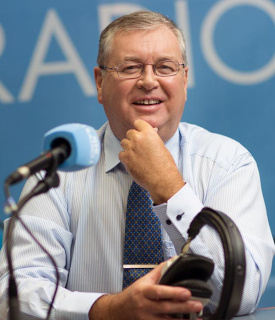
Birth of RTÉ Broadcaster Joe Duffy

Joseph Duffy, Irish broadcaster employed by Raidió Teilifís Éireann (RTÉ), is born in Mountjoy Square, Dublin, on January 27, 1956. One of RTÉ’s highest-earning stars, he is the current presenter of Liveline, an interview and phone-in chat show broadcast on RTÉ Radio 1.

Duffy is brought up in Ballyfermot, one of five siblings. His father is Jimmy and his mother Mabel. His father, who has problems with alcohol, dies aged 58 in 1984. His 25-year-old brother Aidan is killed in a road accident on the Maynooth Road in 1991, with Duffy first learning of the “horrific accident” on the news on RTÉ Radio. His brother Brendan is described by him as “crippled, ruined and wrecked by a savage addiction” to sniffing glue which he develops as a teenager.

Duffy attends De La Salle Boys’ primary school, St. Lorcan’s B.N.S and St. John’s De La Salle College. He enrolls at Trinity College, Dublin (TCD) in 1977 to study Social Work and is elected President of Trinity College Students’ Union in 1979, becoming President of the Union of Students in Ireland (USI) four years later.

Duffy considers resigning from RTÉ in 2007 after the broadcaster forces him to give Minister for Justice Michael McDowell a platform on Liveline to make a “party political broadcast.” He considers it “direct party-political interference” in Liveline. However, he goes ahead with the broadcast and does not resign or make any protest on air.

In October 2008, Duffy is proactive as a supporter of Irish pensioners who march on Leinster House to protest at the proposed means testing of their medical cards in the Government Budget. However, earlier that month, he is reportedly censored by the government when he attempts to continually discuss the effects of the global financial crisis in Ireland. This follows on from the outrage caused when he is held responsible by Minister for Finance Brian Lenihan Jnr for inciting widespread public fear that Irish citizens are on the verge of losing their savings. Several callers freely speak of their lack of confidence in the banking system, of how they have withdrawn their money from banks, some of which are identified, and are either carrying it around on their person, or considering keeping it “under the mattress,” or burying it in their garden. Lenihan personally calls Cathal Goan, the Director-General of RTÉ, to express his outrage at the sudden increase in potentially disastrous speculation following the show.

The extent of the Finance Minister’s concern first publicly emerges the following morning when he is interviewed by RTÉ’s economics editor George Lee. In that interview, Lenihan insists that deposits are not in any danger and says that people should not be going to banks to shift their deposit accounts “on the basis of unfounded allegations made on radio programmes.”

Rival broadcaster TV3 accuses Raidió Teilifís Éireann (RTÉ) and Duffy of waging a “dirty tricks” war against them after a late-night game show run by TV3 is berated by callers to Liveline and saying several times on air that he has been unable to get a representative from the station to reply to callers’ concerns. TV3 says a lengthy statement is sent to the Liveline office almost two hours before the September 2009 show goes on air but is ignored, despite the fact that it clarifies some of the issues. The Play TV service is discontinued by TV3 in March 2010 after 29 complaints to the Broadcasting Authority of Ireland (BAI), though TV3 says it is because of a decline in viewership.

Duffy is famous for taking up the causes of the disadvantaged on Liveline, and examples of this include Berry Fleming who lost her job in 2010, and Aubrey McCarthy, who is trying desperately to get his removal business off the ground in 2012/2013.

Duffy is frequently lampooned at length on the satirical TV programme The Savage Eye. It portrays him as a fetish garment clad sado-masochist who derives perverse pleasure by urging his call-in radio listeners in a strong working-class Dublin accent, to express excesses of degradation and misery as he “empathizes” verbally and plays with his nipple clamps. He has since questioned viewership figures for The Savage Eye on his daily radio show and has questioned whether it is “blasphemous” on his Sunday afternoon religious affairs TV show Spirit Level.

Duffy is married and is the father of triplets. He currently resides on Dublin’s Northside. His autobiography, Just Joe, is launched by Gay Byrne in Harry’s Bar in October 2011. In 2014, he makes a cameo in Mrs. Brown’s Boys D’Movie as himself. The film is negatively received but is a moderate box office success.

In 1992, Duffy wins a Jacob’s Award for his reports on RTÉ Radio 1’s The Gay Byrne Show. He is named 11th most influential person of 2009 by Village.


Leave a comment

Micheál Martin Elected Leader of Fianna Fáil

Micheál Martin is elected leader of Fianna Fáil on January 26, 2011. He beats the competition of finance minister Brian Lenihan Jnr, tourism minister Mary Hanafin, and social protection minister Éamon Ó Cuív. He replaces Brian Cowan who stepped down on January 22. During his acceptance speech, the new leader apologises for mistakes he and the Government made in managing the economy but says the most important thing is to learn from these mistakes.

Martin has been a Teachta Dála (TD) for the Cork South-Central constituency since 1989. He previously serves as Minister for Education and Science and Lord Mayor of Cork from 1992 to 1993, Minister for Health and Children from 2000 to 2004, Minister for Enterprise, Trade and Employment from 2004 to 2008, Minister for Foreign Affairs from 2008 to 2011, and Leader of the Opposition in Ireland from 2011 to 2020.

While Martin is Minister for Health and Children in 2004, he introduces a ban on tobacco smoking in all Irish workplaces and establishes the Health Service Executive (HSE). Ireland is the first country to introduce a full workplace smoking ban. As Foreign Minister, in 2009, he travels to Latin America for the first time and makes the first official visit to Cuba by an Irish Minister. That same year, he travels to Khartoum following the kidnapping of Sharon Commins and Hilda Kawuki. In 2010, he becomes the first Western foreign minister to visit Gaza since Hamas took control there in 2007.

In January 2011, Martin resigns as Minister for Foreign Affairs and is subsequently elected as the eighth leader of Fianna Fáil following Cowen’s resignation as party leader. In the 2011 Irish general election, he leads the party to its worst showing in its 85-year history, with a loss of 57 seats and a drop in its share of the popular vote to 17.4%. In the 2016 Irish general election, Fianna Fáil’s performance improves significantly, more than doubling their Dáil representation from 20 to 44 seats. In the 2020 Irish general election, Fianna Fáil becomes the largest party, attaining the most seats at 38, one seat ahead of Sinn Féin with 37 seats. He is appointed Taoiseach on June 27, 2020, leading a grand coalition with longtime rival Fine Gael and the Green Party as part of a historic deal. Under the terms of the agreement, Martin’s predecessor, Leo Varadkar, becomes Tánaiste, and will swap roles with Martin in December 2022.


Leave a comment

The Funeral of Michael Collins

Michael Collins, soldier and politician who is a leading figure in the struggle for, and achievement of Irish independence in the early 20th century, is laid to rest in Dublin‘s Glasnevin Cemetery on August 28, 1922.

Collins is shot and killed by anti-Treaty ambushers as his Free State Army convoy approaches Béal na Bláth, an isolated crossroads in County Cork, on August 22, 1922, during the Irish Civil War.

Collins’s body is transported by sea from Cork to Dublin. He lay in state for three days in Dublin City Hall where tens of thousands of mourners filed past his coffin to pay their respects, including many British soldiers departing Ireland who had fought against him. His funeral mass on August 28, 1922, takes place at Dublin’s St. Mary’s Pro-Cathedral where a number of foreign and Irish dignitaries are in attendance. According to a report in The New York Times, the seven-mile journey from the cathedral to his final resting place in Glasnevin Cemetery is lined with half a million mourners, almost one fifth of the country’s population at the time, and many of whom likely differed with him on his Treaty vote.

No official inquiry is ever undertaken into Collins’s death and consequently there is no official version of what happened, nor are there any authoritative, detailed contemporary records.

In this vacuum, independent investigations and conspiracy theorists have put forward a number of suspects as having executed or ordered his death, including an anti-Treaty sharpshooter, members of his own escort, the British Secret Intelligence Service, or Éamon de Valera himself.

De Valera is alleged to have declared in 1966, “It is my considered opinion that in the fullness of time history will record the greatness of Michael Collins; and it will be recorded at my expense.”

An annual commemoration ceremony takes place each year in August at the ambush site at Béal na Bláth, organised by The Béal na mBláth Commemoration Committee. In 2009, former President of Ireland Mary Robinson gives the oration. In 2010, the Minister for Finance Brian Lenihan, Jnr. becomes the first Fianna Fáil person to give the oration. In 2012, on the 90th anniversary of the death of Collins, Taoiseach Enda Kenny gives the oration, the first serving head of government to do so. There is also a remembrance ceremony in Glasnevin Cemetery every year at Collins’s gravesite on the anniversary of his death.

RIP Big Fellow!