Rice is born to Johnny Rice and his wife Nell (née Hayes). Her mother can sing, and her father is a master mason. Her mother’s singing brings in extra money after her father is posted overseas during World War II. She goes to Methodist College Belfast and by the age of fourteen is living in the family home with lodgers as her parents are in Africa where her father is working. She is not academic and takes only a passing interest in becoming a secretary. A school friend says that all she wants to do is draw.
The artist Gerard Dillon comes from Belfast. He helps Rice after they are introduced to each other by her piano teacher in 1951. He is friends with the painter George Campbell. They both share “an interest in bohemian characters.” She regards both Dillon and Campbell as her mentors for decades and her work is of a similar surrealistic and primitive style.
In 1956, Rice completes her first solo exhibition at the British Council in Hong Kong. She had been there since 1954 doing typing and practicing her painting. Her father is working there, and she stays in Hong Kong until the following year. When she returns, she earns money working night shifts in the BBC newsroom.
Gerard Dillon and his sister, Mollie, have a property on London‘s Abbey Road in 1958. They rent part of the house to artist Arthur Armstrong, and they rent a flat to Rice and her brother. Dillon and Rice would tour junk yards to find objects like leather and string that they include in their artwork. The house is known for its ex-pat Irish artists which also include Aidan Higgins and Gerry Keenan.
In 1963, Rice goes to the United States to exhibit, and she has to be persuaded to find time to meet President Kennedy. This is three weeks before he is killed in Dallas. In 1967, she is in Paris learning lithography and marries the German contemporary artist Haim Kern. Their child Tristran is born, and the marriage soon ends, and she leaves for Switzerland.
Rice marries again after she returns to Ireland to live in County Fermanagh. They have a daughter who is named Trasna. She exhibits twice in Belfast. In 1997, a large collaboration with Felix Anaut results in images of Adam and Eve which is prepared for a Spanish arts festival near Zaragoza. Another large commission is to decorate the shutters of Pushkin House at Baronscourt for Alexandra Hamilton, Duchess of Abercorn, in 2005.
Rice dies in County Monaghan on March 23, 2015, where she had lived for twenty years. She completes her last exhibition in 2009, over fifty years after her first in Hong Kong. She has exhibited and had her work in notable collections including the United Nations. She is noted for only creating art when she wanted to, she had never conformed, Aeneas Bonner says in her obituary “Normality was a not a close acquaintance.”
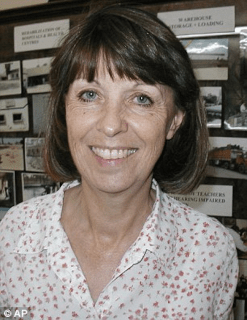
Margaret Hassan, Irish-born aid worker also known as “Madam Margaret,” is born Margaret Fitzsimons in Dalkey, County Dublin on April 18, 1945. She works in Iraq for many years until she is abducted and murdered by unidentified kidnappers in Iraq in 2004. Her remains have never been recovered.
Soon after the end of World War II Hassan’s family moves to London, where she spends most of her early life and where her younger siblings are born. At the age of 27, she marries Tahseen Ali Hassan, a 29-year-old Iraqi studying engineering in the United Kingdom. She moves to Iraq with him in 1972, where she begins work with the British Council of Baghdad, teaching English. Eventually she learns Arabic and becomes an Iraqi citizen.
During the early 1980s, Hassan becomes the assistant director of studies at the British Council, later becoming director. Meanwhile, her husband works as an economist. She remains in Baghdad during the 1991 Gulf War, although the British Council suspends operations in Iraq, and she is left jobless at the end of it.
Hassan joins humanitarian relief organisation CARE International in 1991. Sanitation, health, and nutrition become major concerns in the sanctioned Iraq. She is crucially involved in bringing leukemia medicine to child cancer victims in Iraq in 1998. She becomes a vocal critic of the United Nations restrictions. She is opposed to the United States invasion of Iraq in 2003, arguing that the Iraqis are already “living through a terrible emergency. They do not have the resources to withstand an additional crisis brought about by military action.”
By 2004, Hassan is head of Iraqi operations for CARE. Well known in many of Baghdad’s slums and other cities, she is especially interested in Iraq’s young people, whom she calls “the lost generation.” Her presence draws large crowds of locals.
Hassan is kidnapped in Baghdad on October 19, 2004, and is killed some weeks later on November 8. In a video released of her in captivity she pleads for help and begs British Prime MinisterTony Blair to remove British troops from Iraq. She adds that she does not “want to die like Mr. Bigley,” a reference to Kenneth Bigley, who had been executed in Iraq only weeks earlier.
Patients of an Iraqi hospital take to the streets in protest against the hostage takers’ actions. On October 25, between 100 and 200 Iraqis protest outside CARE’s offices in Baghdad, demanding her release. Prominent elements of the Iraqi insurgency and Iraqi political figures condemn the kidnapping and call for her release. On November 2, Al Jazeera reports that the kidnappers threatened to hand her over to the group led by Abu Musab al-Zarqawi and who is responsible for the execution of Bigley. On November 6, a statement purportedly from al-Zarqawi appears on an Islamist website calling for the release of Hassan unless the kidnappers have information she is aligned with the invading coalition. The statement cannot be authenticated and Hassan’s whereabouts in the video are unknown.
On 15 November, U.S. Marines in Fallujah uncover the body of an unidentified blonde- or grey-haired woman with her legs and arms cut off and throat slit. The body cannot be immediately identified, but is thought unlikely to be Hassan, who has brown hair. There is one other western woman known missing in Iraq at the time the body is discovered, Teresa Borcz Khalifa, a Polish-born long-time Iraqi resident. Khalifa is released by her hostage takers on November 20.
On November 16, CNN reports that CARE has issued a statement indicating that the organisation is aware of a videotape showing Hassan’s execution. Al-Jazeera reports that it has received a tape showing Hassan’s murder but is unable to confirm its authenticity. The video shows Hassan being shot with a handgun by a masked man. It is not known who is responsible for Hassan’s abduction and murder. The group holding her never identifies itself in the hostage videos.
CARE International suspends operations in Iraq because of Hassan’s kidnapping. At least eight other women kidnapped by insurgents during the conflict are released unharmed by their captors. It is unclear why Hassan, who was opposed to the war, lived in Iraq for many years, held Iraqi citizenship, was married to an Arab Muslim and spoke fluent Arabic was killed.
On May 1, 2005, three men are questioned by Iraqi police in connection with the murder. On June 5, 2006, news reports emerge that an Iraqi man by the name of Mustafa Salman al-Jubouri has been sentenced to life imprisonment for “aiding and abetting the kidnappers” but two other men are acquitted. Al-Jubouri appeals this sentence and is given a shorter imprisonment.
An Iraqi man named Ali Lutfi Jassar al-Rawi, also known as Abu Rasha, an architect from Baghdad, is arrested by Iraqi and U.S. forces in 2008 after contacting the British Embassy in Baghdad and attempting to extort 1 million dollars in return for disclosing the location of Hassan’s body. Though Jassar signs statements confessing to the charges, he pleads not guilty, stating he was forced to sign them after receiving beatings and electrical shocks during questioning.
On June 2, 2009, the Press Association reports that Jassar is given a life sentence by Baghdad’s Central Criminal Court for being involved in Hassan’s abduction and murder, and for attempting to blackmail the British Embassy. Hassan’s family welcomes the court’s decision but pleads with Jassar to tell them where her body is so they can return her to Britain for burial. On July 14, 2010, a day before Jassar is due to appear in court for retrial, it is reported that he could not be located in the prison facility where he was being held. He had been missing for a month.


 seamus dubhghaill