seamus dubhghaill

Promoting Irish Culture and History from Little Rock, Arkansas, USA


Leave a comment

Founding of the Football Association of Ireland

The Football Association of Ireland (Irish: Cumann Peile na hÉireann), the governing body for association football in the Republic of Ireland, is founded on September 2, 1921.

In the 19th century, association football outside of Ulster is largely confined to Dublin and a few provincial towns. The British Army teams play a role in the spread of the game to these areas, especially in Munster, as local clubs are initially reliant on them to form opposition teams, leading to the nickname “the garrison game.” Association football is played in relatively few Catholic schools as middle-class schools favour rugby union while others favour Gaelic games. The Irish Football Association (IFA) had been founded in 1880 in Belfast as the football governing body for the whole of Ireland, which was then a part of the United Kingdom and considered a Home Nation. The Leinster Football Association was an affiliate, founded in 1892 to foster the game in Leinster, outside of the Ulster heartlands. This was followed by the establishment of the Munster Football Association in 1901.

By 1913, the Leinster FA becomes the largest divisional association within the IFA, displacing the North East Ulster Football Association, yet all but two clubs in the 1913–14 Irish League are based in Ulster. While this largely reflects the balance of footballing strength within Ireland, southern members feel the IFA is doing little to promote the game outside of the professional clubs in its northern province. In the other provinces, association football is also under pressure from the Gaelic Athletic Association (GAA), which has banned members from playing or watching the sport as it is considered a “foreign” game. Furthermore, there is a growing feeling in Dublin of alleged Belfast bias when it comes to hosting matches and player selection for internationals. This view is not helped by the composition of the IFA’s sub-committees, with over half of the membership consisting of delegates hailing from the North-East, and the International Committee, who chooses the national team, containing just one member from Leinster. The Belfast members are mainly unionist, while the Dublin members are largely nationalistWorld War I increases the gulf between the northern teams and the clubs in the south as the Irish League is suspended and replaced by regional leagues, foreshadowing the ultimate split. Tensions are then exacerbated by the Irish War of Independence of 1919–21, which disrupts contact between northern and southern clubs further and prevents resumption of the Irish League. The security situation prompts the IFA to order the March 1920-21 Irish Cup semi-final replay between Glenavon and Shelbourne to be replayed in Belfast, rather than in Dublin as convention dictates. This proves to be the final straw and the Leinster FA confirms their decision to disaffiliate from the IFA at a meeting on June 8, 1921.

The Football Association of Ireland (FAI) is formed in Dublin on September 2, 1921, by the Leinster FA. The Free State League (originally the Football League of Ireland and now the League of Ireland) is founded in June of that year when the Leinster FA withdraws from the IFA. This is the climax of a series of disputes about the alleged Belfast bias of the IFA. Both bodies initially claim to represent the entire island. The split between Southern Ireland (which becomes the Irish Free State in December 1922) and Northern Ireland (which comes into existence as a jurisdiction in 1921) does not produce a split in the governing bodies of other sports, such as the Irish Rugby Football Union (IRFU). The Munster Football Association, originally dominated by British Army regiments, falls into abeyance on the outbreak of World War I, and is re-established in 1922 with the help of the FAI, to which it affiliates. The Falls League, based in the Falls Road of nationalist West Belfast, affiliates to the FAI, and from there Alton United wins the FAI Cup in 1923. However, when the FAI applies to join FIFA in 1923, it is admitted as the Football Association of the Irish Free State (FAIFS) based on a 26-county jurisdiction. (This jurisdiction remains, although Derry City, from Northern Ireland, are given an exemption, by agreement of FIFA and the IFA, to join the League of Ireland in 1985.) Attempts at reconciliation followed. At a 1923 meeting, the IFA rejects an FAIFS proposal for it to be an autonomous subsidiary of the FAIFS. A 1924 meeting in Liverpool, brokered by the English FA, almost reaches agreement on a federated solution, but the IFA insists on providing the chairman of the International team selection committee. A 1932 meeting agrees on sharing this role, but founders when the FAIFS demands one of the IFA’s two places on the International Football Association Board (IFAB). Further efforts to reach agreement are made through a series of conferences between the IFA and FAI from 1973 to 1980 during the height of the Troubles in Northern Ireland.

The IFA does not feel obliged to refrain from selecting Free State players for its international team. The name Football Association of Ireland is readopted by the FAIFS in 1936, in anticipation of the change of the state’s name in the pending Constitution of Ireland, and the FAI begins to select players from Northern Ireland based on the Constitution’s claim to sovereignty there. A number of players play for both the FAI “Ireland” (against FIFA members from mainland Europe) and the IFA “Ireland” (in the British Home Championship, whose members had withdrawn from FIFA in 1920). Shortly after the IFA rejoins FIFA in 1946, the FAI stops selecting Northern players. The IFA stops selecting southern players after the FAI complains to FIFA in 1950.

From the late 1960s, association football begins to achieve more widespread popularity. Donogh O’MalleyTD and then Minister for Education, begins a new programme of state-funded schools in 1966, many with association football pitches and teams. The Gaelic Athletic Association’s ban on members playing “foreign” games is lifted in 1971.  RTÉ television, founded in 1962, and British television (available nearly everywhere on cable or microwave relay from the 1970s), broadcast association football regularly. Above all, the increasing success of the international side from the late 1980s gives increased television exposure, more fans, and more funds to the FAI.

However, increased media exposure also highlights some inadequacies of its hitherto largely amateur organisation. In January 1999, the FAI announces a planned national association football stadium, to be called Eircom Park after primary sponsors Eircom. This is to be a 45,000-seat stadium in City West, modeled on the GelreDome in Arnhem. It gradually becomes apparent that the initial forecasts of cost and revenue have been very optimistic. FAI and public support for the project is also undermined by the announcement of the Stadium Ireland in Abbotstown, which would have 65,000 seats and be available free to the FAI, being funded by the state. The Eircom Park project is finally abandoned in March 2001, amid much rancour within the FAI.

During preparation for the 2002 FIFA World Cup, the captain of the senior football team, Roy Keaneleaves the training camp and returns to his home. He is critical of many aspects of the organisation and preparation of the team for the upcoming games, and public opinion in Ireland is divided. As a result of the incident, the FAI commissions a report from consultants Genesis into its World Cup preparations. The “Genesis Report” makes a number of damning criticisms regarding corruption and cronyism within the association, but is largely ignored. The complete report is never published for legal reasons. The FAI subsequently produces its own report of itself titled “Genesis II” and implements a number of its recommendations.

In 2002, the FAI announces a deal with British Sky Broadcasting to sell broadcasting rights to Ireland’s international matches, as well as domestic association football, to be televised on its satellite subscription service. The general public feels it should be on RTÉ, the free-to-air terrestrial service, in spite of their offering much lower rates. Faced with the prospect of the government legislating to prevent any deal, the FAI agrees to accept an improved, but still lower, offer from RTÉ.

In 2002, the FAI makes an unsuccessful bid with the Scottish Football Association to host UEFA Euro 2008.

Following the respectable performance of the national team in the 2002 FIFA World Cup, the team’s fortunes decline under the management of Mick McCarthyBrian Kerr and Steve Staunton.

In September 2006, Lars-Christer Olsson, CEO of UEFA, is quoted as anticipating that Lansdowne Road in Dublin (actually owned by the Irish Rugby Football Union) will stage the UEFA Cup Final in 2010, and that the FAI and the IFA will co-host the 2011 UEFA European Under-21 Championship. The 2010 final is ultimately awarded to Hamburg, but in January 2009, UEFA nameS Lansdowne Road as the host stadium for the renamed 2011 UEFA Europa League Final. In August 2010, an FAI spokesman says they will have repaid all of their stadium debt of €46 million within 10 years despite the disastrous sale of 10-year tickets for premium seats at the Aviva Stadium.

In November 2007, the FAI moves to new headquarters at the National Sports Campus in Abbotstown. Its headquarters since the 1930s had been a Georgian terraced house at 80 Merrion Square, which is sold for a sum variously reported as “in excess of €6m” and “almost €9m.”

Leave a comment

Birth of Mal Donaghy, Former Northern Ireland Footballer

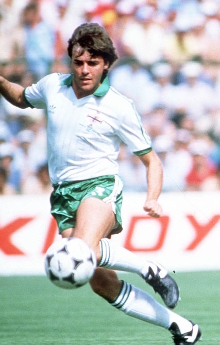
Malachy Martin Donaghy, former Northern Ireland international footballer who also plays for Luton Town F.C. and Manchester United F.C., is born in Belfast, Northern Ireland, on September 13, 1957. He is the manager of the Northern Ireland national under-19 football team from 2000-2008.

Originally from west Belfast, Donaghy begins his football career as a goalkeeper with little-known Down and Connor League side team St. Agnes before moving on to play as an outfield player for works team Post Office Social Club. After barely six months, he is on the move again, this time joining Amateur League side Cromac Albion, where his blossoming talent is spotted by then Larne F.C. boss Brian Halliday.

Donaghy’s rapid rise in the game continues when, after just 20 matches with the Inver Park club, he is transferred to Luton Town F.C. in June 1978 for a fee of £20,000.

Donaghy spends ten years at Luton Town F.C., overseeing the most successful era of their history to date. He collects a Second Division title winner’s medal in 1982, enabling him to experience First Division football for the first time. He helps Luton Town F.C. retain their First Division status and is a key part of the team that finishes a club record high of seventh in the 1986–87 season. In 1987–88, he helps Luton Town F.C. win their first major trophy as they achieve a shocking 3–2 win over Arsenal F.C. in the 1988 Football League Cup Final.

In October 1988, Donaghy departs from Kenilworth Road in a £650,000 move to his boyhood heroes Manchester United F.C. It is at the time a big risk for Alex Ferguson to pay out a large sum of money for a 31-year-old, but Donaghy repays the United manager’s faith in him with some consistent performances in not only his favoured central defensive position but also as a full-back.

Immediately after joining United, Donaghy is the club’s first choice left-back for the 1988–89 season, missing only the League Cup game for which he is cup-tied. However, his opportunities are limited in the 1989–90 season, and he is unable to make even the substitutes bench for the 1990 FA Cup final triumph over Crystal Palace F.C. However, he does make the substitutes bench for the 1991 European Cup Winners’ Cup final triumph.

United are First Division runners-up in 1991–92 and win their first-ever League Cup, but Donaghy’s first-team chances continue to be restricted, and he is also left out of the side that beats Nottingham Forest F.C. in the League Cup final.

Donaghy’s next move is in August 1992 when, just a month short of his 35th birthday, Chelsea F.C. manager Ian Porterfield pays £100,000 for his services. He helps Chelsea finish 11th in the inaugural Premier League season and helps them reach the 1994 FA Cup final, although he does not make the squad for the team that loses 4–0 to double-winners Manchester United F.C. At the end of the season, he announces his retirement from club football.

Donaghy makes his final appearance for Northern Ireland against the Mexico national football team in Miami in June 1994, three months before his 37th birthday.

Shortly after his playing career ends, Donaghy returns to the province with his family and after a brief spell as manager at Newry City F.C., he has stints as a coach with Cliftonville F.C. and as a Youth Development Officer back on his home pitch with Donegal Celtic F.C. In 2000, he is appointed manager for the Northern Ireland national under-19 team. He serves in this capacity until 2008.

The first of Donaghy’s 91 international caps comes in May 1980 at Windsor Park in the 1–0 British Home Championship victory over Scotland. He further enhances his reputation during the 1982 and 1986 World Cup finals. In the former tournament, he plays in four of Northern Ireland’s five games. He is sent off after 60 minutes of the famous 1–0 win over Spain in Valencia, for the offence of shoving Spain’s José Antonio Camacho, but returns for Northern Ireland’s final match, a 4–1 defeat by France in Madrid.


Leave a comment

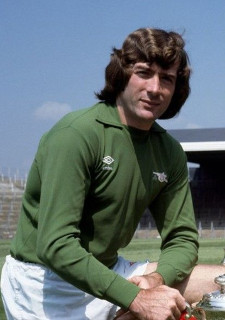
Pat Jennings Becomes First to Make 1,000 Senior Appearances

On February 26, 1983, Northern Irish footballer Pat Jennings becomes the first player in English football to make 1,000 senior appearances, celebrating this milestone with a clean sheet in a goalless league draw for Arsenal at West Bromwich Albion.

Jennings is born in Newry, County Down, Northern Ireland on June 12, 1945. After playing for Shamrock Rovers‘ under-18 side at the age of 11, he concentrates on Gaelic football until he is sixteen years old, when he makes his soccer comeback with his hometown side Newry Town. After impressing with the team, he moves to English Third Division side Watford in May 1963. He again impresses in his first season in England, playing every league game for his club. He makes his international debut with the Northern Ireland national football team at the age of eighteen while playing for Watford. This game, on April 15, 1964, is a British Home Championship match against Wales, with Northern Ireland winning the game 3–2. George Best makes his international debut in the same game. Jennings is signed by Tottenham Hotspur for £27,000 in June 1964.

Jennings spends thirteen years at White Hart Lane, where he plays in 472 league games for Spurs, and 591 in all competitions. He wins the FA Cup in 1967, the League Cup in 1971 and 1973, and the UEFA Cup in 1972. In the 1967 Charity Shield he scores once from his own area, kicking the ball from his hands and sending a large punt down the field that bounces over Manchester United goalkeeper Alex Stepney and into the net. In 1973 the Football Writers’ Association names him as its footballer of the year. Three years later he wins Professional Footballers’ Association‘s version of the award, the first goalkeeper to receive this accolade, and to this date remains only one of two, along with Peter Shilton.

In August 1977, he is transferred to Tottenham’s arch-rivals, Arsenal, with Tottenham thinking he is nearing the end of his career. However, he sees off rivals for the goalkeeper’s jersey to play for Arsenal for another eight years. While at Highbury, he helps Arsenal to four Cup finals in three successive years, the FA Cup final in 1978, 1979, and 1980, as well as the European Cup Winners’ Cup final that year. However, Arsenal only manages to win the second of these finals, a 3–2 victory against Manchester United. In total, he makes 327 appearances for Arsenal, 237 of them in the League, between 1977 and his eventual retirement from first-team club football in 1985.

Despite his retirement from club football in 1985, Jennings returns to Tottenham Hotspur, playing mostly in their reserve side to maintain his match sharpness for Northern Ireland’s 1986 FIFA World Cup campaign. He plays his final international game at the 1986 World Cup, on his 41st birthday, making him at the time the World Cup’s oldest-ever participant. The match is Northern Ireland’s final group game, a 3–0 defeat against Brazil. In total, he participates in the qualifying stages of six World Cups between 1966 and 1986.

Jennings final appearance for Tottenham is in the Football League Super Cup against Liverpool in January 1986. He is also briefly on Everton‘s books, having been signed as goalkeeping cover for the 1986 FA Cup Final against Liverpool, Neville Southall having been injured playing for Wales.

Jennings works as a goalkeeping coach at Tottenham since 1993. In 2003 he is inducted into the English Football Hall of Fame in recognition of the skills he demonstrated in the English league. He and his family have lived for many years in Broxbourne, Hertfordshire, where his son attended The Broxbourne School along with the sons of fellow Spurs players Chris Hughton, Osvaldo Ardiles and Ray Clemence. He is still associated with the Spurs and hosts Corporate Hospitality fans in the Pat Jennings Lounges at White Hart Lane and Windsor Park, Belfast.


Leave a comment

Birth of Norman Whiteside, Northern Ireland Footballer

norman-whiteside

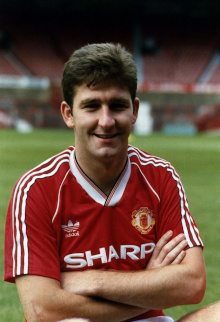
Norman Whiteside, former Northern Ireland international footballer who played in two World Cups, is born in Belfast, Northern Ireland on May 7, 1965. He plays both as a midfielder and as a striker.

Whiteside grows up on Shankill Road, and because of his aggressive, physical playing style he is later nicknamed the “Shankill Skinhead” by Manchester United supporters. The family later moves to 10 Danube Street. He remains relatively unscathed by The Troubles as his Protestant parents keep a firm watch on their children to ensure that they do not stray far from home and that none of them become involved with Ulster loyalism. At around seven years of age, he joins the Boys’ Brigade, and quickly shows his natural talent for football, scoring ten goals in a game against boys almost twice his age. He is educated at Cairnmartin High School and becomes famous in the Shankill area as a footballing prodigy by the age of eleven.

Whiteside is said to have been discovered by Ipswich Town scout Jim Rodgers, who is told by manager Bobby Robson to wait until Whiteside grows older. Instead, it is Manchester United’s 80-year-old Ulster scout Bob Bishop, who previously unearthed Belfast-born George Best and Sammy McIlroy for the club, who first offers him a trial at an English club. He finds that he has been offered schoolboy terms at the club during a school trip to the United States, on which he and his classmates meet President Jimmy Carter in the Oval Office, a rare and extraordinary occasion for children from a disadvantaged background.

Whiteside signs professional forms in 1982 at the age of 17 and quickly becomes a key member of the Manchester United club. He scores 68 goals in 278 league and cup appearances for the club over the next seven years, picking up two FA Cup winners medals in 1983 and 1985, as well as playing in the 1982 FA Youth Cup final, the 1983 League Cup final, and the FA Charity Shield in 1983.

Whiteside remains with United until July 1989, when he is sold to Everton F.C. for £600,000. However intense running sessions run by coach Mick Lyons take their toll on his right knee, and on September 20, 1990, he takes a knock in a practice match, which requires him to have another operation on his right knee. After the return of Howard Kendall as manager in November 1990, he manages to appear in a few reserve team games, but this only delays the inevitable, and he is forced to retire from the game at the age of 26 in June 1991.

Upon retirement, Whiteside studies to become a podiatrist, graduating with a degree from the University of Salford, and serves Northwich Victoria F.C. as their assistant manager/physio from October 1991 until March 1992. He quits the role as he does not enjoy the amount of time spent travelling between games. He instead became an after-dinner speaker and also works for the Professional Footballers’ Association, while taking a postgraduate course at Manchester Metropolitan University. He later takes up private practice as a podiatrist in Manchester. Since 1994, he has also worked at the corporate hospitality department at Old Trafford. In 2003, he releases a book entitled My Memories of Manchester United. With the help of writer Rob Bagchi, he releases his autobiography entitled Determined in August 2007, published by Headline Publishing Group, and with a foreword by actor James Nesbitt.

Whiteside holds records as the youngest player to take part in a World Cup, the youngest player to score in a League Cup and FA Cup final, and the youngest player to score a senior goal for Manchester United. Winning 38 caps for Northern Ireland, he plays at the 1982 and 1986 World Cups and also helps his country to win the last ever British Home Championship in 1983–1984.


Leave a comment

Ireland’s First Ever Win in International Soccer

ifa-original-badgeIreland wins its first ever match in international soccer on February 19, 1887, beating Wales 4-1 in Belfast. Prior to 1921 and the partition of the country, all of Ireland is represented by a single side, the Ireland national football team, organised by the Irish Football Association (IFA).

On February 18, 1882, fifteen months after the founding of the Irish FA, Ireland makes its international debut against England, losing 13–0 in a friendly played at Bloomfield in Belfast. This remains the largest ever defeat for the team, and is also England’s largest winning margin.

Ireland competes in the inaugural British Home Championship in 1884 and loses all three games. Ireland finally wins its first game on February 19, 1887, with a 4–1 win over Wales in Belfast. Between their 1882 debut and this game, the Ireland team has a run of 14 defeats and 1 draw, the longest run without a win in the 1800s. Despite the end of the losing streak, heavy defeats continue. In March 1888 they lose 11–0 to Wales and 10–2 to Scotland. Further heavy defeats come in March 1890 when they lose 9–1 to England, in 1899 when they lose 13–2 to England, and in February 1901 when they lose 11–0 to Scotland.

Ireland is partitioned into Northern Ireland and Southern Ireland in 1920. Southern Ireland gains independence in 1922 as the Irish Free State, later to become a republic under the name of Ireland. Amid these political upheavals, a rival football association, the Football Association of Ireland, emerges in Dublin in 1921 and organises a separate league and international team. In 1923, at a time when the home nations have withdrawn from the Fédération Internationale de Football Association (FIFA), the FAI is recognised by FIFA as the governing body of the Irish Free State on the condition that it changes its name to the Football Association of the Irish Free State. The IFA continues to organise its national team on an all-Ireland basis.

Between 1928 and 1946 the IFA is not affiliated to FIFA and the two Ireland teams co-exist, never competing in the same competition. However, on March 8, 1950, in a 0–0 draw with Wales at the Racecourse Ground in Wrexham, North Wales in a World Cup qualifier, the IFA fields a team that includes four players who were born in the Irish Free State. All four players have previously played for the FAI in their qualifiers and as a result have played for two different associations in the same FIFA World Cup tournament.

After complaints from the FAI, FIFA intervenes and restricts players’ eligibility based on the political border. In 1953, FIFA rules that neither team can be referred to as Ireland, decreeing that the FAI team officially be designated as the Republic of Ireland, while the IFA team is to become Northern Ireland.