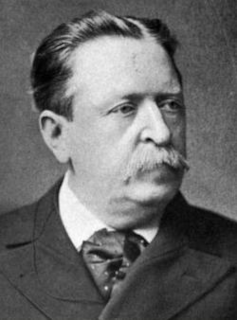
Young is invited to accompany President Ulysses S. Grant on Grant’s famous 1877-79 world tour, chronicled in Young’s book Around the World with General Grant. He impresses Grant, especially in China where he strikes up a friendship with Li Hongzhang. Grant persuades President Chester A. Arthur to appoint Young minister to China in 1882. In this position he distinguishes himself by mediating and settling disputes between the United States and China and France and China. Unlike many other diplomats, he opposes the policy of removing Korea from Chinese suzerainty.
In 1885 Young resumes working for the New York Herald in Europe. In 1890 he returns to Philadelphia. In 1897 President William McKinley appoints him Librarian of Congress, the first librarian confirmed by Congress. During his tenure, the library begins moving from its original home in the United States Capitol building to its own structure, an accomplishment largely the responsibility of his predecessor, Ainsworth Rand Spofford. Spofford serves as Chief Assistant Librarian under Young. Young holds the post of librarian until his death.
Young’s brother is Congressman James Rankin Young. His son is Brigadier General Gordon Russell Young, who is Engineer Commission of the District of Columbia from 1945-51 and a recipient of the Distinguished Service Medal and the Legion of Merit.
Raised in Ohio, Grant possesses an exceptional ability with horses, which serves him well through his military career. He is admitted to West Point, graduates 21st in the class of 1843 and serves with distinction in the Mexican–American War. In 1848, he marries Julia Dent, and together they have four children. He abruptly resigns his army commission in 1854 and returns to his family but lives in poverty for seven years.
Grant’s responses to corruption charges, in his federal departments rife with scandal, are mixed, often naïvely defending the culprits, particularly his war-time comrade Orville E. Babcock. But he also appoints cabinet reformers, such as John Brooks Henderson, for the prosecution of the Whiskey Ring. The Panic of 1873 plunges the nation into a severe economic depression that allows the Democrats to win the House majority. In the intensely disputed 1876 presidential election, he facilitates the approval by Congress of a peaceful compromise.
In his retirement, Grant is the first president to circumnavigate the world on his tour, meeting with Queen Victoria and many prominent foreign leaders. In 1880, he is unsuccessful in obtaining the Republican presidential nomination for a third term. In the final year of his life, facing severe financial reversals and dying of throat cancer, he writes his memoirs, which prove to be a major critical and financial success.
After a year-long struggle with throat cancer, surrounded by his family, Grant dies at 8:08 AM at his Mount McGregorcottage on July 23, 1885, at the age of 63. Philip Sheridan, then Commanding General of the Army, orders a day-long tribute to Grant on all military posts, and President Grover Cleveland orders a thirty-day nationwide period of mourning. After private services, the honor guard places Grant’s body on a special funeral train, which travels to West Point and New York City. A quarter of a million people view it in the two days before the funeral. Tens of thousands of men, many of them veterans from the Grand Army of the Republic (GAR), march with Grant’s casket drawn by two dozen black stallions to Riverside Park in the Morningside Heights neighborhood of Upper Manhattan. His pallbearers include Union generals William Tecumseh Sherman and Philip Sheridan, Confederate generals Simon Bolivar Buckner and Joseph E. Johnston, Admiral David Dixon Porter, and Senator John A. Logan, the head of the GAR. Following the casket in the seven-mile-long procession are President Cleveland, the two living former presidents Rutherford B. Hayes and Chester A. Arthur, all of the President’s Cabinet, as well as the justices of the Supreme Court.
Attendance at the New York funeral tops 1.5 million. Ceremonies are held in other major cities around the country, while Grant is eulogized in the press and likened to George Washington and Abraham Lincoln. His body is laid to rest in a temporary tomb in Riverside Park. Twelve years later, on April 17, 1897, he is reinterred in the General Grant National Memorial, also known as “Grant’s Tomb,” the largest mausoleum in North America.
In 1787 Paterson heads the New Jersey delegation to the federal Constitutional Convention, where he plays a leading role in the opposition of the small states to representation according to population in the federal legislature. As an alternative to James Madison‘s large-state Virginia Plan, he submits the small-state New Jersey Plan, also called the Paterson Plan, which advocates an equal vote for all states. The issue is finally resolved with the compromise embodied in the bicameral Congress —representation by population in the House of Representatives, and equality of states in the Senate.
Paterson is instrumental in securing ratification of the final document in New Jersey and is elected one of the state’s first two U.S. senators. He resigns his seat in 1790 and serves as governor of New Jersey until 1793, when he is named an associate justice of the United States Supreme Court.
On September 9, 1806, Paterson, aged 60, dies from the lingering effects of a coach accident suffered in 1803 while on circuit court duty in New Jersey. He is on his way to the spa at Ballston Spa, New York, to “take the waters”, when he dies at the Manor of Rensselaerswyck home of his daughter, Cornelia, and son-in-law, Stephen Van RensselaerStephen Van Rensselaer, in Albany, New York. He is laid to rest in the Van Renssalaer family vault. When the city acquires the property, his remains are relocated to Albany Rural Cemetery in Albany County, New York. Also buried there are Associate Justice Rufus W. Peckham and President Chester A. Arthur.
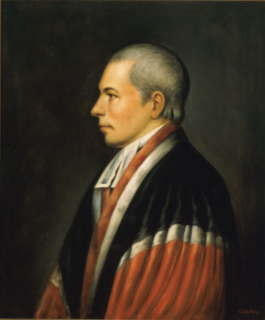
(Pictured: Portrait of William Paterson (1745–1806) when he was a Supreme Court Justice (1793–1806). This image is from a copy by C. Gregory Stapoko(1913-2006) of the original by James Sharples(1751-1811))


 seamus dubhghaill