seamus dubhghaill

Promoting Irish Culture and History from Little Rock, Arkansas, USA


Leave a comment

Birth of Florence O’Donoghue, Historian & IRA Member

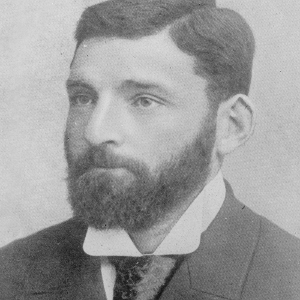
Florence O’Donoghue, historian and head of intelligence of the Cork No. 1 Brigade of the Irish Republican Army (IRA) during the Irish War of Independence, is born in Rathmore, County Kerry, on July 22, 1894, the son of farmer Patrick O’Donoghue and Margaret Cronin. He moves to Cork in 1910, where he works as an apprentice in the drapery trade.

The 1916 Easter Rising is a watershed in O’Donoghue’s life. In December 1916, he joins the Cork branch of the Irish Volunteers. In early 1917, he is elected unanimously First Lieutenant of the Cyclist Company and as a result devotes all his spare time to Volunteer work. He begins writing weekly for two years for The Irish World newspaper. By May 1917, he is sworn into the Irish Republican Brotherhood (IRB) and in October, Tomás Mac Curtain appoints him head of communications of the Cork Brigade. He replaces Pat Higgins as Brigade Adjutant in February 1917. He is a key organiser in the sensational jailbreak of Captain Donnchadh Mac Niallghuis on Armistice Day 1918 and takes personal responsibility for his protection. Michael Collins is the last officer from Volunteers General Headquarters to visit Cork shortly after Christmas 1919, until the truce in 1921.

O’Donoghue builds up an intelligence network and agents which includes his future wife, Josephine Marchment. She is head female clerk at the 6th Division Headquarters at Victoria Barracks, Cork, and passes on secret British Army correspondence to him. He recruits people to open letters, tap phone lines and intercept telegrams. The Irish Republican Army has 2,000 active members in Cork which are also used for intelligence gathering. By March 1920, after killing a Royal Irish Constabulary (RIC) Inspector, he is on the run and serving full-time in the IRA. In November of that year, the Cork Brigade kills six British Army officers and executes five Cork civilians on suspicion of spying.

After two and a half years of fighting, a truce is agreed upon on July 11, 1921. When the Dáil approves the Anglo-Irish Treaty, in January 1922, the IRA splits into pro- and anti-Treaty camps. Over the coming months and after being elected to the army’s executive as Adjutant General, O’Donoghue warns of the dangers of an Irish Civil War. In June 1922, he resigns from the army’s national executive and a month later, on July 3, 1922, from the army. Civil war does break out on June 28, 1922, between pro- and anti-Treaty factions, much to his dismay.

During the Irish Civil War, O’Donoghue remains neutral and tries to organise a truce to end the fighting. In December 1922, he forms a group called the “Neutral IRA”, along with Seán O’Hegarty, composed of pro-truce IRA men. He claims he has 20,000 members in this group. He campaigns for a month’s truce between the two sides, so that a political compromise could be reached. However, his efforts come to nothing and in March 1923, he winds up the “Neutral IRA,” judging that its objectives cannot be achieved. The Irish Civil War ends on May 24, 1923.

O’Donoghue serves as major in the Irish Army from 1939-1946. He forms a Supplementary Intelligence Service that is to remain behind enemy lines in the event of an invasion. He also teaches guerrilla warfare tactics to new army recruits.

O’Donoghue marries Josephine Brown (née Marchment) in April 1921, and they have four children. The couple also adopts two children from Josephine’s first marriage, including Reggie Brown, whom O’Donoghue kidnaps from his grandparents in Wales in 1920. He becomes a rate collector and remains outside politics.

In later years O’Donoghue becomes a respected historian. While in the army he edits An Cosantóir, the Irish Army’s magazine. He convinces Éamon de Valera to establish the Bureau of Military History to record personal accounts from the Irish War of Independence. He is a recording officer until 1948. His most famous work is his biography on Liam Lynch, entitled No Other Law.

O’Donoghue dies on December 18, 1967, in Mercy University Hospital, Cork, County Cork. Tom Barry gives the graveside oration. His papers are in the National Library of Ireland (NLI) and his statement to the Bureau of Military History is in the Military Archives.


Leave a comment

Execution of Major Geoffrey Lee Compton-Smith

geoffrey-lee-compton-smith

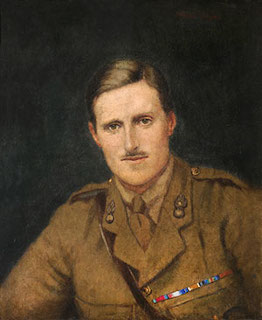
Major Geoffrey Lee Compton-Smith (DSO) of the 2nd Battalion of the Royal Welch Fusiliers is captured and executed by the Irish Republican Army (IRA) on April 30, 1921, during the Irish War of Independence.

Compton-Smith was born in 1889 in South Kensington, London. After finishing school, he decides not to follow the family tradition of studying law. He actually wants to become an artist, but his father insists that he join the army. He studies at the Royal Military College at Sandhurst and during World War I his regiment is sent to France. In 1917 he is wounded at the Battle of Arras, but he continues to fight on. He is awarded the Distinguished Service Order (DSO). In 1919 he is sent to serve in Ireland during the Irish War of Independence.

In 1919 Compton-Smith is commander of the British Army base at Ballyvonane, near Buttevant, but he is also an intelligence officer. As an officer he also sometimes presides over courts martial. In January 1921, for instance, three IRA volunteers are tried by him for involvement in the ambush at Shinanagh, near Charleville, and he sentences them each to six months.

February 1921 is a bad time for the IRA in County Cork. They suffer major losses at the ambushes at Clonmult and Mourne Abbey, and several volunteers are taken prisoner, four of whom are sentenced to death. The IRA believes that these death sentences might be commuted if a British officer is held as a hostage. This leads to the capture of Compton-Smith. On April 16, 1921, he travels to Blarney, supposedly on a sketching trip but actually to meet a nurse in Victoria Barracks with whom he is having an affair. The IRA has spies in Victoria Barracks who likely tip off the IRA that Compton-Smith is coming to Blarney. A squad led by Frank Busteed easily capture him after he gets off the train.

Busteed then meets with Jackie O’Leary, the IRA battalion commander. It is decided that Donoughmore is the perfect place to keep a hostage, because parts of the parish are remote and the IRA is strong there.

On April 18, under the cover of darkness, Compton-Smith is transferred by car to Knockane House, an abandoned big house in Donoughmore. The following night he is moved again, this time by pony and trap, to Barrahaurin, a remote townland in the Boggeragh Mountains. He is kept there for the last eleven days of his life, on the small farm of Jack and Mary Moynihan. He is held prisoner in a shed, always under guard. Every evening he is brought into the house, where he eats and stays at the fireside. He and his guards have conversations about history and politics.

The four IRA prisoners are executed on April 28, 1921. On April 30, O’Leary informs Compton-Smith that he is going to be executed. He then writes a final letter to his wife. He tells her that he will die with her name on his lips and her face before his eyes and that he will “die like an Englishman and a soldier.” He also writes a letter to his regiment and one to Lt. General Strickland.

After finishing his letters, Compton-Smith is led up into Barrahaurin bog behind the Moynihan house, to a place where his grave had already been dug and is given a final cigarette. In his witness statement Maurice Brew writes, “When removed to the place of execution he placed his cigarette case in his breast pocket of his tunic … He then lighted a cigarette and said that when he dropped the cigarette it could be taken as a signal by the execution squad to open fire.”

It is not until late May, following the discovery of the cache of letters in a Dublin raid, that the Compton-Smith family is informed of his death. His father, William, then starts a campaign to find his son’s body. He wrote letters to MPs and to the British Army, seeking information and help. He also writes to Erskine Childers but gets no reply. He offers a reward of £500 for information, but only The Irish Times agrees to print his advertisement.

In November 1921 a cousin of Compton-Smith’s wife, Gladys, meets Michael Collins in London and asks him for help in finding the body. Correspondence between Collins and the Compton-Smith family suggests that Collins is trying to help in 1922, but he fails to get any results before he is assassinated at Béal na Bláth later that same year.

On March 3, 1926, Compton-Smith’s grave is discovered by the Gardaí. The newspapers report that the remains, because of the conditions of the bog, “were not so badly decomposed as to render identification impossible.” The body is brought to Collins Barracks in Cork. On March 5 the Gardaí send a telegram to the Compton-Smiths, informing them that the body has been located.

The reburial of Compton-Smith is carried out with great dignity on March 19, 1926. The Irish Army escorts the coffin from Collins Barracks to Penrose Quay, where British forces from Spike Island take the coffin on board a boat. While the boat travels down the River Lee, the Irish Army’s guard of honour presents arms and sounds the “Last Post.” The British then bring the coffin to Carlisle Fort, near Whitegate, where it was buried in the in the British Military Cemetery with full military honours.


Leave a comment

Irish Protests of the War in Iraq

iraq-war-protest

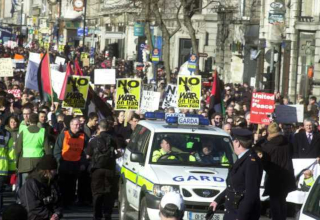
On the evening of March 20, 2003, up to 2,000 people take part in a protest outside the United States Embassy at Ballsbridge in Dublin to voice their opposition to the war in Iraq. This is one of numerous protests held in response to the Irish Anti-War Movement‘s call on Irish citizens to mount mass protests against the U.S.-led war in Iraq. The group says thousands of workers, students and school pupils had taken part in stoppages and walk-outs throughout the day.

Richard Boyd Barrett, the chairman of the IAWM, says, “The complicity of the Irish government in this murderous war through providing facilities for the U.S. military at Shannon Airport is an absolute disgrace. “This war has little support among ordinary people and has provoked a wave of anger and revulsion. We call on the people of Ireland to come out in their thousands at 6:00 PM tonight to their town centre demonstrations to show this carnage is not being mounted in our names.”

Earlier in the day, several hundred protesters gather outside Dáil Éireann to protest the Irish Government‘s decision to continue allowing U.S. military aircraft use Shannon Airport. The Dáil is holding a six-hour debate on a Government motion which, among other topics, contains a clause permitting U.S. forces continued use of Irish airspace and facilities.

A 10-minute work stoppage at noon is observed by thousands of people, the IAWM claims. They say hundreds of students in University College Dublin, Dublin City University, University of Limerick and the Waterford Institute of Technology walked out, as did secondary school students in several schools in Dublin. Up to 1,000 students from second level colleges in Derry take part in an hour-long city centre protest. Around 50 health workers at Connolly Hospital Blanchardstown, staff at the National Museum of Ireland in Kildare Street and Collins Barracks and workers at the Motor Taxation office in Cork also stop work.

The NGO Peace Alliance says it is “extremely disappointed” at the Government’s refusal to condemn the attack on Iraq. “We call upon thousands of Irish people to reject this shameful position by thronging the streets of Dublin and other cities and towns next Saturday” said the alliance’s co-ordinator, Brendan Butler.

SIPTU‘s National Executive Council also interrupts their monthly meeting. “This war is not only unnecessary but illegitimate in the context of international law”, says Joe O’Flynn, SIPTU General Secretary.

The Irish Congress of Trade Unions organises peace vigils on March 21 at the Spire of Dublin and other locations in various town and cities. Weekend anti-war protests take place in Dublin, Cork, Derry, Belfast, Galway, Sligo and Waterford.

(From: “Thousands protest against war at US Embassy” by Kilian Doyle, The Irish Times, March 20, 2003)


Leave a comment

State Funeral for Thomas Kent

thomas-kent-funeral

A state funeral for Thomas Kent takes place on September 18, 2015, 99 years after his execution following the 1916 Easter Rising. Thousands of people line the route from Collins Barracks in Cork to the Church of Saint Nicholas, Castlelyons, County Cork for the funeral mass.

Kent is executed after a gun battle with members of the Royal Irish Constabulary (RIC) who come to arrest him and his brothers on May 2, 1916, during the aftermath of the Easter Rising. During the ensuing fight, head constable William Rowe is killed, and Kent’s brother Richard later dies of his wounds. He is executed by firing squad on May 9, 1916, in the Military Detention Barracks, Cork and is buried in an unmarked grave on the grounds.

Apart from Roger Casement, Kent is the only one of the sixteen men executed after the Easter Rising to be executed outside Dublin. In June 2015, his remains are exhumed, and DNA testing confirms their identity.

A ripple of applause breaks through the crowd when the funeral cortege arrives at the church near where Kent was born and raised. The church is unable to accommodate all the visitors, so a marquee is set up on the grounds of the church.

President Michael D. Higgins is in attendance along with Taoiseach Enda Kenny, Tánaiste Joan Burton, Fianna Fáil leader Michéal Martin and Sinn Féin President Gerry Adams. The diplomatic corps is represented by British ambassador Dominick Chilcott, U.S. ambassador Kevin O’Malley and the Papal Nuncio Archbishop Charles Brown. The extended Kent family is represented mostly by the relatives of Edmund and William Kent, Thomas Kent’s brothers.

Kent’s funeral “writes the final chapter in a long ordeal for the Kent family,” the Bishop of Cloyne William Crean tells the congregation. Delivering the funeral eulogy, Cmdt. Gerry White says Thomas Kent was once known only for being the man who gave his name to Kent Station in Cork. “Today, however, all that is changed. Today, because of the recent discovery of his remains, Thomas Kent has once again become someone who is very much in the present. Today, members of Óglaigh na hÉireann, the Irish Defence Forces, will render the military honours that were denied him 99 years ago. Today, he will no longer be the ‘Forgotten Volunteer.’ Today, after 99 years, Thomas Kent is finally coming home.”

Thomas Kent’s life is represented by a picture of the family home, rosary beads, a pioneer pin and a leabhair gaeilge representing his interests in life. He is buried in the graveyard at Castlelyons. Taoiseach Enda Kenny gives the funeral oration.

(From: “State funeral for executed 1916 rebel Thomas Kent” by Ronan McGreevy and Éanna Ó Caollaí, The Irish Times, September 18, 2015 | Pictured: The remains of Thomas Kent as they are carried into St. Nicholas’ Church, Castlelyons, County Cork, photograph by Alan Betson)


Leave a comment

Execution of Thomas Kent

thomas-kent

Irish nationalist Thomas Kent is executed at Cork Detention Barracks on May 9, 1916. Kent’s story is one of the stranger episodes that happens after the rebellion in Dublin has been quelled. Unlike the Dublin rebels, Kent does not go out to fight. Rather the British come to him looking for trouble.

Kent is part of a prominent nationalist family who lives at Bawnard House, Castlelyons, County Cork. After spending some time in Boston, he returns to Ireland because of poor health. He is active in the Land League, Sinn Féin, and the Irish Republican Brotherhood. With the launch of the Irish Volunteers in 1913, he is prominent with another legendary Cork man, Terence MacSwiney, in organizing and training recruits.

The Kent family is prepared to take part in the Easter Rising but when the mobilisation order is countermanded by Eoin MacNeill, commander of the Irish Volunteers, on April 22, they stay at home. The rising nevertheless goes ahead in Dublin on Easter Monday. The Royal Irish Constabulary (RIC) is dispatched to arrest well-known sympathizers throughout the country including, but not limited to, known members of the Irish Republican Brotherhood, Sinn Féin, and the Irish Volunteers.

When the Kent residence is raided at 3:45 AM on May 2, the RIC is met with resistance from Thomas and his brothers Richard, David, and William. A gunfight lasts for four hours, during which RIC officer Head Constable William Rowe is killed and David Kent is seriously wounded. Eventually the Kents are forced to surrender, although Richard makes a last-minute dash for freedom and is fatally wounded.

Thomas and William are tried by court martial on May 4 on a charge of “armed rebellion.” William, who is not political, is found innocent, but Thomas is found guilty in the death of Constable Rowe and is sentenced to death. Before being led out for his execution, Kent says, “I have done my duty as a soldier of Ireland and in a few moments, I hope to see the face of God.” He is executed by firing squad in Cork in the early morning hours of May 9. David Kent is brought to Dublin where he is charged with the same offence, found guilty, and sentenced to death, but the sentence is commuted, and he is sentenced to five years penal servitude.

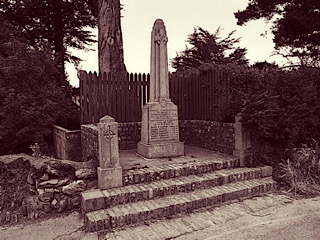
Apart from the singular case of Roger Casement, Thomas Kent is the only person outside of Dublin to be executed for his role in the events surrounding Easter Week. He is buried on the grounds of Cork Prison, formerly the Military Detention Barracks at the rear of Collins Barracks, Cork. The former army married quarters at the rear of Collins Barracks are named in his honour.

Taoiseach Enda Kenny offers a state funeral to the Kent family early in 2015 which they accept. Kent’s remains are exhumed from Cork prison in June 2015 after being buried for 99 years. The state funeral is held on September 18, 2015, at St. Nicholas’ Church in Castlelyons. Kent lay in state at Collins Barracks in Cork the day before. The requiem mass is attended by President Michael D. Higgins, with Enda Kenny delivering the graveside oration.