
Samuel Haliday, Irish Presbyterian non-subscribing minister to the “first congregation” of Belfast, is born on July 16, 1685, in Omagh, County Tyrone, in what is now Northern Ireland. His refusal to sign the Westminster Confession of Faith leads to a split between Subscribing and Non-Subscribing adherents.
Haliday is the son of the Rev. Samuel Haliday (1637–1724), who is ordained presbyterian minister of Convoy, County Donegal, in 1664. He then moves to Omagh in 1677, leaving for Scotland in 1689, where he is successively minister of Dunscore, Drysdale, and New North Church, Edinburgh. He returns to Ireland in 1692, becoming minister of Ardstraw, where he continues until his death.
Haliday enters Glasgow College, enrolled among the students of the first class under John Loudon, professor of logic and rhetoric. He graduates M.A. and goes to Leiden University to study theology in November 1705.
In 1706 Haliday is licensed at Rotterdam and in 1708 receives ordination at Geneva, choosing to be ordained there because of its tolerance. He becomes chaplain to the 26th (Cameronian) Regiment of Foot, serving under John Churchill, 1st Duke of Marlborough in Flanders. He is received by the Synod of Ulster in 1712 as an ordained minister without charge and declared capable of being settled in any of its congregations. For some time, however, he lives in London, where he associates with the Whig faction, in and out of the government, and uses his influence to promote the interests of his fellow-churchmen. He opposes the extension of the Schism Act 1714 to Ireland. In 1718 he takes a leading part in obtaining an increase in the regium donum and the synod of Ulster thanks him. He introduces two historians, Laurence Echard and Edmund Calamy, in a London social meeting with Sir Richard Ellys, 3rd Baronet.
In 1719 Haliday is present at the Salters’ Hall debates, and in the same year receives a call from the first congregation of Belfast, vacant by the death of the Rev. John McBride. He is at this time chaplain to Colonel Anstruther’s regiment of foot. It being rumoured that he holds Arian views, the synod in June 1720 considers the matter, and clears him. His accuser, the Rev. Samuel Dunlop of Athlone, is rebuked.
On July 28, 1720, the day appointed for his installation in Belfast, Haliday refuses to subscribe the Westminster Confession of Faith, making instead a declaration to the presbytery. The presbytery proceeds with the installation, in violation of the law of the church, and in the face of a protest and appeal from four members. The case comes before the synod in 1721, but though Haliday still refuses to sign the Confession, the matter is allowed to drop. A resolution is, however, carried after long debate that all members of synod who are willing to subscribe the confession might do so, with which the majority comply. Hence arises the terms “subscribers” and “non-subscribers.” He continues to be identified with the latter until his death. A number of members of his congregation are so dissatisfied with the issue of the case that they refuse to remain under his ministry. After much opposition they are erected by the synod into a new charge.
The subscription controversy rages for years. Haliday continues to take a major part in it, both in the synod and through the press. To end the conflict, the synod in 1725 adopts the expedient of placing all the non-subscribing ministers in one presbytery, that of Antrim, which in the following year is excluded from the body.
Haliday is a lifelong friend to the philosopher Francis Hutcheson. In 1736 Thomas Drennan is installed as his colleague in Belfast. Haliday dies at the age of 54 on March 5, 1739.
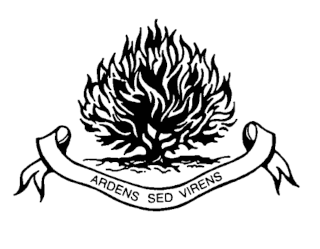
(Pictured: The burning bush is a common symbol used by Presbyterian churches; here as used by the Presbyterian Church in Ireland. The Latin inscription underneath translates as “burning but flourishing”. In Presbyterianism, alternative versions of the motto are also used such as “burning, yet not consumed”.)

 seamus dubhghaill