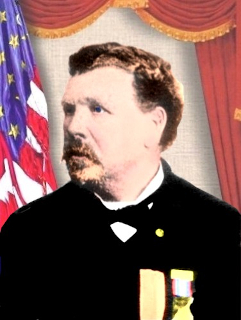
Lonergan immigrates to the United States with his family in 1848. It is said that the Lonergans were on the run from the Great Famine, as well as British oppression. Settling in Vermont, he works alongside his father as a cooper.
In 1862, Lonergan forms a company of fellow Vermont Irishmen to volunteer to fight the Confederates. He does so with the mindset to gain more military skill to help the cause of Irish freedom. He is also leader of the Vermont branch of the Fenian Brotherhood, a forerunner to the Irish Republican Army.
Lonergan serves for the Union Army in two stages, 1862-1863 and 1865. Serving as the captain of Company A, 13th Vermont Infantry, his efforts on July 2, 1863 at the Battle of Gettysburg earn him the Medal of Honor, which cites him for “Gallantry in the recapture of four guns and the capture of two additional guns from the enemy; also the capture of a number of prisoners.”
Following his services in the Civil War, Lonergan helps organize a pair of failed raids into Canada from staging areas in St. Albans. The Fenians’ quixotic aim is to pressure Britain, which rules Canada as a colony, to surrender control of Ireland.
Lonergan dies in Montreal, Quebec, Canada on August 6, 1902. In 2013, a memorial is erected to him in Burlington, Vermont.
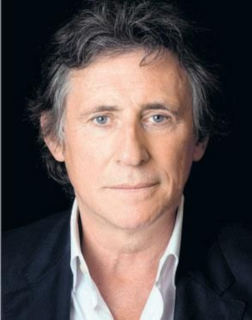
Byrne is the first of six children. His father is a cooper and his mother a hospital worker. He is raised Catholic and educated by the Irish Christian Brothers. He spends five years of his childhood in a seminary training to be a Catholic priest. He later says, “I spent five years in the seminary, and I suppose it was assumed that you had a vocation. I have realized subsequently that I didn’t have one at all. I don’t believe in God. But I did believe at the time in this notion that you were being called.” He attends University College Dublin (UCD), where he studies archeology and linguistics, and becomes proficient in the Irish language. He plays football in Dublin with the Stella Maris Football Club.
Byrne works in archeology after he leaves UCD but maintains his love of his language, writing Draíocht (Magic), the first drama in Irish on Ireland’s national Irish television station, TG4, in 1996.
He discovers his acting ability as a young adult. Before that he works at several occupations which include being an archaeologist, a cook, a bullfighter, and a Spanish schoolteacher. He begins acting when he is 29 years old. He begins on stage at the Focus Theatre and the Abbey Theatre in Dublin, later joining the Royal Court Theatre and the Royal National Theatre in London.
Byrne does not visit the United States until he is 37 years old. In 1988, he married actress Ellen Barkin with whom he has two children. The couple separates amicably in 1993 and divorce in 1999.
John F. Kennedy, an Irish American and the first Catholic to become president of the United States, arrives in Ireland on a state visit on June 26, 1963. After Air Force One touches down at Dublin airport, Kennedy’s motorcade weaves through the streets of Dublin city, the thrilled crowd, lacking ticker tape, improvises by throwing rolls of bus tickets.
Kennedy is proud of his Irish roots and makes a special visit to his ancestral home in Dunganstown, County Wexford, while in the country. There, he is greeted by a crowd waving both American and Irish flags and is serenaded by a boys’ choir that sings TheBoys of Wexford. Kennedy breaks away from his bodyguards and joins the choir for the second chorus, prompting misty-eyed reactions from both observers and the press.
Kennedy meets with 15 members of his extended Irish family at the Kennedy homestead in Dunganstown. There he enjoys a cup of tea and some cake and makes a toast to “all those Kennedys who went and all those Kennedys who stayed.” His great-grandfather, Thomas Fitzgerald, had left Ireland for the United States in the middle of the Great Famine of 1848 and settled in Boston, becoming a cooper. Generations of his descendants go on to make their mark on American politics.
Kennedy later tells his aides that his favourite part of the trip was the wreath laying and silent funeral drill done by the Irish Army cadets at Arbour Hill military cemetery in Dublin.
Five months later, his widow, Jacqueline Kennedy, makes a special request to the Irish government. She asks that those same Irish army cadets, who so impressed the President on his visit, perform the drill again at his state funeral. Within days, those awe-stuck, trembling young men stand just inches away from foreign dignitaries from over 90 countries and perform their silent funeral drill in memory of a president that had inspired their country just a few short months earlier.
Bridget Cleary is burned to death on March 15, 1895, by her husband who believes her spirit has been taken by bad faeries and replaced with a changeling.
Cleary is born Bridget Boland around 1869 in Ballyvadlea, County Tipperary. Bridget meets Michael Cleary in Clonmel in August 1887, where he works as a cooper and she serves as a dressmaker’s apprentice, and they marry a short time later.
After the marriage, she returns to her townland of Ballyvadlea to live with her parents while Michael continues to work as a cooper in Clonmel. During this period of living apart, Bridget’s independence grows and she begins keeping her own flock of chickens and selling the eggs to neighbours. She is also a professional woman which is somewhat unusual for the era and area. She obtains a Singersewing machine, which is state-of-the-art at the time, and is variously described as a dressmaker and a milliner.
Despite their eight years of marriage, the couple has no children by the time of Bridget’s death. Following the death of Bridget’s mother, the Clearys find themselves responsible for Bridget’s elderly father, Patrick Boland. His residence with the couple enables them to secure a house reserved for labourers. Neither Bridget nor Michael is entitled to this cottage, but as Patrick had been a labourer in his youth, they are able to acquire the best house in the village. However, there is no widespread interest in the house as it is built on the site of a supposed fairy ringfort.
In early March 1895, Bridget becomes ill although her specific diagnosis is unknown. On March 13, more than a week into her illness, a physician visits her home. Her condition is considered sufficiently grave that a priest soon follows to administer last rites. Several friends and family members attend her over the next two days and a number of home remedies are administered including one ritual that anticipates her later demise. Her father and her husband accuse her of being a fairy sent to take Bridget’s place. Urine is thrown on her and she is carried before the fireplace to cast the fairy out. By March 16, rumours begin to circulate that Bridget is missing and the local police begin searching for her. Michael is quoted as claiming that his wife has been taken by fairies. Witness statements are gathered over the ensuing week and, by the time Bridget’s burned corpse is found in a shallow grave on March 22, nine people have been charged in her disappearance, including her husband. A coroner‘s inquest the next day returns a verdict of death by burning.
Legal hearings take place from April 1 to April 6, 1895. The court session begins on July 3. Evidence indicates that Michael attempted to force-feed his wife, throwing her down on the ground before the kitchen fireplace. Bridget’s chemise catches fire and Michael then throws lamp oil on Bridget. Witnesses are unclear as to whether she is already dead by this point. Michael keeps the others away from her body as it burns, insisting that she is a changeling and has been for a week. Michael believes that this will allow him to get his wife back from the fairies.
Michael Cleary is found guilty of manslaughter and spends 15 years in prison.



 seamus dubhghaill