seamus dubhghaill

Promoting Irish Culture and History from Little Rock, Arkansas, USA


Leave a comment

Anti-Treaty IRA 4th Northern Division Attacks Dundalk

On August 16, 1922, three hundred men of the Anti-Treaty Irish Republican Army’s (IRA) 4th Northern Division, commanded by Frank Aiken, launches an attack on Dundalk in County Louth during the early phase of the Irish Civil War. This operation is part of a broader campaign by Anti-Treaty forces to resist the newly established Irish Free State army and to disrupt Free State control in the border counties.

By mid-1922, the Irish Civil War begins after the Anglo-Irish Treaty splits the IRA into pro- and anti-Treaty factions. The 4th Northern Division, based in counties Armagh, Down, and Louth, is one of the most formidable Anti-Treaty units in the region. Frank Aiken, a veteran IRA commander, has rebuilt this division during the Truce period, using it for guerrilla operations and border raids.

The Free State Army, under the National Army, is consolidating control in southern and midland counties, while Anti-Treaty forces focus on border counties to prevent Free State expansion and to maintain resistance.

The August 16 assault on Dundalk is a border raid aimed at disrupting Free State supply lines and communications, isolating and weakening Free State positions in the Louth area and demonstrating Anti-Treaty strength to other IRA units and the wider population. They use two mines to breach the walls of the barracks and temporarily take over the town.

Seven Free State soldiers are killed and fifteen are wounded. Two republicans are killed, accidentally by one of their own mines, and thirty are wounded. About 240 republican prisoners are freed from the prison and 400 rifles are taken. Aiken, however, does not try to hold the town and, while in possession of it, calls for a truce in a meeting in the town square.

While the attack is significant in symbolic terms, it does not achieve a decisive strategic breakthrough. Free State forces are able to regroup and counterattack, and the operation highlights the challenges Anti-Treaty units face in sustaining large-scale offensives against a better-equipped and more mobile National Army.

The raid exemplifies the “war along the border” strategy, where Anti-Treaty forces target Free State-held border towns and infrastructure. Aiken’s leadership as commander of the 4th Northern Division underscores his reputation as a skilled guerrilla leader. The attack reflects the early Civil War pattern of small-scale, mobile raids by Anti-Treaty forces against Free State-held towns and garrisons.

In summary, the August 16, 1922, Dundalk attack is a notable Anti-Treaty IRA operation that showcases the 4th Northern Division’s capabilities but also the limitations of their conventional-style assaults against the Free State’s growing military presence.

(Pictured: Frank Aiken and the 4th Northern Division of the Irish Republican Army)

Leave a comment

The Capture of Frank Aiken by Free State Forces

On July 16, 1922, Free State forces under General Dan Hogan storm Dundalk Gaol in County Louth, capturing Frank Aiken, the Chief of Staff of the Anti-Treaty Irish Republican Army (IRA), and a large number of his men from the Fourth Northern Division. This is part of a broader Free State military campaign to suppress anti-Treaty resistance following the Anglo-Irish Treaty and the establishment of the Irish Free State.

The Irish Civil War (June 1922–May 1923) pits pro-Treaty Free State forces against anti-Treaty IRA units who oppose the Treaty’s terms. Aiken is a key republican commander, and Dundalk is a stronghold for his forces. By mid-July 1922, Free State troops have taken several towns, and Dundalk is next in line for reoccupation.

General Hogan’s forces enter Dundalk, engaging republican snipers and irregulars. The attack targets the Gaol, where Aiken and many of his men are held. The Free State troops overpower the defenders, leading to Aiken’s arrest and the capture of a significant portion of the Fourth Northern Division.

Aiken and about 104 other prisoners escape on July 27, 1922, through a narrow gap in the jail wall, later dubbed the “Hole in the Wall.” This escape is a major republican success, temporarily reoccupying Dundalk. However, Free State forces retake the town on August 14, 1922, and the jail remains under military control until 1924.

The capture is significant as it marks a turning point in the Free State’s campaign in County Louth, weakening republican resistance in the area. Aiken’s arrest underscores the Free State’s determination to dismantle anti-Treaty leadership. The events in Dundalk become a symbol of republican resilience, as the escape through the “Hole in the Wall” is widely reported and commemorated.

In summary, the July 16, 1922, capture of Frank Aiken in Dundalk is a decisive Free State action in the Irish Civil War, leading to a notable republican escape and a prolonged military standoff in the town.

(Pictured: Frank Aiken and the 4th Northern Division)


Leave a comment

The Adavoyle Train Ambush

The Adavoyle Train Ambush takes place on June 24, 1921, during the Irish War of Independence, when the Irish Republican Army’s Fourth Northern Division, led by Frank Aiken, carries out a targeted attack on a British military train near Adavoyle railway station in the rural townland of Adavoyle, near Dromintee, in County ArmaghNorthern Ireland.

The train is returning from Belfast, where King George V has just opened the first Parliament of Northern Ireland on June 22. It is part of a heavy security escort for the King, including the 10th Royal Hussars (machine gun troop) and their horses, who have been stationed at the Curragh in County Meath. Three special trains have been arranged to bring them back to Dublin, but the third is attacked.

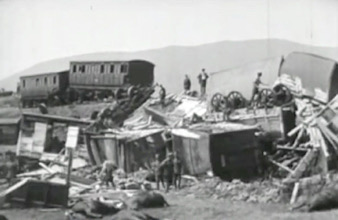
The IRA plants a mine or detonates a bomb that partially derails the train a mile north of Adavoyle Station, between Newry and Dundalk. The derailment causes ten carriages to be thrown across an embankment, killing and injuring many soldiers and horses.

At least three British soldiers are killed (including a sergeant and a private) and twenty are wounded, some of whom later die from their injuries. The train guard, Frank Gallagher, is killed and two other railway officials are seriously injured. Reports vary about the number of horses killed. Some say over 40 horses are killed while others claim as many as 100. Many horses are shot to prevent them from being captured or causing further casualties. Soldiers reportedly weep for their dead horses, as they had served together in World War I. A local farmer and a train guard are also shot dead in the aftermath.

The attack causes an outcry in Britain, highlighting the IRA’s ability to strike high-profile military convoys. The incident underscores the vulnerability of British forces returning from political events in Ireland and is one of several such attacks during the War of Independence.

The Adavoyle ambush is remembered as a symbolic and brutal act in the conflict, combining military casualties with the killing of animals that have been comrades in war. It also illustrates the IRA’s use of railways as a strategic target during the campaign.

Today, the Adavoyle railway station is in ruins, though the Belfast-Dublin line still passes the site.