McCartney takes part in the civil rights march in Derry on January 30, 1972, an event widely known as Bloody Sunday. One of his cousins, James Wray, is one of fourteen men shot and killed by the 1st Battalion, Parachute Regiment of the British Army on that march. As a result of this incident, he joins the Provisional IRA several months later. In 1974, Martin McGuinness, who commands the IRA in Derry, instructs him to beat up an Irish National Liberation Army (INLA) man, Patsy O’Hara, who McGuinness calls a “scumbag” and a “hood.” On January 12, 1979, at Belfast‘s Crown Court, he and another man, Eamonn MacDermott, are convicted of the murder of Detective Constable Patrick McNulty of the Royal Ulster Constabulary (RUC), who was shot several times outside a garage in Derry on January 27, 1977. He is also convicted of IRA membership and the murder of businessman Jeffery Agate in February 1977 and is sentenced to life imprisonment. The murder convictions are overturned in 2007.
McCartney spends 53 days on hunger strike, from October 27 to December 18. From 1989–91 he is Officer Commanding of the IRA prisoners in the H-Blocks and is released in 1994.
Following his release, McCartney is active with ex-prisoners’ groups Tar Abhaile and Coiste na n-Íarchimí, and is the first member of Sinn Féin to hear his own voice heard on television after the lifting of the British broadcasting ban in 1994. He is arrested on April 4, 2002, following a breach of security at Belfast’s police headquarters, but is released without charge the following day. Later that year, on September 5, he is the first former IRA member to appear before the Bloody Sunday Inquiry, and encourages anyone with information, including paramilitaries, to come forward. He is a member of the Legislative Assembly (MLA) for Foyle from July 15, 2004, until February 3, 2020.
On February 15, 2007, McCartney and MacDermott have their murder convictions quashed by the Court of Appeal, following an investigation by the Criminal Cases Review Commission (CCRC) in 2002. The Secretary of State for Northern Ireland declines to compensate McCartney and MacDermott on the grounds that they have not proven themselves innocent. The decision is appealed to the Supreme Court of the United Kingdom which, in May 2011, finds in favour of the applicants, opening the way for a substantial compensation claim from both for their prison terms of 15 and 17 years.
Stagg is the seventh child in a family of thirteen children. His father, Henry, and his uncle had both fought in the Irish War of Independence and Irish Civil War. His brother, Emmet Stagg, becomes a Labour Party politician and a Teachta Dála (TD) for Kildare North. He is educated to primary level at Newbrook Primary School and at CBS Ballinrobe to secondary level. After finishing his schooling, he works as an assistant gamekeeper with his uncle prior to emigrating to England in search of work. Once in England, he gains employment as a bus conductor in North London and later becomes a bus driver. While in England he meets and marries fellow Mayo native, Bridie Armstrong from Carnacon in 1970.
In 1972, Stagg joins the Lutoncumann of Sinn Féin and soon after becomes a volunteer in the Provisional Irish Republican Army (IRA).
In April 1973, Stagg is arrested with six others alleged to comprise an IRA unit planning bombing attacks in Coventry. He is tried at BirminghamCrown Court. The jury finds three of the seven not guilty. The remaining four are all found guilty of criminal damage and conspiracy to commit arson. Stagg and English-born priest, Father Patrick Fell, are found to be the unit’s commanding officers. Stagg is given a ten-year sentence and Fell is given twelve years. Thomas Gerald Rush is given seven years and Anthony Roland Lynch, who is also found guilty of possessing articles with intent to destroy property, namely nitric acid, balloons, wax and sodium chlorate, is given ten years.
Following the hunger strike that results in the death of Michael Gaughan, the Price sisters, Feeney and Kelly are granted repatriation to Ireland. Stagg is denied repatriation and is transferred to Long Lartin Prison. During his time there he is subject to solitary confinement for refusing to do prison work and is also subjected, along with his wife and sisters during visits, to humiliating body searches. In protest against this, he begins a second hunger strike that lasts for thirty-four days. This ends when the prison governor agrees to an end of the strip-searches on Stagg and his visitors. He is bed-ridden for the rest of his incarceration in Long Lartin, due to a kidney complaint.
In 1975 Stagg is transferred to Wakefield Prison, where it is demanded that he again do prison work. He refuses and is placed in solitary confinement. On December 14, 1975, he embarks on a hunger strike in Wakefield, along with a number of other republican prisoners, after being refused repatriation to Ireland during the IRA/British truce. His demands are an end to solitary confinement, no prison work and repatriation to prison in Ireland. The British government refuses to meet any of these demands and Stagg dies on February 12, 1976, after 62 days on hunger strike.
Stagg’s burial causes considerable controversy. Republicans and two of his brothers seek to have him buried in the republican plot in Ballina beside the grave of Michael Gaughan, in accordance with his wishes. His widow, his brother Emmet Stagg and the Irish government wish to have him buried in the family plot in the same cemetery and to avoid republican involvement in the funeral.
In order to prevent the body from being disinterred and reburied by republicans, the grave is covered with concrete. Local Gardaí keep an armed guard by the grave for six months. However, unknown to them, the plot beside the grave is available for purchase. Stagg’s brother George purchases the plot and places a headstone over it, with it declaring that the “pro-British Irish government” had stolen Frank’s body. In November 1977, a group of republicans dig down into the plot that George had purchased, then dig sideways and recover Stagg’s coffin from the adjacent plot under cover of darkness, before reburying it in the republican plot beside the body of Michael Gaughan. The Republicans hold their own version of a funeral ceremony before disappearing back into the night.
The IRA swears revenge over Stagg’s death, warning the British public it is going to attack indiscriminately. They explode about 13 bombs throughout England within a month after his death.
Sir James Peter Comyn, Irish-born barrister and English High Court judge, is born at Beaufield House, Stillorgan, County Dublin on March 8, 1921. Considered by many to be “the finest all-round advocate at the English bar”, he is appointed to the High Court of Justice in 1978, serving on the bench until his retirement in 1985.
Comyn is the son of Nationalist barrister James Comyn KC and of Mary Comyn. Through his father he is the nephew of the barrister Michael Comyn KC. Both his father and uncle had been political and legal advisers to Éamon de Valera, who at one point uses Beaufield House as a safe house. However, the Comyn brothers have a falling out with de Valera shortly before he comes to power in 1932, and Michael Comyn is passed over as Attorney General of the Irish Free State. As a result, James Comyn, who is then attending Belvedere College in Dublin, is sent by his father to attend The Oratory School in England. He spends six months as a trainee at The Irish Times under the editor R. M. “Bertie” Smyllie, but abandons journalism after a joke he added to an obituary is printed in the paper, leading to his demotion to the racing department.
Comyn is called to the English bar by the Inner Temple in 1942, the Irish bar in 1947, and the Hong Kong bar in 1969. In 1944, he begins his pupillage with Edward Holroyd Pearce KC, later a law lord, and joins his chambers at Fountain Court. He practises in London and on the Western circuit, supplementing his earnings by teaching banking, a subject of which he knows nothing. On one occasion, he rises in Lambeth County court to cross-examine a female defendant in an eviction case. Just as he begins by saying “Madam,” the defendant opens her bag, takes out a dead cat, and throws it at him. The judge’s reaction is to tell the defendant, “Madam, if you do that again, I’ll commit you.” Comyn wins the case.
Comyn takes silk in 1961, and acquires a large practice as a senior, appearing in many high-profile cases. In 1964, he wins damages for libel for the former safe-breaker Alfred George Hinds against a Scotland Yard inspector by convincing the jury that Hinds is in fact innocent. In 1970, he successfully defends the Labour MP Will Owen, who is accused of providing information to the Czechoslovak intelligence services. In 1975, he defeats the government’s attempt to obtain an injunction against the publication of the diaries of former minister Richard Crossman.
Comyn is Recorder of Andover between 1964 and 1971 (honorary life recorder from 1972), commissioner of assize for the Western Circuit in 1971, and a Recorder of the Crown Court between 1972 and 1977. He is elected a bencher of the Inner Temple in 1968 and serves as chairman of the Bar council from 1973 to 1974.
Having refused a previous invitation by Quintin Hogg, Baron Hailsham of St. Marylebone to join the bench, Comyn is again nominated by Elwyn Jones, Baron Elwyn-Jones, in 1977, and is appointed a High Court judge in 1978, receiving the customary knighthood upon his appointment. Initially assigned to the Family Division, he does not take to the work and is reassigned to the Queen’s Bench Division in 1979. He has a reputation for leniency in sentencing, first acquired as Recorder of Andover. In 1980–81, he presides over an unsuccessful libel action by a member of the Unification Church, colloquially known as the Moonies, against the Daily Mail, the longest libel trial in England up to that time. His Irish background makes him the target of Irish Republican Army (IRA) action, and in 1981 the Provisional IRA burns his house in Tara.
Recurring bouts of depression lead to Comyn’s early retirement, on grounds of ill health, in 1985. In retirement, he divides his time between England and Ireland, whose citizenship he has retained. He writes a number of books, including memoirs, light verse, and books on famous trials. He also breeds Friesian cattle. He dies in Navan, County Meath on January 5, 1997, at age 75.
The blast engulfs a carriage of the train in flames, killing three and injuring five others. One of the dead and the most seriously injured survivor are volunteers of the IRA. After the blast, the organisation issues a statement acknowledging responsibility, apologising to those who were harmed and state that it was ‘grave and distressing’ but an ‘accident’ caused by the ‘war situation.’
The train is a Northern Ireland Railways afternoon service carrying passengers between Ballymena railway station and Belfast Central railway station. The train is largely empty as it leaves Dunmurry railway station and enters the outskirts of Belfast, crossing under the M1 motorway on its way to Finaghy railway station shortly before 4:55 PM. A large fireball erupts in the rear carriage, bringing the train to a standstill and forcing panicked passengers to evacuate urgently as the smoke and flames spread along the train. The survivors then move down the track in single file to safety while emergency services fight the blaze. After several hours and combined efforts from fire, police and military services the blaze is contained. One fireman is treated for minor injuries. The two damaged carriages are transported to Queen’s Quay in Belfast for forensic examination and are subsequently rebuilt, one remaining in service until 2006 and the other until 2012.
Of the four persons occupying the carriage, three are killed with burns so severe that it is not possible to identify them by conventional means. Rail chief Roy Beattie describes the human remains as “three heaps of ashes.” The fourth, later identified as Patrick Joseph Flynn, is an IRA member and one of the men transporting the bombs. He suffers very serious burns to his face, torso and legs, and is reported to be close to death upon arrival at the hospital. Of the dead, two are eventually named as 17-year-old Protestant student Mark Cochrane from Finaghy and the other a 35-year-old Belfast-based accountant and recent immigrant from Lagos, Nigeria, Max Olorunda, who had been visiting a client in Ballymena. The identity of the third is harder to ascertain, but it is eventually confirmed by the IRA by their statement that he is 26-year-old IRA member Kevin Delaney. In addition to the fireman, four people are injured, including Flynn, two teenagers treated for minor injuries and an older man who suffers much more serious burns.
Further bomb alerts are issued across the region and two similar devices are discovered on trains, at York Road railway station in Belfast and at Greenisland railway station. Both are removed safely, and control detonated. The devices are simple incendiary bombs similar to that which exploded south of Befast, consisting of a 5-lb. block of explosives attached to a petrol can with a simple time device intended to delay the explosion until the train is empty that evening. Later testimony indicates that Delaney armed the first of two bombs and placed it beside him as he picked up the second one. As he arms this device, the first bomb suddenly detonates for reasons that remain unknown. Delaney is killed instantly and his accomplice, Patrick Joseph Flynn, is forced to leap from the train in flames. Flynn is guarded by police in hospital and arrested once his wounds heal sufficiently.
The IRA releases a lengthy statement about the event, terming it a ‘bombing tragedy,’ blaming the Royal Ulster Constabulary for their ‘sickening and hypocritical … collective activity of collaboration with the British forces.’ In Britain, ConservativeMPWinston Churchill calls for the death penalty to be reinstated for terrorists as a result of the incident.
Patrick Flynn is tried at Belfast Crown Court for double manslaughter and possession of explosives after he recovers from his injuries. He is severely disfigured and badly scarred from the extensive burns the incendiary device had inflicted upon him. The judge is asked and agrees to take this into account for sentencing after reviewing the evidence and finding Flynn guilty due to his proximity to the explosion, his known IRA affiliation and the discovery of telephone numbers for the Samaritans and Belfast Central railway station in his jacket, to be used to telephone bomb warnings. Justice Kelly sentences Flynn to ten years in prison for each manslaughter as well as seven years for the explosives offences, to be served concurrently.
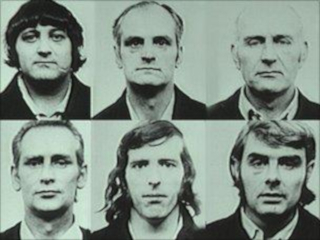
Hugh Callaghan, Patrick Hill, Robert Hunter, Noel McIlkenny, William Power, and John Walker, known as the “Birmingham Six,” are arrested on November 22, 1974, in connection with pub bombings which took place earlier in the week.
The Birmingham pub bombings take place on November 21, 1974, and are attributed to the Provisional Irish Republican Army. Explosive devices are placed in two central Birmingham pubs, the Mulberry Bush at the foot of the Rotunda and the Tavern in the Town in New Street. The resulting explosions, at 8:25 PM and 8:27 PM, collectively are the most injurious attacks in England since World War II. Twenty-one people are killed and 182 are injured. A third device, outside a bank in Hagley Road, fails to detonate.
Five of the six arrested are Belfast-born Roman Catholics, while John Walker is a Roman Catholic born in Derry. All six have lived in Birmingham since the 1960s. All the men except for Callaghan leave the city early on the evening of November 21 from New Street Station, shortly before the explosions. They are travelling to Belfast to attend the funeral of James McDade, a Provisional IRA member who had accidentally killed himself on November 14 when his bomb detonates prematurely while he is planting it at a telephone exchange in Coventry.
When they reach Heysham they and others are subject to a Special Branchstop and search. The men do not tell the police of the true purpose of their visit to Belfast, a fact that is later held against them. While the search is in progress the police are informed of the Birmingham bombings. The men agree to be taken to Morecambe police station for forensic tests.
On the morning of November 22, after the forensic tests and questioning at the hands of the Morecambe police, the men are transferred to the custody of West Midlands Serious Crime Squad police unit. Callaghan is taken into custody on the evening of November 22.
The Birmingham Six are charged with murder and conspiracy to cause explosions on May 12, 1975. The trial begins on June 9, 1975, at the Crown Court sitting at Lancaster Castle, before Justice Nigel Bridge and a jury. The jury finds the six men guilty of murder. On August 15, 1975, they are each sentenced to twenty-one life sentences.
On November 28, 1974, the Birmingham Six appear in court for a second time after they had been remanded into custody at HM Prison Winson Green, all showing bruising and other signs of ill-treatment. Fourteen prison officers are charged with assault in June 1975 but are ultimately acquitted. The Six bring a civil claim for damages against the West Midlands Police in 1977, but it is struck out on January 17, 1980, by the Court of Appeal (Civil Division).
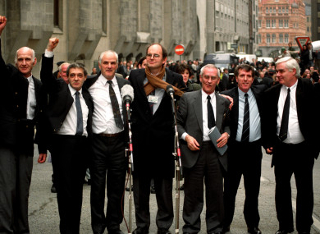
In March 1976 the Birmingham Six’s first application for leave to appeal is dismissed by the Court of Appeal, presided over by John Widgery. Their second full appeal, in 1991, is allowed. New evidence of police fabrication and suppression of evidence, the successful attacks on both the confessions and the 1975 forensic evidence causes the Crown to decide not to resist the appeals. The Court of Appeal states that in light of the fresh scientific evidence, the convictions are both unsafe and unsatisfactory. On March 14, 1991, the Birmingham Six are set free.
In 2001, a decade after their release, the six men are awarded compensation ranging from £840,000 to £1.2 million.
The Birmingham Six – Paddy Joe Hill, Hugh Callaghan, Richard McIlkenny, Gerry Hunter, Billy Power and Johnny Walker – are released from jail on March 14, 1991, after their convictions for the murder of 21 people in two pubs are quashed by the Court of Appeal.
The Birmingham pub bombings take place on November 21, 1974, and are attributed to the Provisional Irish Republican Army. Explosive devices are placed in two central Birmingham pubs – the Mulberry Bush at the foot of the Rotunda and the Tavern in the Town, a basement pub in New Street. Up until this point, the resulting explosions collectively are the most injurious attacks in Great Britain since World War II. Ten people at the Mulberry Bush and eleven at the Tavern in the Town are killed and 182 people are injured. A third device, outside a bank in Hagley Road, fails to detonate.
Five of the six are taken into custody on the evening of November 21. The men agree to be taken to Morecambe police station for forensic tests. The following morning, after the forensic tests and questioning at the hands of the Morecambe police, the men are transferred to the custody of West Midlands Serious Crime Squad police unit. Hugh Callaghan is taken into custody on the evening of November 22.
On May 12, 1975, the six men are charged with murder and conspiracy to cause explosions. The trial begins on June 9, 1975, at the Crown Court sitting at Lancaster Castle. After legal arguments the statements made in November are deemed admissible as evidence. The unreliability of these statements is later established. Forensic scientist Dr. Frank Skuse uses positive Griess test results to claim that Hill and Power had handled explosives. Callaghan, Hunter, McIlkenny and Walker all had tested negative. The jury finds the six men guilty of murder. On August 15, 1975, they are each sentenced to 21 life sentences.
In March 1976 their first application for leave to appeal is dismissed by the Court of Appeal. Their second full appeal, in 1991, is allowed. New evidence of police fabrication and suppression of evidence, the successful attacks on both the confessions and the 1975 forensic evidence causes the Crown to decide not to resist the appeals. The Court of Appeal states that “in the light of the fresh scientific evidence, which at least throws grave doubt on Dr. Skuse’s evidence, if it does not destroy it altogether, these convictions are both unsafe and unsatisfactory.” On March 14, 1991, the six walk free.
In 2001, a decade after their release, the six men are awarded compensation ranging from £840,000 to £1.2 million.
The success of the appeals and other miscarriages of justice cause the Home Secretary to set up a Royal Commission on Criminal Justice in 1991. The commission reports in 1993 and leads to the Criminal Appeal Act 1995 which establishes the Criminal Cases Review Commission in 1997. Superintendent George Reade and two other police officers are charged with perjury and conspiracy to pervert the course of justice but are never prosecuted. During the inquest into the bombings in 2016, Hill states that he knows the identities of three of the bombers who are still “free men” in Ireland.
Stagg is educated to primary level at Newbrook Primary School and at CBS Ballinrobe to secondary level. After finishing his schooling, he works as an assistant gamekeeper with his uncle prior to emigrating to England in search of work.
Once in England he gains employment as a bus conductor in north London and later becomes a bus driver. Whilst in England he meets and marries fellow Mayo native, Bridie Armstrong from Carnacon. In 1972, he joins the Lutoncumann of Sinn Féin and soon after becomes a volunteer in the Provisional Irish Republican Army (IRA).
In April 1973, Stagg is arrested with six others alleged to comprise an IRA unit planning bombing attacks in Coventry. He is tried at BirminghamCrown Court. The jury finds three of the seven not guilty. The remaining four are all found guilty of criminal damage and conspiracy to commit arson. Stagg and English-born priest, Father Patrick Fell, are found to be the unit’s commanding officers. Stagg is given a ten-year sentence and Fell twelve years. Thomas Gerald Rush is given seven years and Anthony Roland Lynch, who is also found guilty of possessing articles with intent to destroy property, namely nitric acid, balloons, wax, and sodium chlorate, is given ten years.
Following the hunger strike that results in the death of Michael Gaughan, the Price sisters, Feeney, and Kelly are granted repatriation to Ireland. Stagg is denied repatriation and is transferred to Long Lartin Prison. During his time there he is subject to solitary confinement for refusing to do prison work and is also subjected, along with his wife and sisters during visits, to humiliating body searches. In protest against this he begins a second hunger strike that lasts for thirty-four days. This ends when the prison governor agrees to an end to the strip-searches on Stagg and his visitors. Stagg is bed-ridden for the rest of his incarceration in Long Lartin, due to a kidney complaint.
In 1975 Stagg is transferred to Wakefield Prison, where it is demanded that he again do prison work. He refuses and is placed in solitary confinement. On December 14, 1975, Stagg embarks on a hunger strike in Wakefield, along with a number of other republican prisoners, after being refused repatriation to Ireland during the IRA/British truce. Stagg’s demands are an end to solitary confinement, no prison work, and repatriation to prison in Ireland. The British government refuses to meet any of these demands. Stagg dies on February 12, 1976, after 62 days on hunger strike.
Frank Stagg’s burial causes considerable controversy in Ireland, with republicans and two of his brothers seeking to have Stagg buried in the republican plot in Ballina in accordance with his wishes, while his widow, his brother, Emmet Stagg, and the Irish government wish to have him buried in the family plot in the same cemetery and to avoid republican involvement in the funeral. As the republicans wait at Dublin Airport for the body, the Irish government orders the flight to be diverted to Shannon Airport.
His body is taken to Ballina and buried near the family plot. In order to prevent the body being disinterred and reburied by republicans, the grave is covered with concrete. In November 1976, a group of republicans tunnel under the concrete to recover the coffin under cover of darkness and rebury it in the republican plot.



 seamus dubhghaill