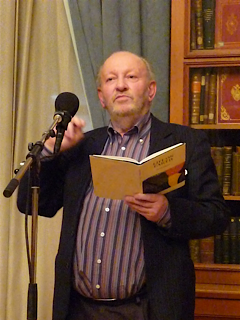
Norman Derek Mahon, Irish poet, is born in Belfast, Northern Ireland, on November 23, 1941, but lives in a number of cities around the world. At his death it is noted that his “influence in the Irish poetry community, literary world and society at large, and his legacy, is immense.” President of IrelandMichael D. Higgins says of Mahon, “he shared with his northern peers the capacity to link the classical and the contemporary but he brought also an edge that was unsparing of cruelty and wickedness.”
At Inst Mahon encounters fellow students who share his interest in literature and poetry. The school produces a magazine in which he produces some of his early poems. According to the critic Hugh Haughton, his early poems are highly fluent and extraordinary for a person so young. His parents cannot see the point of poetry, but he sets out to prove them wrong after he wins his school’s Forrest Reid Memorial Prize for the poem ”The power that gives the water breath.”
At times expressing anti-establishment values, Mahon describes himself as an “aesthete” with a penchant “for left-wingery […] to which, perhaps naively, I adhere.”
In March 2020, at the beginning of the COVID-19 pandemic, RTÉ News ends its evening broadcast with Mahon reading his poem Everything Is Going to Be All Right.
Mahon dies in Cork, County Cork, on October 1, 2020, after a short illness, aged 78. He is survived by his partner, Sarah Iremonger, and his three children, Rory, Katy, and Maisie. His papers are held at Emory University.
Mahon features on the Irish Leaving Certificate course with ten of his poems (Grandfather, Day Trip to Donegal, Ecclesiastes, After the Titanic, As It Should Be, A Disused Shed in Co. Wexford, Rathlin, The Chinese Restaurant in Portrush, Kinsale and Antarctica)
O’Brien is born on December 15, 1930, the youngest child of farmer Michael O’Brien and Lena Cleary at Tuamgraney, County Clare, a place she would later describe as “fervid” and “enclosed.” Her father inherits a “thousand acres or more” and “a fortune from rich uncles,” but is a “profligate” hard drinker who gambles away his inheritance, the land sold off or bartered to pay debts. From 1941 to 1946 she is educated by the Sisters of Mercy at the Convent of Mercy boarding school at Loughrea, County Galway – a circumstance that contributes to a “suffocating” childhood. In 1950, having studied at night at pharmaceutical college and worked in a Dublin pharmacy during the day, she is awarded a licence as a pharmacist. She reads such writers as Leo Tolstoy, William Makepeace Thackeray, and F. Scott Fitzgerald.
In Dublin, O’Brien purchases Introducing James Joyce, with an introduction written by T. S. Eliot, and says that when she learned that James Joyce‘s A Portrait of the Artist as a Young Man was autobiographical, it made her realise where she might turn, should she want to write herself. “Unhappy houses are a very good incubation for stories”, she says. In London she starts work as a reader for Hutchinson, a publishing firm, where on the basis of her reports she is commissioned, for £50, to write a novel. She publishes her first book, The Country Girls, in 1960. This is the first part of a trilogy of novels (later collected as The Country Girls Trilogy), which includes The Lonely Girl (1962) and Girls in Their Married Bliss (1964). Shortly after their publication, these books are banned and, in some cases, burned in her native country due to their frank portrayals of the sex lives of their characters. She is accused of “corrupting the minds of young women.” She later says, “I felt no fame. I was married. I had young children. All I could hear out of Ireland from my mother and anonymous letters was bile and odium and outrage.”
In the 1960s, O’Brien is a patient of R. D. Laing. “I thought he might be able to help me. He couldn’t do that – he was too mad himself – but he opened doors,” she later says. Her novel A Pagan Place (1970) is about her repressive childhood. Her parents were vehemently against all things related to literature. Her mother strongly disapproved of her daughter’s career as a writer. Once when her mother found a Seán O’Casey book in her daughter’s possession, she tried to burn it.
O’Brien is a panel member for the first edition of BBC One‘s Question Time in 1979. In 2017 she becomes the sole surviving member.
In addition to the Irish PEN Award, O’Brien’s awards include The Yorkshire Post Book Award in 1970 for A Pagan Place, and the Los Angeles Times Book Prize in 1990 for Lantern Slides. In 2006, she is appointed adjunct professor of English Literature at University College Dublin.
In 2019, O’Brien is awarded the David Cohen Prize for Literature at a ceremony in London. The £40,000 prize, awarded every two years in recognition of a living writer’s lifetime achievement in literature, has been described as the “UK and Ireland Nobel in literature.” Judge David Park says, “In winning the David Cohen Prize, Edna O’Brien adds her name to a literary roll call of honour.”
(Pictured: Edna O’Brien speaking at the 2016 Hay Festival, photo by Andrew Lih and licensed under the Creative Commons Attribution-Share Alike 3.0 Unported license)


 seamus dubhghaill