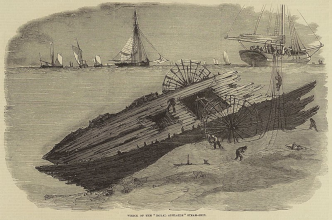
The RMS Royal Adelaide, captained by John Batty, leaves Cork fully laden with cargo and about 250 passengers on Wednesday, March 27,1850, touching off at Plymouth, Devon, England, on Thursday evening. By the time the ship leaves Plymouth for London at 3:00 a.m. on Friday, March 29, there are almost three hundred deck passengers.
The ship is totally lost at about 11:00 p.m. on Saturday, March 30 on Tongue Sands north of Margate, Kent, England, with the loss of all on board. News only reaches London late on Sunday as the river pilot waiting for the ship happens to meet a Deal, Kent, pilot, Charles Gillham, who reports seeing a ship of a similar description in distress the previous evening (The Illustrated London News, April 6 and 13, 1850).
The dead include more than one hundred fifty deck passengers from Ireland, during a time when the Great Famine is at its height.
(Pictured: “The Wreck of the Royal Adelaide,” illustration for The Illustrated London News, April 13, 1850)
On a cold December day in 1919, a group of young IRA volunteers wait at a public house near the Ashtown gate of Dublin’s Phoenix Park. Some are from Dublin, members of Michael Collins’ recently created assassination unit, the Squad. Others are from farther afield, like Dan Breen and Seán Treacy from County Tipperary and Martin Savage from County Sligo.
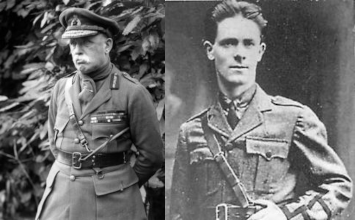
They are waiting for Sir John French, Lord Lieutenant of Ireland, the most senior British official in the land. He is returning from a visit to the west of Ireland and has alighted at Ashtown train station before returning by car to his official residence, the Viceregal Lodge, in the Phoenix Park.
The IRA men have a signaler in a tree and when French’s car approaches, they attempt to block the road with a farm cart. However, they are too late to block the Lord Lieutenant’s car which sweeps through the impromptu barricade. Shots are fired and one policeman is wounded but French himself emerges unscathed.
A second car, which the IRA believes to contain French, bears the brunt of the volunteers’ revolver fire and grenades. Though the car is badly damaged, there are no casualties.
The third car in the convoy contains French’s military escort and the soldiers inside the vehicle return fire, killing one of the attackers, Martin Savage. Some of the volunteers attempt to recover his body but the Crown forces’ fire is too heavy. Savage’s body is left on the scene as the IRA party flees on bicycles back to the city.
The Irish Times, for one, expresses outrage at the attack, “the attempted assassination of the greatest of Irishmen” which it says will “shock Ireland” and force Sinn Féin, victorious in the election of the previous year, to reflect on whether it wants to be associated with “outrage and assassination.” “There will now be many throughout the world ready to attribute the character of a murder society to the whole new Irish movement.”
Many in Ireland are even less sympathetic to hear of the escape of the Lord Lieutenant. The Irish Catholicbishops issue a statement the next day condemning not the attack but British rule in Ireland, which they characterise as “rule of the sword, utterly unsuited to a civilised nation.”
The attack is, in hindsight, a turning point, moving the standoff over Irish independence toward all out guerrilla warfare, but also, in a way, symbolising the eclipse of French and of his vision for what the country should be.
Sir John French’s health declines in 1920 and though he holds the position of Lord Lieutenant until April 1921, his central role in Irish affairs is eclipsed by new Chief Secretary for Ireland Sir Hamar Greenwood. He wants to retire to his estates in Ireland in 1922 but is told it is simply too dangerous for him. During the Irish Civil War (1922-23), his country house at Drumdoe, County Roscommon, is raided by armed men who carry off much of the furniture.
(From: “Today in Irish History: 19 December 1919, The Attempted Assassination of Sir John French” by John Dorney, The Irish Story, http://www.theirishstory.com, December 18,2019 | Pictured: L to R, Sir John French and Martin Savage)
Armstrong is the second surviving son of William Jones Wright Armstrong of County Armagh and Frances Elizabeth, widow of Sir Michael McCreagh, and daughter of Major Christopher Wilson. He is educated at The Royal School, Armagh and Trinity College, Cambridge, gaining a BA (2nd Class Law Tripos) in 1867 and an MA in 1870. Admitted at the Inner Temple in 1866, he is called to the Bar in 1868.
In 1883, Armstrong marries Margaret Leader, daughter of William Leader of Rosnalea, County Cork. They have five sons and three daughters, of whom C. W. Armstrong also becomes a politician.
Armstrong is returned unopposed to the House of Commons of the United Kingdom for Mid Armagh in a by-election in 1921, at the advanced age of 76, becoming one of the oldest first-time MPs whose birth date is recorded. Certainly, he immediately becomes the oldest member of the current House of Commons. He is a Senator of Northern Ireland from 1921 to 1937, and Lord Lieutenant of Armagh from 1924 to 1939. For 25 years he is a member of the Representative Body of the Church of Ireland. He is Chairman of the County Armagh Education Committee from 1925 to 1931, and President of the Association of Education Committees of Northern Ireland. In 1932 he is made a Privy Councillor for Northern Ireland, and in 1938 he serves as a Justice for the Government of Northern Ireland in the absence of the Governor.
Armstrong dies at the age of 99 on December 4, 1943, at his home in Dean’s Hill, County Armagh.
Whaley is born in Dublin on December 15, 1766, the eldest surviving son of the landowner, magistrate and former Member of Parliament Richard Chapell Whaley. At the age of sixteen, he is sent to Europe on the Grand tour, accompanied by a tutor. He settles in Paris for some time, maintaining both a country residence and town house, but is forced to leave Paris when his cheque for the amount of £14,000, to settle gambling debts accrued in one night of gambling, is refused by his bankers. Following his return to Dublin, Whaley, at the age of eighteen, is elected to the Irish House of Commons in 1785 representing the constituency of Newcastle in County Dublin.
While dining with William FitzGerald, 2nd Duke of Leinster at Leinster House, wagers totaling £15,000 are offered that Whaley cannot travel to Jerusalem and back within two years and provide proof of his success. The reasoning of those offering the bets is based on the belief that, as the region was part of the Ottoman Empire and had a reputation for widespread banditry, it will be too dangerous for travelers, and it will be unlikely that Whaley can complete the journey.
Whaley embarks from Dublin on October 8, 1788. He sails first to Deal, Kent, where he is joined by a companion, a Captain Wilson, and then on to Gibraltar. In Gibraltar, his party is joined by another military officer, Captain Hugh Moore. The party sets sail for the port of Smyrna, although Wilson is prevented from travelling any further due to rheumatic fever. The remaining pair make an overland journey from there to Constantinople, arriving in December.
The British ambassador in Constantinople introduces Whaley to the VizierCezayirli Gazi Hasan Pasha. Taking a liking to Whaley, Hasan Pasha provides him with permits to visit Jerusalem. Whaley’s party leaves Constantinople on January 21, 1789, by ship and sail to Acre, Israel. He encounters the Wāli of Acre and Galillee, Ahmad Pasha al-Jazzar. Al-Jazzar, notoriously known as “The Butcher” in the region he rules, takes a liking to Whaley and, though he dismisses the documents issued in Constantinople as worthless, he permits Whaley to continue his journey.
Whaley and his companions make their way overland to Jerusalem, arriving on January 28. During his visit, he stays at a Franciscan monastery, the Convent of Terra Sancta. It is a signed certificate from the superior of this institution, along with detailed observations of the buildings of Jerusalem, that provide the proof needed to prove the success of his journey. They stay for little over a month before returning overland to Ireland.
Whaley arrives back in Dublin in the summer of 1789 to great celebrations and collects the winnings of the wager. The trip costs him a total of £8,000, leaving him a profit of £7,000.
Following his Jerusalem exploit, Whaley remains in Dublin for two years and later spends time in London and travelling in Europe, including Paris during the Revolutionary period. Due to mounting debts, he is forced to sell much of his estate in the early 1790s and these financial problems also lead to his departure from Dublin.
Thomas Whaley dies on November 2, 1800, in the Cheshire town of Knutsford, while travelling from Liverpool to London. The cause of death is attributed to rheumatic fever, although a popular story circulated in Ireland is that he is stabbed in a jealous rage by one of two sisters, both of whom are objects of his attentions.
Wellesley rises to prominence as a general during the Peninsular War of the Napoleonic Wars and is promoted to the rank of field marshal after leading the allied forces to victory against the First French Empire at the Battle of Vitoria in 1813. Following Napoleon’s exile in 1814, he serves as the ambassador to France and is granted a dukedom. During the Hundred Days in 1815, he commands the allied army which, together with a Prussian army under Gebhard Leberecht von Blücher, defeats Napoleon at Waterloo. Wellesley’s battle record is exemplary, and he ultimately participates in some 60 battles during the course of his military career.
Wellesley is famous for his adaptive defensive style of warfare, resulting in several victories against numerically superior forces while minimising his own losses. He is regarded as one of the greatest defensive commanders of all time, and many of his tactics and battle plans are still studied in military academies around the world.
Wellesley dies at Walmer Castle in Deal, Kent, his residence as Lord Warden of the Cinque Ports, on September 14, 1852. He is found to be unwell on that morning and is aided from his military campaign bed, the same one he used throughout his historic military career and seated in his chair where he dies. His death is recorded as being due to the aftereffects of a stroke culminating in a series of seizures.
Although in life Wellesley hates travelling by rail, his body is taken by train to London, where he is given a state funeral, one of only a handful of British subjects to be honoured in that way, and the last heraldic state funeral to be held in Britain. The funeral takes place on November 18, 1852. He is buried in a sarcophagus of luxulyanite in St. Paul’s Cathedral next to Horatio Nelson, 1st Viscount Nelson.
Throughout the 1980s, the IRA has been waging a paramilitary campaign against targets in Britain and Northern Ireland with the stated aim of achieving the separation of Northern Ireland from the rest of the United Kingdom. These operations have included an attempt to kill British Prime Minister Margaret Thatcher in 1984 and a similar attack on a military band in London in 1982.
At 8:22 AM on September 22, 1989, a 15 lb. time bomb detonates in the recreational centre changing room at the Royal Marines School of Music. The blast destroys the recreational centre, levels the three-story accommodation building next to it, and causes extensive damage to the rest of the base and nearby civilian homes. The blast is heard several kilometres away, shaking windows in the centre of Deal, and creating a large pall of smoke over the town. Most of the personnel who use the building as a barracks have already risen and are practising marching on the parade ground when the blast occurs. These marines witness the buildings collapse and many of the personnel are in a state of shock for days afterwards.
Some marines remain behind in the building and thus receive the full force of the explosion. Many are trapped in the rubble for hours and military heavy lifting equipment is needed to clear much of it. Kent Ambulance Service voluntarily agrees to end its industrial strike action to aid those wounded by the blast. Ten marines die at the scene with most trapped in the collapsed building, although one body is later found on the roof of a nearby house. Another 21 are seriously injured and receive treatment at hospitals in Dover, Deal, and Canterbury. One of these men, 21-year-old Christopher Nolan, dies of his wounds on October 18, 1989. Three of those killed are buried nearby at the Hamilton Road Cemetery in Deal.
The IRA claims responsibility for the bombing, saying it is a continuation of their campaign to rid Northern Ireland of all British troops who have been deployed there since 1969. Many British people are shocked at the attack, carried out on a ceremonial military band whose only military training is geared towards saving lives.
The British Government also condemns the IRA’s attack. Prime Minister Margaret Thatcher makes a statement from Moscow, where she is on an official visit, saying that she is “shocked and extremely sad.” Leader of the Official Opposition, Neil Kinnock, describes the attack as an “awful atrocity” and says, “Even the people who say they support what the IRA calls its cause must be sickened by the way in which such death and injury is mercilessly inflicted.”
One week after the bombing, the staff and students at the School of Music march through the town of Deal, watched and applauded by thousands of spectators. They maintain gaps in their ranks to mark the positions of those unable to march through death or serious injury.



 seamus dubhghaill